A clear bag looks like the easiest line item on a packaging bill. Oddly, the Clear Poly Retail Bags production timeline is often delayed by everything except the actual bag-making run: approvals, dimensions, barcode placement, carton instructions, print files, and one late question about whether the hang hole should be round or sombrero-style.
That surprises buyers. It should not. Clear Poly Retail Bags sit at a messy intersection of display packaging, product protection, retailer compliance, and brand presentation. A bag for folded apparel, craft kits, hardware, stationery, or accessories may need enough clarity to show the product, enough gauge to survive handling, and enough print control to keep logos and warning copy readable.
Simple? Visually, yes. Operationally, not always.
Why clear poly retail bags take longer than expected
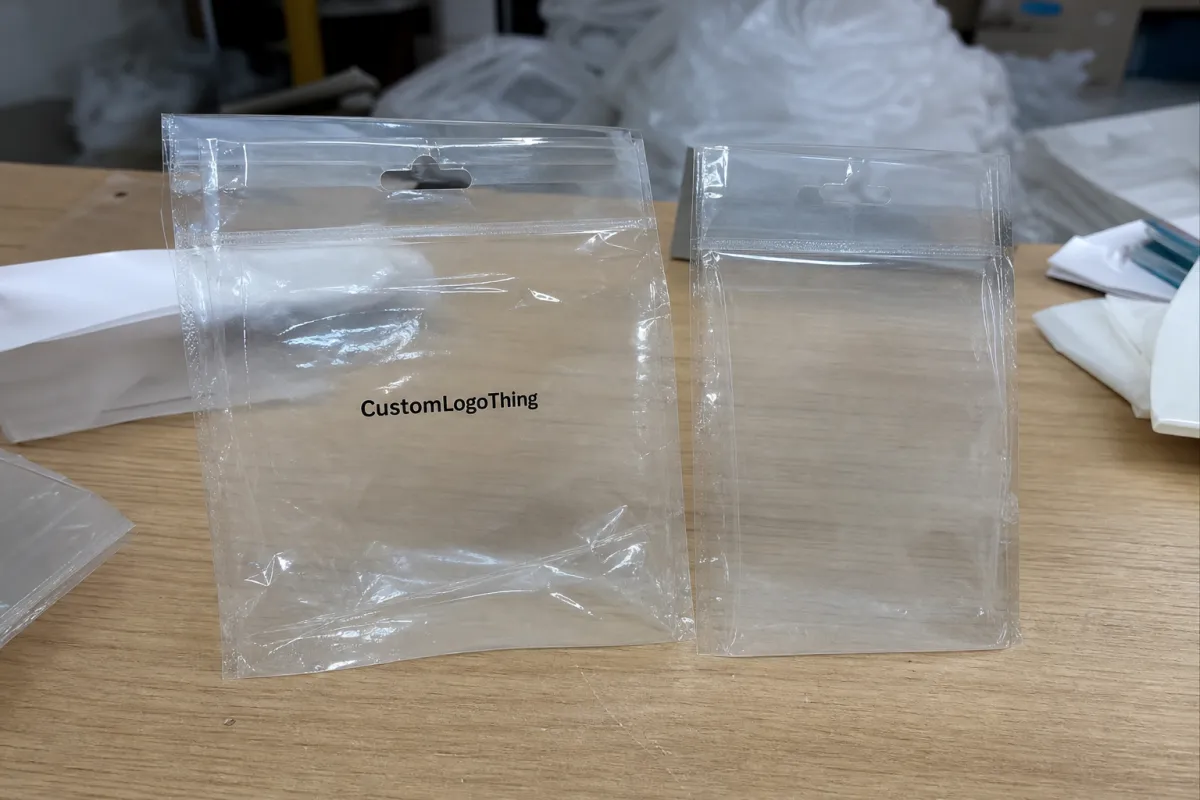
The first delay usually appears before a machine is scheduled. A buyer asks for “a clear poly bag with logo,” then the supplier has to turn that phrase into a production-ready spec: width, length, lip, flap, adhesive strip, vent holes, hang hole, film gauge, print position, carton pack, and delivery date. Miss one of those, and the quote may be accurate only in theory.
In practice, timing is shaped by decision speed as much as production capacity. A standard LDPE or CPP clear bag might be converted quickly once the details are locked. But if the artwork file arrives without outlined fonts, or the barcode lands across a heat seal, the job moves back into review. One small issue can add 24 to 72 hours. More if three departments need to approve the change.
Think about a store launch. Fixtures arrive Monday. Products need to be tagged and bagged by Thursday. The buyer assumes the clear bags can be ordered late because they are “just bags.” Then someone realizes the package needs a suffocation warning, a SKU label zone, and a hang hole that fits the retailer’s peg display. The bag itself may take 10 to 15 business days after approval. The approval is what slips.
Buyer reality check: a plain-looking clear retail bag can still require spec review, artwork proofing, material confirmation, and packing instructions before production starts.
Here is the common mistake: treating clear packaging as invisible. Retailers do not. Consumers do not. Operations teams definitely do not, especially when the wrong thickness leads to torn bags during fulfillment or a barcode that will not scan under store lighting.
Clear poly retail bags production timeline basics
A clean Clear Poly Retail Bags production timeline usually runs through quote, specification confirmation, artwork review, material sourcing, converting, quality control, packing, freight, and receipt. Some suppliers compress these steps. They rarely eliminate them. They overlap, which is not the same thing as disappearing.
Stock clear bags are the fastest path. If the size, gauge, and closure already exist, the supplier may ship in 1 to 3 business days, depending on inventory and warehouse cutoff times. Add custom printing, and the schedule changes. A one-color logo on a standard-size bag may need 7 to 12 business days after proof approval. Custom size, custom gauge, or multi-color print can move the range to 15 to 25 business days.
Offshore production is a different calendar. The factory run may be efficient, but ocean freight, consolidation, customs, and domestic delivery can push the delivered schedule to 6 to 10 weeks. A production run that takes 12 working days is not “two weeks” if the goods still need to cross an ocean and clear a port.
Domestic production often reduces transit risk. Offshore production can reduce unit cost at higher volumes, but freight becomes a larger part of the decision. That tradeoff is fine when demand is stable and the forecast is real. It is less charming when a retailer changes a label requirement after cartons are already moving.
| Bag option | Typical lead time after approval | Best fit | Timeline risk |
|---|---|---|---|
| Stock clear, unprinted | 1-3 business days to ship | Replenishment, samples, urgent packing | Inventory availability |
| Stock size with one-color print | 7-12 business days | Retail logo bags, apparel, accessories | Artwork proof approval |
| Custom size or gauge | 12-20 business days | Products with unusual dimensions or weight | Film sourcing and machine scheduling |
| Multi-color custom printed | 15-25 business days | Premium retail presentation | Print setup, color matching, approvals |
| Offshore custom run | 6-10 weeks delivered | Large programs with stable demand | Freight, customs, port congestion |
Read timeline estimates as ranges, not promises carved into stone. Approval speed, film inventory, press load, holiday shutdowns, inspection requirements, and shipment method all move the date. If a supplier gives only one ship date, ask for the milestone dates behind it.
What changes lead time most: materials, print method, and approvals
Material is the first lever. A common clear LDPE bag in 1.5 mil, 2 mil, or 3 mil film may be available from stock rolls or finished inventory. A higher-clarity CPP bag, a heavier 4 mil film, an anti-static additive, a venting pattern, or a recycled-content request may require sourcing or a separate production slot. That can add several business days before converting begins.
Gauge matters more than buyers expect. A 1.5 mil bag may work for light apparel or paper goods. A 2 mil bag is common for many retail items. A 3 mil or 4 mil bag may be safer for hardware, kits, or products with edges. Thicker film costs more and can run slower, but under-specifying thickness creates a different bill: returns, repacking, torn presentation, and annoyed warehouse staff. Nobody budgets for that line item. They just pay it later.
Film choice also affects appearance. LDPE is flexible and common. CPP can offer higher clarity and a crisper feel, depending on the structure. LLDPE blends may improve puncture resistance. None of these labels automatically means “better.” The better material is the one that fits the product, display method, packing speed, and price target.
Print method is the second lever. One-color flexographic printing is usually the most efficient custom option. Multi-color print needs more setup and registration checks. Heavy ink coverage can affect drying, blocking, and visual consistency on clear film. If color matching matters, ask whether the supplier will provide a digital proof, physical drawdown, or pre-production sample. A PDF proof can confirm position and copy. It cannot always predict ink behavior on a specific film.
Approvals are the hidden bottleneck. Artwork may need branding sign-off. Compliance copy may need legal review. Barcodes should be tested at final size, not merely pasted onto a PDF and admired from a monitor. Retailer requirements may specify suffocation warnings, country-of-origin placement, hang-hole position, or carton labeling. The ASTM standards library at ASTM is a useful reference point for packaging test methods, while the International Safe Transit Association provides protocols often used for distribution testing.
Order size affects scheduling too. A 5,000-piece printed order may fit into a short production window. A 100,000-piece run may earn a better unit price, but it may need batching across shifts or dedicated material. Low MOQ sounds attractive until the setup cost pushes the unit price upward. Large MOQ sounds efficient until demand misses the forecast and cartons sit in storage for eight months.
Cost and pricing factors buyers should budget for
Clear poly retail bag pricing is built from blunt inputs: size, thickness, resin grade, closure, print coverage, quantity, packing, and freight. A small unprinted stock bag may cost only a few cents. A custom printed clear retail bag can land closer to $0.10-$0.35 per unit at moderate quantities, depending on dimensions, gauge, ink coverage, and setup allocation. Very small runs often look expensive because the setup has nowhere to hide.
For example, a 9 x 12 inch 2 mil clear bag with a resealable flap and one-color logo might price around $0.18-$0.28 per unit for 5,000 pieces, depending on plate cost, print area, and carton requirements. Move that same spec to 25,000 pieces, and the unit cost may fall. Add a second print color, special venting, or rush freight, and the savings may shrink quickly.
One-time costs deserve their own line. Printing plates, screens, artwork cleanup, pre-production samples, and proof charges can range from $45 to $250 or more, depending on the method and artwork complexity. If you need a physical proof shipped overnight, budget for both the sample fee and the lost approval days. Speed is rarely free. Sometimes it is just hidden in the freight invoice.
Freight can distort the comparison. A supplier may quote a lower bag price, then ship cartons from farther away. Split shipments, liftgate delivery, special carton labeling, and expedited service can move the landed cost more than a 2-cent unit difference. For buyers comparing clear bags with adjacent items like Custom Poly Mailers, separate product cost from delivery cost before choosing.
There is also an inventory risk calculation. Higher MOQ lowers unit cost. It also ties up cash and storage space. If demand is uncertain, a 10,000-piece run at a higher unit cost may be smarter than 50,000 pieces that become obsolete after a retailer changes labeling rules. Cheap obsolete packaging is still obsolete packaging.
Step-by-step path from quote to shipment
A practical schedule starts with a spec sheet, not a mood board. List the inside width, usable length, flap or lip size, gusset if any, film thickness, closure style, hang-hole type, venting, print colors, print location, quantity, carton count, and target delivery date. If the product has sharp edges or unusual weight, say so early. Suppliers cannot price for risks they do not know exist.
The quoting stage should define assumptions. Is the supplier quoting LDPE, LLDPE, CPP, or another film? Is the bag measured by inside dimension or outside dimension? Does the print sit on the front panel only? Are cartons packed 500, 1,000, or another count? These details are not clerical. They affect fit, cost, and fulfillment labor.
- Day 1-2: Send complete specs, target quantity, delivery ZIP code, and artwork files.
- Day 2-4: Review quote options for stock, custom, standard production, and rush production.
- Day 3-6: Approve digital proof, test barcode size, and confirm compliance copy.
- Day 6-18: Production runs, then quality checks confirm size, print position, seal strength, and carton count.
- Day 18-23: Goods are packed, labeled, shipped, and received, depending on distance and service level.
Those ranges are planning ranges. A simple domestic reorder can move faster. A new custom bag with multi-color art and a physical sample can take longer. If a launch date is fixed, work backward from the in-hands date, not the day someone finally remembers to order packaging.
Approval workflow matters. Assign one operations owner for fit and packout, one branding owner for artwork, and one compliance owner for warnings or retailer text. Then set a rule: consolidated revisions only. Scattered emails create version control problems, especially if a supplier receives a new logo file after the proof has already been approved.
Digital proofs catch many problems, but not all. If the product fit is tight, request a stock sample in a nearby size or a prototype before committing. For display packaging, ask whether the bag clarity and seal style match the visual standard you expect. “Clear” can mean different things depending on film type, haze level, and surface finish.
Common mistakes that derail clear bag orders
The fastest way to lose time is approving artwork before checking production constraints. Bleed, safe area, seal allowance, barcode quiet zone, and final copy length all matter. A barcode that scans on a screen may fail once printed over a wrinkle, placed near a flap, or reduced below the retailer’s preferred size.
Another mistake: treating thickness as interchangeable. A 1.5 mil bag and a 3 mil bag may look similar in a photo, yet they behave differently during packing and shelf handling. Product weight, corners, edges, and handling frequency should guide the gauge. For retailer-bound goods, check whether the buyer manual specifies minimum film thickness or suffocation warning language.
Late freight planning creates a special kind of pain. Seasonal resets, trade shows, subscription box drops, and store openings all have fixed dates. If packaging arrives two days late, the product may miss the shelf even though manufacturing finished on time. Air freight can rescue some orders, but it can also erase the savings from offshore or high-volume production.
Carton instructions are easy to overlook. If the warehouse expects 1,000 bags per carton and receives 2,500, labor changes. If cartons lack SKU labels, receiving slows. If clear bags are mixed across sizes without clear identification, repacking can add days. That delay rarely shows up in the original quote, but it lands on the buyer’s calendar.
- Confirm final artwork size, not just logo appearance.
- Test barcode scannability at printed dimensions.
- Match film gauge to product weight and handling risk.
- Lock carton count and labeling before production.
- Separate production date from delivery date in every schedule.
Quality checks should not be vague either. Ask what the supplier inspects before release. Common checks include finished width and length, film thickness tolerance, seal strength, adhesive strip alignment, flap function, print placement, print legibility, barcode readability, carton count, and carton label accuracy. For retail programs, that last one matters more than people admit. A perfect bag in the wrong carton still creates a receiving problem.
Expert ways to shorten production without sacrificing quality
If schedule matters, standardize what you can. Standard widths, common gauges, familiar closures, and one-color print usually move faster than a fully custom structure. Customization is not bad. Customizing every variable at once is what stretches the calendar.
Send one complete spec package. Basic, yes. Still routinely missed. Include dimensions, quantity breaks, film preference, thickness, print files, Pantone references if needed, closure style, carton pack, delivery ZIP code, in-hands date, and whether the order is a new project or reorder. Suppliers can quote faster when they are not reconstructing the job from six email threads.
Pre-clear anything that usually triggers debate. Compliance language. Retailer instructions. Artwork ownership. Barcode placement. Recycled-content claims. If a sustainability statement appears on the bag, be careful; claims should match the actual material and applicable guidance. The EPA recycling resources are a useful starting point for understanding consumer-facing recycling language, though local film collection rules vary widely.
Ask for milestones, not just a promised ship date. A useful schedule might read: proof within 2 business days, approval due by Friday, production slot beginning Tuesday, QC complete by the following Thursday, cartons ready for pickup Friday. That gives the buyer a chance to intervene early. A single ship date gives no warning until it is already in danger.
For broader packaging programs, consider grouping clear retail bags with related items through Custom Packaging Products. Coordinated quoting can reveal whether labels, mailers, insert cards, and clear bags are fighting for the same launch date. Packaging calendars are rarely isolated. One delayed component can hold the full kit.
Next steps to lock specs and request a quote
Before requesting pricing, build a short checklist. Confirm dimensions, thickness, closure, hang hole, venting, print count, carton pack, delivery deadline, and estimated reorder cadence. If you have a physical product sample, measure the packed product, not the product lying flat. Add tolerance for folds, seams, and human packing speed.
Gather final artwork files, compliance copy, barcode files, retailer instructions, and expected order quantity. Ask for at least two options: a standard schedule and a rush schedule. Sometimes the rush premium is modest. Sometimes expedited freight costs more than the bags. The point is to compare the tradeoff before the launch date starts shouting.
The most useful request is direct: “Quote the fastest safe option and the most economical option, with proof timing, production timing, and freight shown separately.” That wording forces the schedule into the open. It also keeps the conversation practical. Specs first. Then quotes. Then approvals. Then production, with fewer surprises and fewer expensive rescue moves.
FAQ
How long is a clear poly retail bags production timeline for custom orders?
Stock, unprinted bags can often ship in 1-3 business days if inventory is available. Custom-size or custom-printed bags usually need more time for proofing, setup, production, and quality checks, often 7-25 business days after approval for domestic work. The real schedule depends on approval speed, material availability, print complexity, and shipping method, so ask for a stage-by-stage schedule that separates production time from freight time.
What slows down clear poly retail bags lead time the most?
Late artwork approval is the most common delay, especially when copy, barcode placement, suffocation warning text, or retailer compliance language still needs review. Nonstandard materials or gauges can also slow sourcing if the supplier cannot pull from stock. A missed spec detail can create more delay than the printing itself.
Are clear poly retail bags more expensive when they are custom printed?
Yes. Custom printing usually adds setup, plate, proof, and sometimes artwork cleanup costs that stock clear bags do not have. Higher quantities can reduce unit cost, but the total order value still rises with customization. Rush shipping and split deliveries can raise landed cost even if the quoted bag price stays stable.
What MOQ should I expect for clear poly retail bags?
Stock-size bags often allow lower MOQs because the supplier already has material or finished inventory. Custom print and custom dimensions usually require a higher MOQ to cover setup time and production efficiency. The right MOQ depends on demand forecast, storage space, reorder timing, and target unit cost.
How can I speed up a clear poly retail bags quote and approval?
Send one complete message with dimensions, thickness, closure style, print details, quantity, delivery deadline, carton instructions, and final artwork files. Name one approver so the supplier is not waiting on multiple responses. Ask for proof timing up front so the full clear poly retail bags production timeline stays visible from day one.

