Clear Poly Retail Bags Unit Cost Breakdown for Bulk Orders
Need a Clear Poly Retail Bags unit cost breakdown? Learn what changes price, how MOQ works, and what to confirm before you place a bulk order with confidence.
A Clear Poly Retail Bags unit cost breakdown can look simple on paper and still surprise buyers once the real spec is on the table. The bag price changes fast when film gauge moves from 1.5 mil to 2.0 mil, when the width grows by an inch, when an adhesive flap gets added, or when the pack format changes. None of that is dramatic by itself. Put it on a bulk order, and it suddenly matters.
The mistake is treating the quoted per-bag number as the final answer. It is only one line in the total. A usable number is the cost of the bag packed correctly, shipped, received, and ready for use without rework. That is the number that matters when you are buying at scale.
Clear Poly Retail Bags stay popular for a reason. They show the product. They keep dust off. They weigh almost nothing. For folded apparel, accessories, printed inserts, and small boxed goods, they protect the item without hiding it behind a heavy carton or a glossy sleeve that does more talking than selling. Good packaging should do its job and then get out of the way.
Why the first quote for clear retail bags is rarely the real unit cost
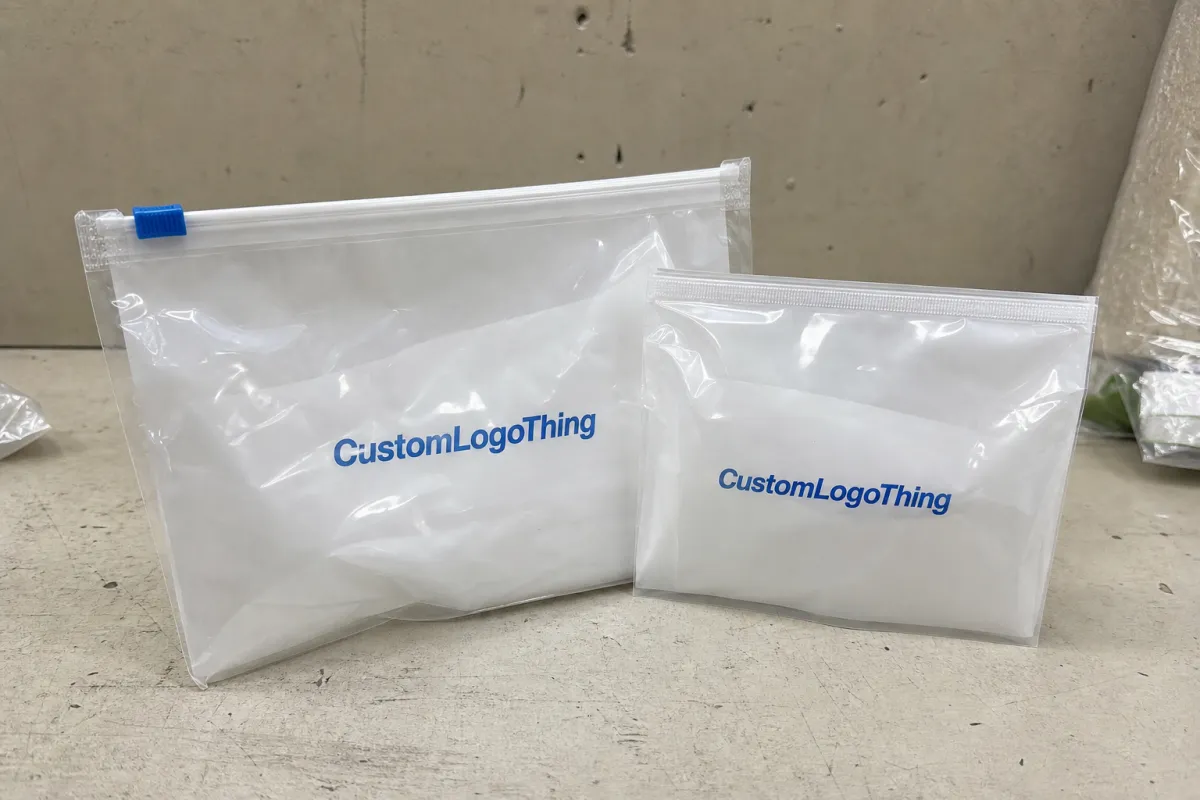
The first quote is usually a starting point, not the full buying picture. Suppliers can price a basic clear bag quickly if the dimensions, thickness, and quantity are known. Retail use rarely stops there. A hang hole, resealable flap, barcode zone, header space, suffocation warning, or specific carton pack can move the number more than most buyers expect.
What people often compare is bag price against bag price. That misses the point. The better comparison is usable cost per piece. A bag that looks cheaper may come loose-packed, have inconsistent seals, require repacking at your facility, or ship in bulky cartons that inflate freight. Those costs show up later. Usually at the worst time.
Think beyond the film. If the bag opens cleanly, stacks well, and packs quickly, it saves labor on the production side. If it arrives with inconsistent sizing or sloppy seals, the hidden labor cost eats the savings. The “cheap” option is not always cheap once the full process is counted.
Buyer rule: compare the same bag spec, carton pack, and freight basis before deciding which quote is actually lower.
Clear retail bags also carry practical value that is easy to ignore. They show product color and texture. They protect against handling marks. They help stores keep inventory looking neat without forcing a premium unboxing experience onto a product that never needed one in the first place.
Product details that determine the right clear poly retail bag build
Clear poly retail bags are usually made from polyethylene-based film for flexible retail applications. LDPE and LLDPE blends are common because they balance softness, clarity, and packability. Some buyers ask about polypropylene for a crisper look and higher clarity, but that is not a universal upgrade. Different films behave differently during converting, sealing, and packing. The right material depends on the product, not on the word “better.”
Start with the item that goes inside the bag. A folded T-shirt, a sock set, a carded accessory, a phone case, and a boxed insert all need different bag behavior. Soft goods usually tolerate lighter gauges and easier-open flaps. Rigid edges and sharp corners need more puncture resistance, more room, or both. A thin bag can look polished on apparel and fail quickly around a hard insert. That is a bad trade.
Clarity, flexibility, and tear resistance do not rise together automatically. High clarity improves shelf presentation. Flexibility helps packing teams move quickly without fighting the film. Tear resistance matters when the product has corners, hang tags, zippers, or stiff inserts. Buyers often overpay by chasing the thickest film in the room instead of choosing the film that matches handling conditions.
- Open-top bags: useful for fast packing, inserts, and products closed with labels or header cards.
- Adhesive flap bags: common for folded apparel and accessories where presentation matters.
- Hang holes or euro slots: useful for peg display, but they add converting detail and placement control.
- Resealable closures: practical for reusable sets, spare parts, and customer-access products.
Fit matters more than people think. A bag that is too loose lets the product slide around and look sloppy. One that is too tight slows packing and can stress the seal or flap. Clean edges, straight seals, and consistent dimensions make a bigger difference than most spec sheets admit. A 1/8 inch shift may sound trivial. On a small retail bag, it shows.
Spec sheet decisions that lock in fit, clarity, and consistency
A good quote starts with a complete spec sheet. Without it, a clear poly retail bags Unit Cost Breakdown turns into guesswork, and guesswork usually punishes the buyer. Too little detail leads to a bag that does not fit. Too much vague optimism leads to a bag that costs more than needed.
Before asking for bulk pricing, document the bag width, bag length, usable opening, gusset depth if needed, film thickness, closure style, print area, number of print colors, carton count, packing method, and any display feature such as a hang hole or euro slot. If the bag will hold folded apparel, include the folded dimensions, not just the garment size. If it holds a boxed item, measure the box at the widest point and the thickest point. Rounded guesses do not help anybody.
One spec change can affect both cost and performance. Increasing the width by 1 inch uses more film on every bag. Moving from 1.5 mil to 2.0 mil raises material usage by roughly one-third before any other factor is counted. Adding a stronger seal may be sensible for heavier goods, but it can also slow production or change the feel of the finished piece. None of that is a problem if it is deliberate.
| Spec Choice | Typical Use | Cost Effect | Buyer Check |
|---|---|---|---|
| 1.2-1.5 mil film | Light apparel, paper goods, soft accessories | Lower material cost | Confirm it holds up during packing and carton movement |
| 2.0-2.5 mil film | Heavier soft goods, sharper inserts, repeated handling | Higher cost per piece | Check whether the product truly needs the extra gauge |
| Adhesive flap | Folded retail goods and shelf-ready presentation | Adds converting and material detail | Confirm flap position and adhesive tack |
| Hang hole or euro slot | Peg display and planogram programs | May add tooling or setup charges | Confirm placement from the top seal or header |
| Printed logo or warning | Branding, compliance, barcode support | Depends on colors, coverage, and plate count | Approve proof, barcode size, and registration |
Proofing is where many orders go sideways. Logo placement, barcode size, artwork bleed, suffocation warning layout, and print opacity all need to be checked before production starts. A buyer may approve the logo, then discover the barcode sits across a fold or reflective wrinkle. That is avoidable, which is another way of saying it should not happen.
For distribution testing, the International Safe Transit Association publishes transport test protocols used across packaging programs. Clear poly bags are only one piece of the final pack, but the distribution environment still affects how that pack performs.
Clear poly retail bags unit cost breakdown: what drives pricing and MOQ
A useful clear poly retail bags unit cost breakdown usually comes down to six buckets: material, converting labor, print setup, tooling or plate charges, packing, freight. That sounds almost too neat, but it is the right frame. Material is driven by film type, thickness, width, and length. Converting labor covers sealing, cutting, punching, applying adhesive strips, and holding tolerances. Print setup adds plates or screens, ink, inspection, and press time.
MOQ matters because setup work exists whether the run is 2,500 bags or 50,000. A short custom run carries more overhead per piece because proofing, material staging, and machine setup are spread across fewer units. Bigger runs usually bring the unit cost down, but the savings do not continue forever. Once inventory, storage, and cash flow enter the picture, the cheapest per-piece price is not always the smartest purchase.
For a realistic range, a simple unprinted clear adhesive flap bag might land around $0.07-$0.14 per unit at moderate quantities. A printed custom bag with a hang feature and tighter packing requirements may sit closer to $0.15-$0.32 per unit. Those are working ranges, not promises. Size, thickness, print coverage, closure type, and freight distance can push a quote in either direction. A larger bag uses more film every time. That alone can change the math faster than a logo change does.
Quoted unit cost, landed cost, and reorder cost are not the same thing. Quoted unit cost is the base bag price before outside charges. Landed cost adds freight and any separate charges needed to get the product to your dock. Reorder cost can be lower if plates and tooling are already paid for, but not always. If the spec changes, the film changes, or the print changes, the “easy reorder” stops being easy.
- Ask for quantity breaks: 5,000, 10,000, 25,000, and 50,000 pieces usually reveal where savings actually begin.
- Separate setup charges: confirm whether artwork, plates, or tooling are included or listed apart.
- Check carton pack: 500 per carton versus 1,000 per carton changes handling and freight.
- Compare landed cost: a lower unit price can lose once freight and packing are added.
Do not ignore carton volume. Loose or bulky packing can raise freight enough to wipe out a small unit-cost win. If the supplier can pack efficiently without crushing or deforming the bags, you get a better number without losing presentation quality. That is the kind of boring detail that saves real money.
If you are comparing clear retail bags against other flexible packaging formats, Custom Logo Things also offers Custom Poly Mailers for products that need shipping protection rather than shelf display.
Production steps and lead time from approved art to shipment
The production path is pretty straightforward when the buyer is ready. It usually runs through quote confirmation, spec review, artwork proof, sample or digital approval, production scheduling, converting, printing if needed, quality check, packing, and shipment. Stock bags move faster. Custom printed or custom-sized bags need more coordination because each detail has to match the approved spec.
The real timing risk is often approval delay, not machine time. A supplier may be ready to move, but if the proof sits in an inbox for four business days, the schedule slips before production even starts. Send artwork files, logo colors, barcode files, product dimensions, carton labeling instructions, and shipping details before the final quote is issued. It keeps the process from turning into a chain of small delays.
Typical custom runs often need about 12-20 business days after proof approval, depending on quantity, film availability, print complexity, and the supplier’s queue. A simple one-color logo on a common size usually moves faster than a large bag with heavy print coverage, tight registration, a euro slot, and custom carton labeling. The actual schedule should always come from the current order, not from somebody’s hopeful memory of last month.
- Confirm the quote, quantity, and final bag specification.
- Review artwork proof, including logo placement, barcode zone, and warnings.
- Approve a sample or digital proof, depending on the order requirements.
- Release production only after proof approval is documented.
- Complete quality checks for dimensions, seal strength, print, and packing.
- Ship against confirmed carton counts and delivery instructions.
Signed proof approval protects both sides. So do confirmed carton counts and clear shipping instructions. If the order is going to a distribution center, label format and pallet requirements should be settled early. Fixing that after packing is the sort of fun nobody wants.
How to avoid overspending on thickness, print, and packaging extras
Thicker film feels safer. It is not always better. If a 1.5 mil bag protects a folded lightweight shirt through packing, storage, and store handling, moving to 2.5 mil can raise the unit cost without improving the shelf result. Use product weight, edge sharpness, and handling path to choose gauge. Do not buy thickness just because it sounds premium.
Print coverage is another easy place to overspend. A restrained one-color logo or clean warning panel often looks sharper on clear packaging than heavy coverage that hides the product. That matters because transparency is one of the bag’s main selling points. If the print blocks the product, the bag gives up its best feature for no real gain.
Oversizing is a hidden expense. Extra width and length consume more film and increase carton volume. They can also make the product slide around and look loose. A bag that is 1 inch too wide and 2 inches too long does not look “safe.” It looks careless. Build in enough room for loading and closure, then stop.
Features should justify their own cost. A hang hole makes sense if the product hangs. A resealable strip makes sense if the customer will reopen the bag. A gusset makes sense if the item has depth. If the product is flat and goes into a display bin, those same features may be pure cost. Start with the minimum workable spec, then add only what improves the product’s actual use.
Watch the less obvious costs too. Static cling can make bags stick together and slow packing. Excess haze can mute the product and dull the shelf look. Weak seals can create rejects during fulfillment. None of those issues show up in a simple price table, but they show up fast in the warehouse.
For sustainability claims and recycling language, be careful. Poly film recovery depends on local collection systems and contamination rules. The U.S. Environmental Protection Agency provides general recycling guidance, but package copy should match the actual material and the markets where it will be sold.
What a reliable supplier should prove before you place the order
A reliable supplier does more than send a number. They ask the right questions, then explain the tradeoffs without hand-waving. If a thinner film saves money but raises tear risk around a sharp insert, that should be stated clearly. If a slightly smaller bag still fits and lowers the price, that should be offered too. Buyers do not need a sales speech. They need facts.
Before placing a bulk order, look for dimensional consistency, sample quality, clear communication, accurate quoting, and the ability to repeat the same spec later. A sample should be checked for clarity, haze, seal uniformity, flap alignment, print position, odor, blocking, and how easily the product loads. For printed bags, compare the proof to the sample and confirm any acceptable color variation. “Close enough” is not a spec.
Material confirmation matters most on reorder. If the first run uses a specific gauge and finish, the next run should not quietly change feel or clarity. Keep the approved spec sheet, proof, sample notes, carton pack, and reorder SKU together. Memory is a poor purchasing system. Paperwork is better.
Packing and labeling deserve the same attention as the bag itself. If cartons arrive overfilled, crushed, mislabeled, or packed in counts that do not match warehouse expectations, the receiving team absorbs the pain. For retail-ready programs, carton labels, inner bundle count, pallet pattern, and shipping documents can prevent unnecessary delays.
One more check that gets skipped too often: seal quality. Uniform heat seals and clean cut edges matter because small defects turn into bigger failures during packing or transit. A bag that looks fine on one sample sheet and fails across a full carton is not a good bag. It is a warning sign.
Next steps for confirming quote, sample, and reorder details
Start by gathering exact bag dimensions, product dimensions, target quantity range, closure preference, print files, and any retailer requirements. If the final size is not fixed yet, measure the product in the packed position and leave room for loading, flap closure, and normal product variation. For folded apparel, confirm the fold method because it affects the footprint more than people expect.
Ask for pricing at several volume tiers. A clear poly retail bags unit cost breakdown at 5,000, 10,000, and 25,000 pieces will show whether bulk pricing creates real savings or just locks up inventory. Then verify sample quality, carton pack, freight assumptions, setup charges, tooling fees, and lead time before approving production. Get every assumption into writing. It is a simple habit that prevents expensive arguments later.
Set a reorder trigger point before stock gets tight. If production plus shipping takes 15-25 business days, waiting until the last carton is open creates pressure and usually bad decisions. A workable trigger may be eight weeks of stock, adjusted for sales velocity and seasonality. Not every program needs the same cushion, but every program needs a cushion.
The cleanest purchase decisions come from the same routine every time: compare the spec, the unit cost, the landed cost, and the delivery terms side by side. Approve the order only after the numbers match the product and the supplier has confirmed the exact build they will repeat. That is what a clear poly retail bags unit cost breakdown is for. It turns a simple-looking bag into a controlled buying decision instead of a hopeful guess.
FAQs
What drives clear poly retail bags unit cost the most?
Film thickness, bag size, and order quantity usually have the biggest effect on unit price. Print setup, special closures, and carton packing can also move the total quickly. Freight should be checked separately so you can compare landed cost, not just the bag price.
What MOQ should I expect for custom clear poly retail bags?
MOQ depends on whether the bag is stock, printed, or made to a custom spec. Smaller runs usually cost more per bag because setup costs are spread over fewer pieces. If budget is tight, ask for pricing at multiple breakpoints to see where value really starts.
How do I compare clear poly bag quotes fairly?
Match the same dimensions, thickness, print detail, and carton count on every quote. Check whether freight, setup charges, and packaging are included or listed separately. Use unit cost and landed cost together so you do not pick a quote that only looks cheaper.
How long does production usually take after artwork approval?
Lead time depends on whether the order is stock, printed, or fully custom. Artwork approval is often the easiest place to lose time, so proofs should be reviewed quickly and carefully. Ask for a realistic schedule that includes production, quality check, packing, and shipping.
What should I confirm before reordering clear poly retail bags?
Confirm the exact spec, including dimensions, thickness, closure, and print version. Check whether the supplier kept the same carton count and packaging format from the last order. Review current lead time and pricing before approving the reorder so there are no surprises.

