Clear Resealable Poly Bags sound simple. They are not complicated, but they are not “just bags” either. For agency buyers, the real job is clear resealable poly bags for agency buyers moq planning without overbuying, underbuying, or creating a mess of small reorders that chew up time and margin.
That usually starts with one uncomfortable truth: agencies do not buy packaging in a neat, stable pattern. One client wants a short promo run. Another needs monthly kit fulfillment. A third changes artwork after approval because apparently everyone enjoys making production redo the same job twice. So the bag spec has to hold up across different volumes, different timelines, and different hands touching the same order.
Clear bags are popular because they show the product immediately. No opening cartons just to check contents. No guessing whether the right insert is inside the right kit. Add a resealable closure and the bag does more than sit there looking transparent. It protects items from dust, keeps samples organized, and reduces repacking labor. That is where the value sits. Not in a shiny product description.
For agency teams, the goal is not the lowest sticker price. It is the best combination of fit, clarity, lead time, and order quantity. If the MOQ is wrong, the rest of the quote barely matters.
Why agency buyers over-order poly bags—and how to avoid it
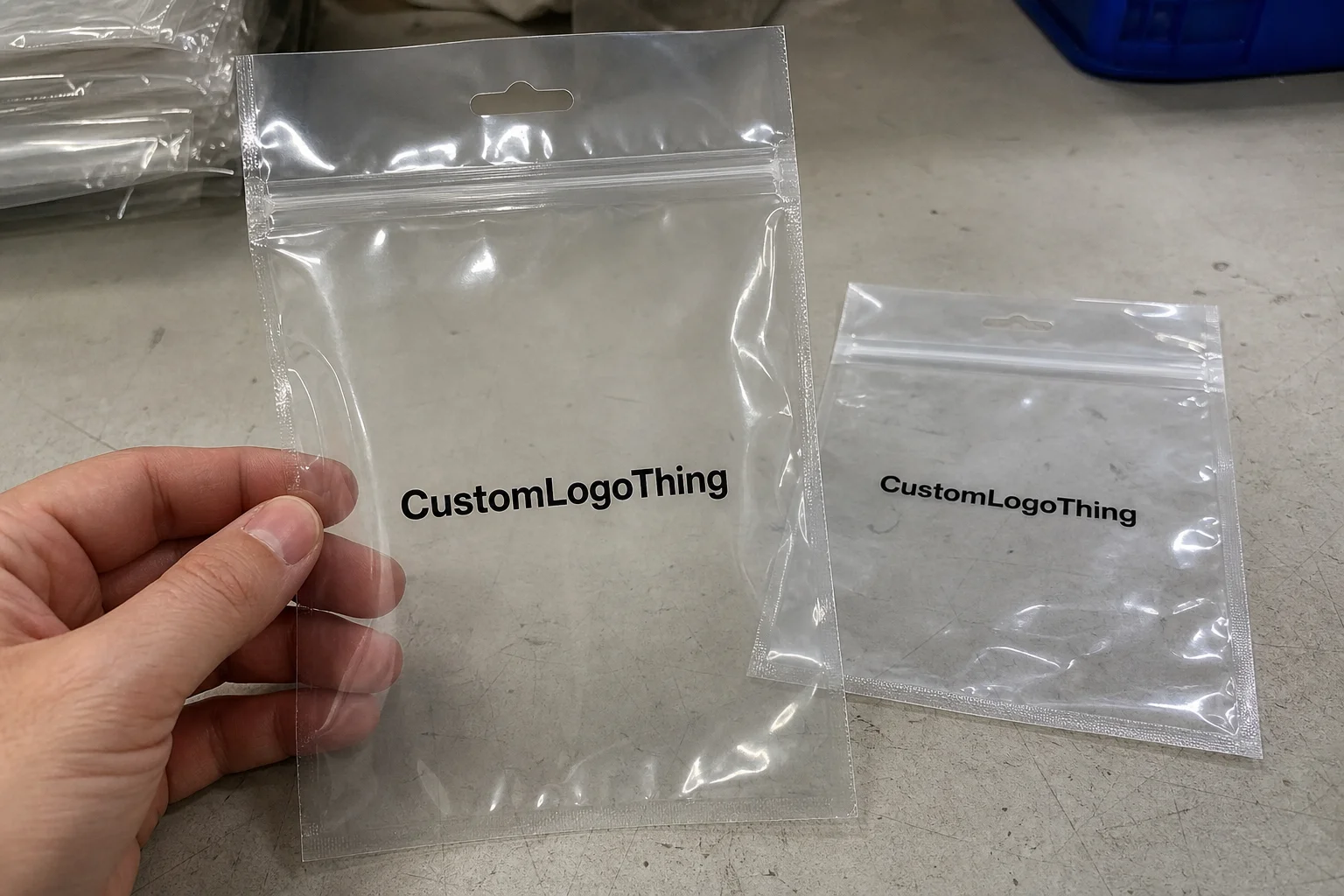
The most common mistake is simple: buyers order to a guessed MOQ instead of actual usage. That is how a campaign ends up with 10,000 bags for a program that needed 3,000, or with four separate reorders because nobody checked consumption history. Both are expensive in different ways. One ties up cash and storage space. The other creates rush fees, production churn, and unnecessary stress.
The fix is boring, which is usually how the useful stuff works. Start with monthly usage, then add a safety buffer based on reorder timing. If a client moves 600 sample kits a month and the reorder cycle is about three months, the base need is 1,800 bags. Add a sensible cushion for approval delays or a spike in demand, and you still stay in a controlled range. That is a very different number from “let’s just order 5,000 and hope.” Hope is not inventory planning.
Clear Resealable Poly Bags are especially practical for agencies because they make verification easier. Fulfillment teams can confirm contents without opening every pack. Warehouse staff can sort SKUs faster. Client-facing kits also look cleaner because the product is visible and tidy. Presentation matters more than people like to admit. A neat clear bag reads as organized, and organized usually clears approvals faster.
Resealability matters for the same reason. Press-to-close or zip-lock styles keep contents contained between inspections, insert swaps, and final pack-out. That matters for sample sets, folded apparel, stationery, and promo items. It also cuts down on torn flaps and repacking waste, which sounds minor until a team spends half a day fixing avoidable mistakes.
“The right bag order is the one that fits the campaign schedule, the product dimensions, and the actual usage rate. Not the prettiest quote. Not the largest number. The right one.”
When a packaging program includes multiple components, it helps to keep the bag order inside the wider system. Custom Packaging Products is useful when resealable bags need to sit alongside mailers, inserts, or kit components, and the FAQ page covers common ordering questions without the usual sales fluff.
Material, seal, and clarity specs that actually affect buyer decisions
Not every clear bag performs the same way. Buyers get caught when they treat “clear poly bag” as one category. It is not. Material choice affects stiffness, clarity, durability, and how the bag feels in the hand. Closure style affects packing speed and how often the bag can be opened and resealed. Thickness changes both protection and cost.
LDPE is softer and more forgiving, which works well for flexible contents, soft goods, and items that do not need a crisp presentation. CPP has a smoother, crisper feel and often looks a little more polished in presentation packs. OPP is the most common choice when clarity and visual appeal matter more than stretch. It is clean and bright, but it is less forgiving if the item is oddly shaped or the dimensions are off.
Seal style matters just as much as material. A press-to-close or zip-lock closure is better for repeated access and reinspection. An adhesive flap works well for presentation packs or one-time sealing. If the bag will be packed quickly and reopened later, a resealable closure is usually the safer choice. If it is mainly a display pack, an adhesive option may be enough. There is no prize for picking the most expensive closure type if the job does not need it.
Thickness should be tied to what the bag actually needs to survive. Light-duty bags often run around 1.5 to 2 mil for inserts or very light items. Standard usage is usually around 2 to 3 mil. Heavier-gauge options, often 4 mil and above, make more sense for apparel, bundled kits, or anything with edges that can stress the film. More thickness generally means more strength, but it also adds cost and can reduce flexibility. Buyers sometimes treat thicker as better. That is not always true. Sometimes it is just heavier, stiffer, and more expensive.
Clarity is also more than a yes-or-no decision. Buyers should think about gloss, haze, and whether anti-fog is needed. If the contents are meant to be visible for retail or internal verification, higher clarity is worth paying for. If the bags will be used in cold storage or in a temperature-shifting environment, anti-fog treatment may keep them readable. For any food-adjacent use, confirm compliance requirements before approving the material. Do not assume a clear bag is automatically suitable just because it looks clean.
Size matters in a less obvious way. A bag that is too tight leaves no workable reseal area. A bag that is too large wastes material and can make the item slide around inside. Good sizing leaves room above the product for the closure and enough headspace for clean handling.
| Option | Best for | Typical feel | Common tradeoff |
|---|---|---|---|
| LDPE clear resealable bag | Soft goods, sample items, flexible contents | Softer, more forgiving | Less crisp presentation |
| CPP clear resealable bag | Presentation packs, folded inserts | Crisper, smoother | Can cost a bit more |
| OPP clear resealable bag | Retail display, branded kits | Very clear, polished | Less stretch, needs accurate sizing |
For shipping and handling standards, the ISTA testing framework is useful when the bag is part of a larger kit. For material disposal and recycling questions, the EPA recycling guidance is a reasonable reference point. Neither one replaces a proper spec review, but both help teams make better decisions.
How to size the order without guessing your MOQ
Start with actual usage. That sounds obvious, which is exactly why people skip it. Pull projected monthly demand, campaign volume, expected reorder timing, and a realistic safety stock. Then build the first order around that number. If each client has a separate SKU or bag size, keep them separate. Do not blend multiple programs into one total just because procurement wants fewer line items. That only makes the spreadsheet prettier. It does not make the inventory smarter.
For Clear Resealable Poly Bags for agency buyers moq planning, MOQ usually depends on size, thickness, closure style, and whether the bag is stock or custom. Stock bags usually support smaller orders because there is no custom setup. Custom sizes, printed bags, or unusual closures generally need higher minimums to cover tooling, setup, and run efficiency. Buyers often ask for “the lowest MOQ possible,” but low MOQ comes with a tradeoff: higher unit pricing and less cost efficiency.
That tradeoff is not mysterious. It just needs to be named clearly.
- Test or pilot program: stock bags, lower MOQ, higher unit cost.
- Repeat campaign: standard custom size, limited print, moderate MOQ, better unit cost.
- Recurring branded program: locked spec, custom print, higher MOQ, lowest unit cost at volume.
A SKU-by-SKU planning sheet helps more than any fancy procurement system. Add the client name, bag size, monthly use, peak month, reorder trigger, and safety stock. Once that is on one page, it becomes obvious where inventory should stay separate and where volume can be consolidated. It also gives finance a cleaner explanation for why one order is small and another is not. They may not love it, but at least the logic is visible.
One practical caution: do not overstate future demand just to “improve the unit price.” If the client may change the campaign next quarter, a huge order can become dead inventory very quickly. The cheapest per-piece number is not always the cheapest result.
Cost, pricing, and unit cost: what changes the quote
Pricing moves faster than buyers expect. Bag dimensions, film thickness, closure type, print count, and order quantity all change the quote. Add a special finish or custom artwork, and the number shifts again. Transparent packaging often looks simple on paper, but small spec changes can move the unit cost more than a buyer expects.
The clean way to compare quotes is to look at total landed cost. Not just the per-bag price. Ask for pricing per 1,000 units, freight, carton charges, setup fees, and tooling if the bag is custom. Then divide by the usable quantity that will actually arrive. A lower per-piece quote can become the more expensive option once freight or packaging charges are added.
Here is the rough pricing behavior most agency buyers run into:
| Order type | Typical MOQ behavior | Unit cost trend | Best use case |
|---|---|---|---|
| Stock clear resealable bags | Lower MOQ, faster release | Moderate to higher | Testing, short campaigns, mixed client work |
| Custom size, no print | Medium MOQ | Better than stock at scale | Repeatable fulfillment programs |
| Custom printed clear bags | Higher MOQ | Lowest at volume | Long-running branded kits and retail programs |
Freight timing also affects the real cost. A bag order that looks good on paper can become awkward if it lands too late for the campaign or if warehouse receiving charges apply because the carton count was not communicated clearly. Agencies often have billing timing to think about too. Sometimes the client invoice is due before the factory invoice. Sometimes it is the other way around. Cash flow is not glamorous, but it is part of the order decision.
That is why a slightly larger MOQ can sometimes be easier to manage if it locks pricing across several reorders. On the flip side, if approvals are still moving, a smaller run can protect the budget and prevent inventory from sitting idle.
If a project also needs outer packaging, Custom Poly Mailers are often paired with resealable inner bags. Agencies that standardize both tend to get more consistent costs and fewer last-minute substitutions.
Process, timeline, and production steps from spec sheet to shipment
The production flow is straightforward if the brief is complete. Size confirmation comes first, then material selection, artwork review, proof approval, production, inspection, packing, and shipment. The process only gets messy when the brief is incomplete or someone decides to change the dimensions after approval. That always seems like a good idea until the schedule moves.
Most delays come from the same small set of problems: missing specs, artwork revisions after proofing, unclear color expectations, and last-minute changes to MOQ. The factory does not need a mystery novel. It needs clear dimensions, clear quantity, and a clear approval path.
Timing depends on whether the order is stock or custom. Stock bags generally move faster, often around 5 to 10 business days after confirmation if inventory is available and packing is straightforward. Custom bags usually need about 12 to 15 business days after proof approval, sometimes longer if the run is large, the closure is unusual, or the artwork requires more revision. Special sizes and printed bags should always get extra time in the schedule. Rushing a bag order is one of those ideas that sounds efficient and ends up costing more.
Before sending a PO, the buyer should have these details ready:
- Bag dimensions, including usable opening width and height
- Product weight and whether the contents have sharp edges
- Closure preference: zip-lock, press-to-close, or adhesive flap
- Quantity range and reorder expectations
- Print requirements, if any, plus artwork format
- Ship-to city, warehouse receiving rules, and carton count preferences
Sampling matters more than some teams want to admit. Plain samples are usually enough for size checks and closure testing. Printed samples or pre-production proofs take longer, but they reduce the risk of approving the wrong fit for premium or fragile items. A few extra days spent testing is cheaper than a bad packout followed by a client complaint.
If the order will move through a fulfillment center or be bundled into a larger shipment, transit and handling should be part of the review. Bags do not need a full lab test in every case, but the packaging should still be checked against how it will actually be used. Real handling beats assumptions every time.
Agency-friendly buying criteria that reduce reorders and mess
Agencies need repeatability. The same bag spec has to work for client approvals, fulfillment teams, and future reprints. If the size changes every time someone new touches the account, the process gets messy very quickly. A locked spec is not boring. It is what prevents the same job from being rediscovered every quarter.
Focus on the details that keep a program organized:
- Carton counts that make receiving and storage predictable
- Bundle sizing that fits packing-line needs
- Palletization that matches warehouse rules
- Labeling consistency so the wrong client order does not get mixed in
Storage matters too. Clear resealable bags can wrinkle, cling, or collect dust if they are handled badly before use. Keep cartons closed until needed. Store them flat. Avoid hot, humid corners of the warehouse. Basic advice, yes. Still ignored often enough to create avoidable defects or handling complaints.
When a program will reorder, it helps to set up the file so the next round is easy. That may mean a reserved stock position under a locked spec, a repeatable die line, or a standard size that does not need fresh approval every time. Some suppliers can keep reorder-ready files in place so the team does not have to rebuild the same quote chain every few months. That saves time and reduces error risk. More importantly, it keeps the agency from acting like every reorder is a brand-new project.
The best supplier in this space is not the one that says yes to everything. It is the one that understands schedules, keeps specs organized, and does not force a reset each time the order returns. That is what makes clear resealable poly bags for agency buyers moq planning manageable across multiple accounts.
If the packaging program is growing, standardizing the spec library is usually the smartest move. Keep the bag size, closure, material, and reorder history in one place. It will not make procurement glamorous. It will make it much harder to mess up.
Next steps for quoting, sampling, and launch-ready ordering
Before requesting pricing, build a one-page spec brief. Keep it short and specific: bag size, material, thickness, closure, print needs, quantity range, and delivery city. If the contents are fragile, premium, or unusually shaped, say so. “Approximate” is not enough when the bag has to fit a real product and survive real handling.
Ask for two quote tiers: one at the planned MOQ and one at a higher volume. That makes it easier to compare bulk pricing against the actual campaign need. If the unit cost drops sharply at the next tier, you can decide whether the extra inventory is worth carrying. Sometimes it is. Sometimes it is just expensive shelf clutter.
If the item is dimensional or the presentation matters, request a plain sample or spec sheet before artwork approval. That is the cheapest way to catch a fit problem early. Use the sample with the actual product, not a random stand-in. It sounds obvious. People still skip it.
Before release, confirm freight timing and carton counts. If the order is going to a warehouse or fulfillment center, include receiving requirements in the purchase order. Labels, pallet height, and delivery appointment windows are not minor details. They are the difference between a smooth receiving process and a call nobody wants to make.
For agencies that buy packaging repeatedly, the best path is straightforward: send a clear brief, a realistic target quantity, and a delivery window that matches the campaign. That keeps the quote aligned with the real job instead of a fantasy number. Done right, clear resealable poly bags for agency buyers moq planning becomes predictable, less expensive to manage, and easier to repeat.
What MOQ should agencies expect for clear resealable poly bags?
MOQ depends on size, thickness, closure style, and whether the bags are stock or custom printed. Stock options are usually available in smaller runs, while custom orders often need a higher minimum to cover setup. The best starting point is actual campaign usage, not the lowest number on a quote sheet.
Are clear resealable poly bags better than plain open poly bags for fulfillment?
Yes, when products need protection, dust control, or repeated opening and closing. Resealable bags also speed up picking and packing because the contents stay contained. They work especially well for samples, promo kits, inserts, and small retail items.
What affects pricing the most on clear resealable poly bags?
Bag dimensions, film thickness, closure type, print count, and order quantity are the biggest pricing drivers. Freight, carton format, and setup fees can also change the total landed cost. Two quotes with the same per-bag number can still have very different final costs.
How long does production usually take after approval?
Stock bags usually move faster than custom-printed or special-size orders. Timeline depends on proof approval speed, sample requirements, and the current production queue. Ask for the full timeline from proof to shipment, not just the factory run time.
What details should I send for an accurate quote?
Send bag size, product dimensions, thickness preference, closure type, print needs, and quantity range. Include usage details if the bag needs to hold apparel, inserts, food contact items, or heavier goods. The more specific the brief, the less likely you are to get a useless quote.


