Buyer Fit Snapshot
| Best fit | Cmyk Printed Recycled Cartons projects where brand print, material claims, artwork control, MOQ, and repeat-order consistency need to be specified before quoting. |
|---|---|
| Quote inputs | Share finished size, material target, print colors, finish, packing count, annual reorder estimate, ship-to region, and any compliance wording. |
| Proofing check | Approve dieline scale, logo placement, barcode or warning zones, color tolerance, closure strength, and carton packing before bulk production. |
| Main risk | Vague material claims, crowded artwork, missing packing details, or unclear freight terms can make a low unit price expensive after revisions. |
Fast answer: Cmyk Printed Recycled Cartons: Board, Finish, Dieline, and Unit Cost should be specified like a repeatable production item. The safest quote records material, print method, finish, artwork proof, packing count, and reorder notes in one written spec.
Production checks before approval
Compare the actual filled-product size with the drawing, then confirm tolerance on folds, seals, hang holes, label areas, and retail display edges. Reserve space for logos, QR codes, warning copy, and material claims before decorative graphics fill the panel.
Quote comparison points
Review material grade, print process, finish, sampling route, tooling charges, carton quantity, and freight assumptions side by side. A quote is only useful when the supplier can repeat the same color, closure quality, and packing count on the next order.
A recycled carton can look richer than a lot of buyers expect, but cmyk printed recycled cartons also expose every choice you make in the board, ink, and finishing. If the substrate is too porous, too rough, or naturally brown in tone, the color story changes fast. The same artwork can feel polished on one stock and flat on another. Annoying? Absolutely. Predictable? Also yes.
That is not a flaw in the process. It is the material doing what material does. From a packaging buyer’s point of view, cmyk printed recycled cartons sit right at the overlap of branding, cost control, and material responsibility. The best results usually come from understanding how the carton stock behaves before the artwork gets locked and everyone starts pretending the proof is going to fix everything later. It never really does.
Recycled carton stock can do a lot more than hold a logo. It can support premium retail boxes, subscription cartons, mailer-style cartons, and lightweight folding cartons for cosmetics, wellness, apparel accessories, and dry goods. The trick is matching the print method, board grade, and finish to the brand promise instead of expecting the substrate to act like coated virgin paperboard. That assumption is where people get into trouble.
A carton that looks clean on screen is not automatically a carton that will print cleanly. With recycled board, the surface texture, fiber visibility, and absorbency are part of the design whether you planned for them or not.
What Are CMYK Printed Recycled Cartons?
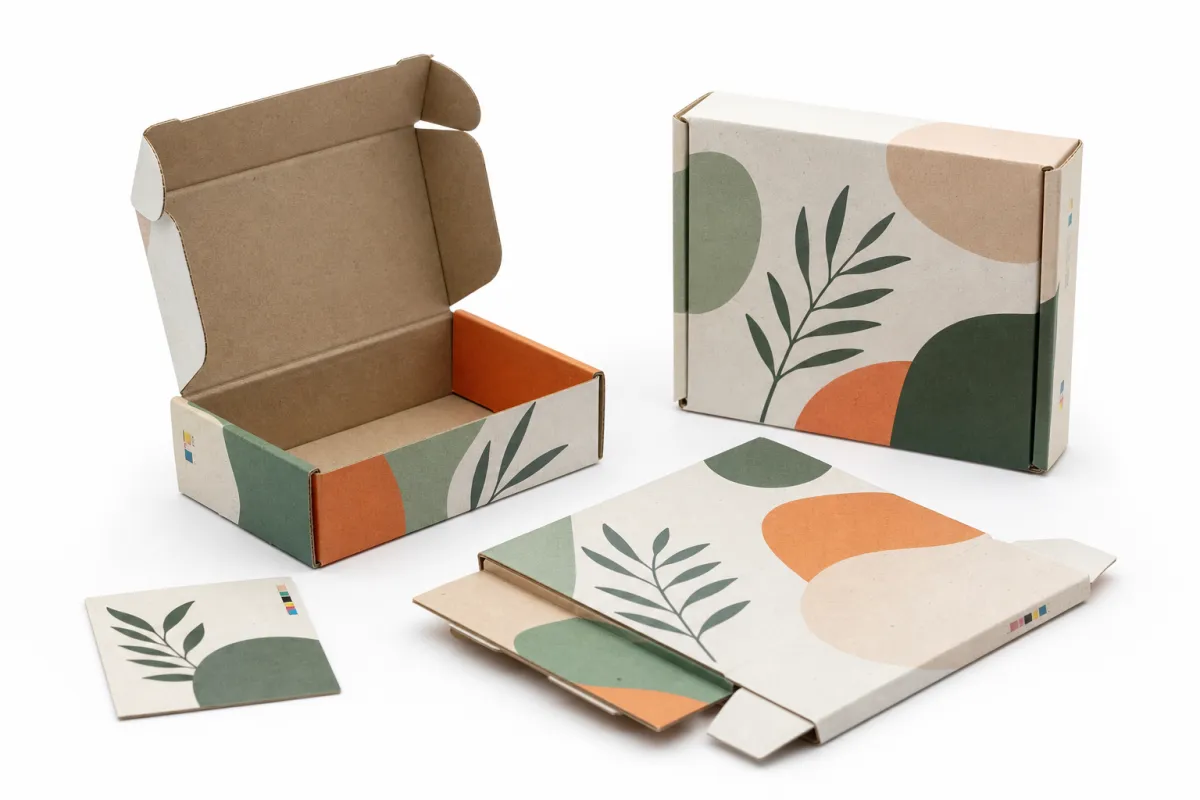
CMYK stands for cyan, magenta, yellow, and black, the four process colors used to build most full-color packaging artwork. cmyk printed recycled cartons are cartons made from recycled-fiber board and decorated with those four inks rather than a single spot color or a special Pantone match. That makes them flexible, efficient, and practical for a lot of everyday packaging programs.
The carton itself is usually a folding carton or mailer-style carton built from recycled paperboard in the 250-400 gsm range, though the exact caliper depends on product weight and shipping needs. Some boards are made from high recycled content fiber, while others blend recycled and virgin fibers to improve stiffness, whiteness, or runnability. Those differences matter because a recycled fiber sheet tends to show more natural variation than a bright coated virgin board.
That variation is not only visual. Recycled board can have a warmer tone, visible fiber specking, and a more porous surface. On cmyk printed recycled cartons, those traits influence how ink sits, how much dot gain occurs, and how dark or muted a color appears once the carton is folded and handled. A pale green can shift toward olive. A pale gray can pick up warmth. A dark navy can absorb more aggressively and lose some crispness if the coverage is not controlled.
For brands, that means the carton should be designed around the material, not just dropped onto it. Solid white backgrounds, heavy photographic content, and delicate pastel gradients all need more careful handling on recycled board than on coated paper stock. By contrast, bold logos, strong typography, and well-spaced layouts usually print with more confidence. That is one reason cmyk printed recycled cartons often feel premium even without heavy embellishment: the design is honest about the substrate.
Use cases are broad. Retail boxes for beauty or supplements, direct-to-consumer mailer cartons, lightweight folding cartons for food-safe secondary packaging, and promotional cartons for seasonal sets all make sense here. What most buyers want is a package that signals responsible material choice without giving up shelf presence. When cmyk printed recycled cartons are specified well, they can do exactly that.
- Retail cartons: good for shelf visibility, especially with strong typography and restrained coverage.
- Subscription cartons: useful when branding, unboxing, and shipping durability all matter.
- Mailer cartons: often pair recycled board with flexographic printing or digital printing for shorter runs.
- Lightweight folding cartons: suitable for inserts, accessories, and secondary packaging around a primary product.
How CMYK Printed Recycled Cartons Are Made
The production path for cmyk printed recycled cartons usually starts in prepress, long before the press operator sees the job. Artwork is checked against a dieline, bleed is confirmed, folds and glue panels are protected, and images are reviewed for resolution, color space, and total ink coverage. If a buyer sends a file built for coated art paper, the first prepress review usually shows why the carton would have printed badly without adjustment. It is not subtle.
After that comes proofing. A digital proof shows layout and color intent, while a press proof or physical sample gives a much better sense of how the board tone affects the final look. On cmyk printed recycled cartons, that proof step is not a formality. It is where everyone sees whether the white areas are truly white, whether the reds carry enough warmth, and whether fine text survives the board texture. I have seen a beautiful design fall apart at this stage because the text was too light and the brand wanted a cool gray on a warm stock. The file was fine. The spec was the problem.
The printing method depends on run length and structure. Offset printing is common for folding cartons because it gives excellent detail, smoother solids, and stronger control over process color builds. Digital printing is often chosen for short runs, multiple SKUs, or fast-turn programs, especially when artwork changes often. Flexographic printing shows up more often on Corrugated Mailer Cartons and shipping-focused formats, where the board structure and press setup differ. Each method can produce cmyk printed recycled cartons, but the results are not identical, and buyers should not pretend otherwise just to make procurement easier.
Ink laydown matters too. CMYK builds color by stacking four process inks in controlled percentages, which means the design depends on halftone dots rather than a single mixed ink. That works very well for photos and gradients, but it also means the board surface must accept those dots cleanly. If the recycled stock is too absorbent, the dots spread. If the surface is too rough, fine details can break apart. That is why carton makers spend so much time on screening, dot gain control, and color calibration for cmyk printed recycled cartons.
Once the sheet is printed, it is dried or cured, then die-cut, scored, stripped, folded, and glued. The final carton may also go through print finishing such as aqueous coating, matte varnish, soft-touch lamination, embossing, or a selective spot color hit for a logo or seal. The finishing choice affects both appearance and recyclability, so it should never be treated like a decoration you toss on at the end because it looks nice in a mockup. With cmyk printed recycled cartons, a finish can rescue a design, or it can overcomplicate a perfectly good one.
A good production partner will also watch for artwork issues that show up most clearly on recycled stock: gradients that band, dark solids that look thirsty, small reversed type that fills in, and brand colors that move away from the expected target. The press may be doing everything right and still the carton can drift visually if the substrate, proof, and artwork were never aligned. That is the real manufacturing lesson behind cmyk printed recycled cartons.
The most useful proof is the one that makes uncomfortable truths visible early. If a carton is going to need a warmer white, heavier text weight, or a simpler background, it is better to learn that before production begins.
Key Factors That Affect Print Quality and Sustainability
Board selection is the first big decision. Recycled board is not one thing; it ranges from highly consistent white-top liners with recycled backing to more natural, kraft-leaning sheets with visible fiber and a warmer cast. cmyk printed recycled cartons on a whiter sheet usually support brighter color and cleaner neutrals, while browner or more textured stock can give the packaging a more earthy, understated feel. Neither is better in a vacuum. The right choice depends on the brand story and the product category.
Surface finish comes next. A smoother coated surface can improve image sharpness and help CMYK dots land more predictably, while an uncoated recycled surface may look more tactile but also more muted. Some buyers want that natural texture. Others need shelf punch. Either way, the finish has to be chosen with the printed result in mind, because cmyk printed recycled cartons rarely behave like glossy brochure paper. They are a different animal.
Ink coverage is another quiet driver. Heavy coverage means more ink on the sheet, longer drying time, and a greater chance of scuffing or blocking during finishing. Large dark areas can also increase waste if the press has trouble keeping color stable. On the sustainability side, lighter coverage often means less ink consumption and less correction waste, which can be useful when the brand wants the carton to do more with less. That is one reason simple, well-structured cmyk printed recycled cartons often outperform overly busy designs.
Color management is where many packaging programs succeed or stumble. A color profile built for coated art paper will not translate cleanly to recycled board. The printer needs to know the board grade, the finish, and the target appearance, then tune the files and the press to match that reality. In a controlled environment, a good supplier can keep brand colors consistent enough for a line extension or a multi-SKU program. With cmyk printed recycled cartons, though, “consistent” usually means controlled variation, not absolute laboratory matching. That is the honest version.
Sustainability depends on more than recycled fiber content. Adhesives, coatings, laminations, and windows all affect the recovery path. A carton with a plastic window and film lamination may still be useful, but it does not behave the same way in recycling as a plain paperboard carton. If the goal is strong material recovery, ask whether the chosen finish fits the local recycling stream and whether the packaging still meets performance needs after that choice. The EPA paper and paper products guidance is a useful reference point, and FSC’s chain-of-custody standards at fsc.org are worth checking if certified sourcing matters to the brand.
There is also a design side to sustainability. Clean typography, strong contrast, and a restrained palette can reduce the need for overprinted backgrounds and late-stage artwork corrections. That means fewer make-readies, less wasted stock, and fewer headaches in production. A package that looks intentional and uses the board well often feels more sustainable because it is more honest about the material. That is one reason cmyk printed recycled cartons are so appealing to buyers who care about both presentation and responsibility.
- Better print quality: usually comes from smoother white-top recycled board, careful proofing, and moderate ink coverage.
- Better sustainability: usually comes from recycled content, recyclable finishes, and a structure that avoids unnecessary plastic add-ons.
- Best brand fit: usually comes from choosing graphics that respect the board texture instead of fighting it.
CMYK Printed Recycled Cartons: Cost and Pricing Factors
Pricing for cmyk printed recycled cartons is driven by a handful of practical variables, and most of them are visible on the spec sheet. Board grade, carton size, print coverage, quantity, die complexity, finishing, and the number of SKUs all influence the final number. A buyer who compares quotes without checking those details may think one supplier is cheaper, when the two specs are not actually equivalent. That happens more often than anyone wants to admit.
Quantity still matters a great deal. At 5,000 pieces, a small folding carton with simple CMYK graphics may land in a very different price band than the same carton at 20,000 pieces because setup cost is spread over more units. Short-run digital printing can be attractive for lower volumes or frequent artwork changes, but the unit cost often stays higher than offset printing on a stable, larger run. Flexographic printing can be efficient on corrugated mailers, especially when the graphics are simple and the structure is tuned for shipping. For cmyk printed recycled cartons, the right print method should match both quantity and carton style.
Here is a practical way to think about the market. These are broad planning ranges, not fixed quotes, and shipping, tax, and local labor conditions can move them a lot. Still, they help buyers separate realistic pricing from wishful thinking.
| Spec / Print Route | Typical Use | Indicative Unit Price at 5,000 | What Drives the Number |
|---|---|---|---|
| Simple recycled folding carton, 1-2 spot colors or basic CMYK | Inner cartons, value-focused retail packaging | $0.16-$0.26 | Low ink coverage, standard die, minimal finishing |
| 4-color CMYK on recycled board with aqueous coating | Retail boxes, subscription packaging | $0.20-$0.34 | Process color control, coating, moderate proofing |
| Heavy coverage with premium print finishing | Beauty, wellness, gift sets | $0.28-$0.48 | More ink, tighter color checks, special varnish or embossing |
| Short-run digital printing on recycled carton stock | Seasonal drops, test runs, multiple SKUs | $0.40-$0.85 | Fast changeovers, lower setup, higher unit cost |
| Flexographic printing on mailer-style recycled cartons | Shipping cartons, e-commerce mailers | $0.18-$0.33 | Board structure, ink coverage, and number of print stations |
The table is useful because it shows what many buyers miss: the lowest unit price is not always the best value. A carton that saves two cents but arrives with weak color, poor folding behavior, or surface rub-off can cost more once rejects, reprints, or brand damage are counted. For cmyk printed recycled cartons, a fair quote should explain the board, the print route, the finish, the tolerances, and the waste allowance, not just the headline unit rate.
Design choices affect cost as much as raw materials do. Full-bleed photography, heavy ink coverage, multiple dielines, and frequent artwork changes all add press time and setup effort. A design that uses one strong background, a disciplined color palette, and a sensible ink build often prints more efficiently than a highly detailed layout with many small elements. That does not mean the carton has to feel plain. It means the artwork should be designed for production reality, which is exactly how experienced teams keep cmyk printed recycled cartons under control.
If you are comparing quotes, ask for these items in writing: board type, recycled content claim, print method, finish, die charges, proof type, and carton test allowance. Then compare apples to apples. That simple habit removes a lot of noise from the purchasing process and helps you judge whether one supplier is truly delivering better value for cmyk printed recycled cartons or just a lower starting figure.
Process and Timeline for Ordering Printed Recycled Cartons
A clean order for cmyk printed recycled cartons usually moves through a predictable sequence. First comes the product brief: dimensions, product weight, shipping requirements, retail goals, and target quantity. Then comes the dieline review, where the supplier confirms the carton structure, panel sizes, and glue flap placement. After that, the artwork gets placed on the dieline so the design team can confirm where the folds, tuck flaps, and cut lines land.
- Brief and structure review: define the carton style, board grade, and product protection needs.
- Dieline and artwork placement: confirm folds, bleed, barcode zones, and glue areas.
- Prepress check: inspect image resolution, color builds, line weights, and text sizes.
- Proof approval: review a digital proof or physical sample and sign off on color and layout.
- Production: print, dry or cure, cut, score, and finish the cartons.
- Folding, gluing, and QC: verify that the cartons erect correctly and hold their shape.
- Packout and shipping: prepare cartons for storage, fulfillment, or direct plant delivery.
For straightforward cmyk printed recycled cartons with ready artwork and standard finishing, production often lands around 12-15 business days after proof approval. More complex structures, special finishes, or tighter color matching can push that to 18-25 business days, especially if samples or revisions are needed. Digital printing can shorten some of the front-end setup on shorter runs, while offset printing can be more economical once the quantity rises. Flexographic printing on corrugated mailers may move quickly once the plates and setup are in place, but the overall timeline still depends on board availability and finishing.
What speeds a job up? Clear artwork, stable dimensions, fast proof review, and a carton spec that does not keep changing. What Slows It Down? Late design changes, uncertain finish choices, sourcing delays, and trying to match a delicate brand color on a more absorbent board without a proof target. That is why experienced buyers lock the carton structure early and spend real attention on the proof stage. It is the easiest place to save both time and waste on cmyk printed recycled cartons.
Planning inventory matters just as much as production. If the carton supports a launch, seasonal kit, or subscription refresh, make sure the order leaves room for press approval, transit, and a little contingency stock. Overstocking is expensive, but underordering can be worse if the product lands well and the carton runs out. From a packaging buyer’s point of view, the most comfortable programs are the ones where cmyk printed recycled cartons are ordered against a realistic demand forecast, not a hopeful one.
One more practical point: request transport testing if the cartons are meant to move through distribution rather than sit on a shelf. Standards such as ISTA protocols and ASTM methods like D4169 help confirm that a carton can survive compression, vibration, and handling. A good-looking carton is useful; a good-looking carton that survives the chain is better. That is especially true for cmyk printed recycled cartons used in e-commerce or multi-touch retail supply chains.
Common Mistakes When Specifying CMYK Printed Recycled Cartons
The most common mistake is expecting recycled board to match coated paper exactly. It will not. cmyk printed recycled cartons need their own color target because the substrate absorbs differently and reflects light differently. A muted pastel may look beautiful in a proof on white art paper, then arrive softer and warmer on recycled stock. That is not failure; that is physics being rude.
Another frequent problem is artwork built around ultra-smooth solids or delicate gradients. Small type below 6 pt, reverse-out text on dark fields, and long skinny hairlines can all become fragile on textured board. If the carton is intended for retail, that risk becomes even more obvious because shelf lighting exposes every registration shift and every soft edge. Stronger type, simpler blocks of color, and cleaner spacing usually serve cmyk printed recycled cartons better than visual tricks that depend on perfect paper conditions.
Skipping proofing is a bigger mistake than people admit. A digital file can look polished and still fail in the pressroom because the board, ink load, and finishing sequence change the final appearance. A physical proof or press sample lets the buyer judge density, contrast, and fold performance before the full run starts. With cmyk printed recycled cartons, that early check often pays for itself in avoided rework alone.
Structural issues get overlooked too. A carton redesign for sustainability can accidentally reduce stiffness, crush resistance, or closure integrity if the board caliper or flap design changes too much. If the box must survive warehouse handling, parcel delivery, or stacked retail display, the structure needs to be tested, not guessed. A carton that looks greener but tears or opens in transit has not solved the real problem. That is why production teams should review both the print side and the structural side of cmyk printed recycled cartons.
Low-resolution imagery is another avoidable problem. Recycled board does not forgive soft files. If the photography is not sharp at final size, the board texture makes that weakness more obvious. The same applies to QR codes, barcodes, and tiny ingredient panels. Clean files, the right contrast, and adequate quiet zones are basic, but they are also where many packaging programs lose polish. A carton line can be upgraded or downgraded by the smallest detail on cmyk printed recycled cartons.
- Do not build the design for coated paper and assume it will transfer.
- Do not skip the proof just to save a few days.
- Do not ignore fold and glue zones when placing artwork.
- Do not assume a recycled carton is automatically strong enough for shipping.
- Do not overcomplicate the design if the board is naturally textured.
Expert Tips and Next Steps for Better Carton Specs
If you are new to cmyk printed recycled cartons, ask for a sample pack first. Side-by-side samples show more than a spec sheet ever can. You can feel the stiffness, see how the white point shifts, and judge whether the board’s natural texture supports the brand. Put those samples under the same lighting where the carton will be sold or opened, because warm retail lighting can change perceived color more than people expect. That little detail catches people off guard all the time.
Build a simple spec sheet before requesting quotes. Include carton dimensions, board type, recycled content target, print method, finish, color expectations, proofing method, quantity, and required delivery date. The clearer the brief, the cleaner the quote. It also helps the supplier tell you whether the job should be handled with offset printing, digital printing, or flexographic printing, rather than forcing one route onto every project. Clear specs are one of the best ways to improve cmyk printed recycled cartons without adding unnecessary cost.
Ask practical questions, not just marketing questions. Will the carton stay recyclable after the finish is added? Can the supplier show a previous job on similar board? How much press waste is typical for the first run? What tolerance do they hold on color on recycled stock? Those answers tell you far more about the real production environment than a glossy brochure ever will. In my experience, the suppliers who answer clearly are usually the ones who understand cmyk printed recycled cartons as a manufacturing product, not just a design surface.
Think about the carton in the full chain, from the moment it leaves the press to the moment a customer opens it. Does it scuff in transit? Does the glue line hold? Does the finish create recycling friction? Does the visual tone support the price point? Those questions are where packaging gets real. A carton is not just a print job; it is a working piece of the product experience.
Ask for the sample, review the proof in real light, and compare board grades with a real product inside the box. That is the fastest way to see whether the carton design is honest about the material and strong enough for the job.
One final practical note: cmyk printed recycled cartons work best when brand goals, sustainability goals, and production realities are aligned from the start. If the design respects the recycled board, the print method, and the finishing path, the result can look sharp, feel thoughtful, and hold up well in the supply chain. If those pieces are forced together late, the carton will usually show the strain. That is why the best cmyk printed recycled cartons are the ones planned with the material in mind, not after the fact.
If you only remember one thing, make it this: choose the board first, prove the color on that board, and keep the finishing simple unless it earns its place. That one habit saves money, reduces waste, and gives cmyk printed recycled cartons a better shot at looking like the brand owner meant it, not like someone copied a screen file onto paper and hoped for the best.
Are cmyk printed recycled cartons suitable for premium packaging?
Yes, if the design leans into texture, contrast, and clean composition rather than expecting photographic perfection on every panel. Premium results usually come from strong structure, careful color management, and a recycled board grade that prints consistently. A proof or sample run is the best way to confirm whether cmyk printed recycled cartons support the brand position you want.
What affects the price of cmyk printed recycled cartons most?
The biggest drivers are board choice, carton size, print coverage, quantity, finishing, and any Custom Die Cutting or specialty coatings. Heavy ink coverage and more complex artwork can raise costs because they add press time, setup, and waste risk. Higher order quantities usually improve unit pricing, especially when the spec for cmyk printed recycled cartons stays stable.
How long does production usually take for recycled printed cartons?
Timing depends on proof approval, material availability, and how much finishing or structural development is required. Simple cartons with ready artwork move faster than custom structures that need samples, revisions, or detailed color matching. The quickest path is usually a clean spec, final dieline, and prompt proof sign-off for cmyk printed recycled cartons.
Can recycled carton stock hold accurate CMYK colors?
Yes, but the color result is shaped by the board surface, fiber tone, and ink absorption, so it will not always match coated paper exactly. Darker tones, neutrals, and bold brand colors generally reproduce more reliably than very delicate gradients. A controlled proof is the best way to verify the final appearance before production of cmyk printed recycled cartons.
What should I ask a supplier before ordering cmyk printed recycled cartons?
Ask about board grade, recycled content, proofing method, lead time, minimum order quantity, and any finish that might affect recyclability. Also confirm how the supplier handles color expectations on recycled stock and whether they can provide samples or preproduction proofs. Those questions reduce surprises and help align packaging quality with your sustainability goals for cmyk printed recycled cartons.