coffee roaster Woven Label Beanies Bulk Order planning usually starts with a simple question that has a surprisingly expensive answer: will this be a real retail item, or just a seasonal accessory that happens to have a logo on it? The difference shows up in the numbers, the material choice, and the amount of scrutiny the sample gets before production starts. A beanie can look tiny on a purchase order and still carry a lot of brand weight once it sits on a counter, a barista's head, or a gift table beside a bag of beans.
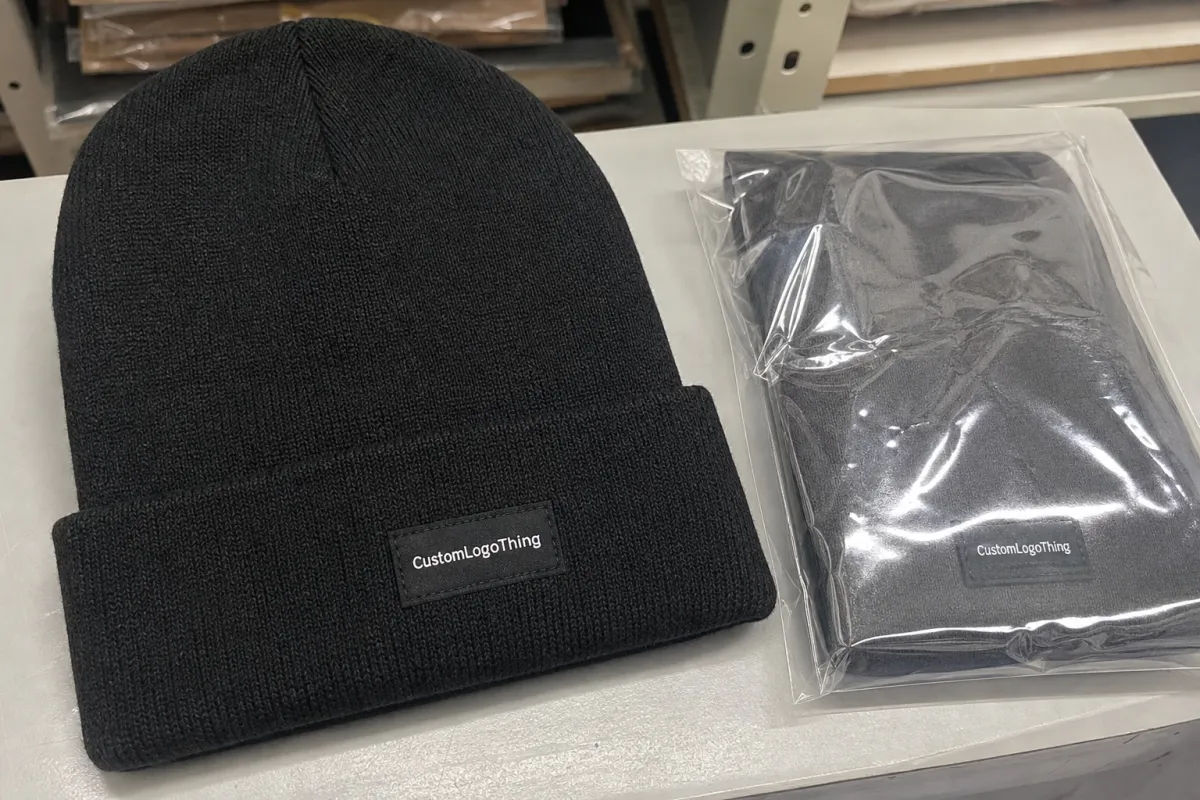
The woven label matters because it does a specific job. It gives the beanie a finished identity without relying on oversized embroidery or a loud graphic. That restraint helps specialty coffee brands, which usually already communicate through packaging, menu boards, roast notes, and service style. A beanie that feels too promotional can cheapen the display. One that is clean, tactile, and well proportioned usually reads as intentional merchandise.
Coffee Roaster Woven Label Beanies That Sell In Store
Most roasters do not buy beanies because they need another item to stock. They buy them because the item lands in the narrow zone between useful and visible. Staff wear them. Customers notice them while waiting. A few customers buy one on impulse because the display looks coherent with the rest of the shop. That overlap is valuable, but only if the product looks like it belongs in the same system as the coffee.
A cuffed knit beanie with a centered woven label tends to perform better than a shape that looks trendy first and merch second. The reason is practical. Structured cuffed styles show the logo clearly, pack neatly, and photograph well. Slouchier fits can work, but they usually require a more relaxed brand identity and more careful color selection. Ultra-thin fashion knits are less reliable for retail because they often lose shape faster and can make the label feel oversized.
There is also a visibility test that buyers tend to underestimate. If the beanie still reads clearly at arm's length and in a quick phone photo, the decoration is probably in the right range. If the logo disappears when the cuff is folded or the knit stretches, the label is either too small, too detailed, or both.
A good retail beanie should survive three conditions without losing its shape: a busy morning behind the bar, a mirror selfie, and a customer folding it back onto a stack.
The selling problem becomes more complex once the order expands beyond one location. A single cafe can tolerate a trial run that is slightly oversized or a colorway that is more experimental. A multi-store drop cannot. Once the order has to support wholesale, trade show inventory, employee uniforms, or bundled gift kits, coffee roaster Woven Label Beanies bulk order planning stops being a design exercise and becomes inventory control.
That shift matters because small accessories move differently than beans or brewing gear. A bag of coffee has a relatively short product life. A beanie can sit through several selling cycles if the fit is right, but only if it does not feel seasonally stale or visually disconnected from the brand. That is why the best beanies usually look like the rest of the roaster's world: understated, durable, and easy to understand fast.
Beanie Bodies, Cuff Styles, and Placement Options
The body of the beanie has more influence on the final result than many first-time buyers expect. Cuffed rib-knit beanies are the most forgiving option because they hold structure well, give the woven label a stable surface, and work across a wide range of head shapes. That stability matters in retail settings where the beanie is handled often and folded repeatedly. A softer knit can look nicer in a product photo, then lose the same shape after a week on the shelf.
Material choice changes the feel and the pricing. Acrylic remains the most common starting point because it is inexpensive, durable, and easy to source in volume. Acrylic-wool blends usually look a little more premium and hold warmth better, but they add cost and can narrow the price gap between a beanie and higher-end apparel. Recycled polyester blends can support a sustainability story, though they require better supplier verification because recycled yarns can vary in hand feel and shade consistency. Cotton-heavy knits are less common for cold-weather retail, but they can make sense in milder climates or staff programs where softness matters more than maximum insulation.
Placement should be decided with the same discipline as the body. Front cuff placement is the most readable and the easiest to photograph. Side-seam placement feels quieter, which can suit brands that prefer a restrained look. Back-cuff placement keeps the front cleaner and may work better for minimal styling. Folded-edge placement can look sharp on low-profile beanies, but only if the label size and the cuff depth are matched carefully.
The label itself needs enough room to breathe. In many bulk orders, a woven label in the range of roughly 35 x 20 mm to 55 x 25 mm is a practical target. Smaller labels may disappear against thick yarn. Larger ones can look pasted on, especially if the logo has a lot of small type. The best outcome usually comes from matching label scale to knit weight and logo complexity rather than forcing one standard size across every product.
Several smaller choices affect the final merchandising result more than buyers expect:
- Fold style: single cuff, double cuff, or relaxed fold changes where the label lands and how much of it stays visible.
- Hangtags: useful for pricing, SKU control, brand story, and barcode application.
- Polybagging: useful for clean presentation, shipping protection, and mixed-channel fulfillment.
- Carton packing: ask for counts per case, color separation, and destination labeling if the order will split across stores.
If matching trim or companion branding is planned across other products, keep the spec language aligned with Custom Labels & Tags. That makes future reorders less messy, especially when the same logo has to be carried across hats, aprons, jackets, and packaged goods.
Coffee Roaster Woven Label Beanies Bulk Order Planning
The first decision in coffee roaster woven label Beanies Bulk Order Planning is not artwork. It is the product structure underneath the artwork. If the blank is weak, the label will not save it. If the knit is too loose, the beanie can sag. If the body is too stiff, it may fit awkwardly and get pushed to the back of the display. Buyers often focus on the logo first because that is the visible part. Production starts elsewhere.
The safest planning path is to define three things before asking for a quote: the beanie body, the label format, and the production purpose. A staff-only run can tolerate slightly different specs than a retail run. A giveaway can tolerate simpler packaging than a front-of-house sales item. A wholesale drop needs more consistent pack-out and carton labeling than either of those. The use case changes the spec more than many buyers realize.
The woven label itself should be designed for durability, not just appearance. It has to survive friction, stretching, and repeated folding. Dense damask-style weaving usually handles fine type better than a loose weave, but even a good weave has limits. Tiny scripts, hairline borders, and intricate line art are where errors start. A safer approach is to simplify artwork, limit color changes, and leave enough open space for the logo to stay legible after production.
Control the details that tend to get overlooked in the first round of quoting:
- PMS references: helpful for brand consistency, though yarn matching can still vary slightly.
- Final dimensions: confirm the actual label size, not only the logo artwork size.
- Placement note: identify front cuff, back cuff, side seam, or folded edge clearly.
- Text limits: avoid micro-copy that will blur once woven into the label.
- Proof format: request an image of the label on the actual beanie body whenever possible.
Quality control should cover more than color. Check how the cuff recovers after stretching. Check whether the label sits flat or puckers at the seam. Check whether the logo is readable in natural light, not just under a monitor. A beanie does not need lab-grade testing to be saleable, but it does need enough verification to show that the label will survive real use, not only an unboxed photo.
There is a sustainability layer too, and it should stay practical. If the order includes hangtags or folded inserts, FSC-certified paper is an easy request. It adds a basic paper-chain reference without complicating the order much. For shipping cartons, transit expectations from organizations such as ISTA are a useful reference point, especially if the order will be handled by parcel networks, warehouses, or multiple store receivers.
One more point that matters more than it sounds like it should: ask how the supplier handles defect thresholds. A vague promise that everything will be "high quality" is not enough. Clear tolerance rules for crooked labels, shade variation, loose stitching, or packing errors tell you much more. Buyers do not need perfection claims. They need a supplier who can explain where the edge of acceptable sits.
Pricing, MOQ, and Unit-Cost Tradeoffs for Bulk Orders
Pricing for woven-label beanies is mostly a function of visible choices and hidden labor. The blank body sets the floor. Label weave complexity adds cost. Thread count, number of label colors, packaging, and finishing all push the price one direction or the other. An unusually low quote is not automatically suspicious, but it is worth checking what the price assumes. Plain polybags, no tags, a simpler label layout, and a large run can make a quote look better than it will land.
MOQ matters because it shapes both risk and margin. A smaller minimum order helps when a roaster is testing demand or outfitting a single cafe. Larger orders improve unit economics, but only if sell-through keeps up. Inventory sitting in storage is not cheap just because it is soft goods. It still takes space, cash, and attention, and it still gets left out of the conversation when people talk only about unit price.
| Order Level | Typical MOQ | Decorated Unit Cost | Best Fit | Main Tradeoff |
|---|---|---|---|---|
| Test Run | 100-150 pieces | $5.90-$8.40 | One cafe, small retail wall, holiday gift set | Less price room, but lower risk |
| Core Drop | 300-500 pieces | $4.40-$6.20 | First broader merch release, multi-location sale | Higher upfront cash outlay |
| Scaled Run | 1,000+ pieces | $3.20-$4.90 | Proven bestseller, wholesale resale, seasonal campaign | Inventory exposure if sell-through slows |
Those ranges are planning figures, not a quote. A beanie with a denser knit, a more complex woven label, individual polybags, or retail-ready hangtags will land higher. A simple blank body, one label color set, and limited packaging usually keeps costs lower. Freight can shift the total more than people expect, especially on smaller runs. Air shipping makes sense for urgent timing, but it can erase part of the margin if the order is thin.
The better pricing question is not just "What does one unit cost?" It is "What does a sellable unit cost after freight, samples, packaging, and spoilage?" A roaster selling through cafes, online bundles, and events may accept a slightly higher unit cost if the item moves quickly. A slower channel needs a tighter landed cost because the margin has to cover storage and markdown risk.
Color strategy matters too. First runs usually perform better when they stay limited to one or two core colors. More color options seem appealing until the inventory splits too far and no single color reaches enough depth on shelf. A focused palette is easier to reorder, easier to restock, and easier to present as part of a consistent merch wall.
Production Steps, Timeline, and Lead Time Checkpoints
The production sequence should stay disciplined: brief, proof, sample approval, bulk production, quality control, packing, and shipment. If the logo is still changing after the supplier has started slotting production, the schedule is already at risk. The fastest runs are rarely the ones with the tightest deadlines. They are the ones with the fewest unresolved decisions.
A realistic planning window for a standard run often looks like this: 24-72 hours for a digital proof, 5-10 business days for a physical sample if one is needed, and about 12-18 business days after final approval for bulk production. Freight timing sits on top of that. Air is quicker and costlier. Ocean is slower and usually better for larger, less urgent runs. A release tied to an event or seasonal launch should build in buffer time instead of assuming the first shipment estimate will hold.
The most common schedule failures are predictable:
- Late artwork changes: even a minor logo adjustment can reset proofing.
- Color revisions: yarn and label matching may require another approval round.
- Fabric shortages: especially on seasonal colors and certain blends.
- Quantity changes: a larger final count can shift the production slot.
- Pack-out changes: adding inserts, tags, or special cartons slows the line.
The cleanest ordering rule is straightforward: lock the spec first, confirm the quantity second, and set the ship date last. That sequence keeps the due date realistic. It also reduces the most annoying kind of delay, which is the one caused by everyone agreeing on the launch date before they have agreed on the product.
For stores receiving split deliveries, specify carton labels and destination splits early. A single bulk order can be easy to manufacture and awkward to receive if the packing instructions are unclear. If the beanies are meant for multiple cafes, direct-to-store boxes need to be labeled in a way that lets staff sort them quickly. Speed on the receiving end matters too.
Repeat programs should be archived properly. Approved spec sheets, artwork files, PMS references, and carton instructions should live in one place. That sounds boring because it is boring, and that is exactly why it works. The second order should not require the same level of reconstruction as the first.
Supplier Proof Points That Reduce Reorder Risk
The quote is only one piece of supplier evaluation. Reorder risk is often revealed by the quality of the answers, not the price. A supplier who can show sample photos, stitch close-ups, color references, and packaging mockups before approval is much easier to trust than one who only wants to move the order forward. The extra checking time is minor compared with correcting a full batch that misses the mark.
Consistency matters more than persuasion. A good supplier can repeat the first run without rebuilding the whole approval chain. That means keeping records clean, version control visible, and substitutions clearly explained. If each answer sounds vague, the risk usually appears later as label drift, color mismatch, or packing confusion. None of those problems are dramatic in isolation. Together, they turn a simple merch order into a labor sink.
Labor is the hidden cost here. A beanie that arrives clean, neatly packed, and correctly labeled saves staff time at the shop, at the warehouse, and at the point of sale. A product that needs repacking or relabeling does the opposite. The difference is not just cosmetic. It affects how easily the item reaches the shelf and how likely it is to stay there in sellable condition.
Wholesale terms also deserve attention if the beanies are likely to be reordered or split across channels. A supplier that supports repeat artwork use, split shipments, and color-based replenishment makes the next run easier to manage. If the business model includes resale or store-by-store distribution, those capabilities matter as much as the first production sample.
Ask how defects are handled. Ask what the tolerance is for crooked labels, off-color yarn, loose stitching, and packing errors. Good suppliers know their thresholds and can describe them clearly. That answer is more useful than a blanket promise of quality because it tells you how the order will be handled when something small goes wrong.
Next Steps for a Fast, Accurate Bulk Order
A clean brief keeps the quote accurate. Start with the beanie body, then the label placement, then the quantity split by color or destination. After that, define the use case clearly: retail, staff wear, gifting, or a combination. Those decisions reduce back-and-forth more than almost anything else in the process.
Before requesting pricing, gather the details that affect both cost and timing:
- Logo files: vector artwork is still the safest starting point.
- PMS colors: include them if brand color accuracy matters.
- Shipping destinations: especially if the order splits across cafes or warehouses.
- Target in-store date: so production can be scheduled backward from reality.
- Packaging needs: polybags, hangtags, carton labels, or insert cards.
Approve a sample or digital proof before bulk production begins, especially if the label uses fine type or a detailed mark. That small step protects the budget. It also protects the launch date, which is often harder to recover than the money if the first batch arrives late or off-spec.
For this category, the smartest order planning is disciplined rather than flashy. Keep the design readable. Match the material to the season and the audience. Size the quantity to actual sell-through instead of optimism. Leave enough time for proofing and transit. Those choices are not glamorous, but they are the difference between a beanie that quietly supports the brand and one that becomes a clearance problem.
How many coffee roaster woven label beanies should I order for a first run?
Start with the smallest quantity that still covers staff wear, retail display, and a realistic test of demand. If the beanies are for resale, leave room for a replenishment run so the second order is not rushed.
What beanie style works best for coffee roaster woven label merch?
Cuffed rib-knit beanies usually give the cleanest label placement and the most reliable retail presentation. Slouch and low-profile styles can work, but they are better reserved for brands that want a softer, less structured look.
Can woven labels hold up to daily wear and washing?
Yes, if the weave density, edge finish, and stitching are specified well during sampling. Ask for close-up proof of the border and seam area so the label stays readable after repeated wear.
How do I keep coffee roaster woven label beanies bulk order pricing under control?
Keep the label design simple, limit packaging upgrades, and focus the first run on one or two core colors. Compare the landed cost, not just the unit cost, because freight and packaging can change the final number quickly.
What should I approve before production starts on a woven-label beanie order?
Approve the artwork, label size, placement, beanie color, and quantity split before bulk production begins. Request a proof that shows the label on the actual beanie body rather than the label by itself.
Good merch planning in coffee is usually the quiet kind. The order is spec'd clearly, the timeline is realistic, the label is readable, and the cartons arrive in a way the store can actually use. That is enough to turn a small accessory into a dependable brand piece.