Coffee roaster Woven Label Beanies unit cost review sounds narrow until you are pricing a product that has to look retail-ready, feel good after repeated wear, and still leave room for margin once packaging and freight are added. The woven label is tiny. The effect is not. On a knit beanie, that patch often decides whether the hat reads like real merch or a throwaway promo item.
That is why coffee roasters keep coming back to woven labels. They hold detail better than ink-heavy decoration on a stretchy surface, they look sharper at small scale, and they make the garment feel finished instead of improvised. If the hat sits near the register, ships in a subscription box, or gets bundled with beans for a holiday sale, the branding has to justify the price quickly. A good label helps. A weak one exposes the rest of the product.
The business case is simpler than the language around it. A small branding upgrade can support a stronger shelf price, cleaner presentation, and fewer objections from buyers who expect coffee merch to look intentional. That only works if the body, knit, label size, and pack-out all match the intended sales channel. A polished mockup will not fix a poor build.
Beanie Body Choices, Cuff Styles, and Label Placement
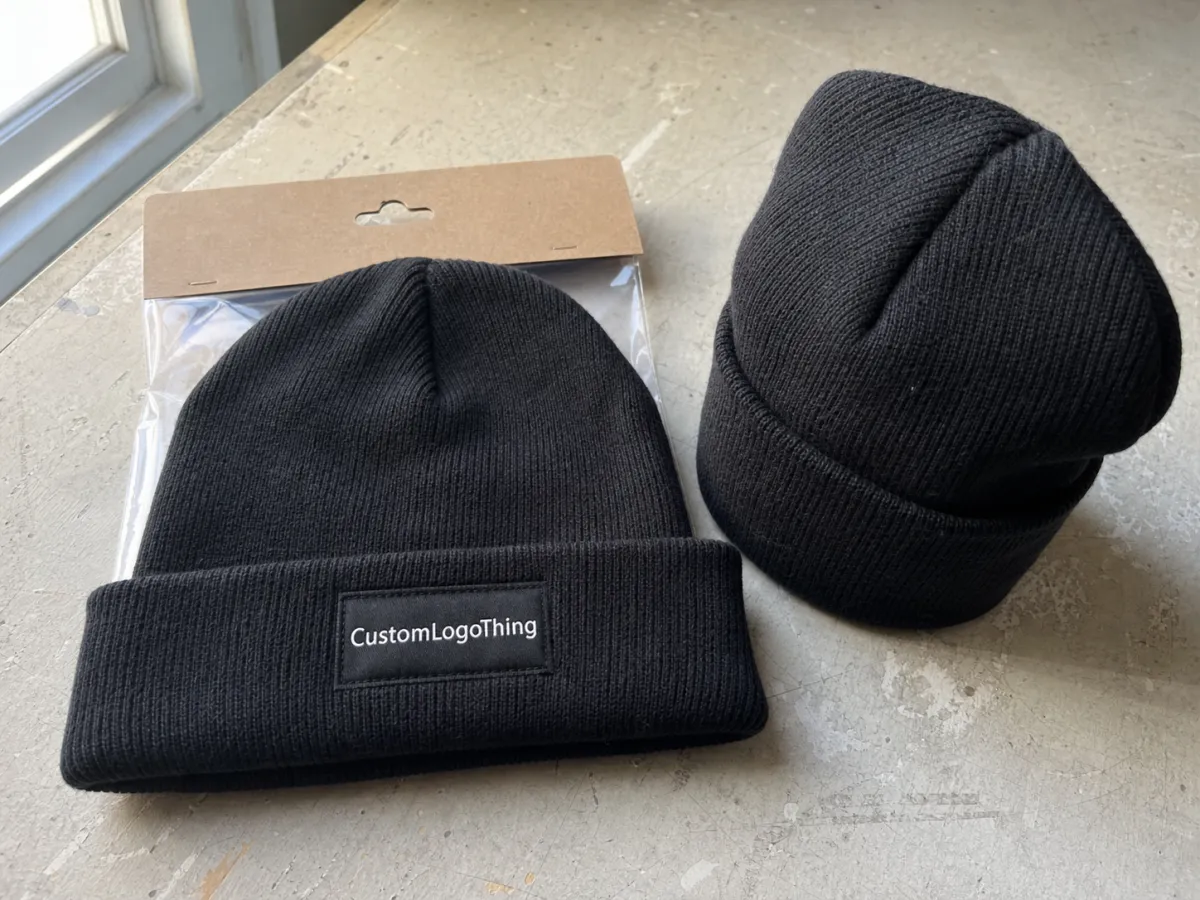
The body of the beanie matters more than most first-time buyers expect. A woven label can improve presentation, but it cannot rescue a thin knit or a beanie that loses shape after two wears. Common bodies include acrylic, acrylic-wool blends, recycled yarn, and heavier rib-knit constructions. Acrylic usually gives the lowest entry price and broad color availability. Acrylic-wool blends cost more, but they generally feel closer to retail. Recycled yarn can strengthen the brand story, though the buyer still needs to check hand feel, stretch recovery, and color consistency before ordering in volume.
Cuff style changes how the branding reads. A center cuff gives the most direct retail look and usually photographs best. A side cuff is quieter and often works better for staff wear. A back cuff can make sense when the front is already carrying another graphic element, but it is rarely the strongest choice for shelf visibility. Sewn edge tags are useful when the goal is subtle branding, though they do not carry the same visual weight as a front-center woven label.
Placement should follow the sales job, not the mood board. Cafe retail usually benefits from a centered mark because the logo needs to read instantly from across a counter. Staff use favors comfort and repeatability, which can make a side placement feel cleaner. Event giveaways need a simple layout because people will pull the hat on and off all day. If the logo needs to stay legible while the cuff stretches, the label dimensions need to be sized for wear, not for a flat mockup. In practice, that often means something around 40 x 15 mm to 50 x 20 mm, depending on knit density and cuff height.
- Center cuff: strongest visibility, best for retail and display.
- Side cuff: quieter look, useful for staff wear or premium merch.
- Back cuff: works when the front already carries another graphic treatment.
- Sewn edge tag: subtle branding for minimal layouts and low-profile finishes.
Cuff height matters too. A taller cuff gives more room for the label and tends to hold the patch flatter. A short cuff can twist or bunch if the knit is loose. Stitch density matters in the same way. A tighter knit keeps the surface cleaner and reduces the chance that the label looks like it is floating on top of a sloppy base. That is not a dramatic point. It is just how the garment behaves once it leaves the sample table.
The best comparison is not digital; it is physical. A mockup can make almost any placement look balanced. A worn sample shows whether the cuff twists, whether the label buckles, and whether the logo still reads after the knit is stretched. That is the difference between a hat that photographs well and a hat People Actually Keep in rotation.
Specs That Protect the Design: Yarn, Stitch, Color, and Finish
A proper quote starts with specs, not assumptions. Ask for the gauge, cuff depth, label size, weave count, attachment method, and color references before anyone starts pricing. If the supplier cannot explain how those choices affect unit cost, the quote is probably shallow and will grow teeth later.
The easiest cost lever is color count. Fewer label colors usually mean less risk, cleaner readability, and lower production complexity. On a small woven patch, too many shades can turn the logo into thread noise. Most coffee roasters do best with one to three label colors, especially if the beanie body is already dark or textured. A simple mark reads better across a cafe floor and holds up better on a crowded retail wall.
The fabric spec matters just as much. For coffee merch, the practical details are anti-pilling yarn, soft hand feel, stable cuff folding, and consistent stitching from piece to piece. If the beanie pills after a few wears, the brand looks older than it is. If the cuff twists, the label stops sitting square. If the weave is inconsistent, the whole run starts looking like a mixed lot even when it came from the same order.
Color accuracy is where many buyers overestimate what a proof can solve. Coffee brands often use nuanced shades such as roast brown, crema, oat, charcoal, and muted green. Those tones can go muddy quickly on knit goods. Thread and yarn do not behave like ink. A digital proof helps, but it does not replace a production sample if the palette is specific. If the label has to match a bean bag, tote, or hangtag, the match should be reviewed before approval, not after the run is complete.
Vector artwork is still the safest file type. Fine gradients, tiny type, and thin lines can disappear once they are translated into woven construction. A simpler logo usually survives better than a detailed one, especially on a small patch. For supporting materials, paper and tag stock should be chosen with the same discipline. FSC-certified paper is a sensible benchmark for inserts and hangtags: FSC. It does not improve the knit itself, but it keeps the presentation consistent with the standards many coffee brands already apply to their packaging.
Attachment method affects both the look and the durability. A sewn-on woven label is the most common choice because it stays flat and handles stretch well. Edge-sewn patch styles are good when the goal is a cleaner seam line. Adhesive or print-on solutions can be cheaper, but they rarely age as well on a beanie that gets pulled, folded, and washed. Small savings disappear fast if the branding lifts or distorts after a few uses.
Unit Cost, Pricing, and MOQ for Bulk Beanie Orders
The unit cost is not just the hat. It includes the blank body, the woven label, attachment labor, packaging, freight, and any setup charges required to start production. With custom woven labels, there may also be loom or tooling fees if the size, weave density, or shape is outside the supplier’s standard spec. That fee does not always look large, but it matters more on a 100-piece run than on a 1,000-piece run.
The biggest cost drivers are predictable: body quality, label size, color count, placement complexity, and pack-out requirements. A stock acrylic beanie with one sewn label is one budget lane. A heavier rib-knit body with a multi-color woven patch, individual polybagging, and rush freight is a different lane entirely. Same category. Different math. Buyers often focus on the decoration and forget that the body itself may be the bigger price swing.
| Order size | Typical build | Estimated tooling/setup | Estimated unit cost | Best fit |
|---|---|---|---|---|
| 100 pieces | Stock acrylic body, 1 woven label, simple pack-out | $45-$120 total | $6.50-$10.50 | Small launches, staff issue, pilot merch |
| 300 pieces | Acrylic or acrylic-wool blend, 1 label, standard cuff placement | $45-$120 total | $4.25-$7.20 | Cafe retail, seasonal bundles, event sales |
| 1,000 pieces | Standard or recycled yarn body, 1-2 labels, bulk pack | $45-$120 total | $2.95-$5.10 | Multi-location roasters, larger retail programs |
These numbers are planning ranges, not promises. The point is to see how the price curve behaves as quantity rises. The tooling fee does not vanish; it gets spread over more units. That is why a low MOQ can still be the right move for a first run, even when the per-piece price is higher. If the goal is to test demand or support a small launch window, a short run is defensible. If the hat already has a clear sales path, bigger volume usually improves the economics faster than another round of design tweaks.
Smaller runs are possible, but they are not free of tradeoffs. A 75-piece order can work for a staff issue or a local event, yet the setup charges remain. Add rush timing, mixed body colors, special yarn choices, or individual polybagging and the unit cost climbs quickly. Pack-out is one of the most ignored cost centers in branded apparel. It is not glamorous, but neither is paying extra because the order was not planned around the real production steps.
Cross-border orders can widen the gap between quoted unit cost and landed cost. Freight, duties, and local taxes are separate line items, and they become more visible as quantity drops. A supplier quote that looks attractive at the factory floor can look different once cartons are moving. For coffee roasters that ship to multiple cafes or directly to customers, carton performance also matters. Transit testing methods from the International Safe Transit Association are worth knowing when the order is built for distribution rather than for a single store shelf: ISTA.
A practical MOQ for coffee roaster Woven Label Beanies often lands around 100 to 300 pieces for stock-body programs. Fully custom knit bodies usually push higher because more of the garment is being controlled from scratch. A tiered quote at 100, 300, and 1,000 units gives a clearer view of the break points. That comparison shows where the cost per piece drops enough to support a retail margin and where it is still too heavy for the sales plan.
Production Steps, Lead Time, and Turnaround From Proof to Ship
The production path is simple on paper, but every step can slow down if the buyer is casual about approvals. The usual sequence is artwork review, woven label proofing, knit production, label attachment, inspection, packing, and dispatch. If a supplier wants to skip the proof stage and move straight into production, that is not speed. That is a way to pay for preventable mistakes twice.
The delays are familiar. Missing vector files are common. Late color changes are common. Slow approval is the most expensive of all because the factory cannot move until someone signs off on the proof. Freight congestion also shows up near peak season, especially when the beanies are tied to holiday drops, pop-ups, or subscription box deadlines. A short production run can still miss a launch if the calendar is handled loosely.
A realistic turnaround for standard orders is often a few weeks after proof approval, with shipping time added on top. Rush jobs may be possible, but the cost usually reflects the schedule pressure. Separate production time from transit time in the calendar. That distinction sounds basic until a buyer quotes the delivery date as if the product magically starts moving the moment the invoice is sent. It never does.
Approval timing matters more than most people think. Once the label art and body color are locked, the rest of the process is mostly mechanical. Before that, every revision resets the clock. If the order is tied to a holiday campaign or a cafe opening, the approval step needs the same urgency as the launch itself. A three-week production window is not very helpful if the proof sits untouched for four days.
A supplier worth listening to will tell you exactly what they still need: file format, placement confirmation, color approval, pack-out choice, and whether the order should ship in bulk cartons or retail-ready units. Those details control both lead time and final pricing. They also reveal whether the quote is being built with the actual use case in mind or just copied from a stock template.
What Coffee Roasters Should Expect From a Packaging-First Supplier
A packaging-first supplier thinks in systems, not isolated SKUs. That matters because coffee merch rarely lives alone. The beanie sits next to bean bags, mugs, shelf talkers, inserts, and maybe a printed postcard. When one supplier understands the whole presentation, the quote scope gets cleaner and the brand looks less stitched together.
The practical advantage shows up in the details. A good supplier spots artwork issues earlier, gives clearer placement guidance, and keeps repeat runs consistent. If a roaster reorders the same beanie for baristas, pop-ups, and retail shelves, the second run should look like the first. No mystery color drift. No label creeping upward on the cuff. No vague promise that “close enough” will pass in person.
Quality control is easy to describe and annoying to skip. Check label alignment. Check stitch quality. Check color variance. Check packing accuracy. If the order includes mixed sizes or multiple body colors, verify that counts are separated correctly. On a wearable product, a small alignment error is visible every time the hat is worn. That is why the sample should be inspected flat and on-head. Knit goods change shape under tension, and the problem often appears only after someone stretches the cuff.
Packaging can either reinforce the value of the beanie or undercut it. Hangtags, belly bands, and folded inserts should feel like they belong to the same product, not like they were selected from three separate jobs. A cheap insert can drag down a good garment. A clean presentation can do the opposite. The goal is not to make the order complicated. It is to keep every visible element speaking the same language.
For roasters that already care about sourcing, the most useful supplier is the one that can talk honestly about yarn choice, carton efficiency, and repeat-run consistency without overselling the role of any one feature. The quote should also make clear which extras affect bulk pricing and which ones are mostly cosmetic. No one likes a surprise markup after a sample looks good. That is not craftsmanship. That is poor cost transparency.
Next Steps to Quote Coffee Roaster Woven Label Beanies
A useful quote starts with a usable brief. Send the logo file, beanie color, label placement, target quantity, and delivery deadline. If the hat is meant to sell rather than simply be given away, say that as well. It changes the body recommendation more often than buyers expect because retail and giveaway products do not need the same construction.
- Send the artwork: vector files are best, and brand colors should be included with clear naming.
- Choose the body: compare at least two colors and two knit styles before locking the build.
- Pick the placement: center cuff and side cuff usually show the clearest tradeoff.
- Ask for tiers: request pricing at low, mid, and higher quantities so the break point is visible.
- Confirm pack-out: bulk carton, polybag, or retail-ready finish all change the final number.
Comparing two body colors, two placement options, and two quantity levels keeps the discussion grounded in margin instead of guesswork. It also shows whether the hat is built for shelf appeal, staff wear, or a seasonal drop that needs a cleaner presentation. The right choice is rarely the one that looks best in isolation. It is the one that survives the sales plan.
A pre-production proof protects color and placement. A landed-cost estimate protects the budget. Those two checks usually tell you more than a stack of glossy sample images ever will. If the proof looks off, fix it before production starts. If the landed cost is too high, simplify the body or trim the pack-out before the order turns into a sunk-cost argument.
The most reliable beanie run is the one that fits the sales goal. If the margin is tight, keep the body simple and the label clean. If the product is part of a premium bundle, spend a little more on the knit and presentation so the price makes sense on the shelf. A good coffee roaster woven label beanies Unit Cost Review ends with a number that supports the business, not a surprise that has to be explained away later.
What is the MOQ for coffee roaster woven label beanies?
Most custom runs make the most sense around 100 to 300 pieces, but the right MOQ depends on body style, label size, and color count. Smaller runs are possible, though setup charges get spread across fewer units, so the unit price climbs quickly. A tiered quote is the clearest way to see where the break point sits.
How much does a woven label change the unit cost?
A woven label adds cost for the label itself plus attachment labor. Larger labels, extra colors, and more complex placement raise the price more than the label material does. Even with that added cost, a woven label often delivers a stronger retail look than heavier decoration methods on a knit surface.
What artwork files do you need for a coffee roastery logo?
Vector artwork is best: AI, EPS, PDF, or SVG with clean outlines and no low-resolution effects. If only a raster file is available, the highest-resolution version should be sent so it can be redrawn correctly. Include brand colors, preferred placement, and any text that must stay readable at woven-label size.
What is the usual lead time after proof approval?
Standard production usually runs in a few weeks after proof approval, then shipping time is added on top. Rush orders may be possible, but they depend on inventory, schedule load, and freight speed. Fast approval is the easiest way to keep the schedule from slipping.
Can you match coffee brand colors on the label and hat?
Yes, within the limits of yarn availability and woven construction, but exact matches should be checked with a proof. High-contrast colors usually read better than subtle near-matches on a small woven label. If the palette is very specific, a close-match review should happen before production starts.
A strong quote is usually the result of clear specs, realistic quantity planning, and a supplier that explains what each option does to the cost per piece. When those pieces are in place, the hat is easier to price, easier to sell, and less likely to come back with avoidable surprises. That is the real advantage of getting the details right before the order moves forward.


