Buyer Fit Snapshot
| Best fit | Compostable Poly Mailers with Logo projects where brand print, material claims, artwork control, MOQ, and repeat-order consistency need to be specified before quoting. |
|---|---|
| Quote inputs | Share finished size, material target, print colors, finish, packing count, annual reorder estimate, ship-to region, and any compliance wording. |
| Proofing check | Approve dieline scale, logo placement, barcode or warning zones, color tolerance, closure strength, and carton packing before bulk production. |
| Main risk | Vague material claims, crowded artwork, missing packing details, or unclear freight terms can make a low unit price expensive after revisions. |
Fast answer: Compostable Poly Mailers with Logo: Film, Print, MOQ, and Carton Packing should be specified like a repeatable production item. The safest quote records material, print method, finish, artwork proof, packing count, and reorder notes in one written spec.
Production checks before approval
Compare the actual filled-product size with the drawing, then confirm tolerance on folds, seals, hang holes, label areas, and retail display edges. Reserve space for logos, QR codes, warning copy, and material claims before decorative graphics fill the panel.
Quote comparison points
Review material grade, print process, finish, sampling route, tooling charges, carton quantity, and freight assumptions side by side. A quote is only useful when the supplier can repeat the same color, closure quality, and packing count on the next order.
Compostable Poly Mailers With Logo: Smart Packaging
Compostable Poly Mailers With Logo sound like a simple sourcing decision. They are not. They sit right in the messy overlap of brand identity, shipping performance, and sustainability claims. Miss one detail and the whole setup starts to wobble. The print can look great, the seal can fail, or the compostability claim can turn into a customer-service headache nobody planned for. Fun stuff.
For e-commerce brands that want to cut waste without making packaging feel like an afterthought, the appeal makes sense. Plain mailers vanish into the background. Branded compostable mailers do two jobs at once: they protect soft goods and signal that the brand paid attention. Customers notice that, even if they never say it out loud.
There is a practical side too. Compostable poly mailers with logo affect artwork setup, minimum order quantities, storage conditions, and how customers understand disposal. Some teams want a cleaner sustainability story. Others want packaging that does not scream cheap plastic. Both goals are valid. Neither one is free.
I keep seeing the same pattern: the buyer cares about price, the designer cares about print, and fulfillment cares about whether the thing seals before the packing table gets backed up. All three are right. The mailer has to survive the warehouse, look intentional on the doorstep, and come with documentation that stands up when somebody asks a pointed question about the material.
"A compostable claim only matters if the supplier can prove it, the warehouse can use it, and the package survives the last mile."
Why Compostable Poly Mailers With Logo Are Getting Attention
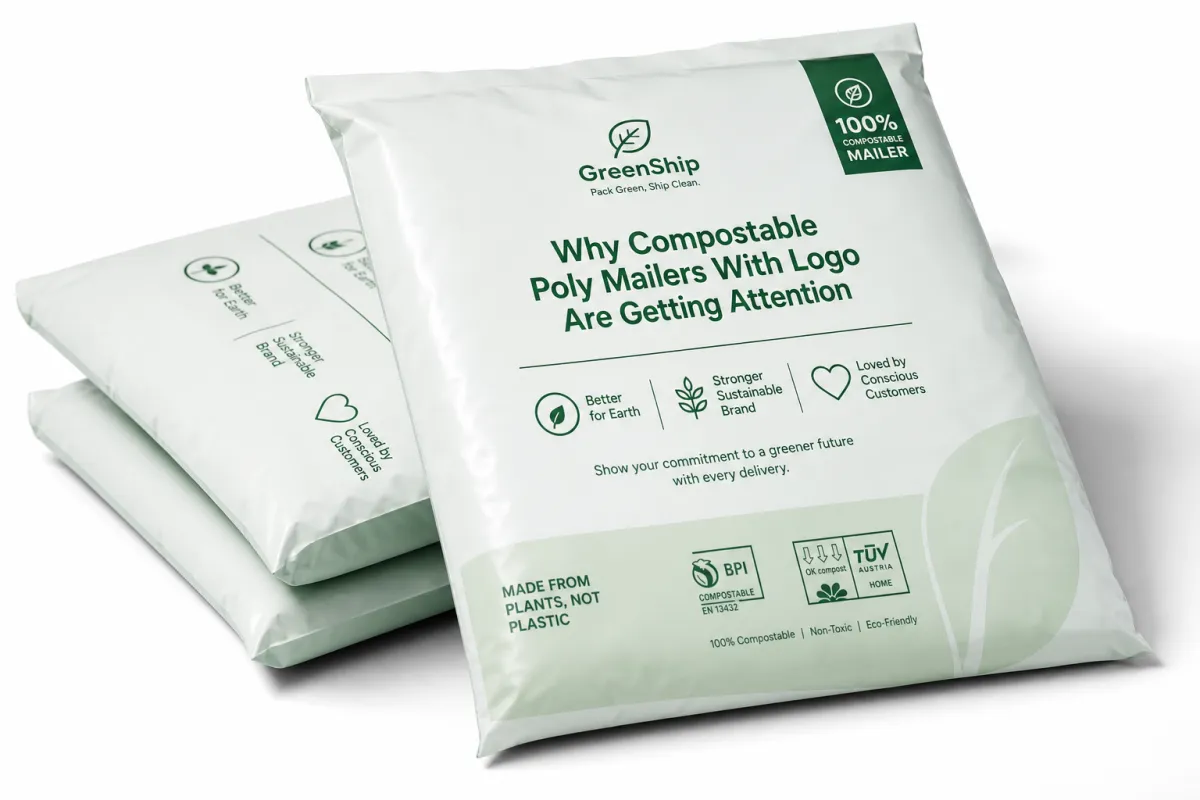
Compostable poly mailers with logo are getting attention because they hit a useful middle ground. Apparel, accessories, subscription kits, and other lightweight goods usually do not need a corrugated box. A mailer packs faster, ships lighter, and takes up less room in storage. Add a logo and the package stops looking disposable in the wrong way. Use compostable material and it starts carrying part of the brand story instead of fighting it.
That story matters more now. Buyers ask sharper questions. Customers do too. Brands choosing compostable poly mailers with logo are often trying to close the gap between what their website says and what lands in the customer’s hands. If the brand talks about responsible sourcing, the shipping bag should not look like a leftover from a warehouse clearance bin. That mismatch is hard to unsee once you notice it.
From a packaging buyer’s point of view, the decision is not only about sustainability. It is also about positioning. A plain mailer says “ship it.” A branded mailer says “we planned this.” A compostable version says “we planned this and thought about disposal too.” That can help a premium brand feel more credible, but only if the claim is real and the print is clean.
The tradeoff is simple enough: compostable poly mailers with logo can demand more attention than standard poly mailers. Print coverage may need to be simpler. Minimums may be higher. Certain films behave differently in heat, humidity, and storage. Buy on price alone and the savings can disappear fast through spoilage, reorders, or a package that feels flimsy in the hand. I have seen brands try to save a few cents and then pay for it three times over in rework. Not exactly a brilliant plan.
The better approach is to treat the mailer as part of the product experience. For a lot of brands, compostable poly mailers with logo are not a nice extra. They are how the packaging stays honest with the rest of the brand.
What Compostable Poly Mailers With Logo Actually Are
Compostable poly mailers with logo are lightweight shipping mailers made for things like apparel, socks, accessories, and flat textile goods. They are printed with a brand mark, message, or pattern, and they are built from materials intended to break down under composting conditions. In plain English, they replace a conventional plastic mailer with a material system designed for a different end-of-life path.
That is where people get sloppy with language. Compostable is not the same as biodegradable, and neither one automatically means recyclable. A mailer can look and feel like plastic while still being engineered very differently. Appearance tells you almost nothing by itself. A white film or opaque film is not proof of anything. Paperwork is.
Construction matters. Thickness affects puncture resistance and hand feel. Seal type affects tamper resistance and package integrity. Film layers affect print quality and how the mailer behaves in transit. Some compostable poly mailers with logo use blends like PLA and PBAT with starch-based components. Others use layered structures tuned for strength, shelf life, and composting performance. There is no single recipe that fits every brand, and anyone selling one should probably be a little suspicious of their own pitch.
Buyers should ask which standard the product is designed to meet. Common references include ASTM D6400 and EN 13432, plus third-party certifications such as BPI or TUV OK compost where applicable. If the supplier cannot explain the claim in concrete terms, the claim is too vague. Same goes for the copy printed on the bag. If the mailer says compostable, the documentation should say the same thing without side-stepping or vague optimism.
Compared with standard poly mailers, compostable poly mailers with logo usually feel more deliberate. They may cost more per unit. They may have tighter storage limits. They still help close the gap between a brand that talks about eco-friendly packaging and a brand that actually ships it.
That difference is not cosmetic. It changes how the package is received, both physically and mentally. Customers may not know the ASTM code on sight, but they can tell the difference between packaging that was selected on purpose and packaging that was chosen because it was cheap and available on a Tuesday.
How Compostable Poly Mailers With Logo Break Down
Compostable poly mailers with logo only deliver on the promise if the end-of-life path is real. The material needs heat, moisture, oxygen, and microbial activity to break down at a predictable pace. For many products, that means industrial composting rather than backyard composting. Those are not the same thing, and pretending they are is how brands end up making messy claims.
The EPA's composting guidance is a useful baseline for understanding why the environment matters; you can review it through EPA composting guidance. The plain takeaway is this: compostable does not mean “disappears anywhere.” It means the material is meant to break down under a specific composting system. If the customer does not have access to that system, the claim loses a lot of practical value.
That is why disposal education matters. A polished logo cannot carry the load by itself. Inks, adhesives, and seals all need to fit the compostable design. One incompatible layer can drag the whole package down. The mailer is only as compostable as the weakest piece attached to it. Packaging people love to talk about the film and then forget the glue, which is kind of the whole problem.
Storage before shipping matters too. Hot warehouses can affect seal performance. Humidity can change how films behave. Long storage can create problems if the material was not chosen for the climate the brand actually uses. This is why pilot testing is worth the time. Compostable poly mailers with logo should be tested in the same conditions they will see in real fulfillment, not in a perfect showroom fantasy that exists only in a sales deck.
Industrial composting and home composting get mixed up all the time. Industrial systems run hotter and more consistently, so they can process materials much faster. Home composting is cooler, slower, and often not suited to thicker films. If the supplier says the mailer is only compostable in industrial facilities, that is not a flaw. It is a condition. Buyers Need to Know that before marketing the product like everything will magically disappear in a backyard bin.
For brands that track carbon footprint, end-of-life is part of the story, not a footnote. Compostable poly mailers with logo can support a stronger environmental position, but only if the claim, the test method, and the customer instructions line up cleanly. If they do not, the packaging is just dressed-up confusion.
What Drives Cost and Pricing for Custom Orders
Compostable poly mailers with logo are priced by size, material structure, print complexity, and order volume. The common mistake is to stare at the unit price and stop there. That number is only a slice of the actual spend. Setup charges, freight, proofing, artwork changes, and minimum order quantities can move the budget more than the listed per-piece cost.
Size is the first lever. A 9 x 12 mailer does not cost the same as a 14 x 19 version because material use climbs fast as dimensions grow. Thickness comes next. A lighter film can cost less, but it may feel less durable and require tighter pack-out control. Print coverage matters too. A one-color logo on one side is far simpler than full-bleed artwork on both sides.
Volume changes the math again. Small runs carry a higher unit price because setup, tooling, and proofing are spread across fewer pieces. Larger runs improve unit economics, but they also tie up more cash in inventory. For a brand still testing demand, that tradeoff can matter more than shaving a penny off the quote.
Setup costs are easy to miss. Some suppliers charge for artwork prep or plate creation. Others roll those costs into the quote. Ask directly. If the mailer uses flexographic printing, plates can create a meaningful upfront cost, especially with multiple colors. Digital printing can reduce setup friction on smaller runs, but the unit price may rise. The right method depends on run size and artwork. No magic trick here, just tradeoffs wearing different shoes.
Ask for landed cost, not just unit cost. Freight, cartons, storage, and sometimes duty can change the real spend. A quote that looks cheaper on paper can turn into the expensive one once the shipment lands and the invoice stops pretending to be polite.
| Order Scenario | Typical Quantity | Unit Price Range | Setup Notes | Best Fit |
|---|---|---|---|---|
| Short-run digital print | 500-2,000 pieces | $0.32-$0.55 | Lower setup, faster artwork changes | Launches, seasonal drops, demand testing |
| Standard flexo one-color | 5,000 pieces | $0.18-$0.28 | Plate or tooling cost may apply | Core SKUs with steady volume |
| Multi-color branded run | 20,000 pieces | $0.10-$0.18 | More press time and proofing | Established brands with repeat reorders |
| High-volume custom program | 50,000+ pieces | $0.08-$0.16 | Best unit economics, higher upfront cash use | National programs, repeat fulfillment |
That table gives you a shape, not a promise. Compostable poly mailers with logo can move outside those ranges depending on certification needs, film composition, logo coverage, and shipping origin. Still, it is better than pretending every quote dropped from the sky. It did not. It is a stack of tradeoffs with a logo on top.
If you want to compare packaging formats, it helps to look at the broader range of options on Custom Packaging Products and benchmark against Custom Poly Mailers so you can see where compostable film sits relative to conventional mailers in cost and finish.
Step-by-Step: Ordering, Proofing, and Production Timeline
Compostable poly mailers with logo move through a predictable process, but the timeline can stretch if artwork is not ready or if the supplier needs to verify material specs. The fastest projects are the ones where the buyer shows up with exact dimensions, clean files, and a realistic quantity target. The slow ones usually get stuck in logo revisions and panel-placement debates that never should have existed in the first place.
Here is the sequence most teams follow:
- Quote request: Share size, quantity, print colors, brand files, and any certification requirement. If you need compostability proof, say that up front.
- Artwork submission: Send vector files where possible. A clean AI, EPS, or PDF file usually beats a low-resolution PNG without effort.
- Proof review: Check logo size, panel placement, colors, barcode or legal copy, and bleed. This is the cheapest stage for fixing mistakes.
- Approval: Confirm the final proof in writing. Once approval lands, production can start.
- Production: Standard runs often take about 12-15 business days after approval, though that shifts with order size and print method.
- Shipping: Transit can take a few days domestically or longer if freight moves by sea or if the order ships from overseas.
Samples are worth the effort. A physical sample tells you more than a PDF proof ever will. It shows how the mailer feels, whether the seal is strong enough, whether the print sits where it should, and whether the dimensions work with your fulfillment workflow. For compostable poly mailers with logo, that matters because the material often feels a little different from conventional plastic film.
Suppliers who know what they are doing will often suggest a pilot run or a pre-production sample. That is not stalling. That is insurance. If you ship apparel in bulk, even a half-inch error or a weak seal can turn into a pile of rework at the packing table. A sample catches that before the launch order becomes a warehouse drama.
For shipping validation, packaging teams often use ISTA methods or similar distribution tests to see how a package behaves under handling, drop stress, and vibration. The point is not paperwork for its own sake. The point is avoiding the very expensive moment when your first big run proves something you did not want to learn.
Some steps can move faster. Artwork can be ready fast. Dimensions can be confirmed fast. Compliance language can be gathered fast. Cure time, press setup, and freight transit do not care about optimism. Compostable poly mailers with logo reward teams that plan ahead and punish teams that try to rush every packaging item like it is a disposable text message.
Common Mistakes That Undermine Compostable Packaging
Compostable poly mailers with logo can look polished on paper and still fail in the field if the basics are ignored. The biggest issue is vague sustainability language. If the supplier cannot explain the exact certification, standard, or disposal condition, the claim is too soft to use with confidence. “Eco-friendly” is not a specification. It is a slogan until someone attaches proof to it.
Artwork mistakes show up next. Compostable films can print well, but they are less forgiving than some buyers expect. Low-resolution logos, thin fonts, and weak contrast can disappear on natural or opaque backgrounds. If the brand wants a premium look, the artwork should be simplified, not stuffed with extra decoration because someone thought more detail automatically meant more value. It usually means more noise.
Size errors are expensive. Too large, and the package wastes material while looking sloppy. Too small, and the seal strains or the product becomes awkward to insert. The mailer needs to match the product and the packing motion. That sounds basic. It is also where a lot of launches break down in the first week.
Storage and compliance mistakes can hurt just as much. A compostable mailer may need to stay away from heat and direct sunlight. Some brands forget to brief the fulfillment team on handling conditions, then act surprised when seals fail in the warehouse. Others print the claim on the bag and never teach customers how to dispose of it. That leaves the message hanging there like a half-finished apology.
Price-only buying is another trap. The cheapest option may have weak seals, blurry print, higher defect rates, or slow lead times. That can cost more than paying a little extra for a better spec. Compostable poly mailers with logo are one of those categories where the cheapest quote is usually the most expensive mistake in disguise.
Here is the short version:
- Do not overstate compostability.
- Do not use weak artwork files.
- Do not choose the wrong size.
- Do not skip sample testing.
- Do not compare quotes without freight and setup.
Every one of those mistakes is avoidable. The catch is that the packaging team has to treat the mailer like a real production item, not a promotional prop with a sustainability label slapped on top.
Expert Tips for Better Branding and Fewer Surprises
Compostable poly mailers with logo look stronger when the branding is disciplined. A clean one-color or two-color graphic usually prints better than a complicated image. It also lowers press complexity and reduces the chance of color drift. If the logo can stand on its own, let it do the work. Not every mailer needs to carry an entire campaign on its back.
Color choice matters more than many teams want to admit. Earth tones, black, white, and muted accent colors often feel more natural on compostable films than bright neon shades. That is not a hard rule. It is a practical one. A good designer will match the finish and tone to the rest of the unboxing experience so the package feels intentional instead of stitched together from three different moods.
Request physical samples before you commit. Then test them in your own workflow. Run them through the packing line. Check how they stack in cartons. See whether the seal closes reliably at your normal pace. Compostable poly mailers with logo should make fulfillment easier, not force the team to work around a fragile format. If they feel flimsy, they probably are. Trust the hand test more than the sales pitch.
Think about the customer too. A brand can be technically correct and still confuse people. If the mailer is compostable only in industrial facilities, say that plainly. If a label needs to be removed before disposal, say that. Good packaging does not leave people guessing and then blame them for guessing wrong.
Inventory planning deserves real attention. Branded mailers can go stale fast if a logo, product line, or campaign changes. Ordering 100,000 pieces might look efficient on a spreadsheet, but it can leave you sitting on dead stock if the brand refreshes six months later. Smaller pilot quantities are often smarter for newer lines or seasonal programs.
There is a broader business point here. Eco-friendly packaging is easiest to defend when it fits the product mix. Compostable poly mailers with logo make sense for soft goods and lightweight kits. They are not the answer for every shipment, and they do not need to be. The smart buyer knows where the material fits and where another structure would do a better job.
Five moves tend to reduce headaches:
- Keep artwork simple and high contrast.
- Match size tightly to the product.
- Test seals under real fulfillment speed.
- Align disposal language with the actual certification.
- Buy to forecast, not to wishful thinking.
That is the difference between a mailer that feels branded and one that actually works as a system. Compostable poly mailers with logo should be tested like packaging equipment, not approved like a social media asset.
Next Steps for Compostable Poly Mailers With Logo
Compostable poly mailers with logo are easiest to launch after a simple audit. What are you shipping? How much protection does it need? Do you need industrial compostability, or do you just want lower-impact packaging with a better brand signal? Those questions narrow the field fast and save you from expensive guesswork later.
Then gather the basics. Prepare the logo file. Confirm the exact dimensions you need. Estimate the first-run quantity and the reorder quantity. Ask whether the supplier can document the material standard, the print system, and the disposal guidance. Give them that information early and the quote tends to sharpen up. The proofing process usually gets shorter too.
Compare at least two suppliers. Look at price, certification, print quality, timeline, and communication quality, not just the lowest bid. A low price with slow proofs and vague documentation is not a bargain. A slightly higher quote with clean artwork handling and better testing support can save a lot of time and rework.
A small pilot order is usually the best place to start. Test the mailer on one product line. Measure packing speed. Watch customer feedback. Check whether the mailer holds up in transit and whether the brand presentation matches the promise. From there, you can decide whether to scale, tweak, or change the spec entirely. No drama required, which is rare enough in packaging to be worth keeping.
For teams building a stronger circular economy story, compostable poly mailers with logo can be part of a broader packaging strategy that also includes right-sized cartons, less void fill, and smarter sourcing. The result is not just better messaging. It is less waste, lower shipping bulk, and a cleaner brand story at the door.
If you want the short version, here it is: compostable poly mailers with logo work best when the material claim is documented, the artwork is clean, the size is right, and the buying team treats the whole package as one system. That is how compostable poly mailers with logo support brand clarity, shipping protection, and a more credible zero waste direction without creating avoidable delays or waste.
Frequently Asked Questions
How long do compostable poly mailers with logo take to break down?
Breakdown depends on the material specification and the disposal environment, not just the word compostable. Industrial composting conditions are usually required for the fastest and most reliable results. Buyers should confirm the exact standard or certification rather than assuming all compostable poly mailers with logo behave the same way in every setting.
Are compostable poly mailers with logo strong enough for e-commerce shipping?
Yes, if the thickness, seal strength, and size are matched to the product and fulfillment method. They work well for soft goods like apparel, accessories, and lightweight kits when tested properly. A sample run is the safest way to verify durability before a full launch, especially if the order volume is high or the packing line moves quickly.
What artwork files do I need for compostable poly mailers with logo?
A vector logo file is usually best because it scales cleanly and prints more crisply. Suppliers often ask for Pantone or color references, bleed settings, and exact print placement. Providing clean files early shortens proofing time and reduces revision costs, which matters even more on compostable poly mailers with logo because artwork and material specs have to work together.
How much do compostable poly mailers with logo usually cost?
Price depends on size, quantity, print colors, certification needs, and setup fees. Larger runs usually lower the unit price, but they raise upfront spend. Ask for a landed-cost quote so freight and other add-ons do not distort the comparison, and compare multiple quotes before choosing the final spec for compostable poly mailers with logo.
Can I use compostable poly mailers with logo for small orders?
Yes, but minimum order quantities can make small runs relatively expensive. Small brands often start with a pilot quantity to test fit, branding, and customer response. If order volume is uncertain, compare short-run pricing against the cost of holding extra inventory, then choose the smallest run that still gives compostable poly mailers with logo enough room to prove themselves in real shipping conditions.


