Buyer Fit Snapshot
| Best fit | Compostable Retail Bags Supplier projects where brand print, material claims, artwork control, MOQ, and repeat-order consistency need to be specified before quoting. |
|---|---|
| Quote inputs | Share finished size, material target, print colors, finish, packing count, annual reorder estimate, ship-to region, and any compliance wording. |
| Proofing check | Approve dieline scale, logo placement, barcode or warning zones, color tolerance, closure strength, and carton packing before bulk production. |
| Main risk | Vague material claims, crowded artwork, missing packing details, or unclear freight terms can make a low unit price expensive after revisions. |
Fast answer: Compostable Retail Bags Supplier: Film, Print, MOQ, and Carton Packing should be specified like a repeatable production item. The safest quote records material, print method, finish, artwork proof, packing count, and reorder notes in one written spec.
Production checks before approval
Compare the actual filled-product size with the drawing, then confirm tolerance on folds, seals, hang holes, label areas, and retail display edges. Reserve space for logos, QR codes, warning copy, and material claims before decorative graphics fill the panel.
Quote comparison points
Review material grade, print process, finish, sampling route, tooling charges, carton quantity, and freight assumptions side by side. A quote is only useful when the supplier can repeat the same color, closure quality, and packing count on the next order.
Compostable Retail Bags Supplier: What Buyers Should Know
A retail bag can look responsible hanging from a peg or sitting on a checkout counter and still fall apart the minute you examine the resin, the print, the seal, or the disposal claim. I have seen that happen more than once, and it usually starts with a buyer trusting the label before checking the structure. That is why choosing a compostable retail bags supplier is less about chasing a nice-looking eco claim and more about understanding how the bag is built, printed, packed, stored, and eventually handled after use.
From a packaging buyer's point of view, the job sounds simple at first and then gets messy, kinda fast: find a compostable retail bags supplier who can match the bag to the product, the store workflow, and the sustainability claim without creating problems at the register. A boutique, specialty grocer, gift shop, apparel brand, or takeaway counter needs more than a green-looking carrier. The bag has to hold up in the hand, fit the brand, move through the store smoothly, and still make sense when someone asks what happens to it after disposal.
There is a practical layer here that gets overlooked often. A compostable retail bags supplier does not just sell film or handles; a useful partner helps balance material choice, bag dimensions, print method, packing format, shelf life, and documentation so the order works on the factory floor and in the store. That difference separates packaging that genuinely supports a lower-waste strategy from packaging that only sounds eco-friendly in a sales deck.
Before comparing quotes, it helps to sort out the vocabulary. Compostable means the material is designed to break down into natural components under defined composting conditions, usually backed by recognized standards. Biodegradable is broader and, by itself, does not say where breakdown happens, how fast it happens, or what remains afterward. Recyclable follows a different path entirely, because the material must fit an existing recovery stream. In retail packaging, those terms are not interchangeable, even when marketing copy tries to blur them together.
The businesses that benefit most from a compostable retail bags supplier are usually the ones handing bags directly to customers and wanting the package to support a cleaner brand message: apparel boutiques, farmers market vendors, specialty food shops, independent gift stores, eco-conscious chains, and food counters where the bag is part of the purchase experience. In those settings, the bag is not just carry packaging; it is visible proof of the store's standards.
What a Compostable Retail Bags Supplier Actually Provides
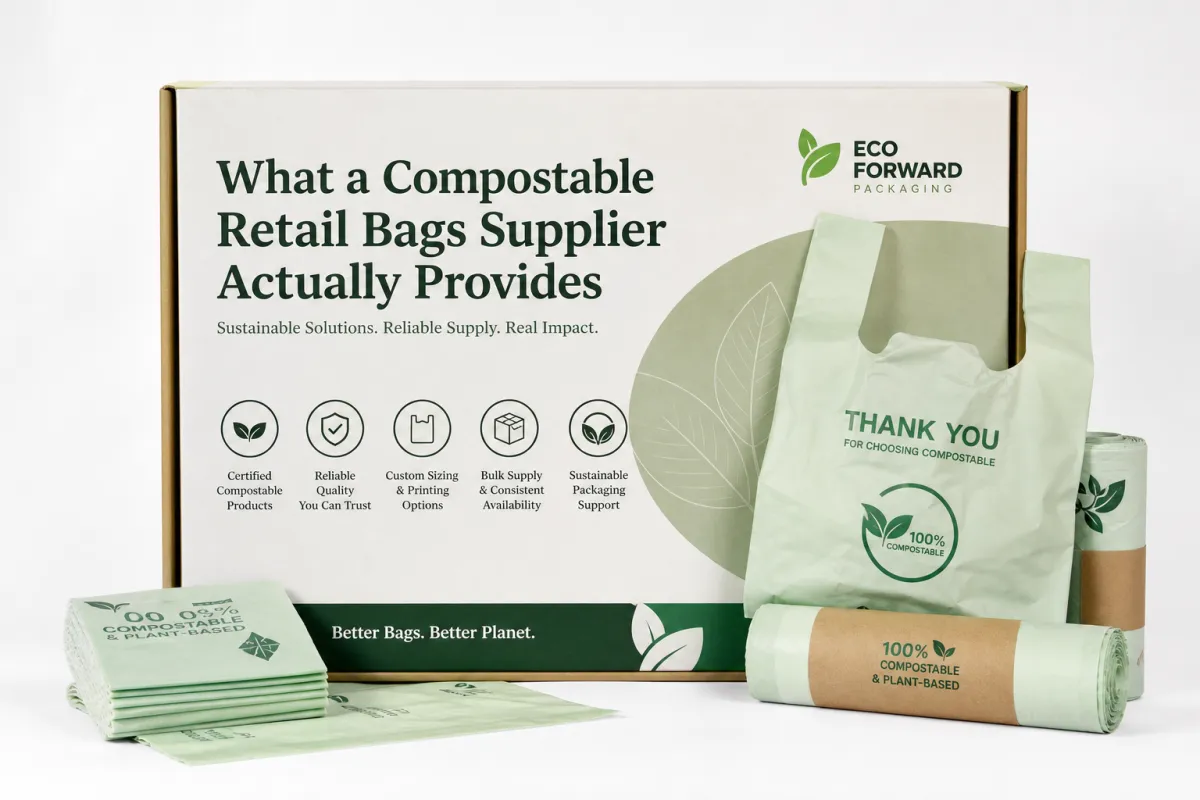
A strong compostable retail bags supplier does a lot more than quote a price per thousand. The supplier should be able to recommend the right film family, the correct gauge, the best handle style, and the right print approach for the load you expect to put into the bag. When those details do not line up, the bag may look fine at first glance but fail where it matters most: in the hand, in transit, or in storage.
In practical terms, a compostable retail bags supplier helps translate a retail use case into a manufacturable specification. That means asking about product weight, whether the bag will carry wet or dry goods, how long it will sit in stock, whether it needs a clear window, and whether it will be used for food contact or general merchandise. A buyer who can answer those questions usually gets a cleaner quote and fewer surprises later.
What suppliers should be ready to explain
A reliable compostable retail bags supplier should be able to discuss the actual material structure, not just a vague "plant-based" claim. You may hear about PLA blends, starch-based compounds, PBAT-based compostable films, or PHA-rich formulations. Those materials do not behave the same way. Some are clearer. Some are softer. Some hold seal strength better. Others need tighter temperature control during production and storage.
- PLA blends can offer good clarity and stiffness, but they may become brittle if the bag is stored or used in heat.
- Starch-based blends can reduce fossil content, though performance can vary more if the formulation is not tightly controlled.
- PBAT-modified compostable films tend to add flexibility and toughness, which helps in retail carry bags.
- PHA-containing materials can be attractive for certain compostable applications, but pricing is often higher.
That is why a good compostable retail bags supplier will not push one material as the answer for every store. The right bag depends on what it has to carry and how long it has to stay stable before use.
Compostable, biodegradable, and recyclable are not the same
Buyers often assume a green-looking bag automatically supports a lower-waste strategy, but the details matter. A compostable retail bags supplier should be able to explain whether the bag is certified for industrial composting, home composting, or neither. Industrial composting usually means controlled heat, moisture, oxygen, and active microbial conditions. Home composting is far less predictable, so a material that passes one claim may not pass the other.
A compostability claim is only as strong as the weakest link: the resin blend, the print system, the seal, and the disposal pathway all have to line up.
For broader packaging guidance, the U.S. EPA has useful background on waste reduction and materials management at epa.gov, and the Sustainable Packaging Coalition at packaging.org offers practical packaging resources and terminology. A credible compostable retail bags supplier should be comfortable discussing the same distinctions without hand-waving.
In a retail environment, the label alone is never enough. If the bag is sold as compostable but the ink system, additives, or seal chemistry are not compatible with the certification claim, the result is a packaging story that sounds clean but is hard to defend. A good compostable retail bags supplier helps close that gap before it becomes a customer complaint.
How Compostable Retail Bags Work in Real Use
The way a compostable retail bags supplier describes the material is only half the story. The other half is how the bag behaves in actual use. On the factory floor, compostable films can react differently to sealing temperature, dwell time, and pressure than conventional polyethylene. In the store, they can feel softer, crisper, or more temperature-sensitive depending on the blend. That is why sample testing matters so much.
Compostability is tied to environment as well. Heat, moisture, oxygen, and microbial activity all play a role. A bag certified for industrial composting is designed for a managed composting facility, not for random exposure to backyard soil, a hot stockroom, or a wet loading dock. A compostable retail bags supplier should be clear about those boundaries, because the claim only holds when the use conditions are honest.
What changes performance on the shelf and in the store
A store buyer usually cares about four performance points: shelf life, seal integrity, appearance, and load handling. A compostable retail bags supplier should talk through all four. Shelf life matters because some compostable films can lose flexibility if they sit too long in warm or humid storage. Seal integrity matters because weak seals create split corners and customer complaints. Appearance matters because retail bags are part of the brand presentation. Load handling matters because customers rarely carry only one item.
Printing can also affect performance. Heavy ink coverage, aggressive varnishes, or poorly matched color systems can interfere with compostability claims or simply make the film harder to run. A careful compostable retail bags supplier will explain whether the print method is flexographic, whether the inks are compost-compliant, and whether the artwork coverage changes the feel or odor of the bag. Odor may sound minor, but customers notice it fast, especially with food-adjacent packaging.
Here is the short version: a bag can survive a checkout handoff and still fail if it sits in a humid storage room for two months, gets overloaded with a sharp box corner, or is used to carry damp products without enough film thickness. That is not a defect in compostable packaging itself; it is a reminder that the compostable retail bags supplier has to match material behavior to the real use case.
Typical storage and handling limits
Most buyers should ask about recommended storage conditions and practical shelf life. Depending on the resin system and bag build, many compostable retail bags perform best when kept cool, dry, and out of direct sunlight, with cartons sealed until use. In real terms, that often means planning for a shelf life that is closer to months than years. A compostable retail bags supplier should be able to tell you the storage window they stand behind, not just the certification line on the spec sheet.
If you want to compare options more clearly, this table shows the typical trade-offs buyers see with a compostable retail bags supplier:
| Bag Option | Typical MOQ | Indicative Unit Price | Lead Time | Best For |
|---|---|---|---|---|
| Stock unprinted compostable bag | 5,000-10,000 pcs | $0.06-$0.12 | 7-12 business days | Quick rollout, internal testing, simple store use |
| Custom printed light retail bag | 10,000-25,000 pcs | $0.12-$0.28 | 12-18 business days | Boutiques, gift shops, small chain branding |
| Custom printed heavier shopping bag | 20,000-50,000 pcs | $0.18-$0.38 | 15-25 business days | Grocers, apparel, multi-item carry loads |
| Specialty format with reinforced handle or custom sizing | Often 25,000+ pcs | $0.22-$0.45 | 20-30 business days | Branded programs with stricter durability needs |
Those are not universal numbers, because every compostable retail bags supplier prices against size, print coverage, material availability, freight, and documentation, but they are a useful starting point for budget conversations. A buyer who understands the range can spot quotes that are too low to be believable and quotes that are high because of unnecessary setup.
Key Factors for Choosing a Compostable Retail Bags Supplier
If you are comparing one compostable retail bags supplier against another, start with cost, but do not stop there. Resin cost, custom sizing, print colors, minimum order quantity, freight, certification documentation, and packing format all shape the final landed price. A quote that looks attractive on paper can become expensive once you add artwork setup, tool charges, carton repacking, or air freight to meet a store opening.
Price also depends on how specific the bag spec is. A simple, unprinted stock bag usually costs less than a custom-branded bag with multiple colors, handle reinforcement, or a special gusset. A trustworthy compostable retail bags supplier should separate the base bag cost from the extras so you can see exactly where the money goes. That makes it easier to adjust the spec without losing the whole project.
What quality looks like beyond the quote
Quality is not a vague feeling; it shows up in measurable details. A strong compostable retail bags supplier should be able to talk about certification scope, tensile strength, seal performance, bag thickness, odor, clarity, and batch consistency. If the supplier has test data, ask for it. If they say "tested" but cannot explain the method, that is a warning sign.
For compostable films, buyers often ask for proof tied to recognized standards such as ASTM D6400 or EN 13432. Those standards are not the same thing as a marketing claim. They are a way to verify that the material is designed for composting under defined conditions. A good compostable retail bags supplier should be able to show how the product matches the claim, not just repeat the wording on the carton.
Sustainability proof should also be easy to understand. Ask for the exact material breakdown, the certification number if one exists, and whether the bag is industrial compostable or home compostable. A responsible compostable retail bags supplier will use straightforward language. They will also tell you if a claim is limited to certain markets, because regulations and acceptance vary by region.
How different retail channels change the bag spec
Checkout bags for apparel are not the same as produce bags, and produce bags are not the same as Branded Shopping Bags. A compostable retail bags supplier should know that a light garment bag might work at 25-35 microns, while a heavier retail carry bag may need 45-70 microns, stronger seals, or wider handles. Wet produce can require different puncture resistance. Sharp-edged gift boxes can call for more film toughness. A one-size-fits-all spec rarely performs well across channels.
- Checkout bags need quick dispensing, easy opening, and enough strength for mixed merchandise.
- Merchandise bags often need stronger print quality and a cleaner premium look.
- Produce or food-contact bags may need different compliance documentation and storage rules.
- Branded shopping bags usually need more consistent graphics, better handle feel, and tighter color control.
A thoughtful compostable retail bags supplier will ask where the bag sits in the customer journey, because that answer changes everything. A bag handed over after a luxury purchase has different expectations than a bag used for fast-moving counter sales. In both cases, the bag needs to support the brand story without slowing down the team.
Apples-to-apples comparison checklist
To compare suppliers fairly, line up the same variables every time. One compostable retail bags supplier may quote a lower unit price but exclude freight, while another may include delivery and certification documents. One may offer a better print finish but require a larger MOQ. Another may have shorter lead time but less flexibility on size. If you compare only the per-bag number, you can easily choose the wrong partner.
- Confirm the exact bag dimensions, gauge, handle type, and print colors.
- Ask whether the quote includes freight, artwork setup, plates, tooling, and carton packing.
- Request certification documents and written storage guidance.
- Check whether the quoted bag matches your expected load and disposal pathway.
- Ask the compostable retail bags supplier how they handle repeat orders and reorders.
That checklist keeps the discussion grounded. It also helps you spot a supplier who understands packaging as a system rather than just a commodity line item.
Step-by-Step: How to Vet a Compostable Retail Bags Supplier
The easiest way to evaluate a compostable retail bags supplier is to start with your own operating needs, not their catalog. Define the bag dimensions, expected fill weight, branding goals, storage conditions, and whether the bag must support food contact or only general retail. A supplier cannot recommend the right structure if the brief is fuzzy. The more specific you are at the start, the less guesswork there is later.
Once the need is clear, request samples and spec sheets. Do not stop at holding the bag up to the light. Test it the way your staff and customers will actually use it. Load it with real product weight. Check how it opens. Pull on the handles. Look at the printed logo under store lighting. A compostable retail bags supplier worth working with will welcome that kind of testing because it prevents misunderstandings before production starts.
What to test before approval
A practical sample test should cover more than appearance. Ask your team to fill the bag with the heaviest realistic order, not the ideal one. Check whether the seals remain intact, whether the handles cut into the hand, whether the print stays legible, and whether the bag keeps its shape after a few minutes of carry. A compostable retail bags supplier should also be able to tell you whether the material behaves differently in cold storage, humid conditions, or warm back rooms.
For custom printed bags, proof review matters almost as much as material review. Artwork that looks crisp on a screen can appear washed out on a compostable film with a different surface energy. Ask the compostable retail bags supplier whether they can show a digital proof, color reference, or printed sample before full production. That step saves time and avoids unnecessary reprints.
How to compare quotes fairly
Never compare unit price alone. A lower quote from one compostable retail bags supplier might leave out the charges that matter most. Another may include freight, compliance documents, and packing in smaller inner cartons that are easier to store in a stockroom. The goal is not the cheapest number. The goal is the best landed cost for a bag that performs correctly and supports the retail brand.
Ask each supplier to break the quote into the same buckets:
- Bag cost per unit or per thousand.
- Setup cost for artwork, plates, or tooling.
- Documentation cost for certification paperwork or testing.
- Freight cost to your warehouse or store.
- Packing format such as loose-packed, inner bags, or carton count.
That level of detail makes the decision much clearer. A good compostable retail bags supplier should have no issue with transparency here, because clear pricing builds trust and reduces back-and-forth.
Production capability and service matter
Capacity is easy to forget until the season gets busy. A dependable compostable retail bags supplier should be able to handle repeat orders, rush requests within reason, and moderate changes to size or print without turning the project into a crisis. Ask how they manage production scheduling, quality checks, and reorder history. You do not need a dramatic story; you need a repeatable process.
This is also where service style matters. If the supplier answers technical questions quickly and clearly, that is a good sign. If every answer is vague, the relationship may get difficult later. The best compostable retail bags supplier is not necessarily the one with the flashiest brochure. It is the one that can explain material behavior, Pricing, and Lead Times in plain language and then deliver on that explanation.
Process and Timeline: From Quote to Delivery
A typical project with a compostable retail bags supplier starts with the quote stage. At that point, the supplier should confirm bag type, target quantity, artwork requirements, compliance needs, and minimum order quantity. If those basics are missing, the quote may be rough and the timeline may shift later. A clean quote stage usually means fewer surprises downstream.
After that comes pre-production. This is the window where approvals, proofs, material selection, and any print or tooling work happen before the first finished bag is produced. A careful compostable retail bags supplier will not rush this part because errors here are expensive later. The goal is to lock the spec before production starts, not after the order is already on the machine.
Typical timeline milestones
Lead time depends on whether the bag is stock or custom, printed or unprinted, domestic or imported, and how much artwork work is needed. In many cases, a stock compostable retail bag can move in about 7-12 business days once the order is confirmed. A custom printed order often takes 12-18 business days from proof approval. More complex jobs with special handles, heavier gauges, or imported materials can stretch to 20-30 business days. A compostable retail bags supplier should give you a range, not a fantasy promise.
- Quote confirmation: 1-3 business days if the brief is complete.
- Proofing and approval: 2-5 business days depending on artwork revisions.
- Production: 5-15 business days for most custom retail bags.
- Quality control and packing: 1-3 business days.
- Transit: varies by freight method and destination.
Freight planning deserves its own attention. A compostable retail bags supplier may produce the order on time, but ocean transit, customs review, peak season congestion, or internal warehouse delays can still push the bags past the launch date. That is why smart buyers build in a buffer, especially for store openings, seasonal rollouts, and packaging changeovers.
Delivery planning for retail launches
For a single store or a small chain, it may be possible to time delivery tightly. For a broader rollout, it is safer to receive samples early, approve production quickly, and leave enough time for distribution to multiple locations. A compostable retail bags supplier can help with the packaging side of the schedule, but the buyer still needs to coordinate the internal handoff. Good planning here protects the brand story and the customer experience.
If the bags are shipped in cartons that will move through normal distribution channels, remember to think about carton strength, pallet pattern, and label clarity too. That is not separate from the project. It is part of the project. A supplier that understands that level of detail is usually easier to work with over the long term.
Common Mistakes When Working With a Compostable Retail Bags Supplier
The first mistake is buying on label alone. A bag can be described as green packaging or eco-friendly packaging and still miss the mark if the resin blend, certification, or disposal claim is incomplete. A compostable retail bags supplier should be able to explain exactly what is certified, what is not, and what the bag is intended to do. If that answer feels slippery, pause the order.
The second mistake is poor storage. Compostable films can be sensitive to heat, sunlight, and humidity. If bags sit in a warm warehouse or next to a sunlit window, the film may lose flexibility, crack earlier than expected, or become harder to seal cleanly. A good compostable retail bags supplier will give you storage guidance for a reason. Follow it.
Underspecifying the bag
One of the most common failure points is underestimating the load. A bag approved for light apparel may not handle a boxy candle set, bottled goods, or anything with sharp corners. A careful compostable retail bags supplier will ask about fill weight and product shape because those details influence gauge, seal design, and handle reinforcement. If your merchandise varies by season, mention the heaviest realistic combination, not the average one.
Wet or damp products deserve extra attention. Moisture can change hand feel and reduce useful life if the bag stays in storage after contact. In that situation, you may need a different film structure or a different bag format altogether. The right compostable retail bags supplier will not force a standard bag into a job it is not suited for.
Forgetting the disposal pathway
Even a well-made compostable bag can create confusion if the local disposal infrastructure cannot handle it. Buyers should think beyond the bag itself and ask how staff and customers will understand the disposal instructions. If the bag is meant for industrial composting only, say that clearly. If your stores are in areas with limited compost collection, be honest about that reality. A compostable retail bags supplier can support the packaging claim, but the retailer still needs a credible customer message.
That is also where training matters. Cashiers, floor staff, and store managers should know how to explain the bag in one sentence without overselling it. Simple language beats marketing jargon. "This bag is certified compostable under industrial conditions" is clearer than a long speech about being part of a zero waste future. The clear version builds trust.
There is also a brand risk in overpromising. If the bag is presented as the answer to every sustainability concern, customers may later discover the limits and feel misled. A realistic claim, backed by documentation, does more for a circular economy than a grand claim that cannot survive scrutiny. That is why the right compostable retail bags supplier is usually the one who helps you keep the message accurate rather than dramatic.
Expert Tips Before You Place an Order
Before you place an order with a compostable retail bags supplier, ask for the documents that matter most: certification details, test reports, material breakdowns, storage guidance, and any restrictions on temperature or shelf life. If the supplier cannot provide those items quickly, that does not always mean the product is weak, but it does mean the order will require more caution.
Match the bag spec to the actual checkout workflow. That sounds basic, yet it is where many projects drift off course. A bag that slows down staff because it is hard to open or awkward to fill is not a good bag, even if the materials are compostable. A great compostable retail bags supplier knows that packaging has to support speed, brand presentation, and durability at the same time.
A smart pilot run beats a large guess
If the order is important, consider a pilot run before full rollout. Try the bag in a few stores, collect feedback from staff and customers, and look for the same issues that show up in many packaging programs: handle comfort, print readability, seal strength, and carton handling in the back room. A pilot gives the compostable retail bags supplier real feedback to work with, and it gives you a chance to refine the spec before the bigger commitment.
That pilot can also tell you whether the bag supports the visual identity you want. Some brands need a matte, understated look. Others want a brighter graphic and a more obvious sustainability message. A seasoned compostable retail bags supplier can help you adjust thickness, finish, or print density so the bag feels aligned with the rest of the packaging program.
Final checklist before you request the last quote
Here is a practical checklist to use before you ask a compostable retail bags supplier for final pricing:
- Finalize bag dimensions, handle style, and target load.
- Confirm whether the claim must be industrial compostable or home compostable.
- Set the print colors, coverage level, and brand artwork.
- Define your budget, MOQ, and needed delivery window.
- Ask for certification, storage guidance, and sample approval terms.
Once those details are locked, the quote conversation becomes much cleaner. You are no longer asking a compostable retail bags supplier to guess what you need. You are giving them the full brief they need to quote the right bag the first time.
The best buying decisions in green packaging are rarely the flashiest ones. They are the ones that hold up in daily use, match the disposal claim, fit the budget, and keep the brand honest. If you work with a compostable retail bags supplier who can speak clearly about materials, testing, Pricing, and Lead Time, you put your packaging program in a much stronger position from the start.
How do I know if a compostable retail bags supplier is credible?
Ask for certification numbers, test reports, and the exact material breakdown instead of relying on marketing language. A credible compostable retail bags supplier should explain whether the bag is industrial compostable or home compostable, and should be able to talk plainly about storage limits, shelf life, and load performance. If the answers stay vague, keep asking until the details are clear.
What minimum order quantity should I expect from a compostable retail bags supplier?
MOQ usually depends on whether the bag is stock or custom, and custom printing normally requires a larger run. Size, thickness, handle style, and number of print colors can all raise the minimum order requirement. A practical compostable retail bags supplier should also offer tiered pricing so you can compare a small test run against a full production order.
Are compostable retail bags more expensive than standard plastic bags?
Yes, the unit price is often higher because the material, testing, and compliance work can add cost. The total cost may narrow at larger volumes or when the design is kept simple with fewer print colors and less setup. A good compostable retail bags supplier will help you compare the full landed cost, not just the bag price, because freight and documentation can change the real number.
How long does a custom order from a compostable retail bags supplier take?
Timeline depends on samples, proof approval, production scheduling, and shipping method. Stock sizes move faster, while custom printing, tooling, or imported materials can add more lead time. Build in extra buffer if the bags are needed for a store opening, seasonal launch, or packaging changeover, and ask the compostable retail bags supplier for the timeline in writing.
Will compostable retail bags hold up for heavier merchandise?
They can, but only when the gauge, seal, handle style, and bag shape are designed for the expected load. Ask the compostable retail bags supplier for load testing or real-use guidance before approving a bag for heavier products. Avoid overfilling and confirm whether damp or sharp-edged items need a different bag construction.
The clearest takeaway is simple: lock the bag spec, verify the certification, test the sample in real store conditions, and only then approve the order. A dependable compostable retail bags supplier will welcome that process because it protects your brand, your staff, and the promise printed on the bag.

