Corporate Gift Beanies With Logo Patches: A Wholesale Buying Guide
If you are comparing a Logo Patch Beanies wholesale Supplier for Corporate gifting buyers, you are usually not looking for the cheapest promo hat. The real brief is warmer and more specific: a useful beanie, branded neatly, with a finish good enough that people will actually wear it again. A well-made patch on a dense knit does that better than a large print or heavy embroidery.
Why logo patch beanies work for corporate gifting
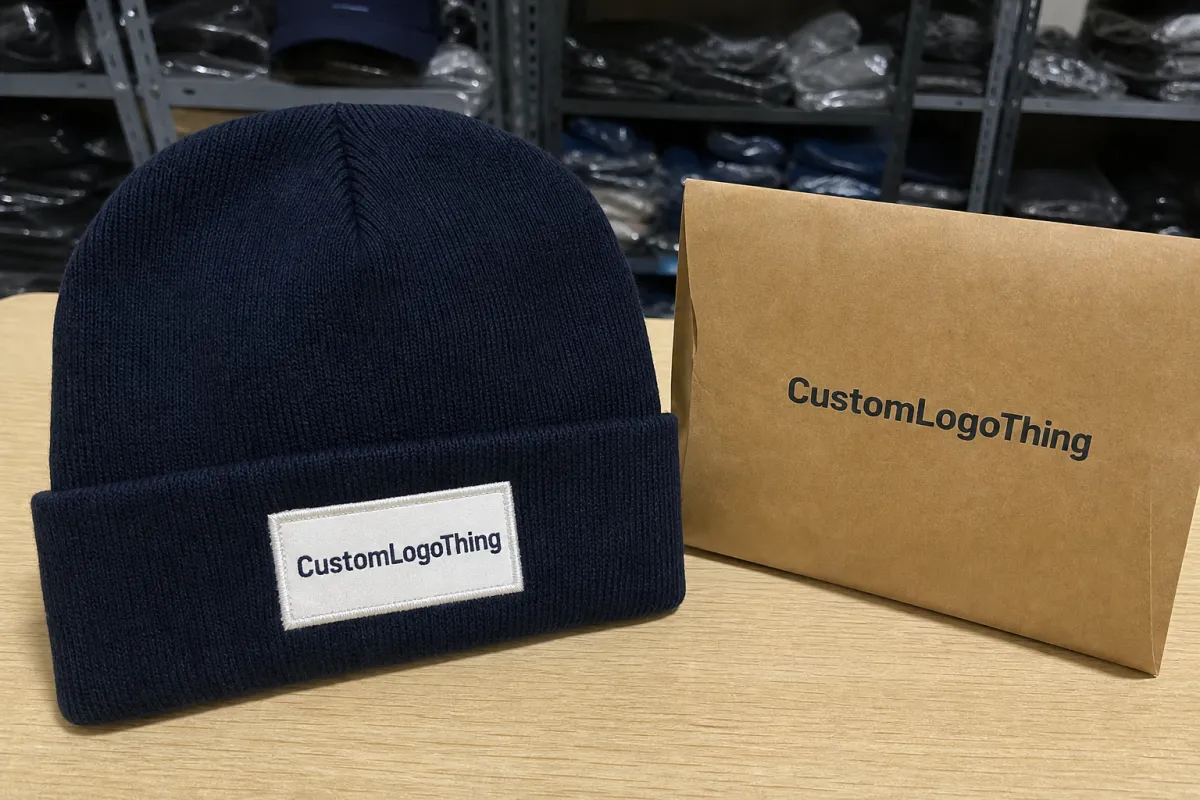
Beanies solve a lot of practical problems at once. They are one-size in a way that usually works, they ship compactly, and they avoid the sizing headaches that can slow down a gift program. That matters when the order is going to employees, clients, event attendees, or mixed groups.
The patch changes the tone. A small woven, faux leather, or silicone patch makes the piece feel more finished than a big front print. It also photographs better, which matters in launch kits, onboarding boxes, and event content. Buyers tend to notice quality in the first two seconds, and a neat patch on a structured beanie reads as deliberate rather than promotional.
There is also a branding advantage. Fine detail is easier to preserve on a patch than on knit surface. That usually means cleaner edges, fewer color shifts, and a better chance that the logo still looks sharp after repeated wear.
The strongest corporate gifts are rarely the loudest. They are the ones that feel useful first and branded second.
For bulk buyers, the category is easy to bundle with outerwear, notebooks, drinkware, or onboarding kits. The order can be simple without feeling cheap, which is why it keeps showing up in corporate gifting programs.
Patch styles, beanie bodies, and logo placement options
The patch does most of the branding work, so it needs to match the logo, the knit, and the audience. A design that looks right on screen can fall apart once it is reduced to a 2-inch patch on ribbed fabric. Small type gets muddy. Thin outlines can disappear. Overly detailed artwork usually costs more and looks less refined.
- Woven patches are best for small text and crisp edges.
- Faux leather patches create a warmer, understated look.
- Silicone or rubber patches feel clean, tactile, and slightly sportier.
- Embroidered patches add texture and work well for bold logos.
Beanie construction matters just as much. A cuffed acrylic beanie is still the workhorse for wholesale gifting because it gives you a reliable branding panel, predictable pricing, and enough stretch for most wearers. Ribbed knit styles look more textured and can feel a little more premium. Wool blends raise cost, but they also raise the bar on hand feel.
Fleece-lined or double-layer knit beanies are worth considering for colder markets. They are warmer, but they add weight and can reduce stretch. If the order is for a broad audience, test the fit carefully.
Placement is where buyers either simplify the order or overwork it. Front cuff is the standard because it is visible and easy to approve in a proof. Side placement feels more subtle. Center-fold placement can work when the cuff is tall enough to balance the logo. For corporate gifting, restraint usually beats visual volume.
Patch size should match the beanie scale. On most cuffed styles, a patch in the 1.5 to 2.5 inch range is usually enough to read clearly without dominating the knit. Larger patches can work on tall cuffs, but they can crowd low-profile beanies.
Materials, fit, and construction details buyers should verify
A sample can look excellent and still hide problems that only show up when the full order is packed and shipped. Buyers should check the body knit, stretch recovery, seam finish, and patch attachment before approving production. Most issues are small defects that add up: loose threads, an uneven cuff, a patch that is slightly off-center, or a rough backing inside the hat.
- Yarn content: 100% acrylic is common because it keeps cost down and handles bulk production well.
- Knit gauge: A tighter 9- to 12-gauge knit usually looks neater and holds shape better than a loose knit.
- Weight: Lightweight beanies often fall around 70-100g, while denser winter styles can land in the 110-150g range.
- Stretch recovery: The beanie should return to form after pulling, not bag out at the crown or cuff.
- Seam finish: Check the top closure, inner stitching, and whether the seam sits flat enough to wear comfortably.
- Patch attachment: Heat-sealed patches can be clean, but stitched or stitched-and-sealed applications are usually safer for durability.
Fit is where a lot of “one size fits most” products quietly fail. A beanie needs enough stretch for comfort without becoming sloppy. People who wear glasses, headphones, or long hair need a little extra forgiveness in the crown and cuff. If the beanie is too tight, it gets left in a drawer. If it is too loose, it looks like an afterthought.
Inside finish deserves more attention than it usually gets. Corporate gifts are supposed to feel considered, and a scratchy seam can ruin that impression. Ask for a close photo of the interior or a physical sample before sign-off.
Color accuracy is another place where expectations should stay grounded. Pantone matching on knitwear is not the same as matching on coated paper. Yarn absorbs dye differently, and patch materials reflect light differently again. A close match is often realistic. A perfect match usually is not.
If packaging matters, ask about the box stock, insert, and transit protection. The practical question is whether the presentation survives shipping without creases. A premium beanie in a crushed box still lands as damaged goods.
Pricing, MOQ, and unit cost drivers for bulk orders
A supplier quote should be broken into parts. If everything is buried in one number, comparison becomes guesswork. The cleanest pricing separates the blank beanie, decoration, setup, sample cost, packaging, and freight.
The main drivers are consistent across most wholesale runs:
- Patch material: woven and faux leather usually sit in the middle; silicone and specialty finishes tend to cost more.
- Logo complexity: more colors, tiny text, and fine lines increase production difficulty.
- Beanie body: standard acrylic is the least expensive route, while wool blends and fleece-lined styles climb quickly.
- Quantity: the first volume break is usually the one that matters most.
- Packaging: polybags are cheap, branded boxes and inserts are not.
- Freight: air, sea, domestic ground, split shipments, and rushed delivery all change landed cost.
As a working range, a plain acrylic cuffed beanie in bulk may sit around $2.10 to $3.80 before decoration. A wool-blend or heavier fashion body can move into the $4.50 to $8.50 range or higher. Add a patch, packing, and freight, and the landed cost shifts quickly.
Decoration add-ons are usually modest individually, but they matter in aggregate. Woven patches often add about $0.30 to $0.70 per unit. Faux leather may land around $0.25 to $0.60. Silicone or rubber can run $0.35 to $0.80. Setup fees may be another $30 to $120, and sample costs are often $25 to $80 depending on the supplier and whether the sample is fully decorated.
| Option | Visual feel | Typical add-on per unit | Best use |
|---|---|---|---|
| Woven patch | Clean, detailed, polished | $0.30-$0.70 | Client gifts, executive kits, fine logos |
| Faux leather patch | Warm, understated, premium | $0.25-$0.60 | Subtle branding with a retail look |
| Silicone/rubber patch | Modern, tactile, sporty | $0.35-$0.80 | Outdoor teams, tech events, casual merch |
| Embroidered patch | Textured, traditional | $0.20-$0.50 | Bold logos, simple crests, classic branding |
MOQ usually starts around 100 to 300 pieces for standard wholesale work, though stock availability and patch type can move that number up or down. Smaller runs carry a higher per-unit cost because setup gets spread over fewer hats. Larger runs generally unlock better pricing, but only if the order is locked early enough for production to stay efficient.
What a wholesale supplier should promise
A wholesale supplier is not just selling knitwear. They are promising that your logo, color, packaging, count, and deadline will survive production and transit without becoming a problem for your team.
The first thing to ask for is a mockup that reflects the real patch size, placement, cuff height, and body color. A flat digital proof is useful, but it is not enough on its own. On a beanie, scale changes everything.
Ask for sample consistency too. If the pre-production sample is polished and the mass run is noticeably rougher, the sample was doing too much work. A good supplier can explain how they control patch placement, stitch count, yarn shade, and final inspection.
It also helps to know who is actually handling the order. Factory, broker, and trading company are not interchangeable labels. A factory often offers better control over construction and color matching. A broker may move faster and have more options. A trading company can help when the order includes packaging or other items in the same shipment.
Useful questions tend to be blunt:
- Is the beanie in stock, or is it knit to order?
- What is included in the unit price?
- How many proof revisions are allowed?
- What happens if the logo file needs cleanup?
- What is the lead time after deposit and proof approval?
- How is the pre-shipment inspection handled?
For production control, ask whether they inspect a sample percentage of the run or follow a documented quality standard such as an AQL-style check. You do not need factory jargon for its own sake. You need evidence that somebody is checking patch placement, stitch quality, and count before cartons leave the building.
Common corporate gifting mistakes that inflate costs or miss deadlines
The easiest way to create avoidable expense is to change the logo after proof approval. Every change can mean another round of artwork, another review, and a delay that pushes the delivery into the wrong week.
Another common mistake is overcomplicating the patch. Tiny type, thin lines, and too many colors make production harder and usually reduce legibility. A logo that depends on precision at a tiny scale is often better simplified for the patch version.
Timing errors cause their own mess. Holiday orders get squeezed by freight congestion, gifting programs get delayed while address lists are cleaned up, and event shipments get approved too late for sensible transit. If the gifts need to arrive on a fixed date, the calendar should include sample review, production, packing, and shipping margin.
- Approve the logo before asking for final pricing.
- Confirm Pantone guidance or nearest-match tolerance early.
- Keep packaging simple if the deadline is tight.
- Lock the delivery list before production starts.
- Ask which changes trigger a new proof or schedule.
There is also a subtle mistake that buyers make with corporate gifts: assuming the product should look exactly like a retail item without accepting the cost of retail-level detail. Better to decide where the program should feel premium and where it can stay practical.
What to send before quoting
A good quote starts with a clean brief. Send the logo file, target quantity, preferred beanie style, patch material, color direction, packaging needs, budget range, and delivery deadline. If you have a specific event date or ship-to location, include that too.
In practice, the simplest orders are often the fastest. One decision-maker, one approved logo version, and one page of requirements usually beats a long email thread full of “maybe” and “close enough.”
Before approval, check patch size, patch placement, body color, cuff height, and the finish on the inside of the beanie. Then confirm packing, carton count, and delivery terms in writing.
If the goal is a gift that looks thoughtful rather than promotional, the formula is usually simple: a sensible knit, a restrained patch, a clear proof, and a lead time that matches reality.
FAQ
What is the usual MOQ for logo patch beanies for corporate gifting?
Most wholesale runs start around 100 to 300 pieces, although stock availability, patch material, and beanie color can move that number. Mixed colors can be possible, but they sometimes raise the unit price or the MOQ because each variation adds handling and sorting.
How long does production usually take after approval?
Simple in-stock orders often take about 2 to 4 weeks after artwork approval. Custom patch work, specialty yarns, or branded packaging can move that to 4 to 6 weeks or more. The clock usually starts after deposit and proof approval.
Which patch material usually looks best on corporate gifting beanies?
Woven and faux leather patches tend to read as the most polished. Woven works well for small text and detail. Faux leather gives a quieter premium feel. Silicone feels more modern and casual, while embroidery is best when the logo is bold and simple.
Can I mix beanie colors in one wholesale order?
Usually yes, as long as the supplier has the base colors available and can keep the patch spec identical across the order. The more colors you add, the more likely the quote changes.
What files do I need to quote logo patch beanies accurately?
A clean vector file is ideal, along with your target quantity, preferred beanie style, patch material, color preferences, packaging request, and delivery location. If you already know the budget ceiling or the event date, include that as well.


