For a roaster, gift shop, or private-label coffee brand, a coffee Black Paper Gift Bags quote is rarely just a number for paper and glue. It is a pricing snapshot of how the bag will read on a shelf, hold up in a packing area, and survive a few handoffs without looking tired. Black paper gives the package more visual weight than kraft or white stock, and that can make a modest gift feel more deliberate without forcing a complex structure.
That matters because the bag has to do two jobs at once. It needs enough presence for gift sets and seasonal bundles, and enough durability to get from the packing bench to the customer with the edges intact, the handles secure, and the logo still clean. A good quote starts with the actual use case, not a generic template, and the fastest way to get there is to be specific from the first inquiry.
Black paper is not a magic material. It hides scuffs better than lighter stock, but it also exposes poor print contrast, weak handle anchoring, and sloppy folding just as quickly. That tradeoff is useful to keep in mind before a purchase is approved, because the bag’s finish and the bag’s build should be judged together.
Why black paper changes how coffee gifts read at the shelf
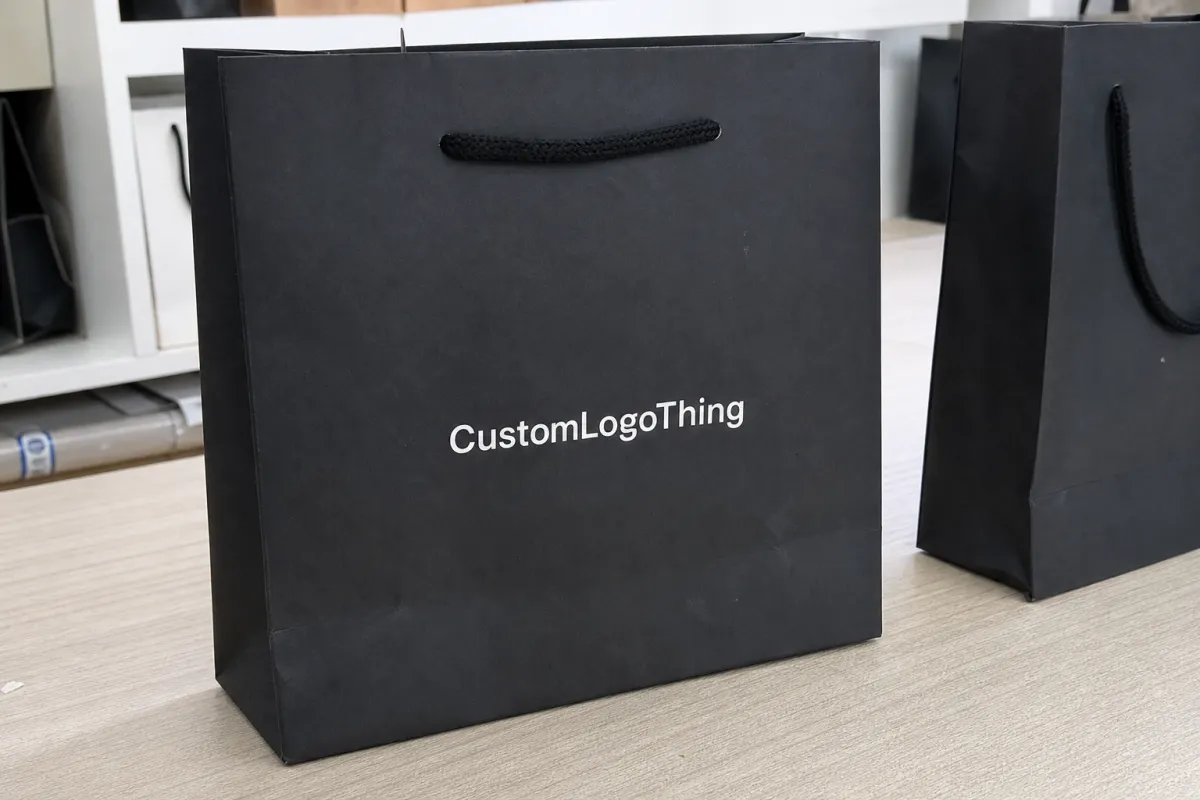
Black paper changes the way a coffee gift is perceived almost immediately. A light kraft bag can feel casual and earthy; black paper reads more controlled, more giftable, and in many settings more premium. It also hides everyday wear better. Corner rubs, carton dust, and light creasing are less obvious on dark stock, which helps if the bag is handled multiple times before it reaches the customer.
That visual discipline matters in coffee retail, where the bag often sits beside printed pouches, ceramic mugs, tins, tasting cards, and seasonal tags. Too many surfaces competing for attention can make the display feel busy. Black paper gives the eye a place to land, especially if the logo contrast is strong and the print area is kept clean.
The format fits a wide range of coffee packaging jobs. It works for single-tin gifts, two-bag sampler sets, mug-and-coffee pairings, subscription welcome kits, and holiday add-ons at the register. In those cases, the bag becomes part of the product experience, not a disposable carrier. That is why handle feel, paper stiffness, and print method all belong in the discussion before price is finalized.
A bag that looks elegant in a mockup can still fail on the line if the gusset is too narrow, the top fold is weak, or the handle sits too close to the edge. The structure has to fit the product before decoration gets a vote.
One practical observation: dark paper also makes some flaws easier to see. White edge exposure on folds, glue squeeze-out, and uneven foil registration stand out more than they would on kraft. That is not a reason to avoid black stock; it is a reason to confirm the production method carefully before anyone approves the run.
So a coffee Black Paper Gift Bags quote should reflect more than the bag dimension. It should reflect how the package will be used, how much weight it must carry, and how it should look under retail lighting. That is the difference between a quote that sounds attractive and one that survives production.
Coffee black paper gift bags quote: what shapes the numbers
The first thing that shapes a quote is the paper itself. For lighter gift items, a dyed-through black paper in the 170gsm to 230gsm range can be enough. For coffee tins, ceramic mugs, or mixed sets that need more body, 250gsm to 350gsm board is often the safer range. Heavier stock improves structure, but it also adds cost, changes folding behavior, and can require better handle reinforcement.
Handle style changes both presentation and pricing. Twisted paper handles tend to be the most economical and are usually fine for modest weights. Rope handles, especially polyester or cotton-look rope, feel more substantial in the hand and often suit higher-value gift sets. Ribbon handles are visually elegant, but they are slower to finish and less forgiving if the pack line is rushed. Die-cut handles can work for lighter presentation bags, though they need careful weight planning if the load is more than decorative.
Finish matters more on black stock than many buyers expect. Matte varnish keeps the surface restrained and avoids glare. Soft-touch lamination adds a velvety feel, but it can raise the unit price and may show fingerprints more clearly in some lighting. Spot gloss, foil stamping, and embossing each add contrast, but they do it differently. Foil can look sharp against black, while embossing without enough ink coverage can disappear into the texture. A design that tries to use every effect at once usually ends up looking busy rather than premium.
Printing choices matter too. White ink, reverse knockouts, and strong logo shapes usually perform better on black paper than tiny pale details. Small legal copy, QR codes, and care notes need to be proofed at actual size; what reads on a screen can blur once it moves through finishing. If the artwork is still being finalized, ask for the dieline early so the logo placement can be judged against the real panel widths and fold lines.
In many supplier quotes, a simple printed black paper bag in moderate volume may land around $0.35 to $0.80 per unit, while a premium version with rope handles, foil, embossing, or soft-touch finish can move into roughly $0.90 to $1.50 or more depending on size, volume, and shipping lane. Those are broad working ranges, not promises. Small orders, domestic production, or unusually heavy board can sit outside them quickly.
If sustainability language matters to your retail channel, ask for FSC-certified stock and confirm whether chain-of-custody paperwork is available for the run. That request is easier to handle before art approval than after production has already started.
Specifications to confirm before you request pricing
Most quote delays come from missing measurements, not from difficult artwork. If you send the finished width, gusset, and height, the supplier can usually narrow the structure quickly. Add handle drop, top fold style, and whether an insert or reinforcement strip is required, and the bag can be matched to the product instead of guessed at.
- Finished size: width, gusset, and height in millimeters or inches.
- Handle style: twisted paper, rope, ribbon, or die-cut.
- Printed area: one side, both sides, wraparound, or inside print.
- Product load: filled weight, tin size, bottle height, mug dimensions, or mixed set contents.
- Finish: matte varnish, soft-touch lamination, foil, embossing, spot gloss, or none.
- Artwork status: print-ready file, Pantone targets, or design still in progress.
That product-load detail is more important than it looks on paper. A 250g coffee pouch is easy to carry; two tins and a ceramic mug are not. The packed weight, the way the product sits in the bag, and whether the load shifts in transit all affect the structure. If the bags are being handed out in store, the handle pull and top fold matter. If they are being packed into mailers or retail cartons, the wall thickness and bottom construction deserve more attention.
A complete request should also explain the distribution path. A bag used for counter pickup has different stress points from a bag that rides inside a shipping carton. If the package is part of a mailed gift set, the outer carton may need transit testing, and ISTA methods are a useful reference point for teams that want to review distribution conditions more formally. The point is not to over-engineer everything; it is to avoid assuming a display bag will behave like a shipping box.
Color targets deserve their own mention. On black stock, the same white logo can look crisp or dull depending on ink density, coating, and paper absorbency. If brand accuracy matters, ask for a printed proof or a calibrated digital proof against a reference file. The quote itself should state whether the artwork will be reproduced in CMYK, Pantone spot color, white ink, foil, or a mix of methods. That level of detail prevents a lot of post-approval arguments.
For buyers who want a faster first response, a practical coffee Black Paper Gift Bags quote is built from a short list: size, quantity, artwork, finish, and ship-to location. If one of those items is missing, the first number is often only a placeholder.
Pricing, MOQ, and quote factors that affect unit cost
MOQ depends on the construction and decoration method. A plain printed bag with twisted paper handles can usually be produced at a lower minimum than a bag with foil stamping, embossing, or a more complex handle assembly. Once tooling, make-ready time, and finishing passes enter the picture, the economics shift. That is true across most custom paper gift bag programs, not just coffee.
For a basic black paper gift bag, minimums often start around 500 to 1,000 units for simple decoration and rise to 1,000 to 3,000 units or more for premium finishing. Very small runs are possible in some markets, but the unit price climbs fast because setup costs are spread across fewer bags. Buyers sometimes focus on the lowest minimum and miss the bigger cost curve. A slightly larger run can be cheaper per unit than a tiny order that looks flexible on paper.
| Option | Best use | Typical quote impact | Notes |
|---|---|---|---|
| Twisted paper handle | Value-driven retail bags | Lowest baseline | Good for lighter coffee gifts and fast assembly |
| Rope handle | Premium gift sets | + $0.04 to $0.12 per unit | Better hand feel, often used for seasonal programs |
| Ribbon handle | High-presentation gifts | + $0.06 to $0.15 per unit | Elegant look, but can slow finishing |
| Foil plus emboss | Hero SKU or gift line | + $0.08 to $0.25 per unit | Needs extra tooling and careful artwork prep |
Setup costs usually come from die cutting, plates or screens, sample work, and any special coating or finish. Black paper can be forgiving in transit, but it is not cheap to print well. Full-coverage logos, fine registration, and metallic foil on dark stock demand more attention than a one-color mark on a light substrate. A small savings on paper grade can disappear if the print process becomes harder to control.
Freight and packing matter too. A quote that looks attractive at the factory can change once cartons, palletizing, or rush shipping are added. Buyers should ask for the factory price and the landed estimate separately. That makes it easier to compare alternatives without mixing manufacturing costs with transport costs. If a supplier only gives one total number, the real margin may be hidden in the logistics line.
There is also a quality-control cost that is easy to ignore until something arrives wrong. Good suppliers should check handle attachment, glue coverage, print registration, fold consistency, and carton count before shipment. For darker bags, a quick rub test matters because some finishes show scuffing faster than expected. If foil is part of the design, the edges need inspection under angled light; a foil defect can look minor on the table and obvious under a retail lamp.
A clean quote should separate setup, unit price, carton pack, freight, and any rush fee. That is the level of visibility a buyer needs to compare offers honestly and explain the choice later if someone asks why one supplier was selected over another.
Order process, proofing, and lead time expectations
The normal order flow is straightforward: request quote, review artwork, approve proof, produce, inspect, and ship. It only feels slow when one early decision is vague. If the structure is not confirmed, the proof changes. If the artwork is not print-ready, it changes again. Each round adds time, and each round introduces another place for a measurement to drift.
For a standard printed bag, production often lands around 12 to 15 business days after proof approval. More complex jobs can stretch to 18 to 25 business days, especially if foil, embossing, custom handles, or a special lamination are involved. Larger runs also take longer because quality control has to be done across more cartons. If a first article sample is needed, or if the launch date is fixed, that extra time should be included from the start rather than treated as a surprise.
Sample types answer different questions. A digital proof checks layout and copy. A physical sample checks feel, stiffness, and overall scale. A preproduction sample is the safer choice when a launch cannot slip because it shows how the material, handle, and print finish behave together. That may sound conservative, but it is often cheaper than discovering too late that a black bag looks excellent in a render and underwhelming in the hand.
Here is the kind of quality-control checklist worth asking about before approval:
- Check bag dimensions against the dieline, not against a verbal estimate.
- Verify handle pull strength and top-fold reinforcement.
- Inspect print registration and logo placement under bright light.
- Run a quick rub check on foil, lamination, and dark ink coverage.
- Confirm carton counts, packing method, and random sample pulls before shipment.
The merchandise calendar should be matched to the production window before the order is signed. If the shelf date is fixed, the quote should be read alongside manufacturing time and transit time, not in isolation. That basic habit prevents a lot of rushed approvals later, especially around holiday runs when every brand seems to want the same delivery slot.
If the supplier supports repeat orders, ask for a saved spec sheet after the first run. That makes later reorders faster and reduces the chance that handle placement, board thickness, or ink choices drift from one batch to the next. Consistency is one of the few things buyers notice immediately when it changes.
For brands that want a broader packaging reference point, industry groups such as the Packaging Machinery Manufacturers Institute can be useful for general material and converting context. They are not a substitute for a working quote, but they do help frame why one bag costs more than another even when both look similar from a distance.
Why a practical supplier fit matters for coffee brands
A practical supplier is one that can translate a spec sheet into repeatable output. That sounds simple until the order includes black paper, a printed logo, a handle change, and a shipping deadline tied to a seasonal launch. A supplier such as Custom Logo Things is only useful if it can keep those variables visible and explain the tradeoffs without dressing them up.
That matters most when a program expands. A single black gift bag can become a small family of sizes, or a holiday design can turn into a year-round retail line. Once that happens, consistency stops being a nice detail and becomes a cost control issue. The second run should look like the first unless the buyer deliberately changes something. If it does not, stores notice before the packaging manager does.
The better packaging partner is the one that can explain why a heavier board is worth the money, where a thinner handle is acceptable, and which finish will hold up in real use. Good advice saves more than bad printing ever does. It prevents overbuilding where a simpler spec would work, and it prevents underbuilding where a bag will fail in the hand.
For coffee brands comparing suppliers, the most useful conversation is rarely about slogans. It is about paper density, handle reinforcement, proof accuracy, and whether the quoted lead time is based on reality or wishful thinking. That is the conversation worth having before the order is placed.
Next steps to get an accurate quote and lock specs
Start with the basics: finished size, quantity, handle style, finish, artwork file, and ship-to location. If the bag is meant for tins, mugs, bottles, or mixed sets, add product dimensions and filled weight. If you are comparing two or three options, ask for side-by-side pricing so the unit-cost breakpoints are visible instead of implied.
Reference photos help more than many buyers expect. A current bag, a shelf shot, or even a competitor example can clarify the look you want faster than a long email thread can. That is especially true with black paper, where tone, gloss level, and logo contrast matter more than they would on a plain natural stock. A visual reference often prevents a bad assumption before it turns into a costly sample round.
Before approving anything, read the quote like a buyer. Check whether the finish is included, whether the MOQ matches your sales plan, whether freight is separated or embedded, and whether the lead time assumes same-day proof approval. Those small details decide whether the order lands smoothly. They also reveal whether the quote was built for your actual use case or for an average order that happens to look similar.
If a coffee brand wants the cleanest path forward, the strongest request is usually a black paper bag quote with two quantity tiers, one finish option, and a clear delivery target. That gives a workable view of cost, timing, and presentation without turning the process into guesswork. Once the spec is locked, the next run becomes much easier to repeat.
What details do you need for a black coffee gift bag quote?
Send the finished size, quantity, artwork, handle style, finish, and ship-to location. Include the product weight and any insert, board, or reinforcement needs. The more complete the request, the fewer revisions before pricing is confirmed.
Which handle style is best for coffee gift bags?
Twisted paper handles are usually the value choice, while rope or ribbon handles create a more premium presentation. Heavier gift sets should use reinforcement at the top fold and handle anchor points. Choose based on both presentation goals and unit cost.
Can black paper bags hold coffee tins or glass jars?
Yes, if the paper weight, bottom construction, and handle reinforcement are matched to the packed weight. Provide the exact container dimensions and filled weight so the structure can be specified correctly. A packed sample is the best way to verify fit before full production.
What affects MOQ on custom paper gift bags for coffee?
Print method, bag size, finish, and number of artwork versions all influence minimum order quantities. Foil, embossing, and special coatings usually raise the minimum more than plain printed bags. Repeat orders can often improve pricing and flexibility.
How fast can I get pricing and production timing?
A complete request usually gets the fastest turnaround because the quote does not need back-and-forth clarification. Proof approval time and transit time both affect the final delivery date. Rush orders depend on artwork readiness, finish complexity, and current production capacity.
For coffee brands that care about presentation and practical handling, the bag is part of the product, not decoration added afterward. A strong Coffee Black Paper Gift Bags quote should make the material, the finish, the cost structure, and the lead time visible in the same conversation. That is the only way the numbers mean what they appear to mean.

