Corporate gifting Kraft Paper Bags unit cost quotes get messy fast when buyers compare only print price and ignore the rest of the job. If you want clean numbers, you have to look at paper weight, handle style, MOQ, freight, and the boring little packing details that decide whether the order stays on budget or quietly grows legs. That is the part most teams miss.
For corporate gifts, a kraft bag can be a smarter buy than a rigid box. Not because it looks cheaper. Because it often is cheaper once you count assembly, inserts, warehouse space, and the labor of handling every extra component. In practice, the best quote is the one that tells the truth about the full landed cost, not the one that flatters your spreadsheet for five minutes.
Why kraft bags can beat gift boxes on landed cost
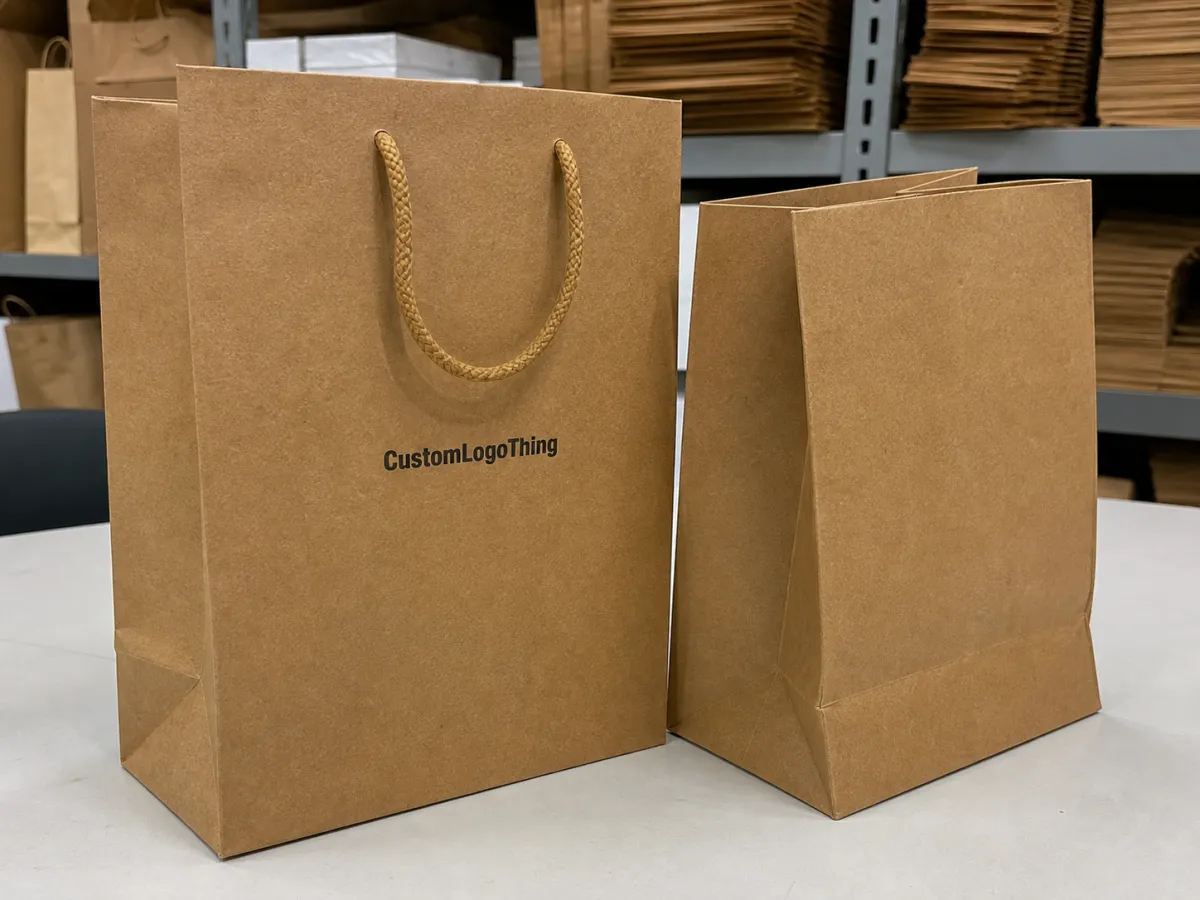
A well-made bag uses fewer parts than a gift box. That sounds obvious, but people still miss it in sourcing meetings. A rigid box might need board, wrap, inserts, magnets, ribbons, and manual assembly. A kraft bag usually needs the bag body, a handle, print, and a simple pack method. Fewer components mean less labor, less storage, and fewer chances to wreck your margin on the back end.
That matters for onboarding kits, holiday mailers, event swag, and client gifts. Those programs need presentation, but they do not always need luxury packaging theater. A clean kraft bag gives you branding surface area, decent protection, and fast handling. For short-notice campaigns, that is often the practical choice. You want the gift to arrive looking organized, not like it took a week of hand assembly to make a company lunch bag feel sacred.
From a buyer's point of view, the real decision is landed cost versus perceived value. The bag itself may cost less than a box, but the whole job can still become expensive if the supplier quotes loosely on freight, overpacks cartons, or adds extra setup charges after approval. That is why I tell buyers to request unit cost and landed cost separately. One is the factory price. The other is what finance actually cares about.
For packaging teams that care about materials, kraft paper also fits better into common sustainability language. If the stock is FSC certified and made with recycled materials or post-consumer waste content, the bag can support a greener procurement story without needing a lecture from marketing. If the project has a disposal angle, it helps to check whether the structure stays within normal biodegradable packaging claims. Do not overpromise here. Claims should match the paper, ink, and coating spec, not the mood board.
A cheaper-looking box is not always the cheaper option. Once you count assembly time, storage, and freight, kraft bags often win on total spend.
Bag styles and add-ons that fit corporate gifts
Not every kraft bag fits every gift. Light items can live in a flat kraft bag or a slim die-cut handle style. Heavier kits need a gusseted shopper with a reinforced bottom. If you are packing bottles, boxed merchandise, or a set with multiple items, you want structure first and decoration second. A bag that looks pretty and collapses under weight is not premium. It is annoying.
Here is the basic logic buyers use when choosing format:
- Flat kraft bags work for light giveaways, brochures, small apparel, and mail-friendly kits.
- Gusseted shoppers suit retail-style gifting, stationery sets, and medium-weight presents.
- Reinforced bottoms help with heavier loads and reduce embarrassing failures at handoff.
- Rope-handle bags look more polished and usually support a stronger brand presentation.
- Die-cut handles keep the silhouette simple and can lower cost on smaller or lighter runs.
Add-ons change the mood quickly. Reinforced handles make the bag feel more credible. Inside print adds polish. Foil, embossing, and matte lamination push the presentation up another level. None of that is free. But sometimes the upgrade is worth it, especially for executive gifts, award packages, or high-touch client mailers where the packaging needs to carry some of the brand weight before the product is even seen.
If budget is tight, stay disciplined. Standard kraft stock, one-sided print, and a single handle style usually keep the order cleaner and cheaper. The quickest way to inflate a quote is to ask for five upgrades that each sound small on their own. Printing and finishing always behave like that: one little “yes” becomes three extra processes before lunch.
| Bag style | Typical use | Relative unit cost | Presentation level |
|---|---|---|---|
| Flat kraft bag | Light giveaways, mailers, inserts | Low | Simple |
| Die-cut handle bag | Events, brochures, small kits | Low to medium | Clean |
| Gusseted shopper | Clothing, curated gift sets | Medium | Better structure |
| Rope-handle bag with reinforcement | Executive gifts, premium client kits | Medium to high | Most polished |
For brand teams comparing options, I usually recommend a simple decision split: standardize the base bag, then upgrade only the touchpoints the recipient will actually notice. A tasteful handle, sharp logo placement, and reliable structure will do more for perception than a pile of decorative extras.
Specifications to lock before you request a quote
Quotes go sideways when the spec is vague. The supplier cannot price what you have not defined. Before you send artwork, lock these basics: finished size, gusset depth, paper weight, handle type, print area, and reinforcement points. If you skip those details, you will get a polite-looking estimate that is only accurate by coincidence.
Size is a bigger driver than most people think. A small dimensional change can affect material usage, carton count, and freight efficiency. If a bag must fit a rigid insert or a boxed item, measure the actual packed product, not the fantasy version someone wrote in a deck. Packaging always reveals the truth eventually.
Artwork details matter just as much. Confirm the number of print colors, PMS targets, logo placement, bleed, and whether the artwork wraps the side panels. If the brand insists on exact color matching, say so up front. If not, a controlled tolerance may save money and reduce rework. Good suppliers will tell you where the limits are instead of pretending every print run is a gallery piece.
Order data also speeds things up. Share quantity, delivery ZIP or port, packaging method, and whether the bags must ship flat, assembled, or nested. A quote for flat-packed bags is not directly comparable to one for pre-assembled bags. Different handling, different freight, different final number. Amazing how often that gets forgotten right before approval.
If you want a useful sustainability angle, ask for paper source details. Is the kraft paper FSC certified? Does it contain post-consumer waste? Is the coating water-based or film-based? Those answers matter more than a vague “eco-friendly” note. For traceability and sourcing language, the FSC standard is worth checking directly at fsc.org. If you are comparing print and packaging waste assumptions, the EPA’s materials guidance at epa.gov is a decent reference point.
Corporate gifting kraft paper bags unit cost: what drives the number
The phrase corporate gifting Kraft Paper Bags unit cost sounds narrow. It is not. The price moves with quantity, paper grade, bag size, handle style, print colors, finish, and reinforcement. A plain natural kraft bag in a standard size with one-color print will sit far below a premium rope-handle version with foil and lamination. No mystery there. Just math.
The biggest variable is quantity. Setup cost gets spread across more units as the run gets larger, so the unit cost drops sharply at certain breakpoints. That is why a 500-piece order can look expensive, while 5,000 pieces often feel more reasonable per bag. MOQ exists for a reason: dies, plates, machine setup, and operator time have to be paid before the first usable bag lands in the carton.
Typical pricing bands vary by spec, but these rough ranges help buyers sanity-check quotes:
- Simple printed flat bag: about $0.18-$0.35 per unit at 1,000-5,000 pieces.
- Gusseted kraft shopper with one-color print: about $0.30-$0.65 per unit depending on size and paper weight.
- Premium rope-handle bag with reinforcement or special finish: often $0.70-$1.50+ per unit for smaller runs.
Those are not universal prices. They move with market conditions, paper grade, and destination. But they are useful enough to catch a quote that is wildly off. If a supplier offers a premium build at the same price as a basic bag, check the spec twice. Either something is missing, or someone is planning to recover the gap elsewhere.
Do not mix up unit cost and landed cost. Freight, duties, carton packs, and local delivery can matter as much as the bag itself. A low factory quote with expensive shipping is still an expensive order. When comparing vendors, make sure every line uses the same artwork coverage, the same carton assumptions, the same shipping terms, and the same packing format. Otherwise you are not comparing quotes. You are comparing fiction.
For buyers who want a cleaner purchasing framework, I like this order of priority: choose the right structure, define the minimum acceptable finish, then ask for a low-cost option and a presentation-first option. That way the team can see the spread without forcing one supplier to guess what “nice” means.
Production steps and lead time from proof to shipment
Good bag orders follow a predictable path: quote approval, dieline confirmation, artwork proof, sample or digital proof, production, QC, packing, and dispatch. If any of those steps are rushed, the risk shows up later. Usually as a correction that costs time and money. The machine is never the problem at the beginning. The missing dimension is.
Lead time depends on complexity. A simple printed bag with standard kraft paper can move faster than a custom handle, foil detail, or large quantity order. Standard production often runs around 10-20 working days after proof approval, with a few days more if the order needs special finishing or has multiple SKUs. Faster is possible, but only when the material is in stock and the artwork is clean.
Most delays come from avoidable problems: late artwork, missing PMS references, vague size instructions, or buyers changing the spec after proof approval. If you need a real deadline, ask for the proof approval cutoff, estimated production window, packing date, and shipping method before you pay. That gives everyone one calendar to follow instead of three people arguing over what “soon” means.
For projects that need cargo handling or transit discipline, ask how the supplier tests the pack-out. International packaging references such as ISTA are useful if the bags are traveling with heavier gift kits or fragile inserts. You can review their standards at ista.org. If a supplier cannot explain how their packing format protects the contents, they are not really quoting a packaging solution. They are quoting a box of paper with a handle.
One more practical point: keep the production calendar honest. If the event date is fixed, build in buffer. Freight can slip. Artwork can stall. Holidays can slow a line. Buyers who plan with a small cushion usually pay less in panic fees than the ones who try to rescue a launch on three days' notice.
What a reliable kraft bag supplier should prove before you buy
Sales talk is cheap. The proof points are not. A reliable supplier should give you a clear quote, a clean spec sheet, sample photos, material disclosure, and a defined QC process. If they cannot explain what is included, what is excluded, and what changes the price, then you are still in the guessing stage.
Good service also shows up in response quality. Fast replies are nice, but useful replies matter more. The supplier should be willing to quote multiple options, explain the tradeoffs, and tell you where the unit cost changes. A real partner does not hide behind one “best price” and hope you do not ask questions. That trick works exactly once.
Consistency matters more for corporate gifting than for random promo runs. A repeat order must match the last one or the brand presentation starts looking sloppy. If the first batch had a slightly warmer kraft tone, and the second one shows up with a different handle color or thinner board, the whole program feels off. Buyers should ask how repeat production is controlled and whether prior specs can be matched on reorders.
Before placing a larger order, test the supplier on four points:
- Ask for prior work with similar bag size and finish.
- Confirm carton packing standards and unit count per carton.
- Request a sample if the order is large or the gift is heavy.
- Check whether the quote includes freight, duties, and delivery to your actual location.
That is not overcautious. It is normal buying discipline. In packaging, the people who ask clear questions usually get clearer orders. Everyone else ends up approving a spec they barely remember reading.
For teams comparing recycled materials, ask whether the paper weight and fiber mix support the presentation you want. Kraft paper with a recycled content story can still look sharp if the stock is chosen well and the print is controlled. It does not need to look rough to be responsible.
Quality checks, shipping format, and storage details to confirm
Quality failures on bags are rarely dramatic. They are embarrassing. A handle pulls loose, a fold line cracks, the print scuffs, or the bottom gives way when the bag is loaded. That is why the basic checks matter: handle pull strength, print rub resistance, base strength, and clean fold lines. If the bag fails at handoff, nobody is admiring the logo.
Shipping format changes both cost and usability. Flat-packed bags save freight and warehouse space. Assembled bags are faster for event staff or retail teams that need immediate handout readiness. Neither option is universally right. Pick the one that matches how the bags will be used, not the one that sounds more impressive in a meeting.
Storage is another sneaky factor. Kraft paper absorbs moisture. Compression can crush handles or warp the fold. Stacking too high can flatten the shape before the bags ever reach the gift table. If your receiving team stores packaging in a humid back room, ask for pack-out that tolerates the environment better. Paper is forgiving, but it is not invincible.
Also confirm tolerances. Ask about overrun or underrun percentage, carton count variance, and what happens if a batch misses the agreed spec. That is where supplier professionalism shows up. A straight answer is better than a cheerful promise that disappears the moment there is a problem.
If the order is meant to carry a sustainability message, keep the claim language grounded. Biodegradable packaging is a useful term only when the material, coatings, inks, and disposal conditions support it. Otherwise, say recycled content, recyclable fiber, or FSC certified paper if that is what you actually have. Precision beats marketing fluff every time.
Next steps to get an accurate quote and place the order
Send the supplier the details that matter first: quantity, finished size, artwork file, handle choice, print colors, delivery address, and target in-hand date. If you want a useful answer, give useful inputs. A vague request produces a vague number. Then everyone wastes time pretending the first quote was “close.”
Ask for two quote options. One should be the lowest practical version. The other should be the presentation-first version. That comparison helps your team decide whether an upgrade is worth the spend. Sometimes it is. Sometimes it is just a fancy way to spend money on a handle nobody will remember.
Before payment, confirm the final proof, production timeline, shipping terms, carton pack, and any backup plan for rush delivery. If the job has a hard event date, build buffer into the schedule. A clean production plan beats an expensive emergency every time.
If you need a clean procurement rhythm, use this simple sequence:
- Gather specs and artwork.
- Request the quote in one format across vendors.
- Compare corporate gifting kraft paper bags unit cost and landed cost side by side.
- Approve proof only after carton and shipping details are locked.
- Place the order early enough to leave room for normal production reality.
That is how you keep the budget honest and the bags useful. If you want custom gifting packaging that looks good without blowing the spend, the smartest move is still the same: define the spec tightly, compare quotes on the same basis, and keep your eye on Corporate Gifting Kraft Paper Bags unit cost from first quote to final delivery.
What affects corporate gifting kraft paper bag unit cost the most?
Quantity usually matters first because setup costs are spread across more bags as the run gets larger. Paper weight, bag size, handle style, print colors, and special finishes all push the price up or down. Freight, carton packing, and delivery location can change the landed cost more than buyers expect.
What MOQ should I expect for printed kraft paper gift bags?
Simple one-color runs often start around 500 to 1,000 bags, but exact MOQ depends on the factory setup. Custom handles, heavy board, foil, or multi-color printing usually raise the minimum order. If you need several sizes, ask whether the supplier can combine them under one material spec.
How long does production usually take for corporate gifting bags?
Proofing can take a few days if artwork is clean and the dieline is already set. Standard production often runs about 10 to 20 working days after proof approval, depending on quantity and finish. Rush orders are possible, but only when the design is simple and the supplier has the material in stock.
What should I send to get an accurate corporate gifting kraft paper bags quote?
Send the finished size, quantity, paper weight, handle type, print colors, and artwork file. Add the delivery address or port, target in-hand date, and any carton or packing requirements. If you want a clean comparison, ask for the quote in the same spec format across every supplier.
How can I lower kraft paper bag pricing without making the bags look cheap?
Use standard sizes, limit print colors, and avoid special finishes unless they are doing real work for the brand. Choose a simple handle and a clean one-sided layout instead of expensive full-wrap decoration. Order enough quantity to push down setup cost, because tiny runs are where unit cost gets silly.


