For corporate buyers, Corporate Gifting Kraft Paper Bags cost is rarely a minor packaging line. It affects how polished the gift feels, how much freight the program absorbs, how much storage space the bags consume, and how forgiving the order is when deadlines tighten. Kraft paper bags usually sit below rigid boxes on unit price, but the real value comes from the whole system around them: less bulk, simpler packing, and a cleaner path from production to delivery.
That is why these bags keep showing up in client gift sets, holiday mailers, event kits, and employee recognition packs. A good kraft bag does not need to shout. It needs the right paper weight, a handle that suits the contents, and print that looks deliberate instead of crowded. When those pieces line up, the package feels more expensive than the material suggests.
The hard part is not finding a low quote. It is finding a quote that survives the full order cycle. A cheap price that leaves out tooling, cartons, sample freight, or rush handling is not really cheap. A slightly higher number with clear assumptions often ends up being the safer buy.
Why Kraft Paper Gift Bags Often Beat Costly Rigid Boxes
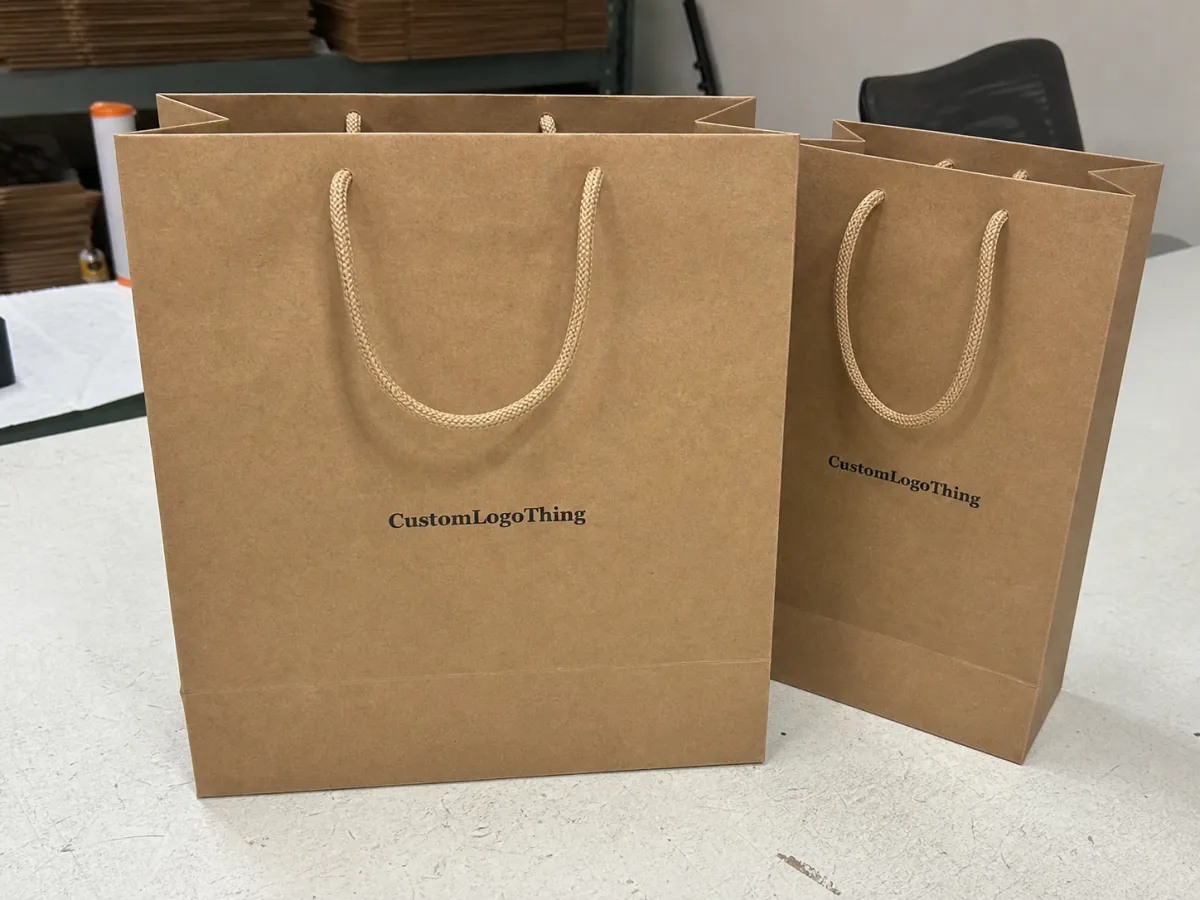
Rigid boxes still make sense for high-end launches and gifts that need a structured reveal. For most corporate programs, though, they bring more cost than benefit. They take up more storage, use more material, and usually require more hands-on packing. That is where corporate gifting Kraft Paper Bags cost starts to look very practical.
A flat-pack kraft bag is easier to store and cheaper to move. It ships with less dead space, fills cartons efficiently, and does not ask the warehouse to manage bulky box shells before the gifts are packed. Those savings matter in real operations. A packaging style that saves even 20 to 30 seconds per kit can free up hours on a larger fulfillment run.
There is also a visual misconception worth correcting. Premium does not always mean rigid. A 300gsm or 350gsm kraft board bag with reinforced top edges, a sturdy base, and crisp logo placement can feel more intentional than a heavy box with weak branding. The look is simpler, but the impression is sharper.
Print discipline does more work than many buyers expect. A restrained layout, enough white space, and the right ink contrast can make a brown bag feel considered rather than generic. By contrast, too much coverage, small type, or a logo squeezed into the wrong panel can make even a higher-cost bag look ordinary. That is a common mistake on corporate gifting runs: the brand tries to do too much and the package loses clarity.
The freight side deserves equal attention. Kraft bags usually compress better than rigid cartons, which reduces both inbound volume and outer carton count. That lower cube matters because it can cut transportation cost and lower the chance of damage during handling. The outer packaging still matters, of course. A premium bag packed into weak corrugated cardboard cartons can still arrive bent, crushed, or dirty.
Sustainability claims also need to be grounded in the actual build. Brown paper is not automatically recyclable, and recycled content alone does not settle the issue. Laminations, heavy coatings, mixed-material handles, and specialty inks can change the recycling path. If your procurement team needs FSC certified material, chain-of-custody paperwork should be part of the brief from the beginning. The same is true for post-consumer waste claims and any wording around biodegradable packaging. The construction has to match the claim.
A corporate bag has to look premium at arm's length and survive the delivery chain. If it fails either test, the savings are not real.
That is why comparison shopping should focus on total spend efficiency, not on bag price alone. For a lot of teams, Kraft Paper Bags hit the sweet spot: decent shelf impact, manageable storage, and a cost structure that leaves room for better contents.
Bag Styles, Handles, and Finish Options That Shape the Order
Bag style has a direct effect on both appearance and pricing. Flat-handle bags tend to be the lowest-cost option and work well for handouts, brochures, and lighter gift sets. Twisted-handle bags feel a bit more finished and are common for retail-style corporate gifting. Rope handles usually push the bag into a more premium lane and are often used for executive gifts, hospitality packs, and higher-value brand programs. Die-cut handles remove the separate handle component and can simplify assembly, though the comfort and strength depend on the board weight and reinforcement at the cut.
For a corporate pack, reinforced gift bag formats are common because they support boxed gifts, apparel, bottles, or multi-item kits without losing shape. Windowed bags can work when the contents are part of the presentation, but the window adds cost and can complicate recycling claims. The cleaner route is often a well-proportioned bag with a solid front panel and a logo placed exactly where it reads best.
Paper weight matters more than most buyers realize. A 200gsm or 250gsm kraft stock can be fine for catalogs, soft goods, or small handouts. Once the contents start adding weight or need a more rigid presentation, 300gsm to 350gsm becomes a safer range. That extra board helps the bag hold its shape and reduces the chance of base failure during transit or event distribution.
Finish options can change the quote quickly. Matte lamination protects print and gives the surface a smoother feel, but it adds a film layer and may affect recyclability. Spot UV can make a logo stand out. Foil creates a strong visual contrast on darker kraft stock, though it requires careful registration and a setup step that adds time and cost. Embossing adds texture and a more tactile feel, but it also brings tooling and press pressure into the equation. Inside print can look impressive, but it only makes sense when the contents and budget justify the extra production steps.
Handle choice is not a decorative afterthought. Rope handles often need different attachment work and can require reinforcement at the top edge. Wider gussets improve usability for boxed gifts, but they also consume more paper and increase the shipping cube. A deeper base can make the bag easier to pack, yet it may reduce how many units fit in a carton. Every change has a downstream effect.
The practical rule is simple: choose the lightest structure that still supports the gift and keeps the bag looking neat after handling. Any upgrade beyond that should have a brand reason behind it, not just a habit from a previous order.
Specifications Buyers Need Before Requesting a Quote
Many quotes look inconsistent because the brief is incomplete. If the supplier does not receive the same details every time, the numbers are not comparable. At minimum, send the finished bag dimensions, paper weight, print colors, artwork coverage, handle type, carton pack count, and delivery destination. Without those points, corporate gifting Kraft Paper Bags cost becomes a rough guess instead of a useful procurement figure.
Dimensions are especially important. A change of 20 mm in width or depth can alter paper usage enough to shift pricing, particularly at scale. It also affects carton packing efficiency, which affects freight. A small size change that seems harmless on a drawing can move the landed cost more than expected.
Artwork needs the same discipline. Ask for file format requirements, Pantone targets, safe zones, minimum line thickness, and the exact logo placement rules. Kraft paper does not behave like coated art paper. Fine lines can break up, small text can disappear into the fibers, and low-contrast colors can print flatter than the brand team expects. If brand color accuracy matters, say so before the quote is finalized. Do not assume the brown stock will carry color the same way white stock does.
Physical samples help when the program is sensitive. That is especially true for VIP gifts, launch events, and holiday packages where the bag is part of the perceived value. A prototype can show whether the logo sits cleanly, whether the handles are balanced, and whether the proportions feel right in the hand. It also catches simple issues that can be hard to see on a flat proof, such as gusset depth, base stiffness, or the way the artwork wraps around a panel.
Buyers who need sustainability language should request it in the brief, not after the quote arrives. If the order needs FSC certified stock, a recycled-content target, or a recycling statement that the legal team can stand behind, that should be built into the spec. Some bag constructions can support a greener story. Others cannot because of coatings, foil, lamination, or handle materials. Honest sourcing starts with accurate language.
For teams that want a reference point on standards, groups such as packaging.org and transit-testing bodies like ISTA are useful benchmarks. They are not part of every order, but they help frame durability expectations and carton handling when a program is moving through more than one shipping stage.
A good procurement brief reads like a working specification. If it is vague, the quote will be vague. If it is tight, the numbers become much easier to defend.
Corporate Gifting Kraft Paper Bags Cost: MOQ and Unit Pricing
This is where the budget conversation gets concrete. Corporate gifting Kraft Paper Bags cost changes with size, paper weight, handle structure, print coverage, finishing, packing format, and ship-to location. MOQ matters because setup costs are spread over fewer units on smaller runs. A 500-piece order will almost always cost more per bag than a 5,000-piece order, even if the bag design is identical.
For a simple custom kraft bag with a single-color logo, buyers may see planning ranges around $0.18 to $0.35 per unit at higher volumes, depending on the dimensions and handle type. A premium rope-handle bag with heavier board and more coverage can move into the $0.45 to $0.85 range at similar volumes. Smaller runs are usually more expensive because die cutting, press setup, proofing, and labor do not scale down as quickly as quantity does.
That is the part many budgets miss. Material cost is only one slice. Machine time, hand assembly, waste allowance, inspection, and packing all sit inside the final number.
The table below gives a practical planning view. These are not fixed rates, but they help buyers understand the tier before asking for a formal quote.
| Bag type | Typical spec | Common MOQ | Indicative unit cost | Best use |
|---|---|---|---|---|
| Plain kraft gift bag | 200gsm, twisted handle, 1-color logo | 1,000-2,000 pcs | $0.18-$0.32 | Seminars, brochures, simple kits |
| Mid-tier branded bag | 250gsm-300gsm, reinforced base, 1-2 colors | 1,500-3,000 pcs | $0.28-$0.48 | Client gifts, retail-style giveaways |
| Premium presentation bag | 300gsm-350gsm, rope handle, foil or emboss | 3,000-5,000 pcs | $0.45-$0.85 | Executive gifting, launches, hospitality |
Two quotes can look similar on paper and still diverge badly once the order is landed. Tooling, plates, sample freight, carton labeling, customs duty, and rush production can each add cost. If you only compare the bag line and ignore the rest, the cheapest quote may end up being the most expensive order.
Request the same spec across at least three quantity tiers. That shows the break point where scale starts to reduce the unit cost. Also ask how the bags are packed into cartons. Bag count per carton, carton strength, and packing orientation affect both freight and damage risk. Corporate gifting kraft paper bags cost should be read as a landed number, not a factory-floor number.
A clean buying habit is to standardize the assumptions. Same dimensions, same handle, same print coverage, same delivery terms, same packing format. That is the only fair way to compare one proposal against another.
Production Steps and Timeline From Artwork to Delivery
Most delays happen before the press starts. The usual path is quote, spec confirmation, artwork review, proof approval, sample sign-off, production, inspection, and shipping. If any one of those steps is unclear, the schedule slips. For that reason, the ship date should be fixed first, then the rest of the timeline should work backward from it.
For a straightforward bag with standard printing, production often takes about 12 to 18 business days after proof approval. More complex work can stretch to 18 to 25 business days, especially if the order includes foil, embossing, special handle assembly, or inside printing. Sampling can add a few days if the buyer wants a physical prototype before the full run. Freight has its own timeline, and it gets less forgiving during holiday season or event-heavy months.
Seasonality is a real production constraint. End-of-year gifting, trade-show periods, and launch calendars can fill capacity quickly. A supplier who turns an order quickly in a quiet month may not have the same room for a rush job in peak season. That is not unusual. It is just how factory planning works.
Artwork readiness is another common bottleneck. Files that need logo cleanup, size correction, or color adjustment slow everything down. If the bag uses multiple print zones, every zone adds a review step. The safest path is to send print-ready art matched to the dieline instead of asking the supplier to guess at layout decisions.
Transit planning matters too. If the bags are part of a larger kit, ask how the cartons will be packed and whether the outer packaging can survive the route. That is where corrugated cardboard quality becomes a practical issue rather than a packaging footnote. A premium inner bag in a weak shipper carton still arrives damaged. For orders that will be handled multiple times, an ISTA-style transit mindset is a smart baseline.
One useful rule: approve artwork early, sample only what needs sampling, and leave space for freight delays. Last-minute changes hit every part of the schedule and often create more cost than the buyer expected. If the gift date is fixed, the order has to be planned with buffer time built in from the start.
Planning note: if the program must arrive by a specific date, do not wait until the week of launch to lock the spec. That is the fastest way to lose both time and budget.
What a Dependable Supplier Should Prove Before You Order
Price matters, but proof matters more. A dependable supplier should be able to explain their material sources, production steps, quality control checks, and revision process without hesitation. If they cannot say how they check handle strength, registration, carton counts, and print consistency, that is a warning sign.
Responsiveness is more than customer service. Corporate gifting orders are deadline driven. They tie into conferences, holiday mailings, executive recognition, product launches, and staff events. If a supplier takes days to answer a basic spec question, the order risk rises before production even begins.
For brand-sensitive programs, ask for pre-production samples. For large-volume orders, ask how inspections are documented. For multi-drop programs, ask how they keep color consistency from one batch to the next. None of those questions are glamorous, but they reveal whether the supplier is set up for corporate work or only for quick spot orders.
Certifications are useful only when they connect to the actual build. FSC certified material is meaningful if the buyer needs chain-of-custody support. Post-consumer content claims matter if they are stated clearly and backed by the paper spec. A supplier should also be able to tell you whether a finish, coating, or mixed-material handle changes the recycling story. Claims without construction detail are not procurement-ready.
Good suppliers also push back when a spec is not practical. They may suggest a standard size to reduce waste, a simpler handle if the load is light, or fewer print colors if the visual return does not justify the extra cost. That kind of honesty is useful. It usually saves money and avoids packaging that tries too hard.
In practice, the best supplier is the one that reduces surprises. In corporate gifting, surprises usually cost more than they help.
Next Steps to Order the Right Gift Bag Program
If you want a quote that actually helps, gather five items first: bag size, quantity, print colors, target budget, and delivery date. Add the handle style and finish preference if those are already set. With that information in hand, the quote becomes a real planning tool instead of a vague number that only looks attractive on the surface.
For many teams, the cleanest approach is to request two or three spec-matched versions. One can be the practical baseline. One can be the upgraded presentation option. One can test a cost-saving change, such as fewer print colors or a simpler handle. That makes it much easier to see how corporate gifting kraft paper bags cost shifts with each specification decision.
If the order is brand-sensitive, time-sensitive, or tied to a premium reveal, ask for a sample or proof before the full run. That extra step is not wasted time. It protects against logo placement errors, awkward gusset proportions, weak handle alignment, and finishes that do not photograph well under event lighting.
There is a sensible middle ground for most programs. Standardize the size, keep the print focused, use recycled materials where they support the brand story, and reserve premium finishes like foil or embossing for the orders that truly need them. That is how buyers keep the budget under control without flattening the experience.
Handled well, this format does not feel like a compromise. It feels deliberate. That is why corporate gifting kraft paper bags cost remains such a practical benchmark for procurement teams that want good presentation, predictable MOQ planning, and a quote they can justify internally.
FAQ
How much do corporate gifting kraft paper bags cost per unit?
Unit price usually falls as quantity rises because setup, print, and handling costs are spread across more bags. A simple custom bag may land around $0.18 to $0.35 at higher volumes, while a premium version with heavier board, rope handles, or foil can run higher. Size, finish, carton count, and delivery location can move the final number quickly.
What MOQ should I expect for custom kraft paper gift bags?
MOQ depends on the construction and decoration. Simple one-color bags often start lower than multi-color or special-finish jobs. In many programs, 1,000 to 2,000 pieces is a realistic entry point for basic customization, while premium builds may need 3,000 pieces or more to price efficiently.
Which specification changes have the biggest impact on kraft bag pricing?
Paper weight and bag size usually move pricing the most because they change material usage. After that, print coverage, foil, embossing, rope handles, and reinforced bases can add meaningful cost. Shipping volume matters too, especially if the bags are bulky and packed in large cartons.
How long does production take after artwork approval?
Simple bags often take 12 to 18 business days after proof approval. More complex bags with special finishes, extra assembly, or sampling can take 18 to 25 business days or more. Add freight transit time and approval buffer so the order does not slip past the gift date.
How can I reduce corporate gifting kraft paper bags cost without lowering quality?
Use a standard size, reduce print colors, and skip special finishes unless they support the brand story. Consolidate quantity into one larger run if possible, and compare freight as carefully as the bag quote. In many cases, logistics affects the final landed cost almost as much as the bag itself.


