Buyer Fit Snapshot
| Best fit | Corrugated Boxes with Handles Wholesale projects where brand print, material claims, artwork control, MOQ, and repeat-order consistency need to be specified before quoting. |
|---|---|
| Quote inputs | Share finished size, material target, print colors, finish, packing count, annual reorder estimate, ship-to region, and any compliance wording. |
| Proofing check | Approve dieline scale, logo placement, barcode or warning zones, color tolerance, closure strength, and carton packing before bulk production. |
| Main risk | Vague material claims, crowded artwork, missing packing details, or unclear freight terms can make a low unit price expensive after revisions. |
Fast answer: Corrugated Boxes with Handles Wholesale: Specs & Pricing should be specified like a repeatable production item. The safest quote records material, print method, finish, artwork proof, packing count, and reorder notes in one written spec.
Production checks before approval
Compare the actual filled-product size with the drawing, then confirm tolerance on folds, seals, hang holes, label areas, and retail display edges. Reserve space for logos, QR codes, warning copy, and material claims before decorative graphics fill the panel.
Quote comparison points
Review material grade, print process, finish, sampling route, tooling charges, carton quantity, and freight assumptions side by side. A quote is only useful when the supplier can repeat the same color, closure quality, and packing count on the next order.
Corrugated Boxes with Handles Wholesale: Specs & Pricing
Corrugated boxes with handles wholesale earn their spot when a carton has to do three jobs at once: protect the product, stack neatly, and give someone a grip that does not feel like an afterthought. That sounds simple. It usually is not. A box can crush-test fine and still be annoying to move across a floor, into a truck, or through a stockroom. Handle cutouts change the way a package behaves in the hand, on a pallet, and during the last handoff at the door.
The value goes beyond convenience. Corrugated boxes with handles wholesale can reduce drops, hand strain, and the small slowdowns that stack up every time a carton changes hands. If a team is restocking shelves, splitting mixed orders, or moving bulk shipments through a warehouse, a built-in handle often does more useful work than a separate insert or carry bag ever will. The design still has to match the board grade, the product weight, and the route the carton takes. A handle that feels fine in a sample can fail fast if the structure around it is flimsy. And yes, that happens a lot more than people admit.
I have seen buyers focus on print and forget the grip. Then the first test run comes back and everyone realizes the box is awkward to lift. That kind of miss is annoying, expensive, and totally avoidable.
"A handle is not a convenience add-on; it is part of the load path."
Why Corrugated Boxes with Handles Wholesale Make Sense
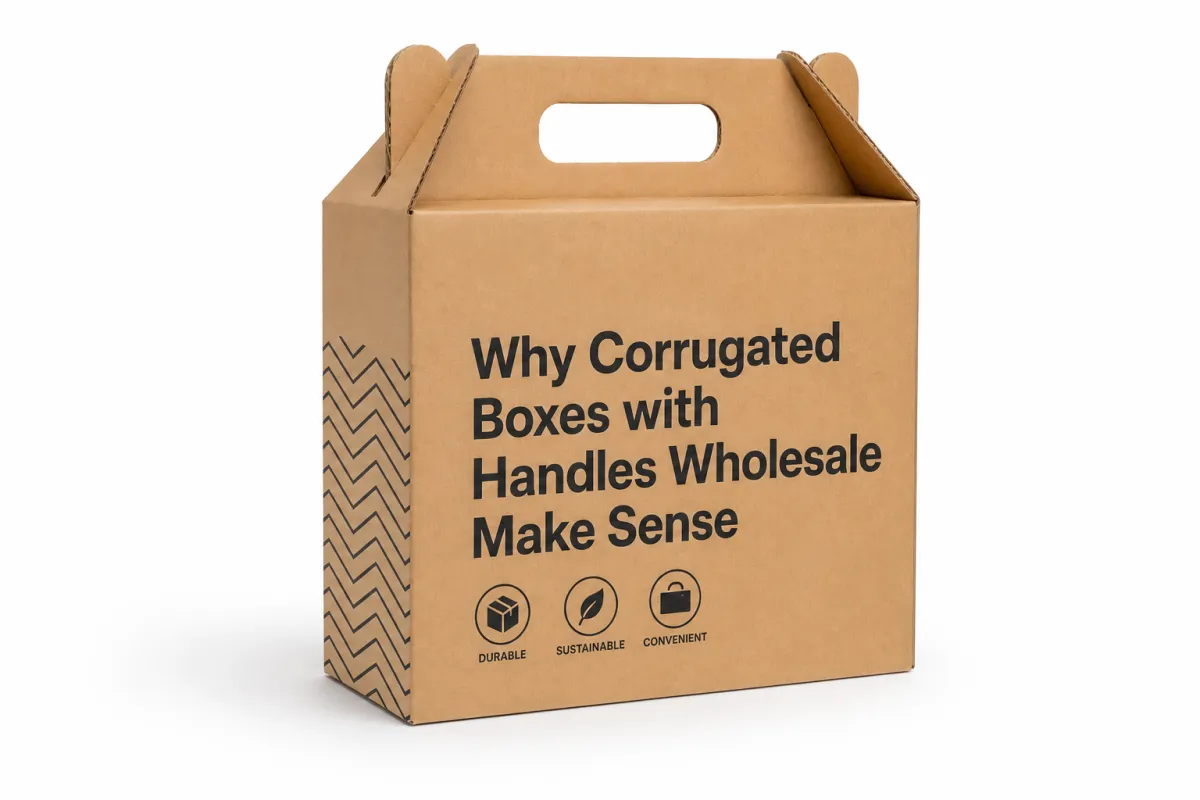
Corrugated boxes with handles wholesale make sense any time people have to lift cartons more than once. A box may live on a pallet for part of the trip, then become a hand-carried package near the end. That is where handle cutouts earn their keep. They give the hand a clean place to land, which matters when workers are moving dozens or hundreds of cartons and do not want to fight slick surfaces, sharp edges, or awkward wrist angles.
From the buyer's side, corrugated boxes with handles wholesale also keep the operation cleaner. There is no extra insert to source, no separate bag to fit, and no loose piece that shows up missing on production day. The handle is built into the carton, so the carry function and the protective function stay linked. That matters for warehouse teams, fulfillment centers, subscription brands, and retail replenishment programs where the box gets opened, lifted, carried, and stacked again before it reaches the customer.
Control is another reason buyers go this route. With corrugated boxes with handles wholesale, handle placement can be tuned to the product weight and the carry path. A low, centered grip may work for a shallow carton. A taller box may need more clearance and a wider opening to stay balanced. If one person is carrying it, the handle needs to keep the load steady instead of pulling the carton toward the heavy side. That sounds tiny until the first batch lands on the floor and everybody suddenly knows which cartons feel right and which ones feel like trouble.
I keep seeing the same mistake: treating the handle like a comfort feature instead of a structural one. Corrugated boxes with handles wholesale should be built around actual use. How many times will the carton be lifted? Will it be stacked? Will it ride in a truck? Will the person carrying it be wearing gloves? If the answer is yes to more than one of those, the handle area needs reinforcement and the board grade needs to match the job. A pretty box that tears at the grip is just a pretty problem.
For buyers comparing formats, it helps to think about the full handling cycle. A good carton should move from pack-out to storage to transit without drama. If your program also needs matching shipping formats, the Custom Shipping Boxes category is a useful place to compare structural styles built for shipping and carry use.
Box Construction, Handle Styles, and Performance
Corrugated boxes with handles wholesale can be built several ways, and the construction choice usually matters more than the artwork. Common starting points include regular slotted cartons, die-cut boxes, mailer-style structures, and reinforced carry boxes with hand holes or integrated side handles. Each behaves differently once product weight, stacking pressure, and repeated carrying are part of the picture.
Regular slotted cartons are familiar, efficient, and easy to scale, but they are not automatically the best carry solution. If the handle is cut into a standard RSC without reinforcement, the board around the opening can fatigue quickly under repeated lifting. Die-cut boxes often perform better because the handle geometry can be built into the full blank, which gives the converter more control over the side panels, folds, and stress points. Mailer-style cartons can work well for lighter retail packs, especially when the top closure helps hold the box together during repeated opening and closing. For heavier loads, reinforced carry boxes with hand holes or folded-in side handles usually make more sense because the extra layers around the opening help resist tearing and collapse.
Handle style should match the job. Die-cut hand holes fit lighter loads and shorter carry distances. Reinforced cutouts are better when the carton gets lifted often or when the load sits close to the handle area. Full-panel handles can work for retail totes or promo kits where presentation matters as much as strength. Corrugated boxes with handles wholesale should also be checked for grip comfort. An opening that is too narrow can be awkward with gloves. One that is too wide can create tear risk along the edge of the cut.
Flute direction is another detail buyers skip right past. The direction of the corrugated flute changes how the board resists bending and how the handle area holds up under stress. If the handle cut runs against a weak orientation, the panel can start to split sooner, especially when the box is lifted from the same spot again and again. Good structural work places the handle so the carton stays balanced, the center of gravity feels natural in the hand, and the panels do not sag under the product load. That part is not glamorous, but it is where the box either behaves or gets weird in use.
Balance matters just as much as strength. I have seen cartons that passed a basic compression check and still felt unstable because the handles were too high, too narrow, or offset from the load center. Corrugated boxes with handles wholesale should let the user carry the box without twisting the wrist or pinching the board. When the load sits evenly between both hands, the carton feels smaller, lighter, and safer, even if the actual filled weight has not changed.
- Die-cut hand holes work well for lighter cartons and simple carry patterns.
- Reinforced openings help the handle area survive repeated lifting.
- Mailer-style structures suit retail presentation and repeated opening.
- Full-panel handles matter when branding and grip quality both count.
If your handle box is part of a wider packaging program, compare it against the other formats in your line. Our Custom Packaging Products page helps map how different carton styles support shipping, display, and merchandising needs. The goal is not to force every project into one structure. The goal is to match the box to the movement pattern and the real load. That keeps the whole system calmer, and honestly, less annoying for everyone touching the carton.
Material Specs That Affect Strength and Print Results
Corrugated boxes with handles wholesale live or die by the board spec. A nice-looking blank does not help if the handle tears on the second lift. Single-wall corrugated is a common starting point and can be fine for many light-to-medium loads if the dimensions are sensible and the handle is reinforced. For heavier products, double-wall board brings more stiffness, more stacking confidence, and a better margin against flexing around the opening. In buyer terms, that usually means fewer surprises in transit and fewer damaged cartons at receiving.
Strength is usually measured with edge crush resistance and burst strength, and both matter in handle boxes. Edge crush resistance shows how the board performs in vertical stacking, which is critical when cartons are palletized or stored in columns. Burst strength is a useful indicator of board toughness, especially when the box faces rougher handling or internal pressure from dense product. Common commercial choices include 32 ECT and 44 ECT board, with heavier or more demanding cartons moving up to stronger constructions or double-wall builds. The right answer depends on the filled weight, the span of the panels, and how much stacking the box will see before it reaches the end user.
Heavier products often need more than a stronger board. Corrugated boxes with handles wholesale may need wider reinforcement around the handle, a different panel depth, or even a different carton style if the load is too concentrated for a basic cutout. A narrow hand hole on a dense carton creates a stress riser, which is the polite way of saying the board will fail where the pressure is concentrated. That is why filled weight matters so much. A 6-pound carton and a 26-pound carton are not asking the same thing from the handle area.
Dimensions shape performance too. A box with a wide panel span can bow even if the board grade looks fine on paper. The same thing happens when the product sits too far from the handle line, because the user feels extra torque during lifting. Corrugated boxes with handles wholesale should be sized to reduce dead air, but not so tightly that the load presses straight against the cutout. Good sizing balances product fit, stacking strength, and carry comfort. If the fit is too loose, the carton rattles. If it is too tight, the handle gets punished.
Print and finish choices matter as well. Kraft exteriors usually give a more natural, utilitarian look, while white exteriors create a brighter print canvas. Flexographic printing is common for corrugated because it scales well, but it has limits on fine detail, heavy solids, and tight registration on the flute pattern. Handle placement can shrink the usable branding area, so artwork should be planned around the cutout instead of being squeezed in after the fact. If the box needs a premium feel, a coated exterior or a cleaner print design can help, but the finish should never weaken the structure around the grip area. Fancy graphics do not save a bad cut line.
For buyers who care about sourcing and compliance, packaging choices can also connect to larger standards. Transit testing references from the International Safe Transit Association are a solid reference point for ship-ready packaging, while the FSC system helps buyers think about responsible fiber sourcing and chain of custody. Those standards do not replace a proper box design, but they do give wholesale buyers a better framework for evaluating suppliers. I like that kind of outside check because it cuts through marketing fluff pretty quickly.
Corrugated boxes with handles wholesale also need to be considered alongside print expectations. If the customer wants crisp logo placement and a handle opening at the same time, there may be tradeoffs in artwork placement, especially near fold lines. It is better to define those limits early than to discover them after plates or cutting tools are already in motion. Once the die is made, the carton is basically telling you what it can and cannot do.
Corrugated Boxes with Handles Wholesale Pricing and MOQ
Corrugated boxes with handles wholesale pricing comes down to a few clear variables: board grade, box size, handle reinforcement, print coverage, quantity tier, and whether the design needs a Custom Die Cut. If the carton can be built from an existing structure, setup cost is usually lower. If the handle is fully custom, the blank is oversized, or the print coverage is heavy, the price moves up because the converter needs more tooling, more setup time, or better sheet efficiency to make the run work.
The main thing Buyers Need to Know is that wholesale pricing improves with volume, but the break points are not always dramatic. Corrugated boxes with handles wholesale may get meaningfully cheaper at 3,000, 5,000, or 10,000 units, yet the real savings depend on how many cartons fit on a sheet, whether the style nests efficiently, and how much waste comes off the press and the cutter. A box that uses the board well can beat a cheaper-looking quote that burns more material per run. That part trips people up all the time because the lowest quote line is not always the lowest landed cost.
Minimum order quantity is tied to structure too. Simple stock-style die lines often allow lower MOQs because the tooling is standard and the setup is straightforward. Custom Handle Boxes with special dimensions or reinforced openings usually need a higher starting quantity because the die, sample approval, and production setup have to be spread over more units. That does not mean the project is too small. It means the economics are different. Corrugated boxes with handles wholesale should be quoted in a way that makes the quantity breakpoints easy to compare, not hidden behind a single number that sounds nice and tells you almost nothing.
For budgeting, ask for pricing by unit, by case pack, and by pallet. That gives you a more honest view of landed cost. A low unit price can still turn into an expensive order if the case pack is awkward, the pallet count is poor, or the freight dimension pushes the shipment into a higher class. Corrugated boxes with handles wholesale should be compared the way they will actually move through your operation, not just by the number on the quote sheet.
| Handle Style | Best For | Typical Wholesale Range at 5,000 Units | Notes |
|---|---|---|---|
| Die-cut hand holes in single-wall board | Light retail packs, short carry distances | $0.48-$0.82 per unit | Good value when weight is controlled and the box will not be lifted repeatedly. |
| Reinforced hand holes with added board layers | Warehouse movement, repeated lifting, moderate loads | $0.62-$1.05 per unit | Often the best balance of comfort, durability, and cost for corrugated boxes with handles wholesale. |
| Mailer-style carry box with handle feature | Retail presentation, subscription kits, branded delivery packs | $0.74-$1.25 per unit | Useful when opening, closing, and display value matter as much as shipping strength. |
| Double-wall reinforced carry box | Heavier products, stacked storage, tougher transport cycles | $1.10-$2.10 per unit | Higher cost, but often worth it when product weight or failure risk is real. |
Those ranges are ballpark figures, not fixed quotes, because corrugated boxes with handles wholesale can swing with board market conditions, print coverage, size efficiency, and freight terms. Still, they give buyers a useful starting point. If a supplier will not explain why a handle box costs more than a plain shipper, the quote is probably missing detail, not revealing some deep market mystery.
In practical terms, the cleanest way to compare suppliers is to ask them to quote the same spec package: box dimensions, filled weight, handle type, board grade, print colors, shipping destination, and target annual volume. That makes corrugated boxes with handles wholesale easier to evaluate across bidders, especially when one vendor is quoting a display-style carton and another is quoting a shipping-style carton that happens to have cutout handles.
From Quote to Delivery: Process and Timeline
The quote process should start with the product, not the box. For corrugated boxes with handles wholesale, the most useful inputs are the finished dimensions, the target weight, the desired handle style, the print requirements, and the shipping destination. If the product is fragile, dense, or oddly shaped, include that too. A good quote gets more accurate when the supplier understands how the carton will be packed, how often it will be lifted, and whether the box will be stacked in storage before it ships.
After the initial quote, the structural review matters just as much as the price. Corrugated boxes with handles wholesale should be checked through a dieline or structural spec before full production begins. That is where handle placement, flap geometry, reinforcement, and print windows get confirmed. If the handle is too close to a score line or too close to the edge of the panel, the carton may look fine on screen and fail on the floor. A sample or prototype is often the safest way to catch those problems before tooling is locked in. I would rather spend a few days there than explain a costly rerun later.
Typical timing works better when it is broken into stages instead of promised as one neat number. Quoting may take a day or two if the spec is clear. Artwork review can add another few days if files need cleanup or dieline adjustments. Samples may take roughly 5-7 business days depending on structure and finishing. Production for a straightforward repeat order often lands around 10-15 business days after approval, while a first-time custom build with new tooling can take longer, especially if the job needs a physical sample sign-off before release. Corrugated boxes with handles wholesale move faster when the customer sends dimensions, weight, print files, and destination together instead of dribbling the details out in separate messages. Nobody enjoys playing detective with half a spec.
Freight planning is part of the process too. A carton with handles may be easy to carry, but it still has to fit shipping realities such as pallet count, carton compression, and destination class. If the order is moving by truck, ask whether the cartons will ship flat or assembled, how many units fit per pallet, and whether moisture protection is needed for longer transit. Corrugated boxes with handles wholesale may look like a packaging decision, but they are also a logistics decision, and the delivery plan should reflect that.
Repeat orders tend to move faster because the structure is already approved. New custom builds usually need more back-and-forth, and that is normal. The mistake is not taking time for review. The mistake is skipping it and paying for it later in cracked handle edges, awkward carry balance, or print placement that crowds the structural cuts. A few extra days up front usually save more time than a rushed rerun after the cartons are already moving.
- Share dimensions, filled weight, and handle style in the first request.
- Confirm whether the carton will be carried, stacked, or both.
- Approve a sample or dieline before full production.
- Clarify shipping destination so freight and pallet counts are accurate.
Why Choose Custom Logo Things for Wholesale Orders
Custom Logo Things fits buyers who want packaging that performs on the floor the same way it looks on paper. For corrugated boxes with handles wholesale, that means focusing on fit, strength, and production reliability instead of empty claims. A buyer does not need hype. A buyer needs a carton that fits the product, a handle that holds under real use, and a quote that is clear enough to compare against other options.
Technical guidance matters because corrugated boxes with handles wholesale are not one-size-fits-all. A lightweight retail kit may need a clean die-cut grip and a bright printed exterior. A heavier fulfillment carton may need reinforced hand holes, a stronger board grade, and a more conservative panel span. Matching those details to the load is where a good packaging partner earns trust. It is also where communication pays off, because a supplier that asks the right questions early will usually save the customer from rework later.
Clear production communication is another reason wholesale buyers care about the right partner. If the handle location affects the print window, that should be said before plates or tooling are approved. If the board grade changes the feel of the carton in hand, that should be part of the discussion before the run starts. Corrugated boxes with handles wholesale are easier to manage when the supplier explains tradeoffs plainly: what improves grip quality, what raises cost, what affects lead time, and what keeps the box from overpromising in use.
Consistency matters too. Wholesale orders are rarely about one perfect sample. They are about the second, third, and tenth run looking like the first one. Buyers want cartons that stack the same way, fold the same way, and carry the same way every time. That kind of repeatability is not flashy, but it protects a packaging budget. If you are coordinating several package types at once, the Wholesale Programs page is a helpful reference for understanding how larger orders are structured across product categories.
There is also value in working with a supplier that can support broader packaging needs. Corrugated boxes with handles wholesale may be the immediate purchase, but many buyers also need cartons, inserts, branded shippers, and other components that all have to fit together. A single packaging partner that can think across the line is usually easier to manage than a scattered group of vendors, especially when schedules are tight and the product launch depends on packaging arriving in the right order.
For buyers who want to compare options across formats, the Custom Packaging Products page helps frame what is possible beyond a single carton style. That matters because the best packaging decision is not always the strongest box or the cheapest quote. Sometimes it is the box that carries well, prints cleanly, and lands in budget without creating handling problems later.
Corrugated boxes with handles wholesale work best when the supplier treats them as a real working package, not just a blank with cutouts. That mindset keeps the carton practical on the line, useful in transit, and comfortable for the person actually lifting it.
Next Steps for Corrugated Boxes with Handles Wholesale Orders
If you are getting ready to price corrugated boxes with handles wholesale, start with the basics. Measure the product carefully, confirm the filled weight, decide how the box will be carried, and note whether stacking strength matters in storage or transit. Those four inputs shape the right structure more than any generic description ever will. The clearer the use case, the cleaner the quote.
Next, gather the artwork, quantity target, and shipping destination. Corrugated boxes with handles wholesale get much easier to quote when the supplier can see the structural side and the commercial side at the same time. A good quote should tell you the unit cost, any setup or tooling charge, the MOQ, and the lead time by stage so you can compare apples to apples.
If the handle location, board grade, or print area is new, request a sample or dieline. That is usually the fastest way to catch fit issues before a full run. It is much cheaper to correct a handle cutout on a sample than to discover, after production, that the grip is too tight, the box feels unbalanced, or the artwork was placed too close to the reinforcement. Corrugated boxes with handles wholesale work best when the prototype confirms the real handling experience.
One more practical point: do not skip freight and pallet planning. A well-designed carton that ships badly is still a problem. Ask how the cartons will be packed, how many fit per pallet, and whether there are any moisture or compression concerns. Corrugated boxes with handles wholesale should support the whole journey, not just the first lift. If the box is easy to carry but awful to ship, the design is only half done.
Send the dimensions, filled weight, artwork, and shipping details, and the quote can be built around the real use conditions rather than a guess. That is the simplest way to get corrugated boxes with handles wholesale that fit the product, the budget, and the handling routine at the same time. Start with the load, the lift, and the route. Everything else should serve those three things.
Frequently Asked Questions
What is the minimum order for corrugated boxes with handles wholesale?
Minimums depend on whether the box uses a stock-style dieline or a fully custom size with new tooling. Lower MOQs are often possible on simpler structures, while custom handle placement and print usually raise the starting quantity. Ask for pricing at several breakpoints so you can compare MOQ against unit cost and decide which run size makes the most sense for your budget. If a supplier can only quote one quantity, you are not really comparing options yet.
Which handle style works best for corrugated boxes with handles wholesale?
Die-cut hand holes are a good fit for lighter cartons and short carry distances. Reinforced handle cutouts are better when the box gets lifted often or carries a heavier load. If the carton will be moved repeatedly in a warehouse, ask for a style that balances comfort with tear resistance and does not place too much stress on one narrow edge. I usually tell buyers to start with the actual lift path, not the graphic they want on the front panel.
How much weight can corrugated boxes with handles wholesale carry?
Capacity depends on board grade, handle reinforcement, box size, and how the load is distributed inside the carton. A smaller, well-designed box may carry more safely than a larger box with a wide panel span and a weak handle area. Share the filled weight and the use case so the structure can be matched to the real load instead of guessed. If you want the honest answer, do not ask for a generic weight limit. Ask what the box will actually do.
What affects pricing on corrugated boxes with handles wholesale orders?
The biggest drivers are board strength, dimensions, custom cutting, print coverage, and total order quantity. Handle reinforcement and special finishes can add cost, but they may also reduce damage and make the carton more practical in use. Request quotes by unit, by case, and by pallet so the comparison reflects true landed cost rather than a single line item. That is the only way to keep the quote from looking cleaner than it really is.
How long does production take for corrugated boxes with handles wholesale?
Timing usually depends on whether the job uses an existing structure or needs new tooling and artwork approval. Simple repeat orders move faster than first-time custom builds, especially when samples are required before production. The fastest way to keep the schedule moving is to submit dimensions, quantity, print files, and shipping details together. If you send one piece at a time, the calendar gets dragged out for no good reason.


