The phrase jewelry Ribbed Winter Beanies Material Sample guide sounds narrow because the buying decision is narrow. A ribbed beanie can look nearly identical in a listing photo and still behave very differently once the yarn, cuff, label, and jewelry-style trim are all under tension. One version springs back cleanly. Another grows baggy by the third try-on and starts sitting low across the forehead. The sample is where that difference shows up.
For buyers sourcing custom headwear, the sample is not paperwork and it is not a ceremonial first step before bulk. It is the only practical way to check whether the knit, decoration, and packaging work together in real conditions. That means fit, stretch recovery, stitch definition, trim balance, and comfort against skin. A flat swatch cannot answer those questions. A finished sample can.
A swatch tells you the yarn. A finished sample tells you the product.
That distinction matters more in Ribbed Winter Beanies than many categories. The construction is elastic by design, so small changes in gauge or yarn twist can alter the silhouette. Add a metal tag, charm, or other jewelry-inspired accent near the cuff and the stakes rise again. Weight, placement, and stitch density all start influencing how the beanie sits. The sample is where those forces either line up or clash.
Jewelry Ribbed Winter Beanies Material Sample: What It Reveals
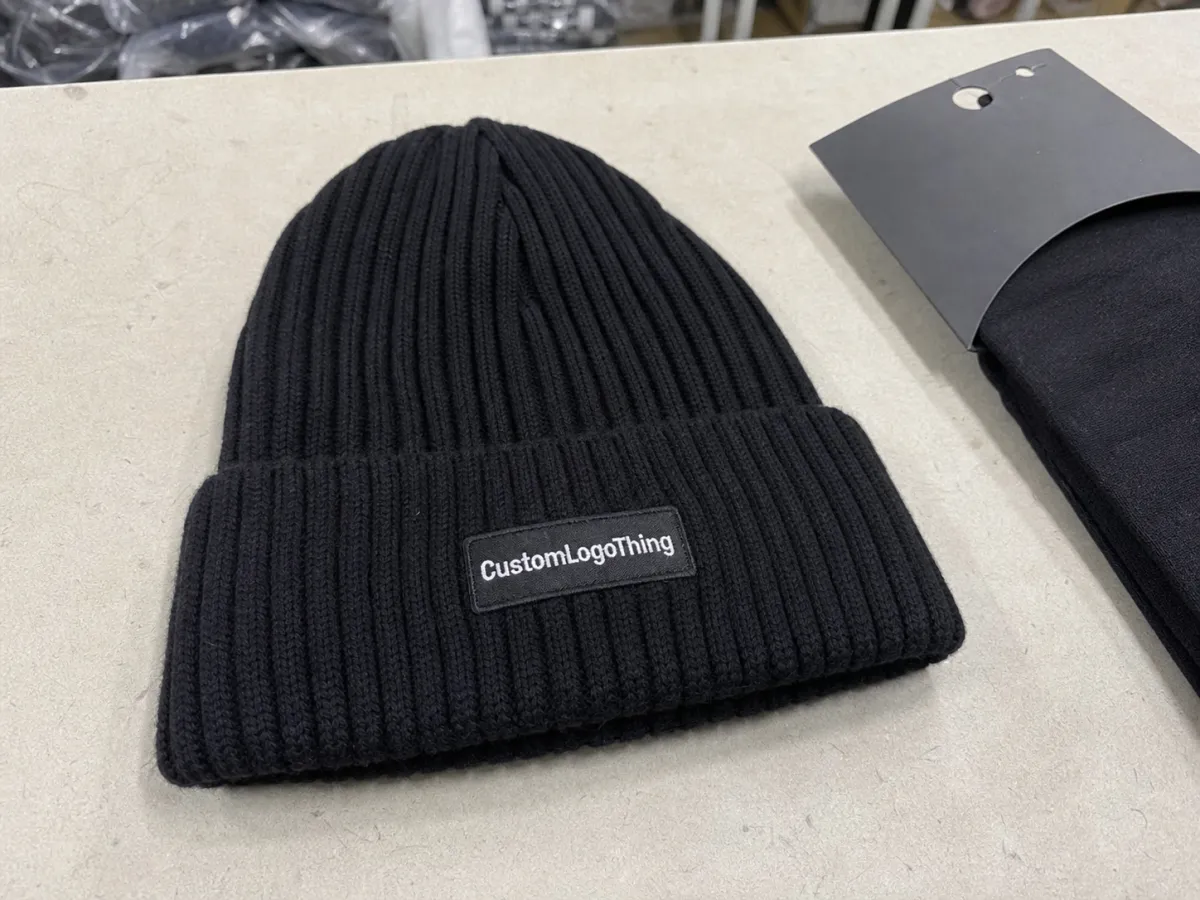
A good sample shows the gap between a supplier’s rendering and the actual hand feel of the product. Rib knit is forgiving, but it is not indifferent. A tight 2x2 rib usually recovers better than a looser structure, while a softer knit may feel nicer at first touch yet lose shape faster after repeated wear. That tradeoff is not visible in a product image, and it is rarely obvious from a spec sheet alone.
Decoration changes the equation. A beanie with a light woven label behaves differently from one with a rigid metal badge, stitched charm, or layered patch. Put that detail near the hem and it can tug the edge out of line. Put it on a side panel and it may shift the fabric into a slight wave. On a headform, those distortions can be subtle. On a customer’s head, they are obvious.
This is why the sample should be evaluated as a set of competing priorities rather than a checklist of isolated parts. Does it feel premium enough for the target price? Does the cuff recover after being stretched? Does the decoration sit flat or tilt once tension is applied? A well-made sample answers those questions at once. It does not merely look “close.”
Experienced buyers usually look for four things first: hand feel, stretch recovery, visual balance, and wear comfort. If one of those fails, the rest matter less. A soft beanie that itches will still get complaints. A polished trim that pulls the knit sideways will still be returned. That is the practical value of a jewelry Ribbed Winter Beanies Material Sample guide: it turns a style decision into a measurable approval process.
How Rib Knit, Yarn Weight, and Decoration Interact
Rib knit behaves a little like a spring. Pull it open and the loops widen; let go and the structure should contract again. That recovery depends on stitch density, yarn thickness, and fiber blend. A denser rib usually gives the beanie a cleaner outline and helps decoration sit more predictably. A looser knit can feel relaxed and softer, but the silhouette often looks less controlled, especially after wear.
Yarn weight changes both appearance and function. Finer yarns give sharper stitch definition, which helps if the design is meant to read neat and premium. Heavier yarns bring warmth and a substantial feel, but they can blur detail and make embellishments look bulkier than expected. A logo element that feels balanced in a sample photo may read oversized in person simply because the stitch scale is different.
There is also a practical production constraint here: the more decorative the trim, the more sensitive the knit becomes to placement and tension. A metal logo plate, stitched accent, or jewelry-style tab adds weight. That weight matters most near the most elastic part of the hat. If the edge is too soft, the trim pulls. If the edge is too firm, the beanie may lose the easy stretch that makes ribbed winter styles comfortable.
Finish treatments deserve attention too. Washing can soften the surface and settle the stitches. Brushing increases loft, which can improve warmth and visual fullness, but it can also blur definition and raise the risk of pilling. Anti-pilling finishes help, yet they are not a cure-all. A buyer should still inspect the sample for fuzzing near seams, loose fibers around the embellishment, and any twist distortion where the knit transitions into the cuff or crown.
For transport and comparison, sample condition matters almost as much as construction. A beanie that arrives compressed in transit can appear flatter than the production version actually is. Packaging guidance from ISTA is useful if you want to protect sample shape and keep approval conditions consistent across shipments.
Fiber Blend, Gauge, and Finish Factors to Compare
Fiber blend is one of the most important cost and quality levers in the program. Acrylic-heavy blends are common because they are budget-friendly, color-stable, and easier to source consistently. Wool-rich blends usually cost more, but they often deliver better warmth, a more premium hand feel, and a stronger seasonal story for retail. Recycled yarns sit somewhere in the middle, but they should be assessed carefully for consistency from lot to lot. Sustainable content only helps if the knit still performs.
Gauge also deserves close attention. In beanie production, common gauges often sit in the midrange rather than at the very fine end of knitwear. A tighter gauge tends to improve structure and support decoration. A looser gauge gives a softer drape, but the finished piece may feel less refined. If the product is meant to sit close to the face and frame the hairline, those differences are not cosmetic. They change how the item reads at retail.
Finish is where small defects show up. Some yarns begin with a matte look and develop shine after handling. Some blends pill early, especially around the cuff where friction is highest. Others hold their surface better but feel a little firmer against the skin. The sample should be inspected after a few wears, not just the moment it comes out of the bag. If it still looks clean after being stretched, folded, and handled several times, that is a stronger signal than a perfect first impression.
A quick comfort test tells you more than most spec sheets do. Try the sample on more than one head size or form. Leave it on for several minutes. Remove it, then check whether it springs back to the same shape or stays widened. Pay attention to the forehead contact point. A beanie that feels slightly scratchy for two minutes can become a customer complaint once it is worn outdoors for an hour.
There are packaging implications too. A structured rib with a crisp cuff can usually travel well in a corrugated carton with paper inserts, while a softer style may need looser folding and less compression. If the packout uses kraft paper, FSC-certified components, or other lower-impact materials, that should be checked alongside the product itself. A neat package does not fix a poor sample, but it can preserve the approval conditions you need to judge the knit fairly. The EPA’s sustainable materials guidance at epa.gov is a useful reference for material and waste considerations.
Sample Process and Lead Time for Approval
The sample process starts with a clear spec, not a vague idea. The supplier needs the tech pack, logo file, color references, measurement targets, and trim instructions before knitting begins. For ribbed beanies, the spec should lock down relaxed width, stretched width, crown depth, cuff height, seam type, and the acceptable tolerance on each. If jewelry-style decoration is included, its exact position matters just as much as the stitch count.
That level of detail reduces guesswork, but it does not eliminate revisions. One correction round is common for straightforward programs. Two is not unusual if the buyer changes yarn weight, decoration size, or fit after seeing the first sample. Each change affects more than one variable. A tighter cuff changes how the trim sits. A heavier yarn changes the shape of the crown. The knit and the decoration need to be rebalanced together.
Lead time depends on what is already in stock. A sample built from readily available yarn and a simple label can move in roughly 5 to 10 business days before freight. Custom dyeing, specialty trims, or manual embellishment can extend that to 10 to 20 business days or more. International freight can add another few days to two weeks depending on the lane. The calendar matters. A sample that is technically complete but still in transit is not useful for approval.
If the launch is tied to a seasonal drop, a retail reset, or a trade show, the timeline should be built backward from the deadline with buffer built in. Production delays often begin with a one-week sample slip. Then the revision arrives during a holiday bottleneck. Then the bulk order gets pushed, and the selling window shrinks. That pattern is predictable.
It helps to define the approval standard before the sample is made. Is the priority softness, structure, warmth, or trim accuracy? If all four matter, say so. If one matters more than the others, rank them. Buyers who state that upfront usually get fewer rounds of revision because the factory knows where to optimize. Ambiguity is expensive in sample development; it tends to show up later as extra freight, extra corrections, and extra wait time.
Pricing, MOQ, and Quote Variables to Watch
Sample pricing and bulk pricing are related, but they are not the same thing. A sample often carries extra setup, manual checking, and one-off finishing work that disappears in production. That is why a low unit price does not always mean a low sample fee. In Ribbed Winter Beanies, especially those with embellishment, the sample can be more expensive per piece than the production order by a wide margin.
MOQ changes the economics fast. If a factory can spread setup cost across 3,000 or 5,000 pieces, the unit cost usually improves. On a small order, every custom decision costs more. Specialty yarn, custom color matching, decorative trim, and custom packaging all push the quote upward. That is not a reason to avoid them. It is a reason to know exactly where the money is going.
| Option | Typical sample cost range | Quote impact | Best for |
|---|---|---|---|
| Stock acrylic rib sample | $18-$35 | Lowest setup burden | Basic fit and color checks |
| Acrylic/wool blend with logo trim | $35-$70 | Moderate labor and finishing | Retail programs with balanced warmth and price |
| Wool-rich knit with decorative embellishment | $60-$120 | Higher setup, more review time | Premium collections and display-led launches |
| Custom color plus specialty packaging | $45-$100 | Color approval and packaging proofing add steps | Brand-sensitive launches and seasonal gifting |
Ask for a line-by-line quote. You want to see knit cost, decoration cost, packaging cost, and freight separately. That split makes comparison easier and reveals where the price actually moves. A supplier who cannot explain a $20 difference between two samples is not necessarily unreliable, but the answer should be available before you approve bulk. If it is not, the pricing structure may be hiding revision fees or rush charges.
These are the variables that usually move cost most: yarn blend, embellishment type, labor intensity, revision count, and packing method. Recycled or FSC-certified packaging may add a little to the sample total, though usually not enough to change the business case by itself. The larger risk is hidden cost. A cheap quote that excludes rework or freight often ends up more expensive than the one that showed the full picture from the start.
For production planning, a useful benchmark is to separate the “approval sample” from the “sales sample” if the project needs both. The first is for fit and construction. The second is for merchandising and photography. Mixing those goals can create confusion, because the sample that photographs beautifully is not always the one that performs best under wear testing.
Common Sample Mistakes That Skew Fit and Cost
The most common mistake is approving from photos alone. Lighting can flatten rib texture, hide a shifted cuff, and make a trim appear more centered than it really is. A camera angle can cover a small wave in the hem or make an oversized embellishment look more proportional. Once the physical sample arrives, the illusion disappears. If the buyer never handled it, the approval was guesswork.
Another error is skipping recovery testing. A ribbed beanie can look excellent when it is new and still fail after repeated stretch. That is especially true with softer blends and looser gauges. If the knit does not bounce back after being worn for several minutes, the product will begin to sag in use. This is one of the easiest problems to miss and one of the most expensive to ignore.
Wear testing should include more than one head size if possible. A beanie that sits correctly on a headform may pull in unexpected places on a larger or smaller head. Check the crown, the cuff, and the side panels after movement. If the decoration shifts, twists, or drags the rib line off-center, that is a production risk, not a minor styling issue. In a retail setting, the customer notices asymmetry long before they notice the fiber content.
Decoration compatibility is another trap. Metal tags, stitched motifs, and jewelry-inspired accents can all behave differently once the knit is stretched. A rigid trim near the elastic edge can create ripples or a permanent lean. If the embellishment is too heavy, the cuff may not sit flat. If the placement is too close to a seam, the distortion can travel across the front panel. The sample should prove the design works under load, not only while resting on a table.
Finally, buyers often underestimate the small costs that show up after the sample is made. Second shipments, packaging corrections, and rush freight can add up quickly. A revision that seems minor on paper may require a new sample, a new photo set, and another round of approval. That is why the best jewelry Ribbed Winter Beanies Material Sample guide is part quality control and part cost control. The two are linked.
Next Steps for a Cleaner Approval Workflow
A cleaner workflow starts with a short checklist that everyone actually uses. Keep it tight enough to stay practical, but specific enough to catch trouble early. The checklist should include yarn blend, gauge, stretch recovery, trim placement, color, hand feel, seam finish, and packaging. If the sample passes on fabric but fails on the label, it should not move forward. Partial approval creates more problems than it solves.
Request two variations if the direction is still open. One can lean softer and more relaxed. The other can be more structured and shape-retentive. Side-by-side comparison is often more useful than a single compromise sample because it reveals the tradeoff clearly. Buyers make better decisions when the options are visible instead of theoretical.
Test the sample in real conditions. Try daylight and indoor light. Stretch it, fold it, and wear it for several minutes. If the product is meant to ship in recycled or FSC-certified packaging, confirm that the packout still protects the knit and keeps the cuff from crushing. A good package should preserve the beanie, not just carry it.
Make notes directly on the approval sheet: whether the cuff recovered, whether the trim pulled, whether the hand feel changed after handling, whether the packaging arrived clean, and whether the sample matched the spec. Those notes are useful later, especially if bulk arrives slightly off target and you need to compare it against the original approved piece. Paper trails are boring. They are also how good programs avoid expensive drift.
Before signoff, compare the approved sample against the production spec one more time. If the knit, trim, and packaging all tell the same story, proceed. If they do not, pause and revise. A short delay at the sample stage is usually cheaper than a warehouse full of beanies that wear differently than expected.
What should a jewelry ribbed winter beanies material sample include?
It should include the final rib structure, actual yarn blend, trim or embellishment placement, and the intended packaging. A flat swatch cannot show stretch recovery or how a decorative piece behaves under tension. Review the sample under more than one light source so color, sheen, and stitch clarity are easier to judge.
How many sample rounds are normal for a ribbed winter beanie order?
One initial sample and one corrected sample are common for straightforward projects. If you change yarn weight, decoration, or fit targets after seeing the first version, expect another round. The more clearly the spec is written at the start, the fewer revisions you usually need.
What affects the unit cost of a sample order?
Yarn choice, decoration complexity, manual finishing, packing method, and freight are the main drivers. Custom colors, specialty trims, and rush timing can move the price quickly. Ask whether the sample fee is credited back on bulk orders, because that varies by supplier.
How long does the sample process usually take?
Stock-material samples are faster than custom knit or embellished versions. A simple sample may be ready in about 5 to 10 business days before shipping, while more complex versions can take 10 to 20 business days or longer. Freight adds its own timeline, so always ask for the full estimate rather than just the making time.
Can I test fit and decoration together in one sample?
Yes, and that is usually the best approach. It shows whether the decoration pulls the knit, shifts under stretch, or affects comfort at the forehead. Use the same sample to judge visual balance, wear feel, and recovery before final approval.

