Buyer Fit Snapshot
| Best fit | Custom Adhesive Labels for Boxes projects where brand print, material claims, artwork control, MOQ, and repeat-order consistency need to be specified before quoting. |
|---|---|
| Quote inputs | Share finished size, material target, print colors, finish, packing count, annual reorder estimate, ship-to region, and any compliance wording. |
| Proofing check | Approve dieline scale, logo placement, barcode or warning zones, color tolerance, closure strength, and carton packing before bulk production. |
| Main risk | Vague material claims, crowded artwork, missing packing details, or unclear freight terms can make a low unit price expensive after revisions. |
Fast answer: Custom Adhesive Labels for Boxes: Materials, Costs, Fit should be specified like a repeatable production item. The safest quote records material, print method, finish, artwork proof, packing count, and reorder notes in one written spec.
Production checks before approval
Compare the actual filled-product size with the drawing, then confirm tolerance on folds, seals, hang holes, label areas, and retail display edges. Reserve space for logos, QR codes, warning copy, and material claims before decorative graphics fill the panel.
Quote comparison points
Review material grade, print process, finish, sampling route, tooling charges, carton quantity, and freight assumptions side by side. A quote is only useful when the supplier can repeat the same color, closure quality, and packing count on the next order.
Custom Adhesive Labels for Boxes: Materials, Costs, Fit
See how Custom Adhesive Labels for boxes support branding, durability, and day-to-day efficiency, plus the material, Pricing, and Lead-time details that shape a good order.
Custom adhesive labels for boxes: the small detail that changes the whole package
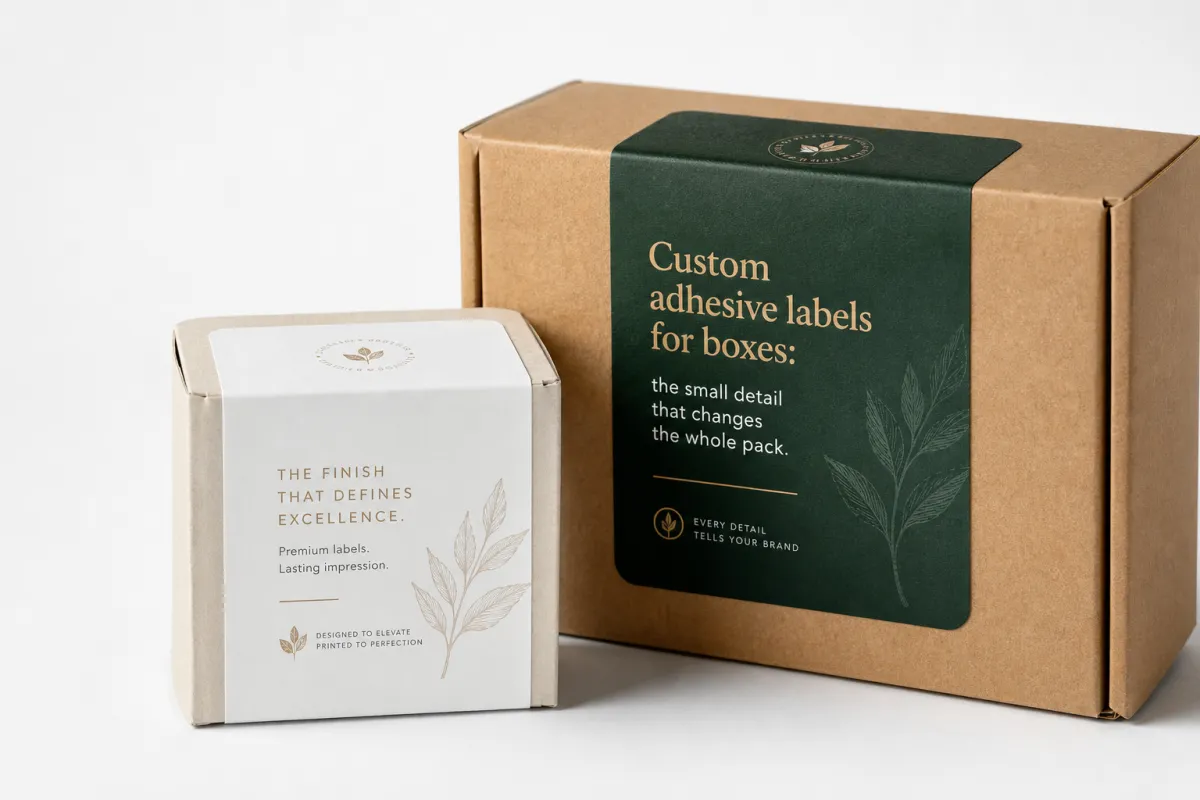
A box can be the right size, stack neatly, and survive receiving, picking, and shipping, yet still feel unfinished if the label peels at the corner, smudges in humid air, or looks like it was added as an afterthought. That is why custom adhesive labels for boxes deserve more attention than many teams give them. They are not decoration alone. They are part of the box’s working surface, and they need to behave like it.
In day-to-day packaging work, custom adhesive labels for boxes sit between printed cartons and loose stickers. A printed carton builds the brand into the board itself. A pressure-sensitive label adds flexibility, and that flexibility matters on plain kraft shippers, white corrugated cartons, folding cartons, reusable boxes, and short-run packaging where full custom printing does not make financial sense. The label becomes the brand layer, the product ID layer, and often the compliance layer as well.
That range is why packaging buyers keep coming back to custom adhesive labels for boxes. One label can carry SKU data, lot codes, barcodes, handling instructions, ingredient or warning copy, and a visual identity that makes the package feel intentional. On the warehouse side, the same label helps line workers separate nearly identical cartons at a glance. On the customer side, it can turn a plain shipper into branded packaging that feels cared for instead of generic.
Small details have a direct effect on throughput. Faster carton identification speeds up receiving. Clean barcode scanning reduces manual entry. Strong adhesion on recycled corrugate cuts down on relabeling and rework. In my experience, the teams that treat labels as a real production input, not just a graphics decision, tend to have fewer headaches once the boxes start moving.
The quiet branding effect matters too. A plain box with a well-placed label can still feel premium because the design looks deliberate. The same box with a crooked, low-contrast, or lifting label feels cheap, even if the carton itself is strong. First impressions carry real weight in retail packaging and subscription packaging, where unboxing is part of the product experience.
If a packaging program already includes matching inserts, cartons, or mailers, it helps to think of the label as one part of a larger system. Teams that source Custom Packaging Products often use custom adhesive labels for boxes to bridge the space between structural packaging and final brand presentation. That approach makes sense when volumes vary or the artwork changes more often than the box construction.
The first question should be practical: what do these labels need to survive? A dry shelf, a refrigerated route, a dusty corrugate line, a high-speed applicator, a cross-dock environment, or a customer’s hands after transit all create different demands. Once that is clear, the rest of the specification gets much easier to shape.
How custom adhesive labels for boxes work on real packaging lines
At a basic level, custom adhesive labels for boxes are built from four parts: the face stock, the adhesive layer, the liner, and any coating or lamination that protects the print. The face stock is the visible layer. The adhesive anchors the label to the box. The liner holds the label in roll or sheet form until application. Coatings and laminations add scuff resistance, moisture tolerance, or a cleaner finish.
On a packing line, pressure-sensitive labels work because the adhesive flows into the texture of the box once pressure is applied. That detail matters. Smooth coated paperboard behaves very differently from rough kraft corrugate, and both behave differently from a reused shipping box with loose fibers, dust, or light crush marks on the surface. A label built for one substrate can fail on another if the spec is too narrow.
Manual application and machine application also create different expectations for custom adhesive labels for boxes. Hand-applied labels give flexibility for smaller runs, mixed carton sizes, and jobs that change often. The tradeoff is consistency. Operators may place labels a little off center, too low, or too close to a seam. Machine-applied labels are faster and more repeatable, but they require tighter control over roll direction, spacing, unwind, and peel strength. If the stock is not matched to the applicator, the line starts fighting the material instead of using it.
Surface conditions shape performance more than many buyers expect. Dust, corrugate lint, condensation, cold temperatures, and oily handling residue can all weaken adhesion. A label that looks perfect in a proof can behave differently once it reaches a real fulfillment floor. Custom adhesive labels for boxes need to be tested in the same environment where they will be used, not only on a clean sample table.
Removal matters too. Some boxes need permanent identification, while others need a label that comes off cleanly without tearing the board or leaving a sticky film. That is where removable adhesives earn their place. For long-term shipping identity or tamper awareness, permanent adhesion is usually the safer choice. For returnable transport packaging, seasonal promotions, or temporary logistics, removable stock can save labor later.
Scuff resistance is another detail buyers often discover late. A label can bond properly and still look poor after conveyor contact, pallet wrap, or carton-to-carton rubbing in transit. A matte paper label may be easier to write on, but a gloss or laminated face stock can hold up better against abrasion. For transit testing and packaging durability, many teams look at the same general abuse patterns used in ISTA procedures, because vibration, drop, and handling damage tend to expose weak points quickly.
The practical takeaway is clear: custom adhesive labels for boxes are not simply graphics with glue. They are a material system designed to survive pressure, handling, and environment. When a label works, it slips into the workflow. When it fails, everybody notices right away.
A useful internal rule is easy to remember: the better the box surface and the steadier the environment, the wider the material choices. The rougher, colder, dustier, or more variable the application, the more carefully the label construction needs to be specified.
Material choices that affect durability, appearance, and label performance
The material behind custom adhesive labels for boxes often has more effect on the outcome than the artwork itself. The same design can look crisp and professional on one stock and look dull, cloudy, or fragile on another. Face stock, adhesive type, and finish all shape how the label behaves on the box and how it feels in the customer’s hand.
Paper remains the most common face stock for custom adhesive labels for boxes, and the reasons are practical. It prints well, costs less than synthetic film, and works nicely on dry indoor applications. A matte paper label is easy to read, accepts handwriting, and usually scans without glare. The downside is moisture sensitivity. If the box sees condensation, refrigerated storage, or heavy abrasion, paper can scuff or soften faster than a film label.
Polypropylene, often called BOPP in label buying conversations, is a strong middle ground. It gives a cleaner look, handles moisture better, and resists tearing more effectively than paper. For custom adhesive labels for boxes that need bright graphics, crisp type, or a more polished finish on retail packaging, polypropylene is a practical choice. It fits especially well when the box plays a role in shelf-facing presentation or e-commerce unboxing and the label needs to keep color clean without fuzzy edges.
Polyester is the tougher option. It is often used where abrasion, chemicals, or temperature swings are part of the job. If a label needs to survive repeated handling, harsh shipping, or a long storage cycle, polyester may be worth the extra cost. That does not make it the right choice for every job, though. More durable is not automatically better. It still has to match the use case, or you can overspend on a label that will never be tested hard enough to justify the premium.
Specialty stocks create another set of choices. Textured papers, recycled facestocks, clear films, and premium tactile finishes can all add personality to custom adhesive labels for boxes. Those options help package branding feel more deliberate. Specialty materials make sense for gift items, boutique retail boxes, and high-touch branded packaging where the label itself is part of the design language.
Finish is not only a visual decision. A matte finish lowers glare and usually makes barcodes easier to read under bright warehouse lighting. Gloss improves color depth and creates a more polished visual effect, but it can also reflect light and show fingerprints more readily. Soft-touch coatings feel elevated, though they may not be the best choice if the box will be stacked, slid, or freighted heavily.
Adhesive choice deserves the same level of care. Permanent adhesive is standard for identity labels, shipping labels, and most retail-ready carton applications. Removable adhesive fits returnable boxes, seasonal branding, and temporary identification. High-tack adhesive helps on rough corrugate, recycled kraft, or textured boards where a standard bond may not hold. Freezer-grade adhesive is the specialist option for cold storage, chill packs, or condensation-prone handling. For refrigerated and frozen applications, the adhesive needs to be rated for the actual temperature range, not just “cold” in a loose, approximate sense.
If sustainability is part of the brief, ask about paper certification and substrate sourcing. Some teams prefer FSC-certified paper stocks because the sourcing story matters to their brand and customers. You can read more about that through the FSC program. That does not make a label sustainable in every sense, but it does provide a clearer sourcing framework.
Here is a simple comparison that I use when helping buyers narrow down custom adhesive labels for boxes:
| Material | Best for | Strengths | Watchouts | Typical price impact |
|---|---|---|---|---|
| Paper | Dry cartons, internal IDs, short-run branding | Low cost, easy print, easy writing | Less moisture and scuff resistance | Lowest |
| Polypropylene | E-commerce, retail packaging, general shipping | Moisture resistance, tear resistance, clean look | Higher cost than paper | Moderate |
| Polyester | Harsh handling, long life, abrasion-prone cartons | Very durable, stable print face | Usually overkill for simple jobs | Higher |
| Specialty textured stock | Premium package branding, gifting, boutique boxes | Distinct look, tactile feel | May not be ideal for rough transit or high-speed machines | Variable |
The key point is straightforward: custom adhesive labels for boxes should be chosen by function first and appearance second, not the other way around. If the line is fast, the box surface is rough, or the environment is cold, choose the stock that can handle that reality. If the goal is a premium retail reveal and the box stays in controlled conditions, there is room to push harder on finish and tactile appeal.
For buyers who want a one-stop packaging program, it also helps to match label stock with the rest of the packaging design. A kraft mailer, a white folding carton, and a soft-touch sleeve each create different expectations, and the label should feel like it belongs in that system rather than fighting it. That is where custom adhesive labels for boxes can quietly lift the whole presentation.
Cost, pricing, and MOQ for custom adhesive labels for boxes
Pricing for custom adhesive labels for boxes depends on a handful of practical variables. Size, quantity, material, finish, adhesive type, color count, and finishing steps all contribute to unit cost. Add variable data, special die-cuts, or heavy ink coverage, and the quote changes accordingly. That is normal. The mistake is assuming labels are priced mainly by image complexity when the real cost usually starts with material and setup.
Minimum order quantities, or MOQ, are another point buyers need to understand early. Smaller runs usually cost more per label because the setup effort is spread across fewer units. Even if the design is simple, the press still needs calibration, the stock still needs loading, and the finishing still needs to be processed. For custom adhesive labels for boxes, that means 500 pieces and 5,000 pieces can sit in very different price bands.
As a rough planning range, a straightforward paper label on a modest run might land around $0.08-$0.18 per unit depending on quantity and print coverage. A polypropylene option often moves into about $0.10-$0.22 per unit, and a more specialized or higher-durability label may reach $0.14-$0.30 or more per unit. Those are planning numbers, not promises. The real quote depends on the job details, but they help when you are deciding whether a label should be treated as a disposable identifier or a presentation piece.
For custom adhesive labels for boxes, quantity usually matters more than almost anything else. Once the setup is absorbed, unit price often drops as volume rises. That can make a larger run cheaper in the long view, especially if the label is used on a recurring SKU. If you are comparing quotes, ask for price breaks at several quantities so you can see where the inflection point appears.
There are also cost factors that buyers sometimes miss. Plate or die fees may apply on some production methods. Proof charges may appear if artwork needs multiple revisions. Rush fees can affect a tight launch window. Split shipments and partial releases may add freight complexity. Variable data, such as serialized QR codes or batch numbers, can increase setup time because the print file and inspection process become more involved. None of those details surprise an experienced packaging supplier, but they do shape the final number.
That is why it helps to compare total value instead of only unit price. A label that costs a few cents more but reduces relabeling, improves scan rates, and cuts confusion on the packing floor can be the cheaper option in practice. The labor savings alone can justify the upgrade. A modest change in adhesive or finish can save enough handling time that the label pays for itself quickly, especially on high-volume fulfillment lines.
Here is a useful way to think about custom adhesive labels for boxes in cost terms:
- Material cost is the base layer, and it changes with paper versus film versus specialty stock.
- Conversion cost rises with die-cuts, roll finishing, varnish, lamination, and variable data.
- Setup cost matters most on small runs because it is spread across fewer pieces.
- Labor impact can be larger than the label price if bad application creates rework.
- Brand value matters on retail packaging and customer-facing shipments where first impression counts.
Sometimes a buyer should compare labels against other package branding options rather than against another label quote. If the same campaign could be handled with a printed carton, a sleeve, or a label, the right answer depends on volume, storage, and artwork flexibility. That is why some teams pair custom adhesive labels for boxes with a broader system of Custom Labels & Tags instead of trying to force every need into a single SKU.
If the goal is a current planning range, a practical first brief usually includes box size, label size, quantity, finish, adhesive, and whether the labels will be applied by hand or by machine. The more complete the brief, the tighter the quote, and the less likely it is that a pricing surprise appears after artwork approval.
Process, timeline, and lead time from proof to production
The workflow for custom adhesive labels for boxes stays fairly simple when the information is complete. It usually begins with discovery and spec review, then moves into artwork preparation, proofing, sample or test approval, printing, finishing, packing, and shipment. Every step sounds easy, but the speed of the project depends on how clearly the usage conditions are defined at the start.
The first thing a supplier needs is the substrate context. What is the box material? Is it corrugated, kraft, coated paperboard, or a reusable plastic-style carton? The second thing is application context. Will labels be placed by hand or by machine? The third is environment. Dry warehouse, cold room, damp route, retail shelf, or long transit? Once those are answered, custom adhesive labels for boxes can be engineered with far less guesswork.
Artwork is the next major gate. A clean vector logo, a well-built barcode, and the right bleed and quiet space around the edges save a surprising amount of time later. If a barcode is too close to a crease or a cut line, the label may print fine and still scan badly. If the text is tiny or low contrast, the label may look crisp on screen and still fail in the real world. That is why proofing matters so much.
Turnaround time varies by method and complexity. A simple digital run can often move from approved proof to production within about 7-12 business days, depending on queue and finishing. More complex jobs with specialty stock, multiple finishes, or higher volume may take 12-18 business days or longer. If variable data or machine-compatible roll finishing is involved, add a little buffer. For custom adhesive labels for boxes, the cleanest projects are usually the ones where the spec is locked before the design file is final.
Sampling can reduce risk even if it adds time at the start. A test application on the actual box stock can show whether the label hugs the surface correctly, whether the edges lift, and whether the print remains readable under the real lighting conditions. That is especially useful for recycled corrugate, textured kraft, or cold-storage packaging. A five-minute bench test often prevents a week of corrections later. I have seen more than one well-designed rollout stumble because no one checked the label against the real carton until the last minute.
Lead time planning matters even more for seasonal packaging, launch dates, and replenishment. If a run supports a promotion or a retail reset, you do not want the label schedule colliding with shipping cutoffs or design approvals. Working backward from the actual in-hand date gives a better picture of how much margin exists if a proof needs revision.
For buyers who handle repeat SKUs, it is smart to keep a reorder cadence. Once custom adhesive labels for boxes are dialed in, the best result is not a one-time order but a repeatable spec with stable performance. That consistency lowers risk, improves warehouse efficiency, and makes future replenishment much easier to plan.
If the label will be used in a packaging system with multiple box styles, the production team should know that too. A label that works well on a small carton may not behave the same way on a larger corrugated shipper with a different flute profile or surface finish. That sort of detail sounds minor until it creates production headaches. Good packaging design takes those differences seriously.
Common mistakes when ordering custom adhesive labels for boxes
The most common mistake with custom adhesive labels for boxes is choosing a sample that looks right on a bright monitor and never checking how it behaves on the actual box surface. That sounds obvious, but it happens constantly. A smooth white carton can make almost any label look good. Dusty corrugate, recycled kraft, or curved package panels tell a much less forgiving story.
Adhesive mismatch is another classic problem. A label with standard tack may work fine on coated board and fail on rough corrugate. A high-tack adhesive may be unnecessary on a clean folding carton and become too aggressive for a box that needs clean removal later. Permanent and removable adhesives are not just pricing choices; they are performance choices. If a label is going on a cold warehouse product or into a damp environment, the adhesive has to be rated for that condition rather than assumed to behave the same as room-temperature stock.
Artwork errors also create a lot of avoidable waste. Small type can disappear once the label is printed at size. Weak contrast can make important copy hard to read. Barcodes that are compressed, tinted, or placed near folds may scan poorly. Critical copy too close to the edge can be trimmed off or look cramped. With custom adhesive labels for boxes, production-friendly design is not a luxury. It is part of the job.
Another mistake is skipping application tests. Even a small test run can show whether the liner releases cleanly, whether the label feeds properly through the applicator, and whether the label settles without bubbles or wrinkles. If you are using machinery, that check is essential. Machine compatibility is often the hidden variable that turns a good label spec into a bad line experience.
Some teams also order too few samples, which makes it hard to compare finishes or observe how the label behaves after handling. I like to see sample labels on the actual box, under the actual light, with the actual barcode reader if scanning is part of the workflow. It is a simple habit, but it saves money. A label can look fine in a proof packet and still be the wrong choice once it reaches production.
One more issue gets overlooked often: shipping labels and product labels are not always interchangeable. A label designed for transit may not look polished enough for retail-ready packaging. A label designed for premium shelf presentation may not hold up under warehouse abuse. The environment decides the spec. That is why custom adhesive labels for boxes should be judged by use case, not by appearance alone.
A quick correction rule works well here: if the box is handled by people, machines, temperature swings, or rough freight, test the label harder than you think you need to. Labels usually fail at the point where someone assumed the surface was more forgiving than it really was.
Expert tips and next steps for better label results
For better results with custom adhesive labels for boxes, start with a clean brief. Give the supplier the box substrate, label dimensions, quantity, finish, adhesive preference, application method, and environment. If you know the box is recycled, textured, refrigerated, or machine-applied, say so early. That one step narrows the material choices and usually improves the quote quality too.
Test on the actual carton stock before you approve the full run. That is the most practical recommendation here. A label can look great on a sample sheet and behave differently on a rough corrugate board with fiber lift or dust. If the boxes are moving through a fulfillment floor, test them under normal handling, not in a pristine office environment. Custom adhesive labels for boxes only perform well when adhesion and readability hold up in real use.
Design with production in mind. Strong contrast, clear hierarchy, and enough quiet space around barcodes and handling icons make life easier for everyone. If the brand wants a premium look, that is fine, but clarity still comes first. A beautiful label that is hard to scan is not a good trade. For retail packaging and branded packaging, the strongest designs feel polished without becoming delicate.
One detail buyers often forget is replenishment planning. If the label supports a recurring SKU or a seasonal item, build a reorder point before stock runs low. That keeps the project from turning into a rush job where color matching, adhesive selection, and artwork review all get compressed. Custom adhesive labels for boxes are much easier to manage when the reorder path already exists.
Here is a practical checklist I would use before requesting a final quote:
- Box material and surface finish
- Label size, shape, and placement
- Quantity and reorder expectations
- Finish preference: matte, gloss, or specialty coating
- Adhesive requirement: permanent, removable, high-tack, or freezer-grade
- Application method: hand-applied or machine-applied
- Storage and shipping conditions
- Barcode, variable data, or compliance text needs
If you already know the box style and need matching packaging support, a supplier that understands both cartons and labels can save time. That is often the difference between a nice-looking design file and a packaging program that works on the floor. In the right setup, custom adhesive labels for boxes become a simple, repeatable part of a larger package branding system rather than a constant troubleshooting item.
My advice is direct: treat the label as a material decision, a workflow decision, and a brand decision all at once. Do that, and the result is usually cleaner, faster, and more durable than a quick-fix approach. If you are ready to evaluate custom adhesive labels for boxes for a current project, gather your box specs, estimate your quantities, and ask for a test-ready quote that reflects the actual use environment.
What are custom adhesive labels for boxes made from?
Most custom adhesive labels for boxes use a face stock such as paper, polypropylene, or polyester, plus a pressure-sensitive adhesive and a liner. The best build depends on whether the box is decorative, shipping-focused, refrigerated, or exposed to abrasion. Optional coatings or laminations can add scuff resistance, moisture protection, or a more premium finish.
How do I choose the right adhesive for custom adhesive labels for boxes?
Match adhesive strength to the box surface first, because smooth coated board, rough corrugate, and recycled kraft all behave differently. Use permanent adhesive for long-term identity labels and stronger hold, and removable adhesive when clean removal matters. For cold, damp, or freezer conditions, ask for an adhesive rated for the actual storage environment.
What affects the price of custom adhesive labels for boxes the most?
Quantity, material choice, finish, and adhesive type usually have the biggest impact on unit price for custom adhesive labels for boxes. Size, color count, special die-cuts, and variable data can raise the cost, especially on smaller runs. Setup, proofing, and rush production can also change the final quote, so it helps to define specs early.
How long does it take to produce custom adhesive labels for boxes?
Simple jobs can move quickly once artwork is approved, while more complex projects need extra time for proofing and sampling. Lead time depends on run size, finishing steps, and whether the label needs special materials or variable information. Planning early is the best way to avoid rushed approvals, delayed shipments, or substitutions.
Can custom adhesive labels for boxes be applied by hand and by machine?
Yes, many custom adhesive labels for boxes are designed for manual application, especially smaller runs or mixed packaging lines. Automated application works best when label size, roll direction, adhesive, and release liner are matched to the machine. If you use equipment, test the label on the real line before full production to check feed, placement, and peel performance.

