Buyer Fit Snapshot
| Best fit | Custom Anti Static Mailers projects where brand print, material claims, artwork control, MOQ, and repeat-order consistency need to be specified before quoting. |
|---|---|
| Quote inputs | Share finished size, material target, print colors, finish, packing count, annual reorder estimate, ship-to region, and any compliance wording. |
| Proofing check | Approve dieline scale, logo placement, barcode or warning zones, color tolerance, closure strength, and carton packing before bulk production. |
| Main risk | Vague material claims, crowded artwork, missing packing details, or unclear freight terms can make a low unit price expensive after revisions. |
Fast answer: Custom Anti Static Mailers: Film, Print, MOQ, and Carton Packing should be specified like a repeatable production item. The safest quote records material, print method, finish, artwork proof, packing count, and reorder notes in one written spec.
Production checks before approval
Compare the actual filled-product size with the drawing, then confirm tolerance on folds, seals, hang holes, label areas, and retail display edges. Reserve space for logos, QR codes, warning copy, and material claims before decorative graphics fill the panel.
Quote comparison points
Review material grade, print process, finish, sampling route, tooling charges, carton quantity, and freight assumptions side by side. A quote is only useful when the supplier can repeat the same color, closure quality, and packing count on the next order.
Custom Anti Static Mailers: What to Know Before Buying
Custom Anti Static mailers can feel like a small line item until a board, sensor, adapter, or cable arrives scratched, charged, or dead on arrival. That is the awkward truth about packaging for electronics: the mailer rarely gets applause when everything lands clean, but it gets blamed the minute a customer opens a damaged shipment. From a packaging buyer’s point of view, custom anti static mailers are a practical way to reduce static buildup, keep parts organized, and present a cleaner brand without making the packout more complicated than it needs to be. The real work is Choosing the Right material, size, print setup, and performance level before the order goes live.
This matters because custom anti static mailers are not all built the same. Some are basic dissipative poly mailers with a branded print. Others are higher-spec ESD packaging with shielding properties meant for more sensitive components. Match the bag to the product and the process gets easier: fewer returns, faster packing, less friction in receiving, and fewer awkward conversations about why the box looked fine while the part inside failed.
What custom anti static mailers are and why they matter
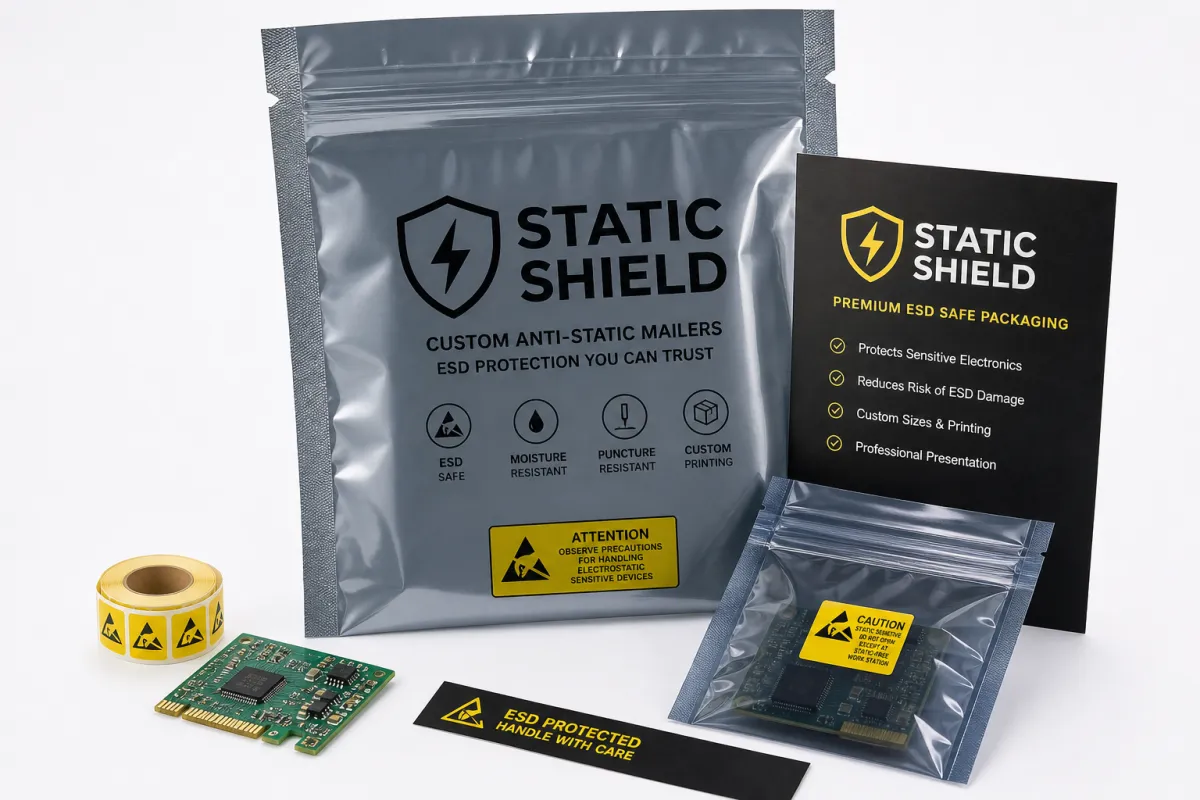
Picture a low-cost sensor or controller board leaving your facility in perfect shape, then reaching the customer with a failure nobody can explain. The product may never have seen a dramatic spark. It may have picked up charge during packing, slide testing, or parcel handling instead. That is the frustrating part of ESD risk: it often stays invisible until the cost shows up in returns, replacements, and lost trust. Custom anti static mailers help reduce that risk before the product leaves the bench.
In plain terms, custom anti static mailers are mailers designed to reduce static buildup and protect small electronics, modules, adapters, cables, and other sensitive components during shipping and storage. They are not the same thing as a standard poly mailer. A plain mailer gives you a bag. A well-made anti-static mailer gives you a bag with better surface behavior, less charge accumulation, and a cleaner way to identify the product through branding or print.
They are different from bubble mailers and shielding bags as well. Bubble mailers are mostly about cushioning. Shielding bags are built for stricter protection because they add a conductive layer that helps block external discharge. Custom anti static mailers usually sit in the middle: better than generic plastic, easier to brand than a hard protective shipper, and often enough for accessories, replacement parts, and moderately sensitive electronics. A finished device may still need inner trays, foam, or a box from Custom Packaging Products or even Custom Poly Mailers depending on the packout.
Their job is practical. They reduce static buildup. They help keep dust and handling grime off the product. They keep small parts grouped, labeled, and easier to receive. They also make returns look cleaner because the customer sees intentional branded packaging rather than a random unmarked pouch. That matters for product packaging and package branding more than many teams expect.
If the mailer is wrong, the whole shipment gets blamed. Buyers rarely separate the bag from the failure. They remember the return, the delay, and the refund.
Set expectations early. Custom anti static mailers are not magic armor. They will not rescue a badly packed product, a loose board rattling inside a bag, or a shipment that needs more protection than the mailer can realistically provide. What they do offer is a low-cost, high-value way to reduce avoidable damage and ugly customer complaints. For many production runs, that is enough to justify the spend.
How custom anti static mailers work
Static starts with friction. Packing tables, release liners, sorting belts, sleeves, adhesive flaps, and dry air can build charge. The package may look harmless, but the charge can sit there waiting for contact. Sensitive electronics can be damaged by a sudden discharge, or they can become the kind of item that fails later and gets blamed on manufacturing. Custom anti static mailers are designed to interrupt that chain.
Most anti-static films use additives or a treated surface that helps dissipate charge instead of letting it accumulate. Some bags feel a little different from standard polyethylene because the surface or blend has been tuned for dissipative behavior. With custom anti static mailers, that matters because the bag is not just a printed wrapper. It becomes part of the protection system. The film, the flap, the seal, and the handling process work together.
There is a real difference between anti-static, static-dissipative, and shielding. Anti-static material is meant to minimize charge generation. Static-dissipative material helps bleed charge away at a controlled rate. Shielding bags go a step further with a conductive or metalized layer that helps block external discharge. For many accessory packs, custom anti static mailers are enough. For higher-risk boards, memory modules, test equipment, or parts traveling through rough parcel networks, a shielding construction may be the smarter choice.
That decision should not rest on guesswork. Ask what the bag is actually made of, not just whether it is “ESD safe.” That phrase can hide a lot of weak product data. If the supplier can provide surface resistivity ranges, material structure, and test references, you are in better shape. In packaging engineering, the most useful references are the ones that describe the actual construction and test method, not just a marketing claim. For ESD packaging, many teams use ANSI/ESD S541 as a benchmark, while parcel durability discussions are better grounded in ISTA test methods than in a glossy spec sheet. For environmental claims, the material composition matters more than a recycled-content buzzword.
One point buyers miss is the full packout. The bag alone does not determine safety. Inserts, labels, tape, humidity, and handling conditions all affect the result. A dry warehouse in winter behaves differently from a coastal distribution center. A bag that works fine for clipped cables may be wrong for a bare PCB. Custom anti static mailers should be specified as part of the whole shipping system, not as an afterthought tossed into a quote request on Friday afternoon. I have seen teams lose a week over a bag spec that looked fine on paper but failed once the actual board and insert were tested together. That kind of miss is avoidable.
There is also a practical trust issue here. “Anti-static” is sometimes used loosely, and not every supplier uses the same testing language. If a vendor cannot explain whether the film is dissipative, whether the package is intended for transport only or for direct contact with sensitive components, and how the print interacts with the substrate, that is a sign to slow down. Better to ask the slightly annoying questions now than find out later that the package was kinda just decorative.
Custom anti static mailers process and timeline
The ordering flow is usually straightforward, provided the buyer brings real information. A good supplier will ask for product dimensions, weight, closure type, print area, quantity, and whether the bag needs to protect a single item or a nested packout. From there, custom anti static mailers move through artwork, proofing, sample review, production, and freight. Nothing mysterious. The problems start when dimensions are vague or the buyer thinks “close enough” counts as a measurement.
For simple print jobs, lead time can move quickly after proof approval. A realistic range is often 12-15 business days for production on a standard spec, then shipping on top of that. If you need custom sizing, heavier print coverage, special film, or a shielding layer, expect the schedule to stretch into several weeks. Custom anti static mailers with tighter performance requirements are rarely the fastest item in the line, and pretending otherwise only creates frustration on both sides.
What slows things down most often is not the plant. It is the paperwork. Missing dimensions. Artwork files that are not press-ready. A logo supplied as a blurry screenshot. A last-minute change to the closure flap. A debate over whether the warning print should sit near the seal or on the front panel. Every one of those delays is avoidable if the spec is clear on day one.
Here is the fastest way to keep the project moving:
- Send exact inner dimensions and product weight.
- State whether the item ships alone or with an insert.
- Confirm the print colors and whether you need one side or both sides printed.
- Choose the closure style before proofing, not after.
- Approve the sample quickly, or give one clear revision round instead of five tiny ones.
Buyers can save real time by doing one smart thing: lock the spec before asking for pricing. A one-page sheet with size, material, print, closure, quantity tiers, and shipping deadline cuts weeks of back-and-forth. That is especially useful if you are planning custom anti static mailers as part of a larger product launch, where packaging design and retail packaging need to coordinate with the mailer instead of fighting it. I have watched projects stall because marketing wanted a bold front panel while operations needed a clean seal zone; sorting that out early keeps everybody from guessing.
If you have multiple pack formats, split the decision into tiers. Keep the first run simple. If the bag works, expand print coverage or adjust the spec later. That is a saner path than trying to solve every future use case in the first order of custom anti static mailers.
Custom anti static mailers cost and pricing factors
The price of custom anti static mailers is mostly a math problem, not a mystery. The biggest drivers are material thickness, bag size, print coverage, number of colors, closure type, and order volume. If one supplier is much cheaper than another, check whether you are comparing the same construction. A 2-mil bag with one-color print is not the same thing as a 4-mil shielding bag with full coverage and a reseal strip.
MOQ matters too. Smaller runs usually carry a higher unit cost because setup, material waste, and labor are spread over fewer bags. Larger runs lower the per-bag price, but they also tie up cash and storage space. That is the basic tradeoff. There is no shortcut around it. If you only need 1,000 bags, you will not get the same unit cost as a 10,000-piece run of custom anti static mailers.
Hidden costs catch people off guard. Setup charges. Plates or tooling if the print method requires them. Sample fees. Freight. Rush production. Storage if the order lands early and sits on a shelf for two months. A quote that looks lower by a few cents can turn into the more expensive option once landed cost is tallied. A nice spreadsheet does not protect you from a bad reality.
| Option | Typical unit cost at medium volume | Best for | Main tradeoff |
|---|---|---|---|
| Stock anti-static mailer | $0.14-$0.24 | Fast replenishment, no branding | Limited size control and no custom print |
| Custom anti static mailers with one-color print | $0.20-$0.34 | Most accessory and electronics shipments | Moderate setup, basic branding only |
| Custom anti static mailers with full-coverage print | $0.28-$0.48 | Stronger package branding and retail presentation | Higher print cost and more artwork prep |
| Shielding bag with print | $0.35-$0.70 | Sensitive parts and higher-risk shipping | Most expensive option, but better protection |
Those numbers are directional, not a promise. The real quote can shift with size, gauge, print location, and freight terms. A narrow bag for a cable kit costs less than a large mailer for a boxed module. A simple brand mark is cheaper than a full-panel design. If you are trying to balance cost against presentation, compare the landed cost, not just the factory line. A lower unit price can still lose once the shipping bill, damage rate, and reorders show up.
That is why many brands compare custom anti static mailers against other forms of branded packaging like custom printed boxes or mailers with a label application. Sometimes the bag is the right answer. Sometimes a box is better because the product needs structure, inserts, or a more premium unboxing feel. The goal is not to buy the fanciest thing. The goal is to buy the right one at the right volume.
There is one more cost angle that gets overlooked: labor. A mailer that opens cleanly, loads fast, and seals reliably saves seconds on every unit. That sounds small until you multiply it across a long production run. If the packaging slows your team down by even a few moments per pack, the true cost is higher than the quote suggests. That is why experienced buyers keep both material cost and line speed in the same conversation.
Key material and performance factors to compare
Buyers should compare more than the logo. Start with size tolerance. If the bag is too tight, insertion gets slow and the seal can fail. If it is too loose, the product rattles, moves, and arrives looking like it was thrown together by someone who stopped caring halfway through the shift. Good custom anti static mailers should fit the product with enough room for easy packing and enough control to prevent unnecessary movement.
Next, look at film gauge and surface behavior. Thicker is not always better, but it can help with puncture resistance and handling. The surface should support the anti-static function without becoming sticky, cloudy, or unpleasant to work with. If the print will rub against conveyors, cartons, or other bags, ask how it holds up to friction. That matters in real shipping. Gorgeous packaging that scuffs immediately is just expensive disappointment.
Closure strength is another detail people skip. A self-seal flap or peel-and-seal strip needs to close consistently, especially on production lines where speed is the point. If the flap opens too easily, returns and transit issues follow. If it is too aggressive, the packout slows down. With custom anti static mailers, you want a closure that fits the workflow, not one that forces your team to fight the bag on every unit.
For sensitive products, ask about test methods and compliance references. Buyers Should Know whether the supplier uses internal QC checks, ASTM-related testing, or shipment simulation. If the product is headed for broader parcel networks, ISTA-style pack testing is worth discussing because the mailer does not travel alone. The item is only as safe as the whole system around it.
Sustainability should also be part of the conversation, especially if your brand is trying to tighten its environmental story. Some custom anti static mailers can be built with mono-material structures that are easier to sort, but print coverage, additives, and closures can complicate recyclability. If that matters, ask for material specifics rather than vague “eco-friendly” language. Product teams say they care about this. Procurement teams usually care once the landfill bill or retailer requirement shows up.
One practical question helps sort the whole thing out: what level of protection does the product actually need? A cable set or accessory pack may do fine with a printed anti-static mailer. A bare PCB or advanced component may justify a shielding bag and a more controlled packout. That is the real decision behind custom anti static mailers, not the logo placement.
For brands that sell both electronics and general consumer goods, the spec may differ by channel. A subscription refill might need lighter branding. A retail accessory might need stronger shelf presence. That is where custom anti static mailers can support both logistics and retail packaging goals without forcing every product into the same format. Good product packaging does not look identical across the catalog. It looks appropriate.
Another useful detail is print durability. If the bag is handled repeatedly during receiving or kitting, the ink should not smear when rubbed by gloved hands or carton edges. It does not need to survive a war, but it should survive ordinary warehouse handling without turning messy. That kind of detail is small until it is not.
Common mistakes when ordering anti-static mailers
The easiest mistake is choosing the wrong bag type because it looks close enough. Anti-static is not the same as shielding, and shielding is not just a fancier way to say “better bag.” If the item is more sensitive than the packaging spec, the failure shows up later, usually as a return, a complaint, or a damaged reputation. That is why custom anti static mailers should be matched to the product, not selected from a feeling.
Size errors are the second classic problem. Too small, and the product bruises the seal or will not fit with the insert. Too large, and the contents slide around. Small parts that rattle inside a big mailer often arrive with scratched finishes, bent leads, or a presentation that looks cheap even if the product still works. The customer does not separate “shipping issue” from “brand issue.” They see one sloppy package.
Another mistake is skipping sample testing with the actual item, actual insert, and actual packing team. Not a paper mockup. Not a guess. The real product in the real workflow. A sample lets you test fit, seal, print placement, handling, and the feel of the finished package before you commit money to a full run of custom anti static mailers. That is how you avoid the awkward “we assumed” conversation.
Artwork can cause problems too. If the print sits too close to the seal, it can interfere with closure. If the ink formulation is wrong, it may flake or smear under friction. If handling instructions are hidden behind a large logo block, the bag stops doing part of its job. Branded packaging should support the use case, not bully it. A clean design usually beats a loud one anyway.
There is also a quiet production mistake: not checking how the mailer behaves in storage and transit. A bag that looks good on a table can perform badly in a warm warehouse, a cold dock, or a shipping lane with heavy friction. A simple test plan helps here. Pack the product. Shake it. Label it. Store it under realistic conditions. Check whether the closure stays intact and whether the print still looks acceptable.
Finally, do not let the order spec turn into a moving target. Every revision adds time and usually adds cost. The cleaner approach is to define the size, gauge, closure, print limits, and acceptable performance range before quoting. That way custom anti static mailers stay a packaging decision instead of a weekly fire drill.
One more thing that gets overlooked: handoff between teams. If purchasing, design, operations, and quality all use slightly different descriptions, the order can drift before anyone notices. A shared spec keeps that from happening. It sounds basic because it is basic, and basic is often what keeps packaging from turning into a mess.
Custom anti static mailers: expert tips and next steps
If you want the safest path, start with a one-page spec sheet. Measure the product. Note the sensitivity level. Decide whether the item needs anti-static treatment only or a true shielding construction. Add closure type, print area, quantity, and delivery target. That sheet turns custom anti static mailers from a vague request into a real procurement project.
Then get samples from at least two suppliers. Compare fit, finish, print quality, seal performance, and whether the bag is easy for your team to use. A catalog photo tells you almost nothing. A sample tells you whether the bag works in a real line, in real hands, and under real shipping conditions. That is also the moment to decide whether the mailer belongs in the same family as your other package branding assets, including custom printed boxes or other branded packaging pieces.
A short test plan removes drama. Pack the item. Apply the label. Move it through the sort path. Store it for a few days. Open it. Check the seal, the print, and the product condition. If the mailer survives that, you are closer to a reliable spec. If it fails, you just saved yourself from a bigger problem. That is the practical value of custom anti static mailers: they give you a controlled way to reduce avoidable risk before the first large shipment leaves.
Do not overbuy spec just to feel safe. Extra layers, heavier film, or a shielding build can be justified, but only if the product actually needs them. Over-spec packaging inflates cost and can slow packing without delivering a meaningful gain. Under-spec packaging saves pennies and creates returns. The middle path is usually the smart one, which is why the best custom anti static mailers projects are boring in the best way: measured, tested, and locked before production.
If you need to expand the program, build from the product outward. Use custom anti static mailers for the item itself, then coordinate the outer carton, insert, label, and shipping method. That keeps the whole system aligned instead of making the mailer do all the work. Good product packaging feels intentional because each part has a job.
Lock the spec, confirm the quantity tier, and approve samples quickly. That is the shortest route to getting custom anti static mailers that protect the product, support the brand, and do not create more problems than they solve. If you are unsure where to start, begin with the product’s actual dimensions and sensitivity level, then choose the lightest construction that still passes a real packout test. That keeps the order grounded in facts instead of optimism.
Are custom anti static mailers the same as static shielding bags?
No. Custom anti static mailers reduce charge buildup, while shielding bags add a conductive layer that helps block outside discharge. Use shielding for more sensitive items or rougher shipping conditions. Ask for the construction details and performance data instead of trusting the vague phrase “ESD safe.”
What information do I need to get a quote for custom anti static mailers?
Have the inner dimensions, product weight, closure type, print colors, and target quantity ready before asking for pricing. Include any required thickness, material preference, and whether you need a sample or production proof first. If timing matters, share your needed delivery date and shipping zip so the quote reflects the real landed cost.
What is a realistic MOQ for custom anti static mailers?
MOQ varies by supplier and spec, but many custom runs start in the low thousands rather than a few hundred. Smaller orders can be possible, but the unit cost usually jumps because setup and material waste are spread over fewer bags. If you are unsure, ask for pricing at three quantities so you can see where the break points actually are.
How long do custom anti static mailers usually take to produce?
Simple jobs can move quickly after proof approval, while special sizes, custom film, or heavy print coverage add lead time. A realistic range is often a few weeks, plus shipping, depending on approvals and material availability. The fastest way to shorten turnaround is to send exact specs and approve samples without dragging out revisions.
Can I print branding on custom anti static mailers without hurting performance?
Yes, but the ink, coverage, and placement need to be chosen carefully so the bag still performs as intended. Keep print away from seal areas and confirm the finish will not flake, smear, or create handling problems. If the product is sensitive, ask for a sample print on the actual bag structure before committing to the full run.

