Custom Beanies With Leather Patch Bulk Order Pricing
A custom Beanies with Leather Patch Bulk order is rarely won or lost on the knit alone. The patch is what people see first, and small problems there are easy to spot. If the logo sits a little high, the edge looks rough, or the color contrast is too soft, the run starts to feel less controlled even when the beanie body itself is perfectly serviceable. Buyers notice that faster than most suppliers expect.
That is why these orders work better when they are treated like a specification-led program. The best results come from tight definitions: exact patch size, approved artwork, beanie color, stitch color, placement on the cuff, and acceptable variation. Without that discipline, a quote may look attractive on paper and still produce a line of hats that do not match each other well enough for retail, event kits, or employee distribution.
There is also a simple economic reality here. Bulk pricing rewards repetition. The cleaner the spec, the fewer surprises during sampling and production, and the easier it is to compare vendors on the same terms. If a supplier cannot tell you what is included, what is optional, and what may change the cost, the quote is not especially useful yet.
“The cheapest quote is rarely the cleanest run. The better test is whether the supplier can repeat the same look 500 times without drift.”
Custom beanies with leather patch bulk order: what drives consistency
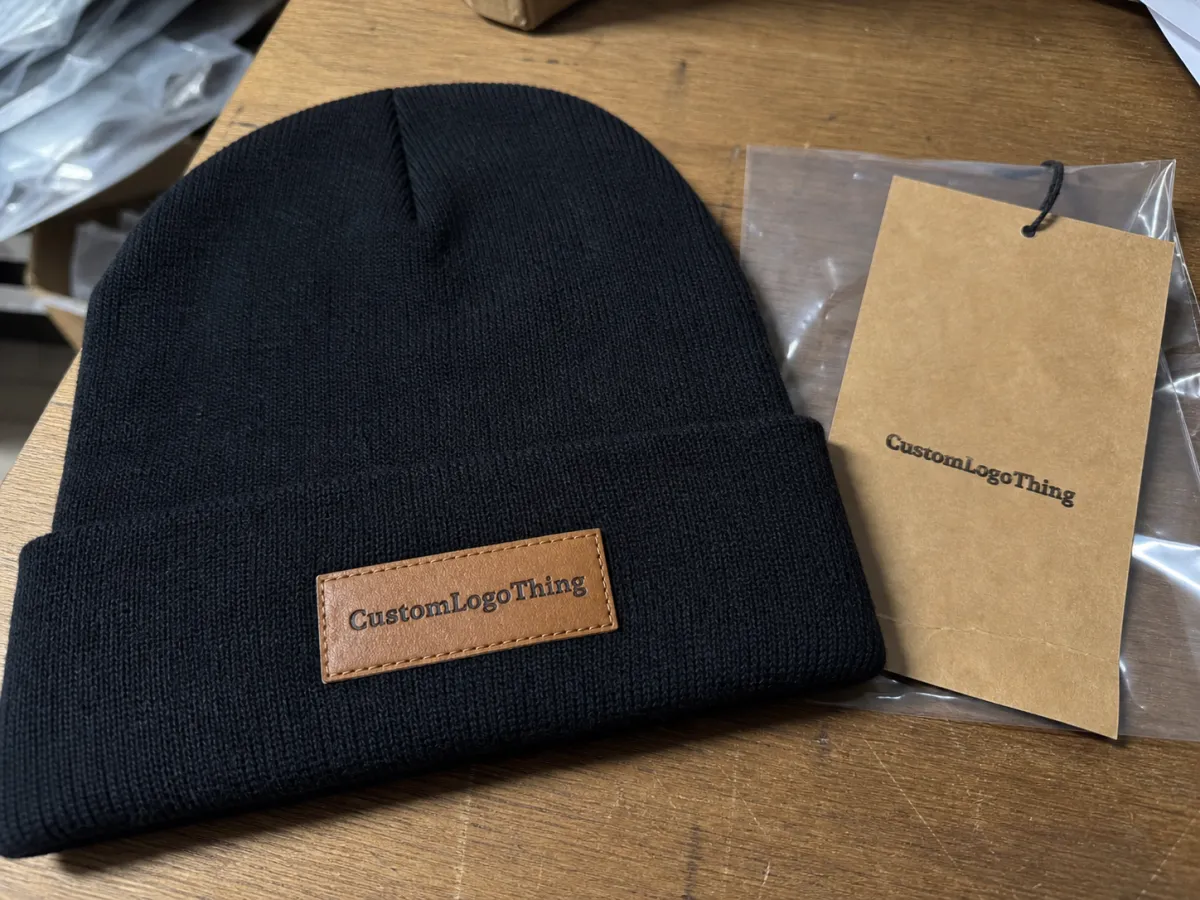
In bulk production, consistency is the product. A beanie can tolerate a little texture variation, but a leather patch is less forgiving. The eye goes straight to edges, alignment, and contrast. Once a logo is off-center by a few millimeters, the mistake reads as a production issue rather than a style choice. That is especially true on cuffed beanies, where the patch becomes the visual anchor of the entire piece.
The most reliable orders start with a spec sheet that leaves little open to interpretation. It should define patch dimensions, placement, knit style, yarn content, body color, stitch color, and whether the patch is sewn on or heat-applied. If those details are vague, the factory may fill in the blanks with the closest standard option, which is rarely what the buyer had in mind.
Bulk orders also expose differences between sample quality and line quality. A single sample can be hand-finished carefully. A 1,000-piece run has to survive normal production conditions, which means thread tension, trimming, and placement need to hold up across the whole batch. That is where a pre-production proof matters. It creates a fixed target before the order expands into multiples.
For buyers who already manage branded kits, this is familiar territory. The same logic applies to inserts, cartons, and labels: the visual standard is set once, then measured against the full order. With beanies, the visible feature is simply smaller and less forgiving than a box panel.
If the order is going to retail shelves or a seasonal promotion, the safest assumption is that every flaw will be multiplied by the number of units on display. A few loose threads on one hat are a nuisance. A visible placement shift across an entire run becomes a quality control problem.
Leather patch styles, placement, and knit options that scale cleanly
Patch material changes both appearance and risk. Genuine leather gives a more traditional, textured look, but natural grain and tone can vary from batch to batch. Faux leather and synthetic alternatives tend to be more uniform, which is useful when the goal is repeatability rather than natural variation. For many bulk programs, that uniformity is worth more than the slight prestige of real leather.
Decoration method matters just as much. Debossed and embossed patches usually read clearly because they rely on depth instead of ink density. Printed details can work, but small text and fine lines often disappear once the patch is cut down to size and sewn onto knit. A strong, simple mark usually survives the process best. If the logo depends on thin serifs, hairline strokes, or multiple nested elements, ask whether a production-sized version will still be legible from a few feet away.
Placement is another decision with more impact than buyers sometimes expect. Center cuff placement is the most direct and common because it keeps the logo in the visual center. Side cuff placement feels quieter and can suit brands that want less front-facing emphasis. Front panel placement can work on slouchier shapes, but only if the knit surface is flat enough to hold the patch without distortion.
The knit itself should support the decoration, not fight it. Rib knit is usually the safest choice because it stretches well and sits neatly on the head. Heavier cuff styles give the patch a flatter, more stable platform. Fisherman-style or chunkier knits can look premium, but the texture may make the patch edge feel less crisp unless the patch is sized carefully.
There are a few practical checks that should happen before quoting:
- Patch size: many bulk programs land around 2" to 2.5" wide, adjusted to logo shape.
- Edge finish: clean-cut or stitched edges usually look sharper than rough trimming.
- Contrast: the logo should stand apart from the knit, especially at viewing distance.
- Detail level: the more compact the patch, the more the artwork should be simplified.
If the beanies are part of a broader branded kit, the hat should match the rest of the package visually. That could mean echoing the color of a mailer insert, a hang tag, or a custom printed carton. Buyers managing Custom Packaging Products often run into this exact issue: a good-looking hat can still feel disconnected if the rest of the presentation uses a different tone or finish.
Sizing, fit, and decoration specs buyers should lock before quoting
Fit affects decoration more than many teams realize. A patch that looks centered on a flat table can sit too high once the cuff is folded, or too low once the beanie stretches on a head. Before asking for a price, lock the crown depth, cuff height, and the general fit profile. Those measurements determine where the decoration lands and how it reads in real use.
Buyers should also define the body construction. Single-layer and double-layer cuffs behave differently, and each changes the stability of the decoration area. If you want a firmer, more structured appearance, say so. If the hat should drape softer, state that too. That single choice can change how the patch appears from the front and how well the stitching holds up around the edge.
Artwork simplification is often the smartest move in a bulk order. A logo that looks excellent on a screen can be too detailed for a small patch. Simplifying the production version does not weaken the brand; it makes the design readable at the scale the product actually lives at. Small labels, tight package faces, and compact decoration zones all reward clarity over complexity.
Before approving a quote, buyers should confirm the following:
- Exact beanie color and yarn finish
- Patch material: genuine leather, faux leather, or another synthetic option
- Decoration method: debossed, embossed, printed, or stitched detail
- Thread color and stitch density
- Attachment method and whether the patch is sewn or heat-applied
- Any special tooling for woven, engraved, or shaped elements
Those details protect the schedule. If the spec changes after sampling, the supplier may need to revise artwork, remake the sample, or source a different material. Every one of those changes can push the delivery date back, and beanie orders rarely have much slack once a season or event date is fixed.
For larger purchases that include apparel, packaging, and assembly, it helps to review Wholesale Programs at the same time as the product quote. Splitting those decisions into separate conversations usually creates mismatched assumptions about labor, packaging, and timeline.
Cost, pricing, MOQ, and unit cost factors that change the quote
Pricing for a custom Beanies with Leather Patch bulk order usually turns on five variables: blank quality, patch material, decoration method, setup time, and total quantity. When one of those changes, the quote can move more than buyers expect. Two orders that look close on the surface can price very differently if one uses a standard faux-leather patch and the other needs custom tooling, a premium knit, or extra packing labor.
MOQ affects unit cost because setup is spread over more pieces. At lower quantities, proofing and material prep carry more weight per hat. At higher quantities, the per-unit cost usually drops. A practical working range for a simple bulk run might land around $5.25 to $8.50 per unit at 500 pieces, while larger runs can often move into the $3.95 to $6.25 range at 2,000+ pieces. Those are reference points, not guarantees, because patch style and knit selection can push the numbers in either direction.
Some cost drivers are easy to miss. Mixed beanie colors can create sourcing or packing complexity. Complex logo artwork can raise setup time because it needs more adjustment before production begins. Rush timing can add cost if the order needs to move ahead of existing jobs or if material has to be pulled from limited stock. Packaging also matters; individual polybagging, size stickers, and kitting by department or location all add labor.
When comparing quotes, the cleanest method is to keep the line items visible. Ask what is included for proofing, setup, freight, patch tooling, and packaging. A lower quote is not useful if the patch is smaller, the knit is lighter, or the shipment excludes charges that will appear later. That is especially true in programs tied to Custom Packaging Products or any broader product packaging budget.
| Option | Typical unit impact | Best fit |
|---|---|---|
| Standard knit + faux leather patch | Lower cost, easier repeatability | Promotions, team wear, larger volume buys |
| Thicker cuff + debossed genuine leather patch | Moderate cost, more premium finish | Retail packaging, gift programs, branded apparel |
| Mixed colors + custom packaging inserts | Higher cost from sourcing and packing labor | Kits, launches, department drops |
For sustainability-minded programs, material disclosure can matter on the packaging side too. If the order includes recycled cartons or paper inserts, the FSC system is a useful reference for confirming traceable paper sourcing. It does not change the beanie itself, but it can be relevant when the hat is part of a broader branded presentation.
Production steps, timeline, lead time, and approval checkpoints
The production flow is usually straightforward: artwork review, proof approval, material confirmation, patch preparation, stitching or attachment, then final packing. The work is simple in sequence, but each step can add delay if the earlier approvals are not tight. That is why the schedule is often more fragile than the product looks.
Lead time is consumed by a few predictable bottlenecks. Artwork revisions are one. Sampling is another. Material sourcing can also slow things down, especially if the order needs a specific yarn shade or a custom patch finish. A standard bulk run may move in roughly 12 to 15 business days after proof approval, but that is only realistic when the blank beanies and patch materials are already available. If the order needs custom elements, more time is normal.
Three checkpoints matter most:
- Proof signoff: confirms placement, patch size, colors, and quantity.
- Pre-production confirmation: verifies materials and production setup before the main run starts.
- Final QC review: checks stitching, color consistency, trim quality, and packing before shipment.
These checkpoints are not administrative clutter. They are how a supplier avoids waste. A clean proof prevents a bad setup. A pre-production check stops small mistakes from becoming a full run. Final QC catches issues like loose threads, crooked placement, or patch damage before cartons leave the facility.
If the hats are shipping with other promotional goods, think about the whole order as a packaging system. Folding method, polybagging, carton strength, and carton fill all affect how the product arrives. For longer transit paths or retail distribution, guidance from ISTA can be useful because it frames how packs should hold up under compression and movement.
Rush orders are possible, but they are not a shortcut around process. They usually require fewer revisions, faster approvals, and limited customization. If a supplier promises speed with no tradeoffs at all, that is a warning sign rather than a comfort.
How to reduce mistakes in artwork, color matching, and packaging
Artwork is the first place avoidable errors show up. Low-resolution files, tiny lettering, and overly intricate logos are the usual troublemakers. What looks crisp on a monitor can become muddy on a patch that is only a couple of inches wide. Vector art gives the supplier the best chance of converting the logo into a clean debossed, embossed, or printed finish.
Color matching needs the same level of discipline. If the brand depends on a specific navy, red, or charcoal, send a Pantone reference or a clear approved sample. Patch tone and thread color should be chosen together so the logo stands apart from the knit. Otherwise, the mark can disappear into the background when the hat is viewed at normal distance.
Packaging is often treated as an afterthought, but it changes the whole order flow. A simple internal giveaway might only need basic folding and individual polybags. A retail-ready order may need neater presentation, tighter folding, and clearer size labeling. That is where package branding and product packaging connect: the hat needs to arrive in the form it will actually be handed out or sold in.
A short approval checklist helps catch issues early:
- Verify logo spelling, orientation, and artwork scale
- Confirm exact beanie color code or approved reference
- Approve patch material, size, and placement
- Check thread color or emboss direction against the proof
- Review packaging notes, including polybagging or kitting
Buyers who already manage packaging programs know the value of that discipline. The same rule applies whether the item is a hat, a carton, or a set of inserts: catch the issue before the run multiplies it across hundreds of units.
What a dependable bulk supplier should prove before you buy
A dependable supplier makes the spec visible. They should show the patch size, the placement, the material option, and the production method without burying the details. If the quote stays vague on any of those points, the buyer is being asked to accept risk without seeing where it comes from.
Solid documentation should include material options, itemized pricing, sample or proof images, and a clear list of what is included. Freight, setup, packaging, and rush charges should be easy to identify. If those costs are hidden, it becomes almost impossible to compare one vendor against another with any confidence.
Good suppliers also handle revisions cleanly. They ask practical questions early, they do not shift the spec without signoff, and they keep production updates useful. A schedule update should tell you something real about the order, not just reassure you that everything is fine. That matters when the hats are tied to a launch date, conference, holiday run, or employee distribution window.
A quick way to judge process quality:
- Do they show exact patch size and placement?
- Do they state the MOQ clearly?
- Do they explain substitutions before approval?
- Do they provide a proof that a non-designer can review?
- Do they describe packaging and packing method plainly?
If the answer is yes, the order is probably being handled with real production discipline. If the answers stay vague, the risk usually shows up later in the run, when the fixes are more expensive.
For buyers who need a broader ordering framework, FAQ pages and wholesale program details are often useful before the purchase order is issued. A short review at that stage can prevent the usual mismatches between budget, spec, and delivery date.
What to send for a fast quote and next steps to place the order
The fastest quote starts with complete information. Send the logo file, preferred beanie color, patch style, estimated quantity, target in-hand date, and any packaging requirements. If the order is going into employee kits, retail packaging, or a branded mailer, say that up front. It changes both the cost structure and the production path.
Reference images help a great deal, especially when the buyer is trying to match a previous batch or a particular feel. A photo can clarify whether the patch should look bold and centered or quieter and more minimal. It can also show the level of contrast you want between the knit and the decoration, which is hard to describe in a sentence.
The cleanest approval path usually looks like this:
- Request the quote with full specs.
- Review the digital proof carefully.
- Confirm materials, patch style, and packaging notes.
- Approve a sample if the project calls for one.
- Release production only after the final details are locked.
That sequence keeps the order moving without backtracking. It also protects the schedule from the kind of late changes that turn a manageable program into a rush job. For most buyers, the smoothest custom beanies with leather patch bulk order is the one where the spec is complete before quoting begins and the approvals are treated with the same care as any other branded procurement.
FAQ
What is the usual MOQ for custom beanies with leather patch bulk order projects?
MOQ depends on the beanie construction, patch material, and whether the order uses standard components or custom details. Larger quantities usually lower unit cost because setup, proofing, and patch preparation are spread across more pieces. Ask for MOQ on the same quote so pricing and volume thresholds are compared on the same basis.
Can I mix beanie colors in one leather patch bulk order?
Yes, many orders can mix body colors as long as the patch artwork and decoration method stay the same. Mixed colors can raise cost if they require extra sourcing, split production, or separate packing steps. Confirm whether the mix still qualifies for the same unit cost break before approving the order.
How long does a custom beanie order with leather patches usually take?
Lead time depends on artwork approval, material availability, and how quickly proofs are signed off. Simple bulk orders often move faster than orders that need sampling, color matching, or custom packaging. If the delivery date is fixed, share it before quoting so the schedule can be checked realistically.
What artwork works best for a leather patch beanie?
Simple logos with strong shapes, clear letterforms, and limited fine detail usually read best on a small leather patch. High-resolution vector files help the supplier convert the design cleanly into a debossed or printed layout. If the logo is complex, ask for a simplified production version before sampling begins.
What should I review before approving the final proof?
Check patch size, placement, thread or emboss detail, color matching, and any packaging notes. Verify spelling, logo orientation, and the exact beanie color code so there are no surprises in production. Treat the proof as the last chance to catch issues before the full bulk order is made.

