Buyer Fit Snapshot
| Best fit | Custom Box Inserts for Products projects where brand print, material claims, artwork control, MOQ, and repeat-order consistency need to be specified before quoting. |
|---|---|
| Quote inputs | Share finished size, material target, print colors, finish, packing count, annual reorder estimate, ship-to region, and any compliance wording. |
| Proofing check | Approve dieline scale, logo placement, barcode or warning zones, color tolerance, closure strength, and carton packing before bulk production. |
| Main risk | Vague material claims, crowded artwork, missing packing details, or unclear freight terms can make a low unit price expensive after revisions. |
Fast answer: Custom Box Inserts for Products: Board, Finish, Dieline, and Unit Cost should be specified like a repeatable production item. The safest quote records material, print method, finish, artwork proof, packing count, and reorder notes in one written spec.
Production checks before approval
Compare the actual filled-product size with the drawing, then confirm tolerance on folds, seals, hang holes, label areas, and retail display edges. Reserve space for logos, QR codes, warning copy, and material claims before decorative graphics fill the panel.
Quote comparison points
Review material grade, print process, finish, sampling route, tooling charges, carton quantity, and freight assumptions side by side. A quote is only useful when the supplier can repeat the same color, closure quality, and packing count on the next order.
Custom Box Inserts for Products: A Practical Guide
Custom Box Inserts for products do a lot more than stop a bottle, device, or kit from rattling around inside a carton. They shape how the product arrives, how it opens, and how the customer reads the package before the item is even in hand. That matters because packaging is not a side detail. It is part of the product itself, part of the shipping system, and part of the cost structure behind every order that leaves the building.
Packaging teams often start with the outer box and treat the insert like a finishing touch. That sequence usually causes more trouble than it solves. Custom Box Inserts for products determine how the item sits, how much movement remains in transit, how the accessories are organized, and how much time the fulfillment team spends on each unit. A good insert might be paperboard, molded pulp, corrugated board, foam, or a tray-style build. The material matters, but the real goal stays the same: keep the product stable, present it cleanly, and make the process repeatable.
For a launch, a subscription kit, or a premium retail set, it helps to think about risk before style. A beautiful box with a loose product inside still creates a poor experience. A purpose-built insert changes that outcome by supporting the item at the right points, separating components, and controlling the reveal. If you need the wider package system to support that insert strategy, our Custom Packaging Products page is a useful place to compare structures that can work together.
What Custom Box Inserts for Products Actually Solve
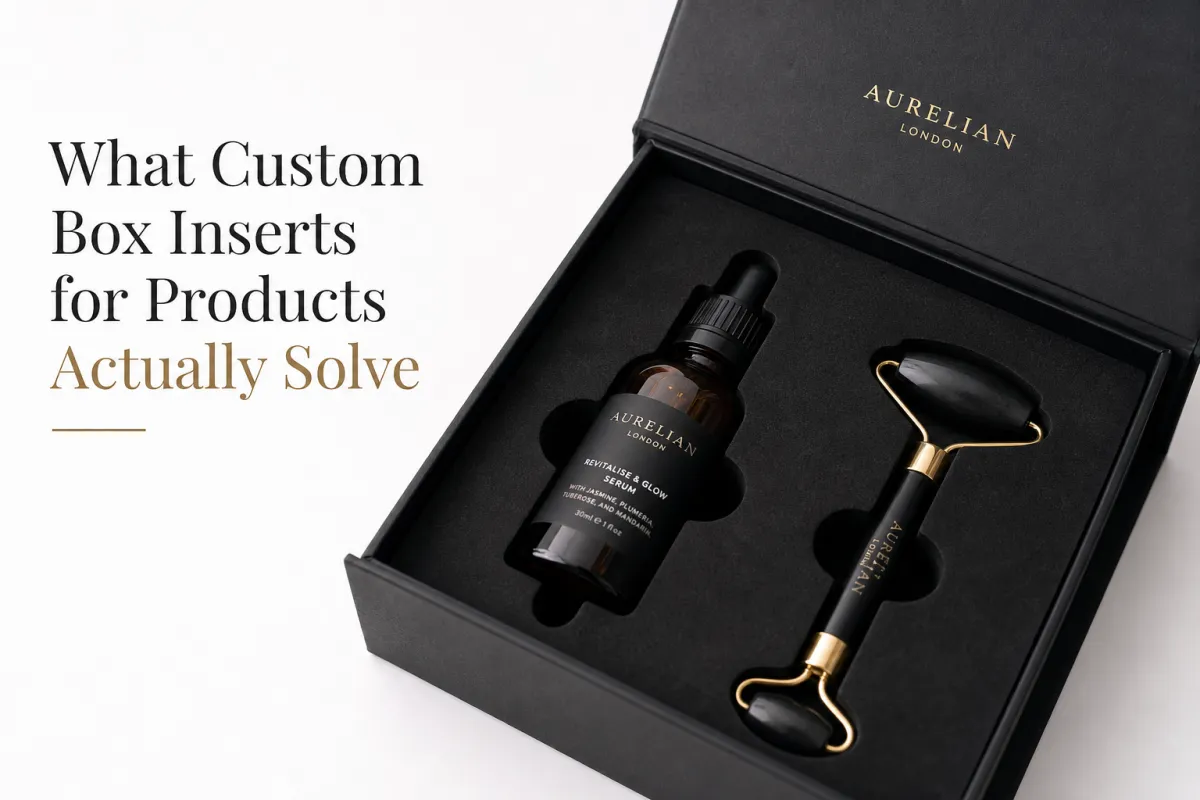
Custom box inserts for products solve a practical problem that every packer and brand owner knows well: objects move, and moving objects get damaged, scuffed, or packaged in a way that looks rushed. A carton can keep out dirt and handle general shipping abuse, but it does not automatically stop a bottle from bouncing, a device from sliding, or a kit from arriving in pieces. A well-designed insert locks the item in place, which reduces abrasion, limits impact, and gives the customer a cleaner first impression.
The hidden cost shows up fast. Replacement shipments, customer service time, repacking labor, and refunds can eat through margin long before a brand notices a pattern. Saving a few cents on the insert can turn into dollars lost when damage starts appearing in the field. That is where custom box inserts for products earn their keep. They reduce movement, keep packing consistent, and make the whole package feel more deliberate.
The branding effect is just as real. Loose void fill can occupy space, but it rarely creates a structured reveal. Custom box inserts for products frame the item, guide the eye, and hold accessories until the right moment. In branded packaging and custom printed boxes, that opening sequence becomes part of the promise. The insert is not invisible. It sets the stage.
Void fill and purpose-built inserts do different jobs:
- Void fill fills space, but it does not reliably lock the product in place.
- Purpose-built inserts support the item at the points that matter most.
- Generic cushioning can soften movement, yet it often looks less polished.
- Custom box inserts for products combine presentation and protection in one structure.
That difference becomes more obvious with mixed kits. A single product with a simple silhouette may work with a straightforward cavity. A bundle with cables, manuals, chargers, and accessories usually needs a more deliberate layout. In that setting, custom box inserts for products handle three jobs at once: they stabilize the contents, guide assembly, and improve the customer's first physical interaction with the kit.
Paper-based inserts can also support sustainability goals when the structure is planned from the start instead of being added later as filler. Fiber-based designs often fit recycling goals better than mixed-material approaches, especially when the carton and insert are developed as one system. Damage prevention and material choices belong in the same conversation. The insert affects both.
“If the product moves, the customer notices it. If the product is hard to remove, the customer notices that too.”
That tension sits at the center of good packaging work. Protection cannot make the opening awkward, and presentation cannot come at the expense of breakage. Custom box inserts for products solve that problem by giving both goals a place to meet.
How Custom Box Inserts for Products Are Designed and Made
Design starts with the product, not the box. That sounds simple, yet many projects go off track because the carton is finalized first and the insert is forced to fit around it. Custom box inserts for products should come from the actual item dimensions, accessory count, surface finish, and the way the product will be packed by a real person on a real line. Measure the product first, then the carton, then work outward. The insert needs to fit the item and still allow for tolerances, material thickness, and packing steps.
In sample reviews, I always start by holding the product in my hand and asking where it wants to sit naturally. That small habit saves a lot of guessing later. The common formats are easy to separate once protection and presentation are both in view. Die-cut paperboard works well for lighter items and clean retail presentation. Corrugated inserts bring more stiffness and fit situations where compression resistance matters. Molded pulp gives brands a more fiber-forward visual language and useful cushioning. Foam still has a place for fragile, precise, or high-value products, although it does not suit every sustainability target. Tray-style structures sit between those options and can be built for nested component layouts. Custom box inserts for products often combine more than one approach, especially when a kit includes several pieces.
Prototyping is where the concept becomes real. A solid supplier should move from digital mockup to sample cut, then to fit testing, then to revision if the first pass needs refinement. Sometimes the change is small: a few millimeters of clearance, a deeper slot, a relief cut for a cable, or a finger notch that makes removal easier. Sometimes the structure needs a more complete rethink. If the insert is for a device with multiple accessories, the layout may need to shift so the packer and the recipient both understand the sequence naturally. Otherwise the kit feels fussy, and nobody wants that.
Drop testing and compression testing deserve a place in the conversation. For parcel shipments, ISTA methods are a sensible reference point, especially common parcel profiles such as ISTA 3A. The framework is available through ISTA. Fiber-based inserts also benefit from sourcing expectations and chain-of-custody language through FSC, especially when recycled or responsibly sourced paperboard is part of the brief. Standards do not solve every packaging issue, but they give the team a common testing language.
Production is less glamorous than the sample stage, yet repeatability matters most there. Custom box inserts for products can be die-cut, scored, creased, folded, glued, stacked, and packed at very different speeds depending on the structure. A simple paperboard insert can run efficiently at volume. A multi-cavity foam assembly may require more handling and tighter quality control. Once the order reaches the thousands, small tolerance problems turn into line problems quickly.
Complexity climbs fast when shapes vary or a kit includes multiple parts. A charger with a cable is not the same as a charger without one. A glass bottle with a dropper is not the same as a glass bottle with a pump. Three items need a different logic than one hero product. Custom box inserts for products should account for the whole package, not just the main item. The layout has to reflect accessories, orientation, visibility, and the time needed to place each piece during packing.
For teams building a package system instead of a one-off shipper, it makes sense to compare insert choices alongside the rest of the structure. The same design logic that supports custom box inserts for products can carry into labels, sleeves, mailers, and carton styles. That is where a broader Custom Packaging Products review becomes useful: it keeps the insert, the box, and the branding working as one system rather than three separate decisions.
Key Factors That Affect Fit, Protection, and Brand Experience
Five variables do most of the work: product weight, fragility, surface finish, accessory count, and shipping profile. Custom box inserts for products that hold a lightweight cosmetic jar are not designed the same way as inserts for a heavy glass object or a precision electronic device. Weight changes how the item behaves in a drop. Fragility changes how much clearance and cushioning the insert needs. Surface finish changes how much rubbing or abrasion the item can tolerate before the damage becomes visible.
A snug fit is not always the best fit. A cavity that feels perfect on paper can still fail when a delicate product needs controlled clearance so the insert can absorb impact instead of passing it straight into the item. Too much space creates the opposite problem because motion returns. The balance depends on the object, the carton, and the shipping conditions. Custom box inserts for products work best when they are built for restraint, not just compression.
Brand experience sits beside protection. The way the insert frames the product changes the perceived value. A matte white paperboard tray can read as clean and modern. A molded pulp insert can signal material honesty and a lower-waste intent. Black foam can feel premium, though it can also read as more technical or less recyclable. Custom box inserts for products shape the opening sequence, which is why packaging design teams should think about reveal order, contrast, and whether the accessory appears before or after the main item.
Fulfillment speed matters too. The insert should protect the product without slowing the line. If packing each unit takes three extra steps, that cost shows up fast. A structure that snaps into place, locates the item clearly, and keeps accessories obvious to the packer is worth more than a pretty insert that creates confusion. In high-volume runs, a few seconds per unit add up quickly.
Sustainability calls for clear trade-offs. Paperboard and corrugated are often easier to recycle. Molded pulp can work well for brands that want a fiber-based presentation and lower plastic use. Foam can outperform other materials in some fragile-item use cases, yet it may not support the recycling story the brand wants to tell. No material is automatically right or wrong. The right answer depends on shipping conditions, fragility, and the promise the brand is making. Custom box inserts for products should not force a sustainability narrative that the package cannot support.
Visibility is another choice that deserves more attention than it usually gets. Some packages work best when the insert disappears behind the product. Others use the insert as part of the visual language, especially in retail packaging or custom printed boxes where structure and print carry the same message. Even when the customer never keeps the insert, it still shapes the perception of quality.
Channel matters as well. A direct-to-consumer package needs to survive parcel handling, vibration, and longer transit paths. A retail package has to stand up to shelf handling and stack pressure. Custom box inserts for products should be specified with the actual channel in mind, not an idealized shipping scenario that only exists in a presentation deck.
Custom Box Inserts for Products: Cost, Pricing, and Value
Pricing gets confusing when teams focus only on the unit cost of the insert. That view is too narrow. Custom box inserts for products carry several cost drivers: material choice, cut complexity, number of cavities, print requirements, order quantity, and whether tooling or setup is needed. A simple one-cavity paperboard insert at volume can be affordable. A multi-part foam assembly with tight tolerances costs more, both in setup and in labor.
Quantity changes the picture. Unit price often falls as volume rises, while setup and sample costs get spread across the run. At low volume, the spread is thin. At high volume, it becomes efficient. That is why custom box inserts for products can look expensive in a 250-unit pilot and far more attractive in a 5,000- or 10,000-unit order. Buyers should compare the full landed cost, not only the number on the insert quote.
Cheap and cost-effective are not the same thing. An insert that saves pennies but allows breakage can become the most expensive choice in the room. The real value of custom box inserts for products shows up in lower returns, fewer replacements, cleaner packing, and stronger perceived value. If the insert helps the item arrive intact and makes the product feel more considered, it is doing more than occupying space. It is protecting revenue.
A practical pricing framework usually breaks into these parts:
- Material cost per unit, based on paperboard, corrugated, pulp, or foam.
- Tooling or setup, including die creation, cut tooling, or mold preparation.
- Sampling, which may include one or more prototype rounds.
- Production, including converting, finishing, and quality control.
- Freight, which can matter more than expected on bulky materials.
When people ask for a rough benchmark, I prefer ranges over promises. A simple paperboard insert at moderate volume might land around $0.18-$0.45 per unit. Molded pulp may sit around $0.25-$0.70 depending on shape and finish. Foam can run wider, often $0.30-$1.20 or more when precision cutting is involved. Those are not universal numbers. They still help buyers compare custom box inserts for products without pretending every quote should look identical.
There is also a difference between visible value and invisible value. If the insert supports a premium presentation, it may help justify a higher shelf price or encourage repeat purchase behavior. If it primarily reduces returns, the benefit shows up in operations. Either way, custom box inserts for products should be treated as a system investment, not a separate line item that exists only to fill a carton.
| Insert Option | Typical Protection | Brand Impression | Common Use Case | Rough Cost at Moderate Volume |
|---|---|---|---|---|
| Die-cut paperboard | Light to moderate | Clean, retail-friendly | Cosmetics, accessories, light electronics | $0.18-$0.45 |
| Corrugated insert | Moderate to strong | Practical, structured | Mailers, kits, shipping boxes | $0.22-$0.60 |
| Molded pulp | Moderate | Eco-forward, natural | Home goods, consumer products, gift sets | $0.25-$0.70 |
| Foam | Strong to very strong | Technical, premium, protective | Fragile items, precision devices, instruments | $0.30-$1.20+ |
For brands comparing choices across a wider packaging program, the insert quote should sit next to the box quote, the print quote, and the fulfillment labor estimate. That is where the logic of Custom Packaging Products becomes practical. The best option is rarely the cheapest insert by itself. It is usually the one that gives the strongest mix of protection, speed, and customer experience.
Step-by-Step Timeline for Custom Box Inserts for Products
A realistic timeline begins with discovery. The team gathers product dimensions, photos, weights, accessory counts, and shipping conditions. That input matters because custom box inserts for products cannot be designed accurately from carton dimensions alone. The product itself drives cavity size, support points, and the amount of clearance needed for transit.
From there, the supplier usually creates a structural concept. That may be a quick digital mockup or a more formal sample build. The first round should answer a simple question: does the product sit correctly, stay stable, and remove cleanly? If not, the design changes. If yes, the team may move to a production-tolerant sample that reflects the material and converting method intended for volume.
Time gets lost in a few predictable places. Incomplete specs create back-and-forth. Late measurements force rework. Unclear finish decisions trigger a fresh sample round. Too many opinion cycles can add days or weeks to the schedule. Custom box inserts for products move faster when the brief is tight and the decision-makers are aligned before the first sample is requested.
A straightforward timeline often looks like this:
- Discovery and measurement: 1-3 business days if specs are ready.
- Concept and sample prep: 3-7 business days for straightforward structures.
- Review and revision: 2-5 business days per revision round.
- Production scheduling: often 5-10 business days once approved.
- Full production: timing depends on quantity, material, and finishing.
For a simple insert with clear dimensions and one sample round, the project may move quickly. Custom box inserts for products with multiple cavities, specialty print effects, unusual shapes, or foam tooling take longer. That is not a delay so much as the nature of packaging design. More moving parts create more points that need to be verified.
If the launch date is fixed, the fastest way to shorten the calendar is to provide final measurements, photos from multiple angles, CAD files if they exist, and a realistic quantity forecast. A clear ship target helps too. Do not leave the supplier guessing on order size. Custom box inserts for products are easier to schedule when the production volume is known early.
Pilot-run inspection deserves a place in the plan. The first production batch should match the approved sample in thickness, cut accuracy, and fit. A receiving check catches small variation before it becomes a customer issue. In packaging operations, tiny mismatches can snowball quickly, whether the insert is paper-based, pulp, or foam.
For recurring orders, the best long-term process is to lock the specification and save the approved sample record. The next production cycle then becomes a controlled repeat instead of a new guess. That is where custom box inserts for products pay off again: once the structure is locked, scaling becomes much easier.
Common Mistakes When Specifying Custom Box Inserts for Products
The first mistake is building around the box before the product. It seems small, yet it creates bad geometry. If the outer carton is fixed first, the insert can end up with awkward voids, weak retention points, or a product that sits too shallow. Custom box inserts for products should begin with the item and work backward.
The second mistake is ignoring real shipping conditions. Vibration, stack pressure, temperature swings, and repeated handling all change how the package behaves. A package that looks perfect on a desk can fail after a few hundred miles in a truck. Custom box inserts for products need testing against actual transit conditions, not only visual alignment.
Third, some teams overcomplicate the structure. More cavities, more folds, and more parts can improve presentation, but they can also raise cost, slow packing, and increase the risk of production errors. The best insert is not the fanciest one. It is the one that solves the shipping problem without creating a new operational problem. That matters even more when custom box inserts for products are produced in large quantities.
Fourth, sample testing should never be skipped just because the digital proof looks clean. A screen view cannot tell you how a surface scratches, how a cavity grips, or whether the product becomes frustrating to remove. Sample testing is cheap compared with a run of bad inventory. The teams that test early usually save money later.
Fifth, brands sometimes act as if the insert is invisible. It is not. The insert shapes the first physical interaction with the product, which means it influences how the customer judges quality, care, and value. In branded packaging, that first impression belongs to the package experience. Custom box inserts for products should account for that even when the insert itself disappears once the item is removed.
Finally, accessories get overlooked more often than they should. A product and its charger, manual, cable, or sample packet do not pack themselves. If the insert does not account for them, the box feels improvised. That is usually the point where a tidy concept turns into a messy packing line. Custom box inserts for products work best when the full kit is mapped before the die line is finalized.
Expert Tips and Next Steps for Ordering Custom Inserts
My first rule is simple: start with the product's failure points. Ask where it breaks, where it scratches, where it shifts, and which part is hardest to protect. That gives a better starting point than finish choices or color. Custom box inserts for products are easier to specify when the protection strategy is grounded in actual risk instead of aesthetics alone.
Build a decision matrix before you ask for quotes. Score each material on protection, appearance, sustainability, assembly speed, and price. A paperboard insert may win on presentation and recyclability. A molded pulp option may fit a more eco-forward brand language. Foam may win on fragile-item protection. The point is not to choose by instinct alone. The point is to compare options in the same frame.
Ask any supplier for three things: a sample, a production-tolerant version, and a packed mockup. Those three views reveal different things. The sample shows fit. The production-tolerant version shows whether the structure can be manufactured consistently. The packed mockup shows what the customer will actually experience. Custom box inserts for products are much easier to approve when those layers are visible side by side.
If you are narrowing the brief, use a checklist like this:
- Final product dimensions and weight
- Accessory count and placement
- Shipping method and transit risk
- Target quantity and replenishment plan
- Branding needs, print surface, and finish
- Sustainability requirements or material restrictions
Once that list is complete, request quotes on at least two material options. The lowest quote is not always the best fit once assembly speed, customer experience, and damage risk are included. Custom box inserts for products should help the operation scale, not just lower the paper quote.
If your packaging program includes cartons, sleeves, and displays alongside inserts, review the wider system before you commit to a final structure. Our Custom Packaging Products catalog can help you compare compatible pieces without rebuilding the entire concept from scratch. Inserts, outer boxes, and print finishes should support one another.
Measure the value of the insert after launch. Track damage rates, returns, packing speed, and customer feedback. If the numbers improve, the structure is earning its place. If they do not, adjust the fit or the material before the next run. Custom box inserts for products are not a one-time aesthetic choice. They are a repeatable operational tool.
If you are specifying custom box inserts for products for the next run, start with the product itself, list every accessory, and test one sample in the actual shipping scenario before approving volume. That sequence keeps the project grounded, and honestly, it saves a lot of costly guesswork later.
Frequently Asked Questions
What are the best materials for custom box inserts for products?
Paperboard and corrugated work well for lighter items, clean presentation, and recyclable packaging goals. Molded pulp is a strong option when you want a more eco-forward look with decent cushioning. Foam usually fits highly fragile or precision items, but it may not match every sustainability target. The best material for custom box inserts for products depends on the product's weight, fragility, and shipping conditions.
How long do custom box inserts for products usually take to make?
Simple designs can move quickly if the dimensions are clear and only one sample round is needed. Complex inserts with multiple cavities, print, or specialty materials take longer because each revision affects tooling and fit. The fastest way to shorten the timeline is to provide final product measurements, images, and quantity expectations at the start. In many cases, custom box inserts for products are held up more by missing information than by manufacturing itself.
Are custom box inserts for products worth the cost for small runs?
They can be worth it when the product is fragile, high-margin, or expensive to replace after damage. Small runs often have higher unit costs, but they can still pay off by reducing returns and improving perceived value. A basic cost comparison should include breakage risk, fulfillment speed, and the customer experience, not just material price. For many brands, custom box inserts for products become more valuable once the first complaints or returns appear.
Can custom box inserts for products reduce shipping damage?
Yes, if the insert is engineered to stop movement and support the product at its weak points. Damage prevention improves when the insert is tested with actual transit conditions rather than only checked for visual fit. The best inserts balance snug retention, cushioning, and controlled space for accessories or nested parts. That is why custom box inserts for products should be validated with a sample and, ideally, a transit-style test.
What information do I need to request a quote for custom box inserts for products?
Share product dimensions, weight, fragility concerns, and whether the item ships alone or with accessories. Include estimated order quantity, desired material, branding needs, and your preferred production timeline. Add box dimensions, photos, and any packaging problems you're trying to solve so the supplier can recommend the right structure. The more complete the brief, the better the quote for custom box inserts for products will be.

