Buyer Fit Snapshot
| Best fit | Custom Branded Shipping Cartons projects where brand print, material claims, artwork control, MOQ, and repeat-order consistency need to be specified before quoting. |
|---|---|
| Quote inputs | Share finished size, material target, print colors, finish, packing count, annual reorder estimate, ship-to region, and any compliance wording. |
| Proofing check | Approve dieline scale, logo placement, barcode or warning zones, color tolerance, closure strength, and carton packing before bulk production. |
| Main risk | Vague material claims, crowded artwork, missing packing details, or unclear freight terms can make a low unit price expensive after revisions. |
Fast answer: Custom Branded Shipping Cartons: Strategy, Cost, and Design should be specified like a repeatable production item. The safest quote records material, print method, finish, artwork proof, packing count, and reorder notes in one written spec.
Production checks before approval
Compare the actual filled-product size with the drawing, then confirm tolerance on folds, seals, hang holes, label areas, and retail display edges. Reserve space for logos, QR codes, warning copy, and material claims before decorative graphics fill the panel.
Quote comparison points
Review material grade, print process, finish, sampling route, tooling charges, carton quantity, and freight assumptions side by side. A quote is only useful when the supplier can repeat the same color, closure quality, and packing count on the next order.
Custom Branded Shipping Cartons: Strategy, Cost, and Design
Most brands still treat the outer box like a wrapper, when in practice it carries far more weight than that. Custom Branded Shipping cartons are often the first physical touchpoint a customer sees, and that first impression starts forming before the product is even out of the carton. If the board feels flimsy, the print looks muddy, or the size is off by a wide margin, people notice. If the carton feels deliberate, protects the product, and carries the brand cleanly through the shipment, that detail quietly lifts the entire experience.
That is why custom Branded Shipping Cartons matter for more than appearance. They protect goods in transit, support order fulfillment, reduce damage claims, and make shipping feel more polished from the warehouse to the doorstep. The right carton can carry a simple logo, a color system, handling marks, product-family coding, or a broader package branding system, all while doing the hard physical job of corrugated protection.
There is a real difference between decorative packaging and functional branding. The best custom branded shipping cartons do both jobs at once. They fit the product, survive the journey, and still look like they belong to the brand. That balance is what this piece covers: how the cartons are built, what drives cost, how to order them without wasting time, and where brands usually spend more than they need to.
Custom Branded Shipping Cartons: Why the Right Box Matters
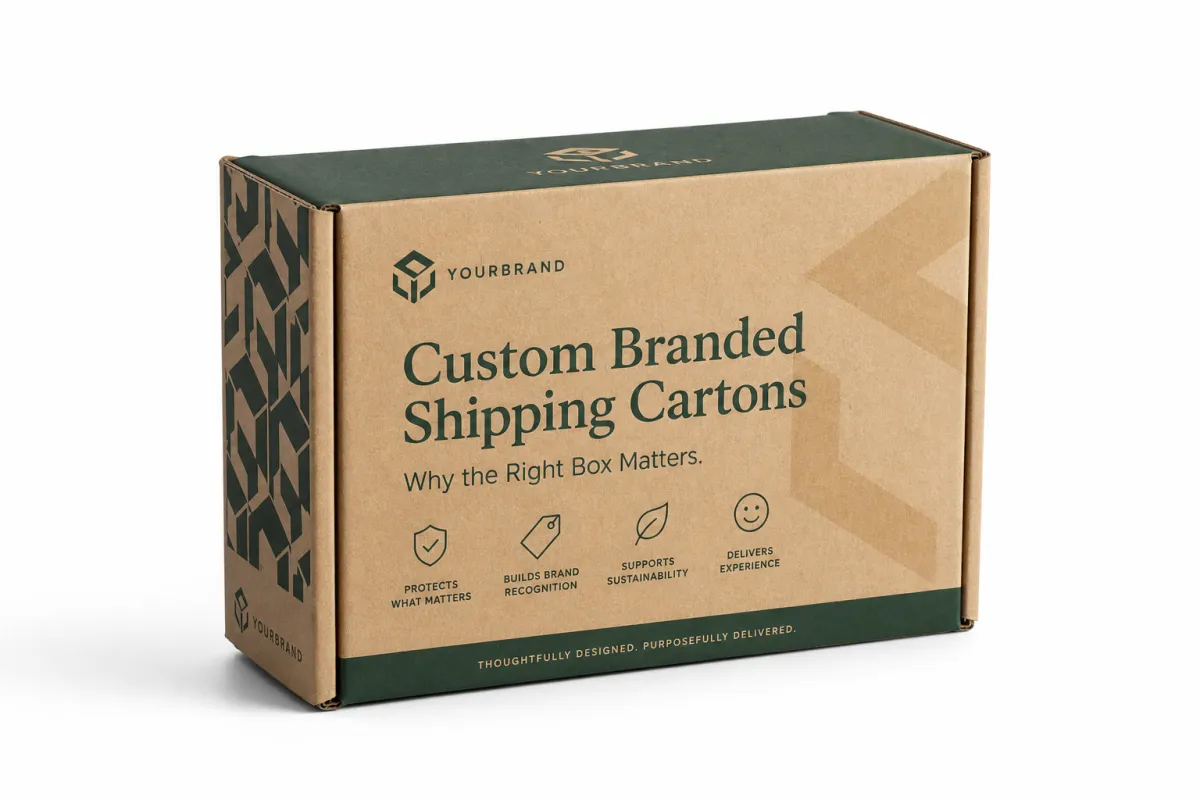
Custom branded shipping cartons are Corrugated Shipping Boxes, mailer-style cartons, and retail-ready shipper formats that carry brand graphics, logos, messaging, or structural details tied to the company. Some are plain on the inside and printed on the outside. Others carry interior art, product-family cues, or handling instructions that help the carton work harder during ecommerce shipping and warehouse packing.
The practical value is easy to overlook because the box is so familiar. Still, from a packaging buyer's point of view, custom branded shipping cartons shape the customer's expectation before the tape is cut. A box with the right size, print quality, and structural strength tells a different story than a generic stock carton. It says the brand paid attention, and that matters in branded packaging as much as the product itself.
Protection is the other half of the story. Good product packaging is not just about graphics; it is about board grade, flute profile, stacking behavior, and how much abuse the carton can handle on the way to the customer. A carton that crushes, scuffs, or bursts creates replacement costs, shipping waste, and customer service headaches. A well-built set of custom branded shipping cartons lowers that risk while making the operation feel more controlled.
I see many teams treat the outer shipper as an afterthought. The outer box is part of the product journey, part of package branding, and part of fulfillment efficiency. If the carton nests well on a pallet, folds cleanly at packing stations, and still gives the brand room to show up clearly, the whole system becomes easier to run. That is kinda the sweet spot: simple to pack, sturdy enough to trust, and branded without turning into a production headache.
The best carton does two jobs at once: it survives the trip and it communicates the brand without getting in the way of the trip.
That is the mindset to keep as you plan custom branded shipping cartons. The goal is not just a prettier box. The goal is a carton system that reduces avoidable damage, keeps order fulfillment moving, and supports a consistent customer experience across every shipment.
How Custom Branded Shipping Cartons Are Made
The build starts with the corrugated structure. Most custom branded shipping cartons use single-wall, double-wall, or occasionally a heavier specialty construction depending on product weight and shipping conditions. Board grade and flute choice matter a great deal. A lighter D-flute or E-flute carton can create a cleaner retail packaging look, while B-flute, C-flute, or BC double-wall structures often make more sense for heavier loads, longer transit, or cartons that stack inside warehouses.
For example, a 32 ECT single-wall carton is common for many standard ecommerce shipping applications, while 44 ECT or double-wall formats are usually better for heavier products, dense contents, or distribution paths with more handling. The right answer depends on product weight, panel size, stacking pressure, and whether the carton needs to protect fragile goods without depending entirely on void fill. That is why custom branded shipping cartons should never be specified from a catalog image alone.
The print method comes next. Flexographic printing is often the workhorse for corrugated because it handles solid logos, repeat patterns, and simple copy efficiently. Digital printing can be attractive for shorter runs, versioned artwork, or frequent design changes. Litho-lamination may be the right answer for premium presentation, especially if the box is meant to feel closer to custom printed boxes used in high-visibility retail packaging. A one-color mark on kraft can be smarter than a full-coverage design if the brand wants cost control and a clean visual system.
Artwork should be planned around the dieline, not forced onto it afterward. A good dieline accounts for panel size, glue flap width, fold lines, and where critical content lands after the carton is formed. Inserts, product tolerance, tape closure, and even where a customer will first open the box all influence the final layout. That is one reason custom branded shipping cartons work best when design, production, and operations speak early, before the file gets locked.
Proofing is not a formality. A clean workflow usually includes art review, a dieline check, a digital proof or mockup, and then a sample carton or physical preproduction version. Some brands also run drop testing or fit testing with actual product loads, which is smart because product packaging is judged in motion, not on a screen. If the carton bends too much, prints off-register, or interferes with closing, the proof stage is the cheapest place to catch it.
For brands that want a benchmark, the ISTA test standards are useful because they help teams think about distribution hazards in a structured way. Fiber sourcing is another consideration, especially for brands with sustainability goals; the FSC framework is one common reference point for responsible sourcing. Those references do not replace real-world testing, but they do give custom branded shipping cartons a more defensible specification.
In practice, the carton build is a collaboration. The brand defines the look and customer experience, operations defines pack-out and shipping constraints, and the supplier translates both into a manufacturable format. That is how custom branded shipping cartons move from concept to line-ready packaging without creating headaches for the pack-out team.
Cost, Pricing, and Timeline Factors to Plan For
Pricing for custom branded shipping cartons is driven by a small set of variables, and most of them are predictable once you know what to ask. Size is the first one. Larger cartons use more board, more ink, more storage space, and more freight volume. Board strength is next. A stronger structure costs more than a lightweight one, especially if the carton needs to support higher stacking loads or heavier products.
Print coverage matters too. A simple one-color logo on kraft is usually easier to produce than a full flood coat, multiple spot colors, or tight registration between fine design elements. Special finishes raise the cost again. Soft-touch coatings, foil, heavy varnish, embossing, or complex die cuts can be worth it for specific product packaging goals, but they should be justified by the role the box plays. Not every carton needs to look like a luxury gift box.
Volume changes the math. At 1,000 units, setup and material efficiency can make the per-unit price feel high. At 5,000 or 10,000 units, the unit cost usually drops because the setup is spread across more pieces. That said, larger quantities increase storage needs and lock up more cash in inventory. For custom branded shipping cartons, the cheapest unit price is not always the best business decision if the brand is still refining its size, artwork, or pack-out.
Timelines are usually shaped by artwork readiness, proof cycles, tooling or plate creation, production queue, curing or drying time, and freight booking. A straightforward job with clean files may move faster than a carton with multiple revisions or custom sizing. In many production runs, a realistic window is often 12-15 business days after proof approval, though that can stretch if the plant is busy or the project needs a structural sample. Custom branded shipping cartons reward planning because every revision adds friction.
It helps to budget for the full packaging system instead of only the outer box. Inner protection, labels, inserts, stretch wrap, void fill, and freight damage allowance all affect the true landed cost. A carton that saves a few cents but increases breakage is not saving money. That is a common trap with custom branded shipping cartons, especially for ecommerce shipping where small damage rates become expensive very quickly.
Here is a simple comparison of common carton approaches. The numbers are typical ballpark ranges for planning, not fixed quotes, because order quantity, board market pricing, and print coverage can move them up or down.
| Carton Type | Typical Use | Print Approach | Approx. Unit Cost at 5,000 Units | Notes |
|---|---|---|---|---|
| Stock brown corrugated | Basic shipping, internal use | No print | $0.45-$0.85 | Lowest cost, no brand presentation |
| Single-color branded carton | Ecommerce, subscription, DTC | Flexo, one spot color | $0.65-$1.10 | Strong value for branded packaging |
| Two- to three-color carton | Retail packaging, premium shipper | Flexo or digital | $0.90-$1.60 | Better visual presence, moderate setup cost |
| Heavy-duty custom printed boxes | Fragile or heavier products | Flexo or litho-lam | $1.25-$2.50+ | Higher board cost, better protection |
Those ranges are useful because they show the tradeoff clearly. Custom branded shipping cartons are not just a design purchase; they are a supply chain decision. A carton that fits well, prints cleanly, and ships reliably can save money in claims, returns, and pack-out time even if the upfront box price is higher.
For teams that want to track budget against real packaging decisions, the internal pages for Custom Packaging Products and Custom Shipping Boxes are a useful place to compare formats before moving to a quote. If the program needs a different outer layer for lighter parcels, Custom Poly Mailers may also be part of the mix, especially for apparel or low-fragility items.
Step-by-Step: Ordering Custom Branded Shipping Cartons
The cleanest way to order custom branded shipping cartons is to start with the job, not the artwork. Define what the carton is shipping, how fragile the contents are, where it will travel, and what kind of brand impression it needs to make. A mailer going to a consumer in a single parcel route has very different needs than a bulk carton moving through a regional warehouse network.
Next, measure the product the way it will actually ship. Include inserts, padding, closures, and the small amount of tolerance needed so the product does not rattle or crush against the sidewalls. A carton that is too tight causes packing delays and product scuffing. A carton that is too loose wastes board and increases movement. Accurate measurement is one of the easiest ways to make custom branded shipping cartons perform better from the start.
Once the size is clear, choose the carton style and print approach. A regular slotted container may be perfect for one line, while a roll-end mailer, telescope box, or custom die-cut mailer may work better for another. Ask for a dieline or spec sheet before finalizing artwork so the graphics match the actual geometry. This is also the point to decide whether the outside alone is enough or whether the inside should carry any product packaging message, instructions, or brand color panels.
Then move into proofing. A virtual proof is useful, but a physical sample or mockup tells you more. Check the closure, test the fit with real product, inspect the print area, and look at how the carton behaves when folded and handled. If the project is important, test it as part of order fulfillment instead of only as a design sample. Custom branded shipping cartons should survive the packing bench, the conveyor, the pallet, and the final doorstep drop.
After approval, production should be monitored against the sample. The first run is the moment to confirm ink density, board caliper, score lines, and overall fit. If there is any change from what was approved, catch it before the full quantity ships out. That discipline matters because custom branded shipping cartons are both a visible brand asset and a functional shipping component, and mistakes tend to show up in both places at once.
- Define the product and shipping environment.
- Measure the packed-out dimensions with inserts and padding.
- Choose the carton structure, board grade, and print method.
- Review the dieline and artwork together.
- Approve a sample or mockup and test it with real product.
- Release production and inspect the first run against the approved sample.
Brands that want to compare packaging formats before they commit can also review examples in Case Studies. That kind of reference is useful because custom branded shipping cartons are easier to specify once you have a sense of what similar product packaging has done well in the real world.
Common Mistakes That Waste Budget and Delay Orders
The first mistake is simple, but it happens constantly: wrong measurements. Teams measure the product and forget to include inserts, tolerances, or compression allowance. Then the box arrives too tight, the top panel bows, or the product shifts inside the carton. That means rework, schedule delays, and sometimes a complete spec change. Custom branded shipping cartons deserve a fit check that reflects the real packed condition, not just the raw product size.
The second mistake is choosing a carton based on appearance alone. A sleek die-cut style might look excellent on screen, yet stack poorly in a warehouse or flex too much in transit. A carton that seems elegant can become expensive if it slows pack-out or creates damage claims. The best custom branded shipping cartons are designed for the trip, not just the unboxing moment.
Another common problem is overdesigned artwork. Too many colors, tiny text, thin reversed lines, or crowded design details can reproduce poorly on corrugated board. This is where packaging design needs restraint. Strong branding usually survives with fewer elements than teams expect, and a cleaner system often looks more confident on the shelf and in ecommerce shipping. If the print method is flexographic, keep the design honest about what the process can reliably hold.
Skipping samples is a fast way to create expensive surprises. A digital mockup may look fine, but it cannot show board stiffness, score behavior, or how the flaps close once the product is inside. A drop test or pack-out test does not need to be elaborate to be valuable. Even a basic trial with real product can reveal whether the carton is strong enough for shipping, especially in programs with fragile contents or heavy inner components.
Inventory and lead time get overlooked too. A brand may approve a beautiful carton and then realize it needs more warehouse space, more cash tied up in stock, or a longer production window than the launch date allows. Minimum order quantities can also push brands into a larger run than expected. Custom branded shipping cartons work best when supply chain realities are built into the decision, not discovered after the quote lands.
- Confirm pack-out dimensions with the actual product and inserts.
- Test stack strength if the carton will sit on pallets or in bins.
- Keep line art and text sized for corrugated reproduction.
- Check storage space before approving a large run.
- Match the print method to the real artwork complexity.
Expert Tips for Better Custom Branded Shipping Cartons
Design for the journey first. That means reinforcing corners, protecting edges, and making sure the branding still reads after the box has been handled, slid, stacked, or scraped a little in transit. A carton that only looks good on a render is not enough. Custom branded shipping cartons should hold up visually and structurally after the rough parts of the shipping path.
Use restraint where it helps. A single strong logo placement, a distinctive color, or a repeated graphic device can do more for package branding than a full-coverage print strategy that raises cost and muddies the message. That advice matters in custom branded shipping cartons because corrugated board has limits, and the cleaner the visual system, the easier it is to keep production consistent across runs.
Standardize wherever possible. A carton family that shares dimensions or print conventions across several SKUs can simplify ordering, storage, and warehouse training. It also makes forecasting easier. If the same core structure can support multiple products with small insert changes, the brand avoids the cost of maintaining too many one-off cartons. That is one of the smartest ways to make custom branded shipping cartons work as a long-term operating system instead of a one-time design project.
Think about the inside as well as the outside. Interior panels, simple messaging, or a color cue where the product should sit can improve the experience without a big increase in print complexity. For brands with stronger retail packaging goals, an interior print can provide a nice reveal while the exterior carries the hard-working protection and shipping information. That balance gives custom branded shipping cartons more value without making them fussy.
Operational clarity is another overlooked advantage. Handling marks, product-family codes, and scannable label zones help warehouse teams move faster and reduce mistakes. If the carton supports order fulfillment instead of slowing it down, the whole program becomes easier to defend. In real terms, custom branded shipping cartons should help the brand look better and help the team ship faster. Both matter.
For brands with sustainability goals, I also think it is smart to ask for clear board specs and sourcing details rather than assuming everything is automatically recyclable or responsibly sourced. Corrugated is widely recyclable in many markets, but local collection systems vary, and fiber sourcing should be documented if the brand needs it. That is where references like the Packaging Coalition can help teams keep their thinking grounded in current packaging conversations without drifting into vague claims.
One more practical note: a carton system should support the rest of the packaging lineup. If the outer shipper, the insert, the label, and the closure all speak the same visual language, the program feels intentional. If they do not, the experience feels patched together. Custom branded shipping cartons are strongest when they fit into a broader product packaging system instead of standing alone.
Next Steps for Custom Branded Shipping Cartons
The best next move is to build a simple packaging brief. List the product dimensions, product weight, packing method, shipping method, artwork needs, and target quantity. Add any retail packaging constraints, warehouse handling requirements, or launch dates that cannot move. Once that information is on one page, custom branded shipping cartons become much easier to quote and compare.
From there, choose the carton style, request a sample quote, and ask for a physical mockup if the run is important or the product is fragile. A mockup is often the fastest way to compare presentation against cost and transit performance. The real question is not whether custom branded shipping cartons look good on paper; it is whether they perform in the real pack-out environment and still feel like the brand you want customers to remember.
If the launch date is close, work backward from production and freight. Leave room for proofing, sample testing, and one round of corrections if needed. That small amount of buffer is often the difference between a smooth start and a rushed workaround. In my view, custom branded shipping cartons should be treated as an operational tool and a brand asset at the same time. That is the most reliable way to turn a box into a measurable advantage.
For teams ready to move forward, start with one test order, review the pack-out, check the print, and confirm the timeline against the launch calendar. If the carton does its job, scale from there. If it misses the mark, adjust before ordering a large run. That disciplined approach keeps custom branded shipping cartons aligned with both cost control and brand presentation.
Frequently Asked Questions
How much do custom branded shipping cartons usually cost?
Price depends heavily on size, board grade, print complexity, and order quantity. Simple one-color custom branded shipping cartons in larger runs usually cost less per unit than short-run cartons with full-coverage print or special finishes. The real budget should also include freight, inserts, storage, and any testing or sample costs.
What information do I need before quoting custom branded shipping cartons?
Have product dimensions, product weight, and any inserts or padding requirements ready. Share your target quantity, print goals, shipping method, and whether the carton must support retail or ecommerce shipping. If possible, provide a sample of the product or a photo of how it packs today so the quote for custom branded shipping cartons reflects the real job.
How long does it take to produce custom branded shipping cartons?
Timeline varies with artwork readiness, sample approval, and the plant's current schedule. Straightforward projects can move quickly, while highly printed or structurally complex cartons take longer. Build in extra time for proofing, sample testing, and freight if the custom branded shipping cartons must arrive before a launch.
Do custom branded shipping cartons need to be printed on the outside only?
No, inside printing can add a memorable unboxing moment or useful handling guidance. Exterior branding usually does the heavy lifting for recognition, while interior print can support storytelling or product protection notes. Keep the design tied to a clear purpose so the added print cost in custom branded shipping cartons is justified.
How do I know if my carton design is strong enough for shipping?
Match the board and flute to the product weight, shipping distance, and stacking conditions. Test the carton with real product loads and handle it as it will be shipped, not just as it looks on screen. Watch for corner crush, excessive flex, product movement, and closure issues before approving a full run of custom branded shipping cartons.
Strong cartons do more than hold product. They protect the shipment, support the operation, and tell the brand story at the exact moment the customer first touches the package. Get the structure right, keep the print honest, and make the carton fit the shipping reality, and custom branded shipping cartons become a quiet but powerful part of the brand. The practical takeaway is simple: define the packed-out size, test one real sample, and only scale once the carton proves it can ship cleanly and hold its shape.

