Buyer Fit Snapshot
| Best fit | buy custom branded shipping labels that match your brand for packaging buyers comparing material specs, print proof, MOQ, unit cost, freight, and repeat-order risk where brand print, material, artwork control, and repeat-order consistency matter. |
|---|---|
| Quote inputs | Share finished size, material target, print colors, finish, packing count, annual reorder estimate, and delivery region. |
| Proofing check | Approve dieline scale, logo placement, barcode or warning zones, color tolerance, and any recyclable or compostable wording before bulk production. |
| Main risk | Vague material claims, crowded artwork, or missing packing details can create delays even when the unit price looks attractive. |
Fast answer: Buy Custom Branded Shipping Labels That Match Your Brand should be specified like a repeatable production item. The safest quote includes material, print method, finish, artwork proof, carton packing, and reorder notes in one written spec.
What to confirm before approving the packaging proof
Check the product dimensions against the actual filled item, not only the sales mockup. Ask for tolerance on folds, seals, hang holes, label areas, and retail display edges. If the package carries a logo, QR code, warning copy, or legal claim, reserve that space before decorative graphics fill the panel.
How to compare quotes without losing quality
Compare board or film grade, print process, finish, sampling route, tooling charges, carton quantity, and freight assumptions side by side. A lower quote is only useful if the supplier can repeat the same color, closure quality, and packing count on the next order.
Buy Custom Branded Shipping Labels That Match Your Brand
If you want to buy Custom Branded Shipping labels, start with a simple truth: the shipping label is often the first branded surface a customer reads, scans, peels, or notices while the parcel is still in hand. A premium box can still feel ordinary if the label looks rushed or generic. That mismatch weakens the whole package, and it is one of the easiest mistakes to avoid.
Why Buy Custom Branded Shipping Labels Instead of Plain Ones
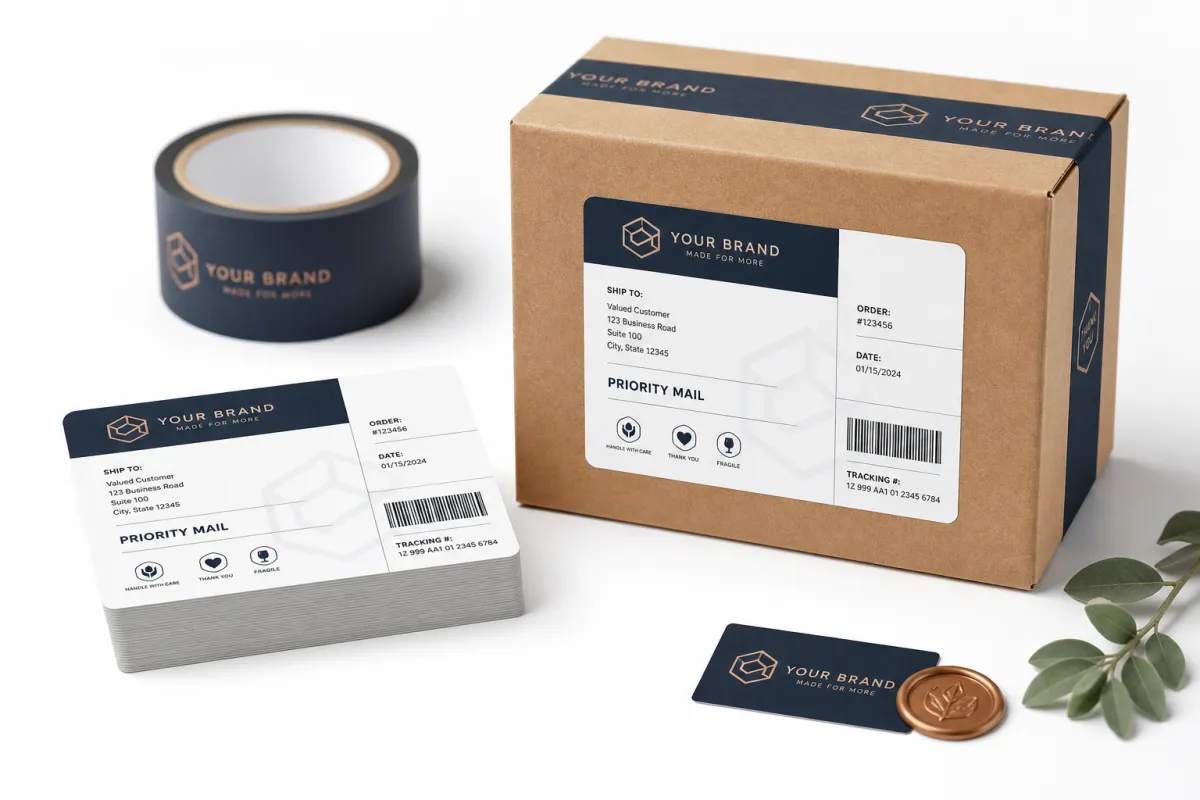
There is a clear difference between a parcel that looks handled and one that looks intentional. A plain shipping label does the job, but it rarely adds anything to the experience. Once a box, mailer, or carton already carries strong branding, a generic label can drag the presentation backward. That is why brands choose to buy custom branded shipping labels instead of settling for the cheapest white rectangle they can run in-house.
Packaging buyers know the first surface customers notice is usually the one they touch, scan, or peel back. That includes the shipping label. It rides on every outbound order, which makes it one of the most repeated brand impressions in an ecommerce shipping workflow. Compared with custom printed boxes or full-wrap product packaging, labels are a low-cost branding layer that shows up constantly.
If you already invest in branded packaging, a custom label closes the visual gap between the shipping carton and the rest of the experience. It is one of the few upgrades that can improve package branding without forcing you into expensive print runs or large storage commitments. A clean, well-designed label can make a basic corrugated box look sharper. A sloppy one can make even a nice mailer look bargain-bin cheap. People notice that whether they say so or not.
Trust plays into it too. Branded labels make outbound parcels feel organized, traceable, and deliberate. That matters in order fulfillment, especially when your team is packing at speed and the outside of the parcel needs to match the care inside. I have seen brands spend heavily on inserts and tissue, then ruin the first impression with a crooked or faded shipping label. Wasteful. Avoidable. Not difficult to fix.
If you sell premium goods, retail packaging logic still applies once the order leaves the warehouse. The package does not stop being a brand asset just because it is moving through a carrier network. It still speaks for you on a doorstep, in a lobby, or at a front desk. That is why smart brands buy custom branded shipping labels early, before the shipping operation gets messy and the details start slipping.
A clean shipping label does not rescue bad packing, but it does keep a good box from looking careless.
For brands building a broader packaging system, labels also connect to the rest of the operation. The same visual language that appears on your label can carry into Custom Labels & Tags, Custom Packaging Products, and even your Custom Shipping Boxes. That consistency is what makes a shipment look like part of a brand system instead of a stack of unrelated pieces.
Plain labels are easy to find anywhere. If your packaging already has a point of view, buy custom branded shipping labels and let the parcel finish the job your box started.
What It Means to Buy Custom Branded Shipping Labels
To buy custom branded shipping labels means ordering pressure-sensitive labels printed with your logo, brand colors, typography, QR code, or other shipping-friendly brand marks. These are working parts of the pack-out process, not decorative stickers added for show. If a label peels, smears, or slows the line, it is the wrong label no matter how good it looks in a mockup.
Common formats include roll Labels for Faster packing lines, sheet labels for smaller batches, and thermal-compatible stock for teams that print shipping information on demand. Roll labels are the workhorse choice for high-volume ecommerce shipping because they feed quickly and store neatly. Sheet labels make more sense for lower volumes, sample kits, or teams that want to hand-apply labels without special equipment. If you are trying to buy custom branded shipping labels for a warehouse or 3PL, roll format usually wins on speed.
There is also real flexibility in how a label gets used. A brand can use one version for shipping labels, another for return labels, another for fragile warnings, and a smaller format for barcode labels or internal warehouse workflows. That approach keeps the visual system organized and avoids the usual mess where every sticker looks like it came from a different shop.
Stock and finish matter more than many buyers expect. Matte tends to look restrained and reads easily. Gloss gives color more punch, which can help logos stand out. Clear labels disappear visually, which works when the box artwork should stay visible. Kraft-look stock supports a natural or recycled aesthetic, especially if the rest of your packaging design leans earthy or tactile. If you want to buy custom branded shipping labels that feel integrated, the stock choice matters as much as the artwork.
The real question is not “What looks prettiest?” The real question is “What prints cleanly, sticks reliably, and fits the packing process?” That is where people often miss the mark. A label that looks beautiful on screen but jams the applicator, fails on a cold carton, or smudges under abrasion is not a good purchase. It is a problem waiting to happen. I have been on enough production floors to know that the hard part is almost never the logo; it is the material behaving the way you expected it to behave.
If you want a wider packaging system, the same planning logic applies across Custom Poly Mailers and other packaging design decisions. The label should support the pack, not fight it. That is the whole point when you buy custom branded shipping labels.
What to Check Before You Buy Custom Branded Shipping Labels
Start with size. Always. If you buy custom branded shipping labels before confirming dimensions, you are building trouble into the order from the start. Label size needs to work with carrier requirements, package surface area, barcode placement, and the rest of the box layout. A label that is too large crowds the carton. A label that is too small wastes branding space and may fail readability rules.
For standard ecommerce shipping, common sizes include 4 x 6 inches for shipping labels, 2 x 3 inches for return or promo labels, and smaller barcode or inventory labels for internal use. Those are practical starting points, not magic numbers. If your box is small, a 4 x 6 label can dominate the surface. If your parcels are large or irregular, a smaller label may look like an afterthought. The proportions have to make sense.
Material matters just as much. Paper labels work for standard cartons and lower-cost jobs. Synthetic stock is better if the parcel may face moisture, abrasion, or rough handling. Freezer adhesives are useful for cold-chain or chilled goods. Removable adhesives make sense for temporary branding or promotional use where the label should come off cleanly later. If you are going to buy custom branded shipping labels for a specific pack-out environment, do not assume every adhesive behaves the same. It does not.
Finish changes both appearance and performance. Matte tends to reduce glare under warehouse lighting and gives a quieter branded look. Gloss can sharpen color and give black logos more density. Clear stock lets artwork behind the label stay visible, which is useful for premium cartons or custom printed boxes with strong base graphics. If the label needs to carry a barcode, do not choose a finish because it sounds fancy. You need scan reliability first.
Compatibility is another place where people waste money. Direct thermal, thermal transfer, inkjet, and laser all have different requirements. If your team prints labels on demand, the stock has to match the printer type, the core size, and the roll orientation. That is not optional. It is basic production logic. The wrong choice turns one order into a drawer full of unusable material. Not a great outcome.
Proofing is the final gate. A good proof should show the dieline, bleed, safe area, barcode or QR code placement, and exact type size. If the label will be used for shipping or warehouse scanning, test the code at real size. Scan it from the same device your team actually uses at pack-out. A QR code that looks sharp in a PDF but fails after print is just decoration.
If you want a more structured way to judge materials before you buy custom branded shipping labels, use this simple comparison:
| Label Type | Best For | Typical Cost Range | Main Advantage | Tradeoff |
|---|---|---|---|---|
| Paper Roll Labels | Standard carton shipping, high-volume pack lines | $0.06-$0.15 per label at volume | Lowest cost, easy to run, simple branding | Less moisture resistance |
| Synthetic Labels | Moisture-prone shipments, rough handling, longer shelf life | $0.12-$0.28 per label at volume | Durable, clean print, stronger resistance to scuffing | Higher unit price |
| Clear Labels | Premium boxes, visible carton graphics, understated branding | $0.14-$0.32 per label at volume | Lets the package artwork show through | Needs careful contrast and layout |
| Kraft-Look Labels | Natural, eco-focused, or rustic branding systems | $0.10-$0.25 per label at volume | Matches earthy product packaging | Color accuracy can be softer than white stock |
For traceability or sustainability claims, check the standards behind the promise. If a supplier talks about transit durability, ask how the label performs under actual handling, not just under a desktop preview. If you want to reference shipping test methods, ISTA packaging tests are a solid benchmark for distribution performance. If you want responsibly sourced paper, look for FSC certification rather than vague “eco-friendly” language. And if someone is waving around recycled-content claims, ask how they line up with current EPA recycling guidance. Buyers should ask hard questions. That keeps the budget honest.
For label adhesion, a supplier who can speak clearly about peel strength, surface texture, and tests such as ASTM D3330 is giving you useful information. The point is not to collect jargon. The point is to know whether the label stays put after a box is tossed, stacked, or rubbed against another parcel. If you are going to buy custom branded shipping labels, buy them for the environment they will actually live in.
What It Costs to Buy Custom Branded Shipping Labels
Pricing is not mysterious. It changes with the specs. Quantity, size, material, finish, color count, and whether the labels are roll-fed or sheeted all affect the final number. If you want to buy custom branded shipping labels on a budget, keep the structure simple. Use a standard size, limit coverage, and avoid specialty finishes unless they do something useful for the pack-out.
In practical terms, basic paper labels are the lowest-cost option. At modest volumes, you may see pricing that sits a few cents above plain stock, and at larger volumes the unit cost usually drops hard. Synthetic or clear labels cost more because the material is stronger and the print process is less forgiving. Specialty shapes and full-coverage color artwork also increase the price because they take more setup care and often more material.
Setup costs depend on the production method. Digital label runs often keep setup lower than traditional methods, especially for smaller quantities. Still, there is usually a proofing step, and that matters. A small order might carry a higher per-label cost but save you from sitting on 10,000 pieces of the wrong design. That tradeoff makes sense for new brands, seasonal launches, and anyone testing a revised package branding system.
The MOQ question is where a lot of buyers make one of two bad choices: they either order too little and pay too much per piece, or they over-order and bury cash in unused inventory. Neither is clever. If you are trying to buy custom branded shipping labels for a new line, a smaller run is usually the safer call. You can always reorder once the design, adhesive, and application method are proven.
Here is the budget reality from a packaging buyer’s point of view: the first version should be simple enough to print well and cheap enough to fix if the market response is lukewarm. Use structure, not decoration, to make the label feel branded. A clean logo, a strong border, and one smart accent color often do more than an overworked design with too many inks and too much ambition.
If you want the label to work alongside other parts of the system, think of it as one element in a broader set that may include branded packaging, insert cards, and outer cartons. Spending an extra few cents on a label can make sense if it protects a larger investment in custom printed boxes or premium mailers. If your shipping carton is already plain and low-value, do not pretend the label is doing all the heavy lifting. It is a support tool, not a miracle cure.
Typical buyers often fall into three rough pricing tiers:
- Entry tier: simple paper labels, one or two colors, standard sizes, smaller orders.
- Mid tier: branded labels with better finish, faster application format, or custom shapes.
- Premium tier: synthetic or clear stock, special adhesives, and high-fidelity print on larger runs.
If you want to buy custom branded shipping labels with a strong price-to-value ratio, focus your spend on the specs that affect shipping performance first. Fancy options come later, after the label has proved it can survive the route.
How to Order and What the Timeline Looks Like
The ordering process is straightforward if you come prepared. First, choose the label size, stock, finish, and format. Then send your artwork, approve the digital proof, and move into production. If you want to buy custom branded shipping labels without dragging the process out, show up with the basics already defined. Vague requests create slow quotes, and slow quotes are how packaging projects drift into nonsense.
The fastest orders usually come from buyers who already know their logo file type, exact dimensions, quantity target, and application method. A vector file is best for logo work. If you are using a barcode or QR code, send it in print-ready format and keep the resolution high enough for the final size. If the label is going onto a curved carton, a textured mailer, or a recycled surface, say so upfront. Adhesives do not guess.
What slows everything down? Missing files, unclear measurements, low-resolution artwork, and last-minute changes after the proof is approved. All of those are preventable. If the supplier has to spend time cleaning up the artwork or re-checking dimensions, the schedule stretches. That is not a mystery. It is just production reality.
A realistic timeline for buy custom branded shipping labels looks something like this: proofing can take one to two business days if the file is clean, production often runs five to twelve business days depending on quantity and complexity, and shipping adds another two to five days. Bigger orders, specialty materials, or unusual finishing can push that longer. Rush service is possible in some cases, but it usually narrows material choice and can raise the unit price. Speed is never free. The industry just likes to act surprised by that.
Here is a practical checklist before you request a quote:
- Confirm the exact label dimensions and shape.
- Decide paper, synthetic, clear, or kraft-look stock.
- Choose matte or gloss finish based on readability and brand look.
- Confirm printer type if labels must run through thermal equipment.
- Prepare logo files, text copy, and barcode or QR code artwork.
- Set the quantity target and decide whether a sample run makes sense.
That list sounds basic because it is basic. Basic is good. The fewer surprises you create before proof approval, the faster you can buy custom branded shipping labels and get them into production.
Brands that care about the broader packaging stack often pair labels with Case Studies to see how other companies solved the same type of order fulfillment problem. That is smart. It keeps the buying decision grounded in actual use, not just mockups and optimism.
What to Expect from a Good Supplier
A good supplier does not just sell labels. It helps you Choose the Right label for the job, which is a very different thing. If you want to buy custom branded shipping labels, the person quoting the job should ask about carton material, packing speed, storage conditions, and whether the label needs to survive cold, humidity, friction, or long transit times. That is the kind of detail that keeps an order from going sideways.
In practice, the best suppliers are the ones who can explain why one adhesive holds better on recycled corrugate while another is better on a coated mailer. They should also be able to tell you when a glossy finish will help the brand look sharper and when it will make the barcode harder to read under warehouse lights. That sort of guidance is worth more than a polished sales page, because it comes from production reality rather than guesswork.
Support matters because packaging changes. A line that runs one carton size in January may be shipping three sizes by summer. A label spec that worked on a coated box might start curling on a rougher substrate after a packaging switch. I have seen teams assume the artwork was the issue, when the problem was really the adhesive not liking the carton face. That is the part people miss, and it is kinda annoying when it happens after you have already ordered 5,000 labels.
A solid supplier also keeps the proofing process clean. The proof should show true size, color intent, bleed, safe area, and code placement without burying the buyer in technical clutter. It should not be a scavenger hunt. If the label will be scanned, the supplier should encourage a real-world test using the same scanner or phone system the packing team actually uses. That is how you catch problems early, before the labels are sitting in a warehouse and nobody wants to admit the file was rushed.
Quality control is the other piece. Cut accuracy, adhesive consistency, print clarity, and roll winding all matter. If the labels misfeed, curl at the edges, or look inconsistent from one roll to the next, the problem is bigger than cosmetics. It slows the line and makes the brand look sloppy. A dependable supplier understands that the label is part of order fulfillment, not a separate design exercise.
There is also a bigger branding payoff. A label that matches the rest of the system can make your shipping carton feel aligned with the customer experience, especially if your retail packaging already has a clear visual language. That consistency can carry across product packaging, mailers, inserts, and outer cartons. If your branded packaging system already uses a tight color palette or a specific logo treatment, the label should echo it. Not copy it. Echo it.
If you are comparing vendors, look for the one that asks good questions before quoting and gives straight answers after the proof. That is usually the easiest way to tell whether you are dealing with a packaging partner or just a printer with a catalog.
Next Steps After You Buy Custom Branded Shipping Labels
Once you decide to buy custom branded shipping labels, lock in the details before production starts. Gather the exact size, material preference, finish, quantity, printer compatibility, and artwork files. If you are testing a new design, order a small run first. That is the low-risk move, and low-risk usually beats “we hope it works” by a mile.
Before placing the order, run a production checklist. Confirm barcode scannability at the actual print size. Check where the label will sit on the parcel. Make sure pack-line staff can apply it quickly without slowing the ship rate. Review storage conditions too, because labels stored in excessive heat, humidity, or direct sunlight can age badly before they are used. Packaging people learn this the hard way, usually after somebody leaves a pallet in the wrong corner of the warehouse.
If your goal is a stronger shipping presentation, compare one or two label specs, approve the proof, and only then place the order. A good label should support the same brand story you already built into your mailers, cartons, and inserts. It should not fight them. That is the practical use of package branding: every visible surface should feel like it belongs to the same system.
For brands that are still refining their fulfillment setup, the best move is to treat labels as a live test, not a forever decision. You can improve finish, size, or adhesive after the first production run once you have actual data from packing staff and customers. That is a better use of budget than guessing from a PDF.
So if the shipping operation is already moving and you want a cleaner presentation without overcomplicating the pack-out, buy custom branded shipping labels now, confirm the proof, and put them to work on the next run. It is one of the simplest upgrades you can make, and one of the easiest to get right if you pay attention to the specs.
FAQ
Can I buy custom branded shipping labels in small quantities?
Yes. Small runs are useful for new brands, seasonal launches, and design testing. If you want to buy custom branded shipping labels without tying up cash in inventory, a small order is usually the sensible route. The unit price will be higher than a bulk run, but the risk is lower and you are not stuck with dead stock if the design changes.
What file do I need to buy custom branded shipping labels?
Use a vector logo file when possible, plus any barcode or QR code artwork in print-ready format. Send the exact size specs, color references, and text copy so the proof stage does not stall. If you want to buy custom branded shipping labels efficiently, clean artwork saves time. Messy files do the opposite.
Which material is best for branded shipping labels?
Paper works for standard cartons and lower-cost projects. Synthetic stock is better if the labels need moisture resistance, durability, or protection from rough handling. The best answer depends on your pack-out conditions. That is why people who plan to buy custom branded shipping labels should start with the shipping environment, not the finish sample.
How long does it take to buy custom branded shipping labels?
Proofing can be quick if the artwork is clean and the specs are clear. Production and delivery depend on quantity, material, and whether the order needs rush handling. If you want to buy custom branded shipping labels on a tighter timeline, the fastest path is to finalize the size and file format before requesting the quote.
Do custom branded shipping labels work with thermal printers?
Yes, if the label stock is built for direct thermal or thermal transfer printing. Always confirm printer type, core size, and roll orientation before ordering to avoid waste. If you plan to buy custom branded shipping labels for a packing line, printer compatibility should be verified before anything else.
If you are ready to buy custom branded shipping labels, the next move is straightforward: Choose the Right size, match the stock to the shipping environment, test the design on the actual carton, and approve the proof only after the barcode scans cleanly and the label sits where it should. That is how you get labels that fit the brand, survive transit, and support an ecommerce shipping process without adding friction for the packing team or confusion for the customer.

