Buyer Fit Snapshot
| Best fit | Custom Brown Boxes with Logo projects where brand print, material claims, artwork control, MOQ, and repeat-order consistency need to be specified before quoting. |
|---|---|
| Quote inputs | Share finished size, material target, print colors, finish, packing count, annual reorder estimate, ship-to region, and any compliance wording. |
| Proofing check | Approve dieline scale, logo placement, barcode or warning zones, color tolerance, closure strength, and carton packing before bulk production. |
| Main risk | Vague material claims, crowded artwork, missing packing details, or unclear freight terms can make a low unit price expensive after revisions. |
Fast answer: Custom Brown Boxes with Logo: Board, Finish, Dieline, and Unit Cost should be specified like a repeatable production item. The safest quote records material, print method, finish, artwork proof, packing count, and reorder notes in one written spec.
Production checks before approval
Compare the actual filled-product size with the drawing, then confirm tolerance on folds, seals, hang holes, label areas, and retail display edges. Reserve space for logos, QR codes, warning copy, and material claims before decorative graphics fill the panel.
Quote comparison points
Review material grade, print process, finish, sampling route, tooling charges, carton quantity, and freight assumptions side by side. A quote is only useful when the supplier can repeat the same color, closure quality, and packing count on the next order.
Custom brown Boxes with Logo are a smart packaging choice, not a compromise. They often feel cleaner and more grounded than a white box covered in heavy ink coverage, especially when the product, the print method, and the unboxing moment need to work together without pushing the budget into awkward territory. Kraft brings texture, warmth, and a natural visual tone that can make a package feel more considered than a glossy surface packed with too much decoration. That is one reason custom brown boxes with logo show up across e-commerce, retail packaging, food service, subscription kits, and gift packaging.
Brands that need presentation and shipping strength at the same time usually end up looking at custom brown boxes with logo for good reason. They can be built from plain kraft, recycled board, corrugated mailers, or coated stock with a brown exterior. A logo can be printed, stamped, added as a label, wrapped in a sleeve, or carried through a full-color layout. Each route changes the price, the look, and the production path, and that is where a lot of buyers make avoidable decisions.
What follows is a practical look at how custom brown boxes with logo are made, what changes pricing, where lead times tend to slip, and which specs keep the box looking polished without turning the job into a pricey special order. If you are comparing packaging options, it also helps to review a wider range of Custom Packaging Products so the box spec matches the product instead of guessing from a template.
Kraft does not need to look plain. The right custom brown boxes with logo can feel restrained, premium, and practical in the same breath. That balance matters because packaging that ships well and photographs well tends to earn its keep through fewer damages, fewer returns, and fewer surprises when the first order lands.
What Custom Brown Boxes With Logo Are and Why They Work
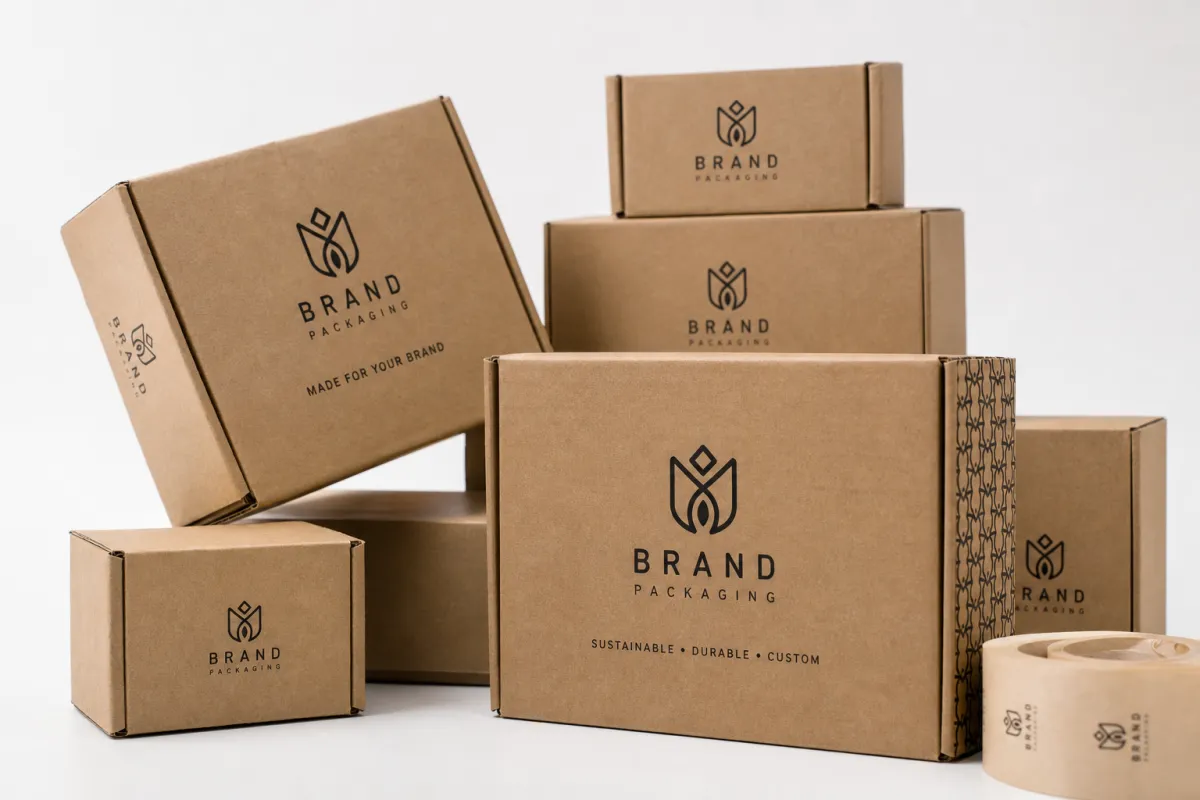
Custom brown boxes with logo usually refers to a kraft-based box that carries branding in one of several ways. The decoration may be a one-color imprint, a stamped mark, a printed label, a paper sleeve, a simple pattern, or a fully wrapped art treatment. The base material is usually brown kraft paperboard or corrugated board, which can be plain, recycled, or FSC-certified depending on the build. For many brands, custom brown boxes with logo sit right between utility and presentation.
Brown kraft works because it feels honest. It does not try to mimic gloss or hide what it is. Minor handling marks are easier to forgive on kraft than on bright white stock, and a logo tends to stand out with less visual noise around it. A simple mark on brown paperboard often looks more deliberate than an overworked layout on a white box. That is why custom brown boxes with logo are common in apparel, cosmetics, specialty foods, handmade goods, and direct-to-consumer shipments.
There is a practical reason buyers keep choosing custom brown boxes with logo too. A package can look finished without requiring expensive print coverage. A black logo, a dark green stamp, or a clean label can create a polished result with far less setup than a fully printed carton. That matters when the packaging has to feel premium and still move through fulfillment without slowing the line.
Brown is not boring. It gives a brand room to move in several directions without forcing the box to carry too much visual weight. Earthy and natural, crisp and modern, understated and luxury-leaning, all of those can work on kraft when the layout is thoughtful. For many brands, that restraint is exactly what custom brown boxes with logo are supposed to deliver.
A box does not need to shout to feel expensive. The strongest custom brown boxes with logo usually fit well, print cleanly, and stop before they start looking busy.
These boxes show up in a few predictable settings. E-commerce shipping uses them for protection and brand recognition. Retail packaging relies on them for shelf presence and easy stacking. Food service uses them for takeout, bakery items, and catered sets. Subscription brands like them because custom brown boxes with logo photograph well, arrive intact, and keep the unboxing experience from feeling generic. Gift packaging benefits too, especially when the goal is thoughtful rather than flashy.
If you want a quick benchmark, custom brown boxes with logo tend to work best when the structure handles the heavy lifting and the graphics stay disciplined. One strong logo placement usually beats clutter. That is plain packaging sense, not design theory dressed up in bigger words.
For buyers who want a broader packaging education reference, the Packaging Institute can be useful for material context and general packaging basics. It is not glamorous, but neither is a damaged shipment.
How Custom Brown Boxes With Logo Production Works
The production flow for custom brown boxes with logo is fairly straightforward once the jargon gets out of the way. The process usually starts with box style and size, then moves into artwork setup, proofing, sampling, production, and freight. The order can shift a little from vendor to vendor, but the core steps stay the same. The real work is not placing the order. It is answering the right questions before the order exists.
The dieline is the flat template that shows folds, cut lines, glue areas, and print-safe zones. If you have seen a layout file full of lines and panels, that is the dieline. It matters because custom brown boxes with logo can look perfect on a screen and still fail in production if the logo sits too close to a fold or lands where the structure changes when assembled. A good dieline is the map, not the decoration.
Proofing usually happens in two stages. A digital proof shows layout, copy placement, and a rough color read. A physical sample shows fit, feel, board strength, and whether the logo actually works on brown kraft. Skipping the sample can feel like a shortcut, then turn into a reprint or a launch delay. Crooked logos, weak closure tension, and dimensions that miss by a few millimeters become obvious once the box is in your hands.
For custom brown boxes with logo, lead time depends heavily on how settled the spec is. A simple reorder with no design changes can move quickly, often in about 10 to 15 business days after approval, depending on the plant and shipping route. A new structure, new tooling, or several sample revisions can stretch that timeline to 3 to 5 weeks or longer. Rush builds are possible, yet they narrow material and finish choices and usually push cost upward. That is a tradeoff, not a surprise.
Most delays come from the same places again and again:
- Artwork files that are not vector-based or need cleanup before print.
- Dimensions that are vague or measured without accounting for inserts.
- Color changes requested after proofing is already underway.
- Structural edits made after the sample has been approved.
- Freight timing that nobody planned for until the pallet was ready.
That is why custom brown boxes with logo perform best when the team treats the process like packaging development, not a quick purchase order. You are not buying cardboard in isolation. You are building a part of the product experience that has to fit the item, survive transit, and still look like it belongs to the brand.
For shipping-heavy programs, performance testing helps a great deal. The ISTA test standards are a useful reference if you want to understand how a box handles drop, vibration, and compression stress before committing to a full run. A box spec should never be approved on hope alone.
When buyers compare custom brown boxes with logo against plain stock cartons, the difference usually comes down to control. The more control you want over finish, placement, and board feel, the more work goes into setup and proofing. That is normal. What creates trouble is learning about those costs after the launch date has already been set in motion.
If you are sorting through structure options, it helps to compare them against the broader Custom Packaging Products lineup so the format fits the item instead of forcing one style to do every job.
What Changes the Price of Custom Brown Boxes With Logo
Pricing for custom brown boxes with logo is shaped by a small set of variables, and most of them are easy to see once you know where to look. Quantity, size, board grade, print method, color count, and add-ons all matter. Freight matters too. Buyers sometimes compare two quotes that appear similar, then wonder why one is much lower. Usually the two specs were not actually the same.
Volume is the first major driver. Setup costs do not disappear just because the order is small, which is why low quantities often look expensive on a per-unit basis. A run of 250 custom brown boxes with logo might fall into one price range, while 1,000 or 5,000 units can lower the unit cost a lot because the setup is spread across more boxes. In plain terms, low-volume buyers pay for customization. High-volume buyers pay less per box, but they carry more inventory risk.
Board grade changes pricing too. Heavier corrugated board, stronger flute choices, and specialty kraft stocks raise material cost. That is not always a problem. If a sturdier box cuts damage or reduces the amount of filler needed, the higher unit price can save money where it matters most. A cheap box that crushes in transit is not cheap at all. It is just a costly mistake that arrived late.
Decoration method matters just as much. One-color print or a simple stamp is usually the least expensive branding route. Full-coverage print, multiple imprint locations, tight registration, or exact color matching pushes cost higher. The same is true for glossy coating, soft-touch lamination, and specialty finishes. For many custom brown boxes with logo orders, the simplest route makes sense because the kraft surface already gives the box character.
Here is a quick comparison of common options:
| Option | Typical Use | Price Impact | Practical Notes |
|---|---|---|---|
| One-color logo print | Shipping boxes, mailers, subscription kits | Lowest setup and print cost | Best for clean branded packaging and tight budgets |
| Logo stamp | Artisan goods, small-batch retail packaging | Low to moderate cost | Looks natural on kraft, though saturation can vary a bit |
| Printed label | Short runs, seasonal product packaging | Moderate cost | Flexible for small quantities, less integrated than direct print |
| Full artwork print | Retail-ready custom printed boxes | Highest print and setup cost | Good for strong shelf impact, less friendly to the budget |
| Paper sleeve or belly band | Gift sets, premium presentation | Moderate to high cost | Good visual impact, though it adds assembly time |
Freight and handling are the line items people underestimate. Palletization, protective packing, inspection, and shipping can add a meaningful amount to the landed cost, especially on larger boxes or longer routes. If the quote only covers the box and not delivery, the final number may be higher than expected. That is not drama. That is logistics.
For a cleaner view of spend, ask for pricing at three quantities. A small run, a middle run, and a scale run will show where the price breaks begin to matter. That tends to be more useful than a single quote at a single quantity, because it reveals the point where custom brown boxes with logo shift from a premium expense to a normal operating cost.
Paper certification can influence price as well. FSC-certified kraft sometimes carries a modest premium, and recycled content can move cost depending on availability. If sustainability matters to your brand story, that premium may be worth it. If it does not matter to your customer or your operations, there is no reason to pay extra just because the term sounds responsible.
Custom brown boxes with logo also become more expensive when the design tries to do too much at once. A giant logo, three colors, spot UV, and a special insert can turn a simple shipper into a boutique project. Sometimes that is the right call. More often, a smaller logo and a better board grade create a better result for less money.
How to Choose the Right Specs for Custom Brown Boxes With Logo
The best way to specify custom brown boxes with logo is to begin with the product, not the box. Measure the item first, then add clearance for inserts, padding, void fill, and closure tolerance. If the product is fragile or irregular, sketch the way it sits inside the package before you lock in a size. A lot of packaging waste starts with guessing dimension by dimension and hoping the final box behaves well. It rarely does.
Different structures solve different problems. Mailers are a strong fit for e-commerce and light-to-medium products that need a tidy presentation. Shipping boxes handle heavier contents and stacked transit better. Tuck-top cartons work well for retail packaging and shelf display. Rigid-style boxes and display boxes push the price higher, but they can be justified for gift sets or premium launches. If custom brown boxes with logo are supposed to protect a product, the structure should do that first and branding second.
Board strength should match the route, not just the item weight. A box that leaves a local warehouse and lands in a store across town does not need the same treatment as one that moves through parcel handling, sortation belts, and several truck transfers. In those cases, stronger corrugation, thicker walls, or better inserts can prevent damage that would otherwise cost more than the upgrade.
Logo placement deserves more attention than it usually gets. Small logos often look cleaner on kraft, especially if the box has a natural finish and the brand does not need to dominate every panel. Bigger art can work, but only when the layout has enough breathing room. A logo that sits too close to an edge, flap, or fold can feel crowded once the box is assembled. That is not good packaging design. That is a layout miss.
Finish and ink choices shape the mood of the package. Matte kraft feels understated. Uncoated natural brown feels rustic. A sharp black print reads modern and direct. A single metallic accent can suit premium goods, but it should be used carefully because too much shine on brown kraft can feel forced. For many custom brown boxes with logo projects, less finish and better layout usually beat extra decoration.
If the box is not meant to behave like a billboard, do not treat it like one. Custom brown boxes with logo often look strongest when the logo is small, the board is right, and the material carries most of the visual weight.
There is also a sustainability angle that deserves honest treatment. Recycled kraft, FSC-certified paper, and right-sized packaging can reduce waste and improve perception, but none of them make a box automatically better. The spec still has to protect the product. A fragile item packed in a weak eco-friendly box is still a damaged item. Good package branding respects both the brand and the shipment.
If you are comparing size and style options, it helps to browse a broader packaging range rather than forcing one structure to carry every use case. The right Custom Packaging Products category often becomes obvious once you compare how each style handles weight, stacking, and presentation.
Step-by-Step: Ordering Custom Brown Boxes With Logo
Ordering custom brown boxes with logo goes much more smoothly when the right information is gathered before the quote request goes out. The first thing to lock down is product size. The second is quantity. The third is the shipping method, because a box built for pallet freight may not fit parcel delivery well at all. Add the actual logo file to that list, not a screenshot pulled from the bottom of a website.
Step 1: Build a spec sheet with the non-negotiables. Include product dimensions, target quantity, box style, intended use, branding method, and any insert or cushioning needs. If the delivery environment is already known, note it. A box for retail shelving is not the same as a box that will be opened, closed, and handled repeatedly in shipping.
Step 2: Request quotes using the same inputs. That sounds obvious, yet people often ask three vendors for custom brown boxes with logo and give each one slightly different dimensions. Then they compare the prices as if they represent the same thing. They do not. Apples, oranges, and a mystery box are not a useful comparison.
Step 3: Review the dieline and proof carefully. Check logo size, fold placement, barcode space, line copy, and any artwork near a score line or edge. This is also where you confirm whether the box closes correctly with the actual product inside. If a label or stamp sits too high or too low, the issue will show once production starts. Proofs are there to catch the boring mistakes before they become expensive ones.
Step 4: Approve a sample if the structure, finish, or logo placement matters to the launch. For custom brown boxes with logo, a sample becomes especially useful when the item is fragile, oddly shaped, or part of a premium kit. A sample costs money, yes. So does a launch full of boxes that do not fit.
Step 5: Confirm production dates, freight timing, and inspection rules before the order is released. Ask who checks the boxes, how many are sampled, what happens if a defect is found, and whether palletization is included in the quote. The goal is simple: nobody should be guessing once production starts.
One practical habit saves a surprising amount of time later: keep the final dieline, approved art, and approved photos in one folder with the exact spec name. That makes reorders faster and reduces the chance of "almost the same" versions drifting around. Reorders for custom brown boxes with logo usually go better than first runs because the unknowns have already been cleared away. That is how the process should work.
If you want a reference point for broader packaging sourcing, the Custom Packaging Products page is a good place to compare styles before the order is locked in. The right choice is usually the one that fits the product with the least filler, the fewest compromises, and the least friction.
Common Mistakes When Ordering Custom Brown Boxes With Logo
The biggest mistake is guessing box size. It sounds harmless until the product rattles, the lid bulges, or the insert has to do work the box should have handled on its own. A sizing miss can waste material, raise shipping cost, and make the unboxing feel sloppy. Custom brown boxes with logo should frame the product, not fight it.
Bad artwork is another common failure. Low-resolution logos, missing vector files, and vague color references create avoidable problems. On kraft, weak artwork becomes even more visible because the surface is less forgiving than coated white stock. If the logo is simple, keep it crisp. If the logo includes fine lines or thin type, test it at the actual print size. A file that looks fine on a monitor is not guaranteed to print well on paperboard.
Lead time also causes unnecessary pain. Buyers approve art late, then act surprised when production and shipping take several weeks. That is a scheduling issue, not a supplier issue. Custom brown boxes with logo can feel like a fast project from the outside, yet they still move through proofing, production, packing, and freight like any physical product.
Over-specifying is another trap. Some brands want a premium look, then stack finish after finish until the box becomes expensive for no functional gain. Others choose a box that is too large because they are nervous about fit, then pay for extra board, extra filler, and extra shipping volume. If the box is too fancy, it can eat margin. If it is too loose, it can damage the product. Neither outcome helps the brand.
Do not skip real-world testing. A basic stack check, a drop check, and a rough unboxing review can prevent a surprising amount of trouble. For parcel shipments, a test that reflects actual handling is far more useful than a theoretical approval based on artwork alone. If the box fails a simple test, it will not improve once it meets a courier.
One more mistake: forgetting that custom brown boxes with logo are part of branded packaging, not just transport packaging. Surface finish, print weight, and closure style all shape how the customer feels before they even touch the product. That does not mean every box needs to be fancy. It means the box needs to make sense for the brand, the product, and the route it travels.
Expert Tips and Next Steps for Custom Brown Boxes With Logo
If the structure is new, order one sample round before a full run. That advice is plain because it works. It becomes especially useful when logo placement matters, the box is part of a launch kit, or the product ships badly when it has room to move. A sample lets you catch fit issues, closure tension problems, and print placement mistakes before they turn into a warehouse problem.
Ask for three quote tiers. Get a minimum quantity quote, a realistic reorder quote, and a scale price. That gives you a clean read on where the savings begin. Too many buyers only request one number, then assume it reflects the market. It does not. It is one number, at one quantity, for one version of the spec.
Build a short approval checklist and keep it tight. Size. Material. Print method. Proof. Freight. Timeline. Revision limits. If those six items are written down, the odds of a quiet change slipping through drop fast. Minor changes are how budgets drift in the wrong direction.
Plan for reorders now, not later. Keep the final artwork, the exact spec, the signed proof, and any vendor notes in one place. That matters because custom brown boxes with logo often become part of a repeat order cycle, and repeat orders are much easier when the original details are not buried in someone's inbox. Good packaging design is rarely the loudest part of the operation, but it is one of the most reusable.
On the sustainability side, ask whether the stock is recycled, FSC-certified, or right-sized for the product. Do not pay for green claims you do not need, but do not ignore material efficiency either. The best custom brown boxes with logo usually fit the product tightly, use less filler, and ship without drama. That is a more useful sustainability result than a slogan printed on the side panel.
One final practical point: think about how the box will look on a shelf, in a mailer stack, and in a customer photo. Custom brown boxes with logo should hold up in all three settings. If they do, you have Packaging That Works as product packaging, retail packaging, and branded packaging at the same time. That is the kind of box most brands actually need.
To compare styles before committing, it helps to review a broader range of Custom Packaging Products and match the format to the product instead of forcing one box type to do everything. The smartest custom brown boxes with logo are the ones that fit the product, respect the budget, and arrive before the launch date.
So the clearest takeaway is simple: start with fit, choose the lightest branding method that still feels like your brand, and sample the box before you place a full order. That approach keeps custom brown boxes with logo practical, polished, and far easier to reorder when the first run proves itself.
Frequently Asked Questions
How much do custom brown boxes with logo cost per box?
The unit price usually drops as quantity goes up because setup costs are spread across more boxes. Simple one-color prints, standard sizes, and plain kraft stock stay cheaper than coated stock, inserts, or multi-location printing. For planning, ask for quotes at multiple quantities, such as 250, 500, and 1000 units, so you can see where the break point really begins.
What is the usual turnaround for custom brown boxes with logo?
Samples often take a few days, while production commonly runs about 2 to 4 weeks after proof approval and payment. Complex artwork, new tooling, or structural changes can add time before the order reaches production. Rush orders are possible, but they usually cost more and may limit material or finish options.
What file format works best for a logo on custom brown boxes with logo?
Vector files like AI, EPS, or PDF are safest because they stay sharp at any size. Use bold line weights and simple shapes so the logo prints cleanly on kraft stock. If color matching matters, include Pantone references so the printer has a clearer target.
Are custom brown boxes with logo good for shipping fragile products?
Yes, if the board grade, size, and insert plan match the product weight and transit risk. Use thicker walls, inserts, or cushioning when the item can move or break in transit. Test the box with a real drop or stack check before ordering a large quantity.
What should I confirm before approving custom brown boxes with logo?
Check dimensions, print placement, finish, and how the box closes with the actual product inside. Review a digital proof or sample so the Logo Placement on brown kraft is accurate. Make sure quantity, lead time, freight terms, and revision limits are written into the quote.

