Buyer Fit Snapshot
| Best fit | custom candle boxes with logo branding for packaging buyers comparing material specs, print proof, MOQ, unit cost, freight, and repeat-order risk where brand print, material, artwork control, and repeat-order consistency matter. |
|---|---|
| Quote inputs | Share finished size, material target, print colors, finish, packing count, annual reorder estimate, and delivery region. |
| Proofing check | Approve dieline scale, logo placement, barcode or warning zones, color tolerance, and any recyclable or compostable wording before bulk production. |
| Main risk | Vague material claims, crowded artwork, or missing packing details can create delays even when the unit price looks attractive. |
Fast answer: Custom Candle Boxes with Logo Branding: Dieline, Finish, Proof, and Buyer Review should be specified like a repeatable production item. The safest quote includes material, print method, finish, artwork proof, carton packing, and reorder notes in one written spec.
What to confirm before approving the packaging proof
Check the product dimensions against the actual filled item, not only the sales mockup. Ask for tolerance on folds, seals, hang holes, label areas, and retail display edges. If the package carries a logo, QR code, warning copy, or legal claim, reserve that space before decorative graphics fill the panel.
How to compare quotes without losing quality
Compare board or film grade, print process, finish, sampling route, tooling charges, carton quantity, and freight assumptions side by side. A lower quote is only useful if the supplier can repeat the same color, closure quality, and packing count on the next order.
Custom Candle Boxes with Logo: Branding That Sells
Custom candle boxes with logo do more work than most brand owners expect. A candle is often bought as a gift, a seasonal treat, or a shelf upgrade, which means the box has to carry the mood before anyone ever lifts the lid or notices the wax. That is not a poetic exaggeration. It is packaging doing the job it was built for.
I have watched a plain jar candle move slowly at retail while a carefully boxed version with the same fragrance sold out first, and the difference was not the wax blend or the scent throw. It was the first impression. Packaging tells a shopper how much care went into the product, and with candles, that message lands almost immediately.
Why Custom Candle Boxes with Logo Matter More Than the Candle
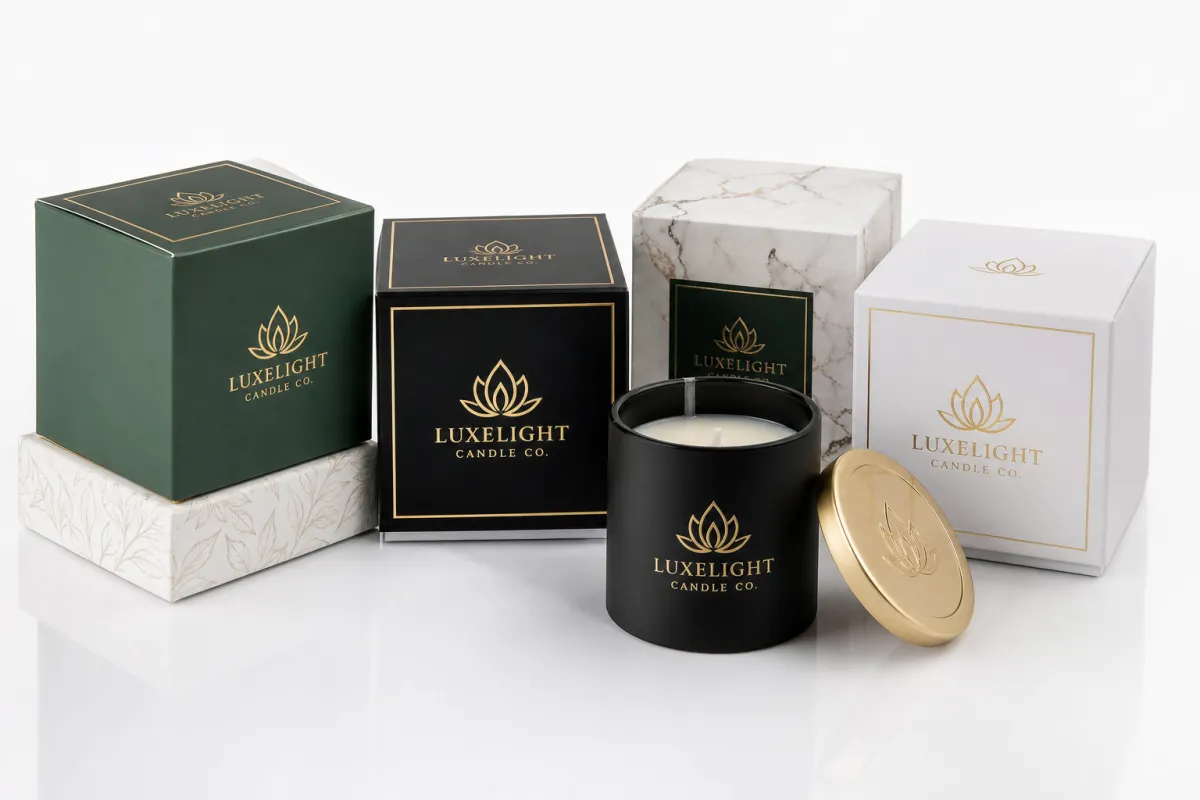
Most candle buyers never open with a technical checklist. They look at the box, read the scent name, judge the finish, and decide whether the candle feels like a $12 impulse buy or a $48 gift. That is why custom candle boxes with logo matter so much. The box creates the price expectation long before the lid comes off.
From a packaging buyer's point of view, candles sit in a strange category. They are practical, but they are also emotional. People buy them for birthdays, housewarmings, thank-you gifts, self-care splurges, and seasonal displays. That means the packaging has to do two jobs at once: protect a fragile product and create enough visual confidence to justify the purchase. Custom candle boxes with logo are not just decoration. They are part of the product.
A plain jar in a plain shipper says, "this is fine." A well-built box says, "this was designed on purpose." That difference matters on retail shelves, in Shopify thumbnails, and in gift boxes stacked on a countertop. Good packaging design makes a candle line look established instead of improvised. Poor packaging makes even a quality candle feel like a private-label afterthought.
Logo placement carries a lot of weight here. Centered foil on a rigid box feels premium. A subtle black logo on natural kraft paperboard feels modern and restrained. A loud, oversized logo on a tiny box can feel cheap quickly. The goal is not to cover every panel with branding. The goal is package branding that supports the scent story, the price point, and the retail setting.
One part many brands miss is how much custom candle boxes with logo can reduce hesitation. Shoppers often use packaging as a shortcut for quality. If the box feels thoughtful, the candle feels safer to gift, safer to recommend, and safer to pay more for. That is why custom printed boxes keep showing up in brands That Actually Sell.
A candle box is not just a container. It is a small, highly visible sales tool that also has to survive shipping, stacking, and the occasional rough-handled warehouse move.
For that reason, brands should treat custom candle boxes with logo as a sales asset, a protection layer, and a memory device. A good box helps a shopper remember your brand after the candle is burned, which matters if you want repeat orders instead of a one-time sale.
How Custom Candle Boxes with Logo Are Made
The production process for custom candle boxes with logo is usually straightforward, but only if the measurements are accurate. It starts with the dieline, the flat template that defines folds, flaps, glue areas, and panel sizes. If the dieline is wrong, everything downstream gets difficult fast. Good artwork cannot rescue a box that is too tight, too loose, or structurally weak.
Typical production begins with dimensions. You provide the candle height, diameter, lid clearance, and any insert or neck space. From there, the supplier recommends a structure: tuck-end box, sleeve, crash-lock bottom, rigid setup box, or another configuration that fits the product and shipping method. Then the artwork is placed onto the dieline so the printer can check alignment, logo position, and bleed. That part feels ordinary. It is also the part that saves money later.
Custom candle boxes with logo can be built as stock-style structures, fully custom shapes, or hybrid formats like sleeves over a tray. Stock style usually means the box format is familiar and easy to produce. Fully custom shapes cost more because they require custom tooling and more setup. Sleeves and inserts sit somewhere in the middle and can make a candle feel more considered without pushing the budget too far.
Proofing matters. A digital mockup is useful for layout and color placement, but it does not show how the stock feels in the hand or whether a magnetic closure lines up properly. If the project uses soft-touch lamination, foil stamping, embossing, or a window cutout, ask for a physical sample or at least a structural prototype. For custom candle boxes with logo, one small mistake in the sample stage is better than one expensive mistake in full production.
Print method changes the final look more than many people expect. Offset printing gives crisp color and works well for high-volume custom printed boxes. Digital printing is flexible and better for smaller runs or faster turnarounds. Foil stamping handles metallic logos well, while white ink on dark stock needs careful setup so it does not look patchy. If your candle line uses a dark background with a fine logo, ask for an ink test. Tiny details disappear fast on textured paper.
Production timing depends on more than the calendar. Artwork revisions, paper availability, special finishes, sample approvals, and shipping all affect the schedule. A simple run of custom candle boxes with logo can move in about 10-15 business days after proof approval if the supplier has everything in hand. Add foil, embossing, inserts, or rigid construction, and the schedule usually stretches. That is normal, even if it still feels inconvenient.
If the candle is meant for retail packaging, think about how the box will handle shelf loading and cartoning. If it is meant for e-commerce, the outer mailer matters as much as the display box. That is the point where product packaging decisions start affecting return rates and damage rates, not just shelf appeal.
For brands that need a starting point, browse Custom Packaging Products to compare box styles before you request quotes. Knowing the structure first keeps the conversation focused.
Production stages that usually matter most
- Dieline setup: confirms dimensions, folds, and glue panels before artwork is finalized.
- Proof approval: catches logo placement, copy errors, and sizing problems before printing.
- Finishing: adds lamination, foil, embossing, spot UV, or coating after print.
- Assembly: may include glued cartons, inserts, sleeves, or rigid setup construction.
- Carton packing: protects finished boxes during transit and warehouse handling.
Materials and Design Choices That Change the Result
Material selection is where many candle brands accidentally spend too much or too little. Custom candle boxes with logo need to match the candle's weight, the shipping method, and the brand promise. A 7 oz jar candle does not need the same package structure as a 3-wick, 18 oz statement piece. Pretending otherwise is how people end up with damaged corners and disappointed customers.
Paperboard is the workhorse option for many custom candle boxes with logo. It is light, printable, and cost-effective. SBS and CCNB board work well for retail shelves and direct-to-consumer kits when the candle is not unusually heavy. Corrugated stock is better for shipping-heavy programs because it absorbs impact and resists crush damage. If the candle is a luxury gift item, rigid stock gives the best presentation and a more substantial hand feel.
The practical tradeoff is simple. Paperboard keeps costs down, corrugated keeps breakage down, and rigid stock makes the brand feel expensive. Choose the one that matches what you are actually selling. Fancy packaging on a low-margin candle line can eat profit fast. Cheap packaging on a premium candle can lower perceived value before the customer even reads the scent notes.
Finishing options change both appearance and wear resistance. Soft-touch lamination gives a smooth matte feel and photographs well. Gloss lamination makes color pop and adds a more commercial shine. Spot UV creates contrast on logos or pattern elements. Foil stamping works well for metallic accents, especially on black or cream stock. Embossing and debossing add tactile depth, which can be useful if the brand wants a quieter look with strong shelf presence.
For custom candle boxes with logo, structural details matter as much as graphics. Inserts keep jars from rattling. Neck supports reduce movement. Window cutouts help shoppers see the candle color or vessel shape. Crush resistance matters if the candle ships through a fulfillment center where boxes may be stacked, dropped, or compressed. A beautiful box that collapses in transit is not premium. It is expensive theater.
Typography deserves more attention than it gets. Thick type on a small candle box can overpower the design. Thin type on a textured stock can disappear. High contrast is usually safer than low contrast if the box needs to be read from arm's length. If the logo has fine lines, ask the printer how it holds up on the selected stock. Some paper surfaces make delicate marks look fuzzy. That is one of those details people only notice after they have already approved the proof.
Good packaging design should also reflect the scent family. A citrus candle does not need the same visual language as a leather-and-amber candle. The box should hint at the same story the product tells. That is what makes branded packaging feel intentional instead of generic.
Brands that want certified fiber can ask for FSC options. The Forest Stewardship Council explains certified sourcing clearly at fsc.org. For ship-tested packaging programs, the ISTA standards at ista.org are useful references, especially if breakage rates matter. You do not need to memorize standards. You do need to know they exist.
For brands comparing build options, the simplest way to think about it is this: if the candle is mostly retail, prioritize appearance; if it is mostly shipped, prioritize protection; if it is both, design the outer package with both realities in mind. That is how custom candle boxes with logo stop being a vanity expense and start acting like product packaging that earns its keep.
| Box Type | Best Use | Typical Unit Cost | Pros | Tradeoffs |
|---|---|---|---|---|
| Paperboard tuck box | Retail shelves, lightweight jar candles | $0.35-$0.90 at mid volume | Low cost, fast production, strong print quality | Less crush resistance, lighter feel |
| Corrugated mailer-style box | E-commerce shipping, fragile glass jars | $0.85-$1.75 at mid volume | Better protection, good for inserts, less damage in transit | Bulkier look, less premium shelf presence |
| Rigid setup box | Gift sets, premium candles, seasonal collections | $2.50-$6.50+ depending on finish and quantity | High-end feel, strong brand impact, excellent unboxing | Higher minimums, higher unit cost, longer lead times |
Cost and Pricing for Custom Candle Boxes with Logo
Pricing for custom candle boxes with logo depends on quantity, structure, stock, print coverage, and finishing. There is no honest one-price answer, which annoys people, but that is the real market. A small run of 250 boxes has a different economics profile than 10,000 boxes. The setup cost gets spread out differently, and the unit price reacts accordingly.
For a basic paperboard candle box with one-color print, expect pricing that may land roughly in the $0.35-$0.90 range at higher short-run quantities, depending on dimensions and supplier setup. A more refined retail box with full-color print, lamination, and a custom insert may move closer to $0.85-$1.75 per unit. A rigid box with foil, embossing, or a magnetic closure can easily climb to $2.50-$6.50 or more. That is not a scare tactic. It is just how custom printed boxes behave when you start adding material and finishing complexity.
Quantity changes everything. Higher volume lowers the unit price because the setup cost is spread out. Small runs are useful for launches, testing, and seasonal campaigns, but they usually carry a more expensive per-box cost. If you only need a few hundred custom candle boxes with logo, expect the price to feel oddly high. That is normal. The math is less forgiving at small scale.
There are hidden costs that get ignored until somebody opens the quote and blinks hard. Die setup, sample production, shipping, artwork revisions, and post-approval changes all matter. If you change the logo size after proof approval, you may pay for a revised die or a new print run. If the box needs a special insert, that is another line item. If the project includes a window, foil, or spot UV, those features add setup complexity and usually increase the lead time.
One way to control spend is to separate visual impact from structural complexity. You do not always need every finish on the same box. A clean uncoated kraft box with a strong black logo can look more confident than a cluttered box overloaded with foil, UV, and pattern work. If the candle sits in a gift set or competes in a luxury aisle, a richer finish may earn back the cost through price positioning. That is the real tradeoff. Not "cheap versus expensive." More like "does this finish help sell the candle, or is it just decorative noise?"
Spend on the thing customers see first: structure, color, and logo clarity. Save on things they will not notice unless they are holding the box and looking for them. Custom candle boxes with logo should support the product, not turn every unit into a tiny manufacturing science project.
If you need a packaging partner comparison, ask suppliers for quotes on the same dimensions, the same finish list, and the same quantity. Otherwise the price comparison is fake. One company might quote a basic tuck box while another quotes a rigid kit, and suddenly everyone is arguing about apples, oranges, and a truckload of completely different board grades.
One practical disclaimer: quoted prices can shift with paper availability, freight, and seasonal demand, especially before major holidays when candle orders get crowded into the calendar. If a supplier gives you a number that looks unusually low, ask what is included before you celebrate. Finishing, inserts, and carton packing can be the difference between a useful quote and a headache.
Step-by-Step Ordering Process and Timeline
The fastest way to order custom candle boxes with logo is to stop guessing and give the supplier useful information up front. Start with the candle dimensions, including the lid and any labels that affect fit. Then choose the box style, provide logo files in vector format if possible, and state the retail channel. A box meant for direct-to-consumer shipping needs a different structure than a box meant only for shelf display.
Here is the cleanest workflow:
- Measure the candle carefully, not just the jar body.
- Choose the box style that matches how the candle will be sold and shipped.
- Send logo files, brand colors, and any copy that needs to appear on the box.
- Request a quote that includes material, finish, quantity, and insert details.
- Review the dieline and confirm all dimensions before proof approval.
- Approve a digital or physical sample, depending on finish complexity.
- Move into production and confirm shipping terms before the job starts.
Most delays happen because the brand leaves out information. A supplier cannot accurately quote custom candle boxes with logo if the candle weight is unknown, the insert requirement is unclear, or the artwork files are low resolution. Low-res logos are a common headache. They look fine on a laptop and then turn into fuzzy nonsense at print size. That is not the printer being dramatic. That is the file failing the job.
A realistic timeline often looks like this: quote in 1-3 business days, dieline and proofing in 2-5 business days, sample or prototype in 5-10 business days if requested, production in 10-20 business days after approval, and shipping after that depending on origin and destination. Premium finishes can add days. International freight can add more. Rush orders can cut time, but they almost always raise cost and stress. Both of those things are expensive in their own special way.
The best time to catch a mistake is before printing. Check the logo scale at both close range and shelf distance. Check whether the box opens the right way. Check whether the candle fits with the insert installed. Check copy, scent names, and barcode placement. If you are using custom candle boxes with logo for a launch, have someone who was not involved in the artwork review the proof. Fresh eyes catch the silly stuff.
One useful habit is to ask for a sample batch before committing to a large run, especially if the box uses foil, a window, or a rigid structure. Special finishes can look slightly different in real life than they do on a screen. That is not a defect. It is packaging reality. Good product packaging accounts for that.
If you already know you need multiple formats, compare options through Custom Packaging Products so you can align structure and budget before you lock the artwork. That simple step saves time.
Common Mistakes Brands Make with Custom Candle Boxes with Logo
The biggest mistake is treating the logo like the entire design. Yes, the logo matters. No, it does not need to dominate every square inch of the box. Oversized logos can make custom candle boxes with logo look loud, desperate, or oddly cheap. A better approach is to give the logo breathing room and let type, color, and structure do some of the work.
Another common problem is ignoring fragility. Candles are breakable, especially glass jars with tight lids or tall vessels with narrow bases. A box that looks nice but allows the jar to move is a future complaint. If the candle can rattle in transit, the packaging failed, plain and simple, and customers are gonna feel that in the first five seconds. Good retail packaging protects the product as part of the brand promise, not as an afterthought.
Clutter also causes trouble. Too many fonts, too many finish effects, too many icons, too much copy. From a shelf distance, clutter reads as uncertainty. In branding terms, uncertainty is expensive. A cleaner design usually performs better because shoppers can process it faster. That is one reason custom candle boxes with logo often look strongest when they keep the front panel focused on one message: brand name, scent, and one memorable visual cue.
Mismatch is another slow leak. A luxury candle inside a flimsy box feels wrong. A budget candle inside an expensive rigid box can push expectations too high and squeeze margin. Neither problem is rare. Both happen because the packaging decision gets made before the pricing strategy does. That is backward. The packaging should fit the product tier, not bully it.
Skipping sample testing is probably the easiest way to waste money. People think the box will be fine because the proof looked good. Then the order arrives and the insert is too tight, the lid touches the top panel, or the box swallows the candle in a way that feels lazy instead of premium. Testing prevents those surprises. If you are building a line of custom candle boxes with logo, sample the worst-case setup, not just the prettiest one.
There is also a common retail packaging mistake where the box looks great in a photo but fails on a real shelf. Shelf lighting changes color. Nearby competitors change perception. A box that looked rich online can feel flat in-store if the contrast is too weak. That is why package branding should be checked in more than one viewing environment. One render is never enough.
If the design only works in Photoshop, it is not a finished packaging system. It is a pretty idea with no manufacturing confidence.
Expert Tips and Next Steps for Custom Candle Boxes with Logo
Start with the candle, not the carton. That sounds obvious, but plenty of people build the box first and try to force the product into it later. Bad move. Measure the jar, lid, label, and any insert clearance first. Then build the custom candle boxes with logo around the real object, not around the fantasy version of it that lives in a spreadsheet.
Test logo visibility at two distances: arm's length and close range. If the logo is unreadable from a shelf, it is not doing its job. If it is too large up close, it can overwhelm the design. The sweet spot usually lives in the middle, and that depends on the box size, the background color, and whether you are using matte, gloss, or textured stock.
Special finishes deserve caution. Foil stamping, embossing, window cutouts, and inserts can look excellent, but they also add setup complexity and production cost. If this is your first run of custom candle boxes with logo, a sample batch is usually the safest way to check color, fit, and finish without gambling on a full order.
Here is a practical action plan:
- Measure the candle completely, including lid and label clearance.
- Define the brand mood in one sentence: calm, rustic, luxury, modern, or gift-ready.
- Pick a budget tier before you ask for quotes.
- Request two or three supplier quotes on the same spec.
- Compare samples, not just PDFs.
- Approve artwork only after checking size, copy, and fit.
If you need a cleaner starting point, browse Custom Packaging Products and match the packaging format to the candle's real use case. That is the smart order of operations. Packaging first, wishful thinking second.
One more thing: do not wait forever to move from concept to proof. Custom candle boxes with logo only help your business once they are printed, tested, and in the market. A nice mockup sitting in a folder is not branding. It is decoration. The box has to exist in the real world, survive real handling, and actually help the candle sell.
FAQ
What size should custom candle boxes with logo be for jar candles?
Measure the full product, not just the jar opening. Include height, diameter, lid clearance, and any insert space. Leave enough room for protection, but not so much that the candle shifts around inside the box. A manufacturer can build a dieline around the candle dimensions, which is safer than guessing from generic box sizes. That is especially true for custom candle boxes with logo that need to fit both shelf display and shipping.
How much do custom candle boxes with logo usually cost?
Price depends on quantity, material, print coverage, and finishing, so there is no honest one-price answer. Simple paperboard boxes are usually the lowest-cost option, while rigid boxes and special finishes raise the unit price. Higher order quantities usually cut the per-box cost, which is why tiny runs can feel oddly expensive. If you are comparing custom candle boxes with logo, make sure every quote uses the same spec.
What is the best material for custom candle boxes with logo?
Paperboard works well for retail presentation and lighter candles. Corrugated stock is better when shipping protection matters more than shelf elegance. Rigid stock is the premium option when the candle is a gift item or part of a higher-end collection. The best material depends on how the candle is sold, stored, and shipped, not just on how the box looks in a mockup.
How long does production take for custom candle boxes with logo?
Simple boxes with standard printing are usually faster than premium boxes with foil, embossing, or inserts. The timeline depends on artwork approval, sample requests, and the current production queue. If the packaging is needed for a launch, build in extra time for proofing and shipping, because rush jobs cost more and usually cause stress. Plan early and custom candle boxes with logo become much easier to manage.
Do custom candle boxes with logo help with retail sales?
Yes, because packaging is often the first thing a shopper notices on a shelf or in an online listing. A clear logo and clean structure make the product look more established and giftable. Good packaging can support a higher price point if the box matches the candle's actual quality. That is why custom candle boxes with logo are more than decoration; they are part of the selling system.
If you are building a candle line that needs better shelf presence, better protection, and better unboxing, custom candle boxes with logo are one of the smartest places to spend. Start by measuring the vessel, Choosing the Right box style for the sales channel, and requesting a sample before the full run. Keep the structure honest, keep the design clear, and keep the production specs realistic. Do that, and the box will help the candle sell instead of just sitting there looking expensive.

