Buyer Fit Snapshot
| Best fit | Custom Cardboard Inserts Bulk projects where brand print, material claims, artwork control, MOQ, and repeat-order consistency need to be specified before quoting. |
|---|---|
| Quote inputs | Share finished size, material target, print colors, finish, packing count, annual reorder estimate, ship-to region, and any compliance wording. |
| Proofing check | Approve dieline scale, logo placement, barcode or warning zones, color tolerance, closure strength, and carton packing before bulk production. |
| Main risk | Vague material claims, crowded artwork, missing packing details, or unclear freight terms can make a low unit price expensive after revisions. |
Fast answer: Custom Cardboard Inserts Bulk: Pricing, Specs & Process should be specified like a repeatable production item. The safest quote records material, print method, finish, artwork proof, packing count, and reorder notes in one written spec.
Production checks before approval
Compare the actual filled-product size with the drawing, then confirm tolerance on folds, seals, hang holes, label areas, and retail display edges. Reserve space for logos, QR codes, warning copy, and material claims before decorative graphics fill the panel.
Quote comparison points
Review material grade, print process, finish, sampling route, tooling charges, carton quantity, and freight assumptions side by side. A quote is only useful when the supplier can repeat the same color, closure quality, and packing count on the next order.
Custom Cardboard Inserts Bulk: Pricing, Specs & Process
Custom cardboard Inserts Bulk Orders solve a packaging problem that looks simple until returns start showing up. A product can pass a bench test, sit neatly in a carton, and still arrive scuffed, tilted, or crushed because the empty space inside the box was never controlled. The insert is what turns a carton from a container into a package that actually protects its contents through vibration, stacking, drops, and the rough handling that happens between the warehouse and the customer.
For brands shipping kits, bottles, cosmetics, accessories, or fragile components, the right insert does more than hold items in place. It lowers damage claims, keeps presentation consistent, and makes assembly faster for the team building the order. Buyers comparing custom cardboard inserts bulk usually end up looking at total landed cost, not just the unit price, because the invoice rarely captures relabeling, rework, replacement freight, or the labor tied up in avoidable fixes.
Why Custom Cardboard Inserts Bulk Orders Cut Damage Costs
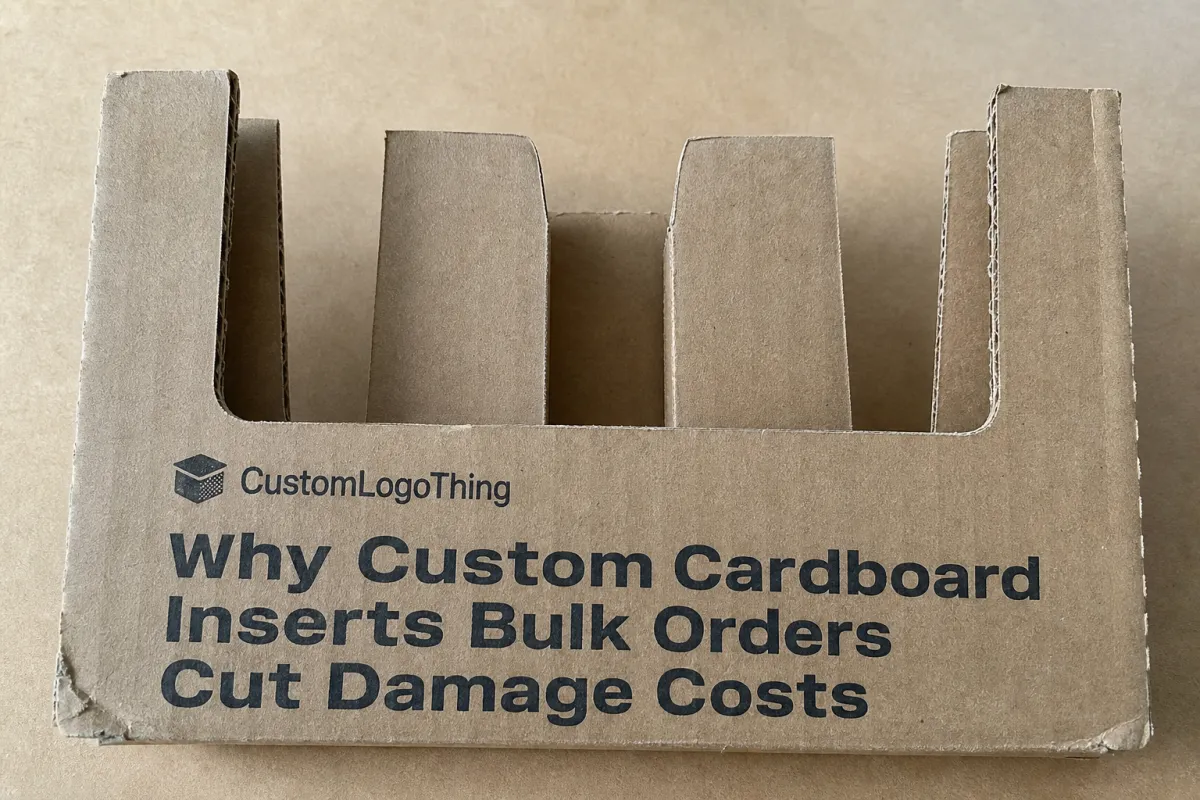
A carton can feel strong in hand and still fail in transit. The weak point is often not the outer box but the way the product moves inside it. If a bottle can lean, an accessory can rattle, or a boxed component can shift during a drop, the outer shipper absorbs the damage even though the real issue started at the packout stage. Custom inserts solve that by controlling movement before the carton ever leaves the packing table.
In bulk programs, the savings come from more than fewer returns. Good inserts protect edges and corners, keep decorated surfaces from rubbing, and reduce the need for void fill, wrap, or last-minute hand adjustments. They also make the opened box look deliberate. That matters for premium kits, subscription shipments, and retail orders where the first unboxing sets the tone for the product itself. A clean internal layout can lower customer service complaints because the product arrives the same way every time, with fewer variables for the receiving end to sort out.
Bulk pricing matters most when the packout repeats. Subscription shipments, retail replenishment, promotional kits, and launch runs all reward consistency. Once a structure is approved, the same insert can support a stable buying pattern instead of forcing the team to rebuild the pack every time volume changes. From a packaging buyer's point of view, that predictability is where much of the value sits. The first tooling pass may cost more, but the repeat runs become easier to forecast, easier to train on, and easier to inspect.
The tradeoff is straightforward. Pay for a fit-engineered insert now, or absorb the hidden cost later through damaged goods, replacement freight, labor waste, and customer dissatisfaction. A product with a low unit value can still become expensive to ship if it creates hand corrections at the packing line or returns from the field. That is why custom cardboard inserts bulk orders are often treated as a process improvement, not just a line item on a purchase order.
A well-designed insert lowers damage, but it also lowers touch time at the packing bench. When a packer does not have to make judgment calls on every unit, throughput becomes more predictable.
For buyers comparing packaging options, the insert should be considered alongside the outer carton and the packout method. That broader view usually improves both cost and consistency. Many teams source a family of Custom Packaging Products, pair the insert with Custom Shipping Boxes, or structure recurring replenishment through Wholesale Programs so the material set stays aligned over time and the reorder path stays short.
What Custom Cardboard Inserts Do in the Package
Custom cardboard inserts have two jobs. First, they create structure. Second, they shape the customer experience when the box is opened. Those two functions are linked, because a product that sits properly in the pack usually looks better too. The item is centered, separated, and supported, which makes the package feel organized rather than improvised.
The protective role becomes especially important when a box contains multiple components. A single item in a carton may only need a snug cavity. A kit with several parts needs a more deliberate layout so nothing presses against anything else. Inserts can hold bottles upright, keep cosmetics separated, cradle electronics accessories, or divide sample sets into a repeatable arrangement. They also stop the micro-movements that create scuffing on coated surfaces, printed cartons, glass, and plated parts. In shipping terms, a few millimeters of motion can become a larger failure after vibration, stacking, and drops have done their work.
There are several common styles, and the right choice depends on the product and the packout speed.
- Partitions create separated lanes inside a carton and work well for bottles, jars, and multi-item kits.
- Die-cut pads support items from top or bottom and are useful for flatter products or layered assemblies.
- Folded supports add shape to lightweight items that need a little lift or tilt control.
- Layer pads help stack products in tiers without direct contact.
- Retention pieces hold an irregular item in a fixed position based on the product outline.
These structures work with the outer carton rather than against it. That matters at scale. If an insert is too complicated, it slows the pack line and raises the chance of assembly mistakes. If it is too loose, the product shifts. The best design usually lands in the middle: enough structure to secure the product, simple enough to build quickly, and flat enough to store efficiently before use. The strongest bulk insert is rarely the most elaborate one; it is the one that behaves the same on unit one and unit ten thousand.
From the standpoint of product packaging and retail packaging, inserts also help create a more controlled unboxing moment. That can be especially useful for premium sets, seasonal bundles, and branded packaging where the first impression needs to be tidy without adding unnecessary material. In many categories, the insert becomes part of the packaging system even though it sits inside the box. Customers may never name it, but they notice when it is missing.
Real-world examples are broad. A skincare set might need a printed carton with a simple retention insert. An electronics accessory kit may need partitioning plus a top pad. A bottle program could use a corrugated divider that keeps glass away from glass. None of these needs are unusual, but each benefits from a design that matches the product shape instead of forcing the item to adapt to a generic cavity. That distinction matters because generic cavities create slack, and slack becomes motion during transit.
One practical note: some buyers assume the heaviest board automatically gives the best protection. That is not always true. If the insert geometry is poor, extra thickness only increases cost and can make assembly harder. A lighter, better-fitted structure often performs better than a thicker one that fights the product at every fold.
Specifications That Matter for Fit, Strength, and Finish
The quality of an insert is usually decided before the die is made. Measurement accuracy, material choice, and assembly logic all affect whether the finished piece fits the way it should. If those inputs are vague, the quote will be vague too, and the production run may need a second pass. For buyers, that means a longer schedule and more back-and-forth than necessary. A clean spec sheet is not paperwork for its own sake; it is the difference between a straightforward quote and a guessing game.
Start with dimensions. The product size matters, but the inside dimensions of the carton matter just as much. The insert has to work within the real packout space, not the ideal one. A useful spec package should include product length, width, and height, plus carton inside dimensions, clearance allowance, and the number of items per box. If the product is irregular, a sample piece or a technical drawing makes the fit conversation much easier. Photos help too, especially when the item includes a cap, handle, flange, or protrusion that changes how it seats in the cavity.
Clearance is where many teams under-specify. A snug fit is good, but zero clearance is usually a problem unless the material and product shape are exceptionally forgiving. In practice, a small amount of working room, often around 1.5 mm to 3 mm depending on board choice and product surface, helps the insert seat properly without creating crush pressure. Heavier structures may need slightly more room for fold memory and production tolerance. Small tolerances are useful, yet they are not magic; the material still needs room to behave like material.
Material choice depends on weight, fragility, presentation, and how much work the outer carton is already doing. Common options include:
- Corrugated board for heavier products, stronger edge support, and shipping environments that need more crush resistance.
- Paperboard for lighter items, retail-facing presentations, and tighter packs where the insert is more about organization than impact protection.
- Chipboard for economical support on lighter, flatter products where a cleaner appearance still matters.
Thickness, score depth, and cut precision should be confirmed early. If the score is too shallow, folds can crack or resist assembly. If it is too deep, the piece may weaken at the crease. Locking features need particular attention because they affect both speed and fit. A tab that is easy to assemble on the bench but too loose in transit can undo the advantage of the insert altogether. The opposite problem is just as familiar: a snug locking tab that looks elegant on a drawing but slows a packing line by a few seconds per unit. Multiply that by ten thousand units, and the cost becomes visible.
Finish and Print Choices
Printing and finishing should support the job, not complicate it. A small brand mark, a fold indicator, or a carton orientation cue can be useful. So can recycled content requirements or a matte surface if glare makes assembly harder. By contrast, heavy print coverage or decorative coatings make sense only when the insert will be seen and the brand benefit is worth the added cost. If the insert is hidden inside the pack and never viewed by the end user, the smartest choice is often a plain functional build with the right structure and minimal waste.
For buyers planning a launch, it helps to think of the insert as part of the broader packaging design system. The product, the shipping carton, the retail box, and the insert all influence one another. That is why a good specification sheet is more valuable than a polished sales deck. It shortens quoting time and reduces the risk of surprises later, which is exactly what most launch teams are trying to avoid.
Where shipping validation matters, many teams reference ISTA test standards for distribution testing and also pay attention to fiber sourcing guidance from the Forest Stewardship Council when recycled or certified content is part of the buying brief. Those references do not replace product testing, but they give buyers a common language for durability and sourcing expectations. They also help keep conversations grounded when procurement, operations, and brand teams all want different things from the same piece of board.
Custom Cardboard Inserts Bulk: Cost, Pricing, and MOQ
Custom cardboard inserts bulk pricing is driven by several moving parts, and the cleanest quotes are the ones that separate those parts clearly. The main cost drivers are material grade, insert size, cut complexity, number of compartments, print coverage, and whether the design needs new tooling. Once those variables are known, the quote becomes much easier to compare across vendors. A good quote should read like a bill of materials, not a mystery novel.
Quantity matters because setup costs spread out over more units. Tooling, design review, press setup, and line changeover all take time. In a small run, those expenses sit on a limited number of pieces. In a larger run, the same overhead is distributed more efficiently, so the unit price drops. That is why bulk orders often look expensive at first glance but become more attractive once the order size is high enough to absorb the fixed costs. The math is unglamorous, yet it is the reason the same insert can look overpriced at 500 units and sensible at 10,000.
Typical pricing ranges vary widely by structure, but useful planning numbers might look like this:
| Insert Type | Typical Bulk Range per Unit | Best Fit For | Notes |
|---|---|---|---|
| Simple flat pad or divider | $0.12-$0.24 | Lighter products, basic separation, simple repeat orders | Lowest tooling burden, fastest to produce |
| Die-cut insert with cavities | $0.28-$0.65 | Cosmetics, accessories, sample kits, presentation packs | Price rises with compartment count and cut detail |
| Heavier corrugated retention insert | $0.45-$1.10 | Fragile or heavier products, bottle packs, shipping applications | Higher material use, stronger support, more precise fit control |
Those figures are planning ranges, not promises. The actual price depends on board selection, print coverage, sheet yield, and freight terms. A compact insert that nests efficiently on the sheet can price very differently from a large design that leaves more trim waste. A buyer should also ask whether samples, structural revisions, or proof adjustments are included in the quote. Some vendors bundle those items. Others charge separately. That difference can be small on paper and significant in practice.
MOQ is another variable that should be handled carefully. There is no universal minimum because sheet size, press efficiency, and die layout all influence what makes sense. A simple insert may support a lower starting quantity than a multi-compartment structure with tight tolerances. In practice, many buyers see lower minimums on repeatable designs and higher minimums on highly customized packs. A good supplier will explain where the price breaks begin and how much the unit cost changes at each tier.
Comparing quotes properly means more than checking the bottom line. Ask what is included. Are samples part of the package? Is freight separate? Are revisions limited? Is the tooling yours to reuse on the next run? Can the design be reordered without reapproval? Those details matter because the cheapest quote can become the most expensive if the buyer has to pay for rework or shipping surprises later. A low sticker price paired with hidden charges is not a bargain; it is delay in disguise.
If the project is tied to a broader product line, the value may extend beyond the insert itself. A steady insert program can reduce line downtime, improve pack consistency, and support better forecast planning. That is especially true for subscriptions, retail replenishment, and launch calendars where the same packout repeats under pressure. The real cost of a bad insert is not just the material. It is the labor, the delay, and the damage it creates downstream.
A practical rule: if the product is fragile, high-touch, or frequently reordered, it usually makes sense to invest in a more controlled structure even if the unit price is slightly higher. The return shows up in fewer claims and less handling time. That is the kind of math experienced packaging buyers tend to trust because it survives contact with actual operations.
Process and Timeline for Production Steps
Good production starts with a clear intake. The first inquiry should include the product dimensions, the carton dimensions, the target quantity, the shipping destination, and any special requirements such as recycled content, branded markings, or a specific assembly method. If the insert has to hold one item, that is one type of design. If it has to hold a set of items in a fixed orientation, that changes the structure and the quote. Small changes in product mix can create large changes in insert geometry.
- Share the basics - product size, carton inside size, quantity, and product photos or a sample if available.
- Review the application - the supplier checks how the product sits, how it moves, and what kind of protection it needs.
- Recommend the structure - the insert style is matched to the packout, whether that means a divider, pad, fold, or die-cut cavity.
- Quote and proof - pricing is confirmed, and a dieline or layout is prepared for approval.
- Sample or test fit - a trial piece is used to confirm the fit before full production starts.
- Production and inspection - the approved design is run, checked, and prepared for shipment.
Sampling matters because fit issues usually reveal themselves early. A cavity that looks perfect on paper may be too tight for a coated bottle label, too shallow for a tall cap, or too loose once the product is shaken during handling. A test piece costs far less than reworking a finished order. For irregular products, it is often the fastest way to save time. For fragile products, it can also be the step that prevents a long chain of claims later.
Timeline depends on the amount of engineering required. Simple repeat orders with existing tooling can move quickly, often after proof approval and a normal production slot. New structures take longer because they need layout work, possible sampling, and more careful checks before the line is committed. Shipping time should be separated from production time so the delivery window is not confused with the factory schedule.
As a general planning guide, simple repeat work may move in a short cycle once the structure is already approved, while new custom work often needs a longer window for fit validation and setup. More complex inserts with multiple compartments or tight registration can require additional time for revision, press adjustment, and final inspection. That does not mean the job is slow. It means the schedule is honest.
Quality control should be treated as part of the process, not an extra. The basic questions are practical: does the cut hold to the drawing, does the insert fold cleanly, does the product stay centered, and does the box still close without stress? If the answer is yes, the program is usually ready for repeat ordering. If the answer is no, the issue should be corrected before volume production starts. Good production is full of small checks; bad production assumes everything will behave later on its own.
For many buyers, the strongest sign of a capable process is not speed alone. It is the absence of surprises. When the first quote, the proof, the sample, and the final run all line up, the buyer can plan inventory and labor more confidently. That reliability is valuable on recurring packaging programs, especially when reorder windows are tight and staffing levels are not flexible.
One more operational detail: if your product line changes seasonally, keep the insert design as stable as possible and only alter what truly needs to change. It is often cheaper to adapt artwork or outer packaging than to reengineer the internal support structure every quarter.
Why Buyers Choose Us for Repeated Orders
Repeated orders are where insert programs either become easy or become annoying. The difference usually comes down to consistency. If the first shipment fits well but the second one drifts, the buyer has to recheck the packout, retrain staff, and sometimes rework the whole structure. In a bulk program, that kind of variation creates more cost than most people see on the invoice.
That is why dimensional control matters just as much as price. A dependable insert should perform the same way on reorder as it did on the first approval. The product should seat the same way, the folds should behave the same way, and the carton should close the same way. If a packaging system changes every time the order is repeated, it stops being a system and becomes a moving target. Procurement may like the lower quote, but operations pays for the inconsistency.
Manufacturing support also matters. Buyers need clear guidance on material choice, cut style, and packout efficiency. A smart recommendation can save material without sacrificing performance, or it can increase strength only where the product actually needs it. That sort of advice is useful because not every product needs the thickest board. Some need better geometry. Others need simpler assembly. Good packaging design starts with the application, not the most expensive material on the shelf.
Quality control should be visible in plain terms. The cut should be accurate. The score should fold cleanly. The insert should hold the product without forcing it. If the structure is complex, the packout logic should still be intuitive for the people building the box. The best design is often the one that reduces errors at the bench while keeping the product secure in transit. A design that saves three seconds per unit can matter more than a design that looks clever on a spec sheet.
For larger programs, the insert should be treated as part of a longer packaging plan. That is especially true for brands running multiple SKUs or seasonal variations. A durable insert concept can support scaling without forcing a redesign every time the volume changes. It can also make it easier to coordinate with other packaging components, including printed cartons, master shippers, and display-ready secondary packs. That is where branded packaging becomes more than decoration. It becomes a repeatable operating method.
For buyers evaluating long-term supply, the best arrangement often starts with a testable structure and then moves into a reorder path. Once the fit is proven, a stable program can be built around it. The benefits show up in less waste, faster packing, cleaner presentation, and easier procurement planning. That is why many teams treat inserts as a core part of product packaging rather than an afterthought.
Practical Buyer Checklist
- Confirm product dimensions and the exact inside size of the carton.
- Decide whether the insert must protect, separate, display, or all three.
- Ask for the board grade and thickness before approving the quote.
- Check whether samples, revisions, and freight are included.
- Verify reorder consistency if the program will repeat.
The point is simple. A well-run insert program should make the operation easier, not just the product safer.
Next Steps Before You Order Custom Cardboard Inserts Bulk
Before requesting a quote, gather the details that matter most. A product sample or clear photo helps. So do the carton dimensions, the target quantity, the shipping destination, and any requirement around recycled content, branding, or assembly speed. The more complete the brief, the closer the first quote will be to the final order. The stronger the brief, the fewer the assumptions.
It also helps to know whether the insert will carry one item or multiple items. That single detail changes nearly everything: the structure, the number of cavities, the material weight, and the assembly method. A single product may fit well in a simple cradle. A kit with several pieces may need partitions, top pads, or a fold-lock design to stay organized during transit. The packout map matters as much as the product itself.
If the order is tied to a launch or a recurring fulfillment schedule, tell the supplier the timing upfront. Lead time is easier to plan when design approval, tooling, production, and shipping are all understood separately. A good quote should show those stages clearly instead of bundling everything into one vague promise. Clear dates help everyone, and they reduce the chance of a launch being held hostage by an assumption that never should have been made.
For brands that need related components, this is also a good moment to line up the whole packaging set. Inserts, cartons, and outer shippers should work together. That coordination reduces trial and error later and helps the pack line run more smoothly. It also keeps the presentation consistent across reorder cycles, which is especially useful for retail packaging and subscription programs. A coordinated packout is easier to train, easier to inspect, and easier to reproduce.
If the job is urgent, send the size, sample photo, and expected order volume in the same message. That single step usually shortens the back-and-forth more than anything else. The closer the initial data is to the real packout, the faster the supplier can recommend the right structure and the right production path.
For custom cardboard inserts bulk orders, the best first move is also the simplest one: send the product size, carton size, and expected volume together so the quote reflects the actual packout rather than a rough guess. That improves pricing accuracy, reduces revision cycles, and makes the final insert far more likely to perform the way it should.
One final practical takeaway: if you are torn between two designs, choose the one that is easiest to assemble without sacrificing fit. A slightly simpler insert with consistent protection is usually better than a clever structure that slows every box on the line.
Frequently Asked Questions
How do I measure for custom cardboard inserts in bulk?
Measure the product itself and the inside dimensions of the carton, then note how much clearance is needed so the item slides in without rattling. Include the number of items per box, the orientation of each item, and whether the insert must hold the product upright, separated, or suspended. A sample product is often the best reference when the shape is irregular or the tolerances are tight. For bulk orders, consistent measuring habits matter because a small error multiplies quickly across the run.
What is the typical MOQ for custom cardboard inserts bulk orders?
MOQ depends on board type, cut complexity, and sheet yield, so there is not one fixed number for every insert style. Simple, repeatable designs usually support lower minimums than highly customized, multi-compartment structures. For the cleanest quote, share the target quantity and ask where the price breaks begin. Some programs make sense at a modest quantity, while others only make financial sense once setup costs are spread across a larger run.
Can custom cardboard inserts be printed or branded?
Yes, many inserts can carry simple branding, assembly marks, or packout instructions without adding much complexity. Printing is most useful when it improves the unboxing experience or reduces assembly mistakes on the packing line. If the insert is hidden inside the carton, keep the print strategy focused on function and cost. A small cue or mark can save more labor than a decorative treatment ever will.
How long does production usually take after approval?
Timing depends on design approval, tooling requirements, and the production queue, so the fastest jobs are usually repeat orders with an existing structure. New designs need extra time for sampling and fit checks before full production starts. Ask for lead time and shipping time separately so the delivery window is clear. That split matters because a one-week production run can still arrive late if transit time was never discussed.
Which material is best for fragile products in bulk packaging?
Heavier corrugated board is usually a strong choice when the insert must absorb handling stress or support a heavier product. Paperboard and chipboard can work well for lighter items, premium presentation packs, and tight-fit retail packaging. The right material depends on weight, fragility, and how much protection the outer carton already provides. A product That Ships Well in one board grade may fail in another if the geometry is wrong, so the decision should start with the item, not the catalog.

