Buyer Fit Snapshot
| Best fit | Custom Carry Bags with Logo projects where brand print, material claims, artwork control, MOQ, and repeat-order consistency need to be specified before quoting. |
|---|---|
| Quote inputs | Share finished size, material target, print colors, finish, packing count, annual reorder estimate, ship-to region, and any compliance wording. |
| Proofing check | Approve dieline scale, logo placement, barcode or warning zones, color tolerance, closure strength, and carton packing before bulk production. |
| Main risk | Vague material claims, crowded artwork, missing packing details, or unclear freight terms can make a low unit price expensive after revisions. |
Fast answer: Custom Carry Bags with Logo: Branding That Travels Well should be specified like a repeatable production item. The safest quote records material, print method, finish, artwork proof, packing count, and reorder notes in one written spec.
Production checks before approval
Compare the actual filled-product size with the drawing, then confirm tolerance on folds, seals, hang holes, label areas, and retail display edges. Reserve space for logos, QR codes, warning copy, and material claims before decorative graphics fill the panel.
Quote comparison points
Review material grade, print process, finish, sampling route, tooling charges, carton quantity, and freight assumptions side by side. A quote is only useful when the supplier can repeat the same color, closure quality, and packing count on the next order.
Custom carry Bags With Logo do something many packaging formats never get the chance to do: they leave the counter, move through public spaces, and keep carrying the brand long after the sale is complete. That reach is part of their value. A well-built bag becomes a traveling piece of branded packaging, not just a container for whatever the customer bought.
Packaging buyers tend to like Custom Carry Bags with logo for the same reason retailers do. The bag handles product, presents the purchase, and signals care in one motion. A customer walking out with a clean, well-proportioned bag sees more than a carrier in their hand; they see a brand that paid attention to the details. That kind of signal can matter just as much as a printed carton, label, or insert, because the bag stays visible instead of disappearing inside the purchase.
The practical use cases are broad. Custom Carry Bags with logo show up in retail handoffs, boutique purchases, trade show kits, gift packaging, event giveaways, product launches, and premium take-home orders. Each setting asks for a slightly different feel. A soft handle, a crisp logo, and a finish that fits the product can turn a routine handoff into something that feels complete and considered.
If you are comparing options across Custom Packaging Products, the biggest mistake is treating every bag as interchangeable. Material, structure, print method, and budget all shape the result. Once those choices line up with the job, custom carry bags with logo do more than move items from point A to point B.
Why These Bags Get Seen So Often
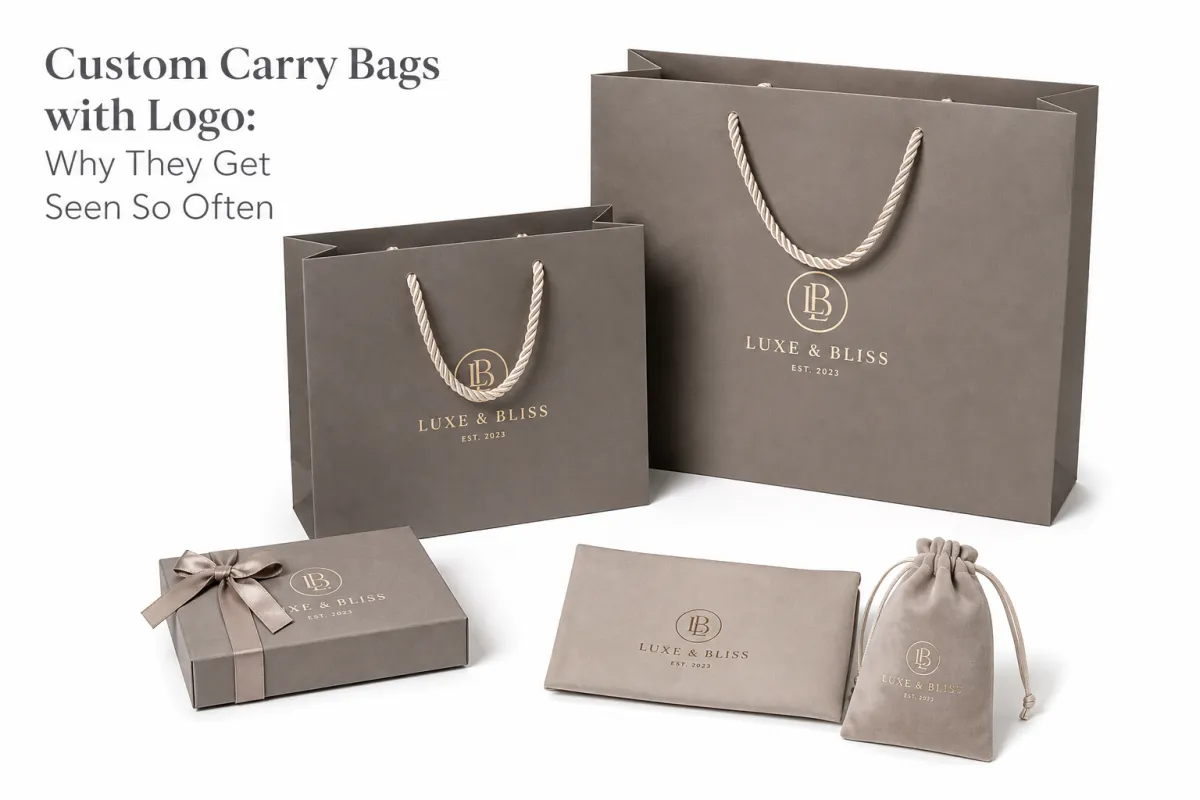
Custom carry bags with logo are one of the few brand assets people willingly hold, reuse, and carry through public spaces. That sounds ordinary on paper, yet it carries real marketing value. A customer may ignore a sign, skim past a flyer, or toss a receipt aside, then keep the bag in sight for the whole trip home. That repeated exposure builds naturally, especially in retail packaging where the bag belongs to the purchase experience and to the street-level impression at the same time.
A carry bag acts like a moving brand surface. It combines presentation, protection, and visibility in one object, which is why custom carry bags with logo often do more work than static marketing pieces that sit on a shelf or get buried in a drawer. The bag does not need to be loud to perform well. It needs proper proportions, comfortable handling, and a print treatment that reads clearly from a few steps away.
These bags matter most in moments when the customer already feels good about the purchase: a boutique buy, a gift wrap add-on, a trade show pickup, a product launch sample, or a premium order that should feel finished the moment it is handed over. That is where custom carry bags with logo earn their place. They become part of the packaging story rather than a loose extra tacked on at the end.
Material and finish change the impression fast. A kraft bag with flat handles says something different from a laminated paper bag with rope handles, and both say something different from a nonwoven reusable tote. Packaging design is never only visual; it is tactile, structural, and practical too. A modest item can feel more intentional when the bag holds its shape well and the logo sits cleanly on the panel.
A bag that feels weak tells the customer the brand cut corners. A bag that feels deliberate tells them the brand pays attention.
The smartest approach is to match the bag to the use case instead of assuming one format fits everything. A lightweight paper carrier may be perfect for apparel or boxed items, while a reinforced reusable bag makes more sense for heavier goods or longer-term brand exposure. That is the real advantage of custom carry bags with logo: they can be built for function and still carry the visual weight of branded packaging.
For teams building a broader package branding program, the carry bag also helps connect the rest of the system. It can echo a printed carton, coordinate with tissue, or pick up a color used in other retail packaging elements. That consistency makes the whole purchase feel finished rather than patched together.
More than anything, custom carry bags with logo work because they are useful enough to stay in the customer’s hands. When the bag keeps getting reused, the logo keeps traveling. That is simple, and it is hard to beat.
How the Production Process Works
The production path for custom carry bags with logo usually starts with a plain brief: what is being carried, how much weight the bag needs to hold, what the brand wants it to look like, and how many units are needed. Sizing, material selection, artwork setup, proofing, printing or finishing, bag conversion, inspection, and packing follow from there. Each step sounds routine, yet each one can shape the final result in a very real way.
A clean dieline saves time early. If the logo placement, bleed, and fold lines are set correctly at the start, the print team has a much easier path through prepress. If they are not, even custom carry bags with logo with a simple one-color design can stall while artwork gets corrected. Good packaging design depends on preparation as much as it depends on visuals.
Lead time changes with material and decoration method. A straightforward paper bag with one-color branding may move through production in about 10 to 15 business days after proof approval, assuming materials are available and the artwork is clean. More complex jobs, especially those with foil, embossing, multiple print stations, or special handles, can stretch into the 15 to 25 business day range. Rush orders can work in some cases, although they usually narrow the available choices for custom carry bags with logo.
- Brief and sizing: 1 to 2 business days for dimensions, load needs, and material direction.
- Artwork prep: 1 to 3 business days, depending on whether the logo file is vector-ready.
- Sampling or pre-production proof: 2 to 5 business days for a physical or digital check.
- Production: often 7 to 20 business days, depending on the style and finish.
- Packing and freight: 2 to 7 business days domestically, longer for longer lanes or palletized freight.
Sampling deserves extra attention, especially if the logo has to land precisely on a gusset, a front panel, or near a handle attachment point. A bag is not a flat sheet forever. Once it is folded, glued, stitched, or converted, the print area behaves differently. That is why a proof for custom carry bags with logo should be reviewed with the actual use in mind, not just as a PDF on a screen.
Good approval habits save money. A buyer who checks the dieline, confirms the Pantone reference, and looks at the physical placement before signoff is less likely to end up with rework. That matters because rework on branded packaging is rarely just a print issue; it can affect scheduling, freight, and the rest of the launch calendar.
Lead time works best as part of planning, not as a last-minute detail. Custom carry bags with logo are easiest to execute when the artwork, structure, and delivery window are all aligned before production starts.
Packaging teams that care about transit durability often look at the test language used by the International Safe Transit Association, while fiber-sourcing conversations often point back to FSC certification. Those references do not choose the bag for you, but they do help frame quality and responsibility in a way procurement teams understand.
What Drives Pricing
Pricing for custom carry bags with logo is usually less mysterious than people expect, but the details matter. Material choice, bag size, handle construction, print coverage, number of colors, finish options, and order quantity all push the unit price up or down. A bag is not priced like a commodity label; it behaves more like a small engineered package with several moving parts.
Quantity is one of the strongest cost drivers. Setup costs, tooling, and prepress labor get spread across more units as the run gets larger, so the unit cost almost always falls as volume rises. A 5,000-piece order can look dramatically more efficient than a 1,000-piece order, even when the artwork and construction stay the same. That is one reason custom carry bags with logo often make more sense as a planned campaign item than as a one-off emergency purchase.
Artwork complexity matters too. A single-color logo on kraft paper is simple. A full-bleed design with foil accents, close registration, and multiple print stations is not. Specialty inks, metallics, embossing, and spot varnish all add labor and quality-control steps. From a packaging buyer's point of view, the budget should cover the whole job, not only the bag shell itself.
| Bag Type | Typical Use | Common Print Style | Approx. Unit Price at 5,000 Pieces | Notes |
|---|---|---|---|---|
| Kraft paper carry bag | Boutiques, apparel, light retail packaging | 1-color flexo or screen print | $0.18-$0.35 | Good value, natural look, lighter load range |
| Laminated art paper bag | Premium gifting, launches, high-visibility branding | Offset print, foil, matte or gloss finish | $0.45-$1.20 | Higher presentation value, stronger shelf appeal |
| Nonwoven reusable bag | Events, giveaways, repeated use | Screen print or heat transfer | $0.35-$0.90 | Reusable, lighter weight, good for brand exposure |
| Cotton or canvas tote | Merch programs, retail resale, long use cycle | Screen print, woven label, embroidery | $0.85-$2.50 | Durable, premium feel, higher material cost |
Those ranges are directional, not universal. Freight, packaging, color matching, custom inserts, and special finishing can all change the final number. A buyer ordering custom carry bags with logo should also ask about carton packing, pallet configuration, and whether the supplier includes proofing or charges separately. Those details often explain the real difference between two quotes.
Size affects cost in a quieter way. A larger bag uses more substrate, yet it can also require heavier stock or stronger handles to keep the bag from feeling flimsy. The cheapest size is not always the best value. If the product sits awkwardly in a bag, the brand impression drops fast. A slightly better-built format often protects the investment in the products being carried.
There is a useful rule of thumb for custom carry bags with logo: if the bag is meant to last beyond one visit, budget for stronger materials and a finish that will not scuff easily. A little extra spend can be easier to justify when the bag keeps circulating and the logo keeps getting seen.
How to Choose Materials and Print Methods
Material choice should follow the product, not the other way around. Paper, coated paper, kraft, nonwoven polypropylene, cotton, canvas, and other substrates each solve a different problem. A folded garment or a lightweight box may do fine in a paper carrier, while heavier goods, bottle sets, or items with sharp corners may need a reinforced bottom, sewn handles, or a reusable structure. That is why custom carry bags with logo should be specified with the load in mind first.
Paper carriers are common because they are flexible, printable, and easy to brand. Kraft gives a natural, grounded look; coated paper opens the door to cleaner color reproduction and a more polished presentation; laminated paper adds protection and a premium surface. In branded packaging, those differences affect more than durability. They shape the tone of the purchase. A matte kraft bag can feel understated and earthy. A gloss-laminated bag can feel more fashion-forward. A soft-touch finish can feel quiet and upscale.
Material and construction choices
For custom carry bags with logo, the construction details matter as much as the substrate. Twisted paper handles are common on retail bags because they are economical and familiar. Flat handles can suit lighter loads and certain price points. Rope handles bring a more premium feel and often handle heavier contents better. Die-cut grips can work well for promotional bags or shorter trips, while reinforced bottoms and board inserts help keep a bag from sagging under load.
- Paper weight: common retail options range from about 120gsm to 200gsm, depending on the style.
- Fabric weight: reusable totes often use 6 oz to 10 oz cotton or similar fabric ranges.
- Nonwoven thickness: many event bags sit in the 80gsm to 120gsm range.
- Gusset depth: deeper gussets help boxes and bundled items sit upright.
- Bottom reinforcement: board inserts can reduce sag and improve load stability.
Print methods and finish options
Printing is where brand clarity either gets reinforced or gets muddy. Flexographic printing is useful for large quantities and simpler artwork. Screen printing is a strong choice for bold logos on fabric or nonwoven bags. Digital print can support more color variation, while foil stamping, embossing, and debossing add tactile detail that can make custom carry bags with logo feel more premium. Label-based branding is another option in some cases, especially if the bag body is already in stock and the goal is to add brand identity quickly.
There is no single best finish. Matte says one thing, gloss says another, and soft-touch creates a different sensory read altogether. If the bag is part of a launch or a luxury retail moment, finish should be treated as part of the brand language. If the bag is a utility piece for frequent use, durability and color fastness matter more than a special surface treatment. That balance is where good packaging design earns its keep.
Custom carry bags with logo perform best when the material, size, and print method all support the same job. If the bag needs to look premium, move cleanly in the hand, and survive a real customer use cycle, those three decisions need to point in the same direction.
For teams building broader package branding, it helps to compare the bag against other touchpoints like retail packaging options and custom packaging products already in use. That comparison keeps the bag from feeling disconnected from the rest of the system.
How to Order Without Delays
Ordering custom carry bags with logo goes more smoothly when the team treats it like a packaging specification project rather than a quick quote request. Start with use case definition. What is being carried? How heavy is it? Is the bag for one-time retail handoff, a premium event, or repeated reuse? The answer shapes the material family, handle style, and finish right away.
Next comes the specification plan. Decide on dimensions, structure, reinforcement, and target quantity before comparing quotes. If one supplier prices a compact bag and another prices a larger gusseted format, the numbers may not be directly comparable. That is one reason custom carry bags with logo can appear cheaper or more expensive than they really are. The spec sheet must be consistent first.
Artwork should be prepared on the dieline, not dropped onto a mockup at random. Keep the logo within the printable area, check the background color against the chosen substrate, and make sure type is legible at production size. Vector files are usually best because they preserve sharp edges and simplify color management. If the artwork will be near folds, seams, or handles, give it extra breathing room.
- Define the use case: product weight, handoff environment, and desired reuse cycle.
- Choose the structure: paper, kraft, nonwoven, cotton, canvas, or another substrate.
- Set the dimensions: confirm width, gusset, and height with the product inside.
- Prepare the artwork: place the logo on the dieline and confirm Pantone or CMYK values.
- Review the proof: check logo placement, handle clearance, and fold lines carefully.
- Approve production: confirm packaging, labeling, freight method, and delivery window.
Proof review deserves real attention. Small changes in paper shade, ink density, or handle attachment can shift the finished look more than most people expect. That is why custom carry bags with logo should be checked as actual production units, not only as screen images. If the bag is intended to represent a premium product or event, a sample is worth the extra time.
One thing many buyers appreciate after a few runs is this: the best orders are the ones where receiving details are confirmed early. Pallet count, carton labeling, dock access, and storage space all matter. If those details are handled before shipment, custom carry bags with logo arrive ready to move into use rather than becoming a logistics problem.
For teams that want to compare options across the board, browsing Custom Packaging Products before placing the order often makes the final choice easier. It helps separate what looks good on paper from what will actually support the product in hand.
Common Mistakes to Avoid
The biggest mistake is choosing a bag by price alone. A low quote can be tempting, but if the bag feels flimsy, tears at the handle, or loses print quality quickly, the brand impression suffers. That is especially true with custom carry bags with logo, because the bag is meant to represent the business in motion. Cheap packaging can make a premium product feel undercooked.
Artwork errors cause trouble too. Low-resolution files, incorrect color values, crowded layouts, and logos pushed too close to folds or seams all create avoidable problems. The same issue shows up when the print is asked to do too much. Too many words, too many icons, or too many colors can make the bag look busy instead of deliberate. A clean logo usually performs better than a crowded message because the eye has a place to land.
Ignoring load requirements is risky as well. Bottle sets, boxed goods, and products with hard edges need more structure than a lightweight apparel purchase. If the handle attachment or bottom reinforcement is underspecified, the customer notices immediately. That is not a small issue. A failure in a custom carry bags with logo program is visible, memorable, and expensive in terms of trust.
- Do not underbuild the handles: the handle is usually the first failure point customers feel.
- Do not crowd the logo: breathing room makes the branding feel more confident.
- Do not skip the proof: a visual approval is not enough if the bag will carry weight.
- Do not forget storage: some bags need dry, clean space to keep the finish in good condition.
- Do not ignore freight packaging: crushed cartons can damage the final appearance before the bags are even used.
Another trap is overbranding. A bag does not need to say everything. Sometimes a single mark, a strong color block, or a well-placed logo does more for brand recognition than a full panel of text. That is a useful lesson in package branding: restraint often reads as confidence. With custom carry bags with logo, less can genuinely feel more polished.
Skipping a sample review can also cost time later. A sample tells you how the material behaves, how the print sits on the surface, and whether the handles feel balanced in the hand. Once you see the real thing, you can make a better decision about custom carry bags with logo before the full run goes forward.
Practical Tips From the Packaging Floor
Design for reuse if you can. A bag that survives multiple trips creates more impressions and usually feels more generous to the recipient. That matters because custom carry bags with logo are not only packaging; they are a small piece of brand property that can keep working after the original purchase. Reusable formats also tend to feel more substantial in the hand, which helps the product inside feel worth the price.
Contrast is another detail worth getting right. A logo has to read at a glance against kraft, white, black, or a specialty color. If the contrast is weak, the branding disappears from normal viewing distance. Simple high-contrast artwork often beats a detailed layout because it survives movement, glare, and imperfect lighting. That is especially true on event floors or busy retail streets where people only see the bag for a few seconds.
Think about the opening path too. What does the customer see first? Is the product visible immediately, or is there tissue, a card, or an insert that creates a layered reveal? The bag is part of that sequence. In thoughtful packaging design, the experience starts before the item leaves the bag. Custom carry bags with logo support that experience best when the opening, the print, and the contents all feel like they belong together.
A simple bag with one clear message usually reads as more expensive than a crowded bag trying to say too much.
Match the bag style to the buying occasion. Subtle finishes and quieter colors often work well for luxury goods or gifts. Sturdier, practical formats make more sense for retail use, groceries, or product bundles. Bright brand-forward looks can be smart for launches or event giveaways. There is nothing wrong with making a bag visible, but the visibility should serve the product and the setting. That is the point of custom carry bags with logo: the bag should fit the moment, not fight it.
In practice, the strongest results usually come from clear structure and disciplined artwork. A centered logo, a sensible amount of white space, and a finish that matches the product can outperform more expensive decoration. That surprises some buyers, yet it should not. People read quality through consistency. When custom carry bags with logo feel calm, sturdy, and intentional, the brand does too.
If you want to compare that approach with other branded packaging formats, it helps to look at how Custom Packaging Products are used across different customer touchpoints. That comparison can reveal whether the bag should carry the visual system or simply support it.
What to Check Before Ordering
Before placing an order for custom carry bags with logo, start with a short internal checklist. Measure the product, define the use case, choose the material family, and decide whether the priority is cost, durability, presentation, or a combination of all three. Those answers keep the project from drifting while quotes are being compared.
Then gather the details that speed up quoting and proofing. Have the logo file ready, preferably in vector format. Pull together any brand standards, Pantone references, and size preferences. Decide on handle type, finish, and estimated quantity. If the bag is part of a launch or premium event, ask for a sample or proof early. That single step removes a lot of guesswork from custom carry bags with logo.
- Quantity: confirm the first run and any likely repeat runs.
- Color count: keep the print plan realistic for budget and lead time.
- Handle choice: match the handle to the load and the brand tone.
- Finish: matte, gloss, soft-touch, or natural depends on the look you want.
- Storage and receiving: know where the bags will go after delivery.
It also helps to think one step beyond the bag itself. Will the customer carry it home and keep it? Will staff reuse it for special orders? Will the bag need to coordinate with tissue, inserts, labels, or retail packaging products already in circulation? These questions matter because custom carry bags with logo work best inside a broader packaging system, not as a standalone ornament.
From a cost-control angle, the smartest orders are usually the ones that match production realities. If the design is simple, the lead time is reasonable, and the material is in stock, the run is easier to manage. If the timeline is compressed or the decoration is complex, expect trade-offs. That is normal. What matters is making those trade-offs knowingly rather than discovering them after the quote is approved.
The practical recap is straightforward: align the structure, the branding, the timing, and the budget before production begins. That is what keeps custom carry bags with logo from becoming a scramble and turns them into reliable branded packaging that feels polished in hand and useful after the sale.
What materials work best for custom carry bags with logo?
Paper works well for retail, gifting, and lighter goods, especially when the goal is a clean presentation and a manageable cost. Fabric, nonwoven, or heavier reinforced options are better when the bag needs repeated use or higher load strength. The best choice for custom carry bags with logo depends on the product weight, the brand feel you want, and how long the bag should stay in circulation.
How long does production usually take for custom carry bags with logo?
Production time depends on the bag style, printing method, quantity, and how quickly the artwork is approved. Simple designs using readily available materials often move faster, while specialty finishes, complex print setups, or custom structural details add time. For many custom carry bags with logo orders, a realistic planning window is about 10 to 15 business days after proof approval for simpler runs, and longer for more elaborate builds.
What affects the price of custom carry bags with logo the most?
The biggest cost drivers are material choice, bag size, order quantity, print complexity, and special finishing details such as lamination, foil, or reinforcement. Shipping, proofing, and custom inserts or accessories can also affect the total job cost. If you are budgeting for custom carry bags with logo, it helps to look beyond the unit price and account for the full landed cost.
Can I use a simple logo file for custom carry bags with logo?
Yes, but the file needs to be clean, high-resolution, and placed correctly on the dieline so the print looks sharp at production size. Vector files are usually the best starting point because they scale cleanly and preserve detail. That makes prepress easier and helps custom carry bags with logo come out the way the brand expects.
What is the best order quantity for custom carry bags with logo?
The best quantity depends on how often the bags will be used, how long the artwork will stay current, and whether you need price efficiency or flexibility. Larger runs usually lower the unit cost, but smaller runs can be smarter if the campaign is limited or the design may change soon. For custom carry bags with logo, the right number is the one that matches actual usage, not just the lowest quote.
One final takeaway: choose the bag for the product, not for the spreadsheet. If the load, the print, and the finish all line up, custom carry bags with logo do their job quietly and well, which is exactly what good packaging should do.

