Buyer Fit Snapshot
| Best fit | Custom Clamshell Boxes with Inserts projects where brand print, material claims, artwork control, MOQ, and repeat-order consistency need to be specified before quoting. |
|---|---|
| Quote inputs | Share finished size, material target, print colors, finish, packing count, annual reorder estimate, ship-to region, and any compliance wording. |
| Proofing check | Approve dieline scale, logo placement, barcode or warning zones, color tolerance, closure strength, and carton packing before bulk production. |
| Main risk | Vague material claims, crowded artwork, missing packing details, or unclear freight terms can make a low unit price expensive after revisions. |
Fast answer: Custom Clamshell Boxes with Inserts: Board, Finish, Dieline, and Unit Cost should be specified like a repeatable production item. The safest quote records material, print method, finish, artwork proof, packing count, and reorder notes in one written spec.
Production checks before approval
Compare the actual filled-product size with the drawing, then confirm tolerance on folds, seals, hang holes, label areas, and retail display edges. Reserve space for logos, QR codes, warning copy, and material claims before decorative graphics fill the panel.
Quote comparison points
Review material grade, print process, finish, sampling route, tooling charges, carton quantity, and freight assumptions side by side. A quote is only useful when the supplier can repeat the same color, closure quality, and packing count on the next order.
Custom Clamshell Boxes with Inserts: Design Guide
Custom clamshell boxes with inserts solve a packaging problem that gets dismissed too easily: products move, rub, and arrive with tiny defects that make them feel less valuable than they are. I have seen a small scuff on a compact, a dented corner on a rigid accessory kit, and a loose item in a gift set change the entire reaction to the product. The box did not fail dramatically. It failed quietly, which is usually worse.
A clamshell box opens like a shell, either as a hinged format or as a two-piece rigid structure that creates a strong reveal. Add an insert, and the package stops behaving like an empty container. The product lands in one place, the opening sequence feels intentional, and the first impression becomes more controlled. That matters in product packaging, especially for branded packaging that has to protect, present, and persuade at the same time.
Cosmetic kits, electronics accessories, collectible items, and gift sets all benefit from custom clamshell boxes with inserts because the same product can look completely different once it sits in a fitted interior. A loose accessory in a plain carton feels ordinary. The same item in a snug cavity feels considered. Buyers register that difference faster than brands expect, even if they cannot describe why the package feels better.
Retail, DTC, and wholesale channels all ask the same things from packaging: protection, presentation, and efficient pack-out. Custom clamshell boxes with inserts sit in the middle of that triangle. Tilt too far toward display and cost rises. Push too hard toward protection and the package gets heavy, bulky, or awkward. Ignore fit, and the result becomes expensive clutter.
The insert does the quiet work. It controls movement, supports the reveal, and keeps the item from arriving with the kind of friction marks that make a premium product feel rushed. Customers may not know the board grade, the die line, or the finish specification. They do know when something rattles.
How Custom Clamshell Boxes With Inserts Work
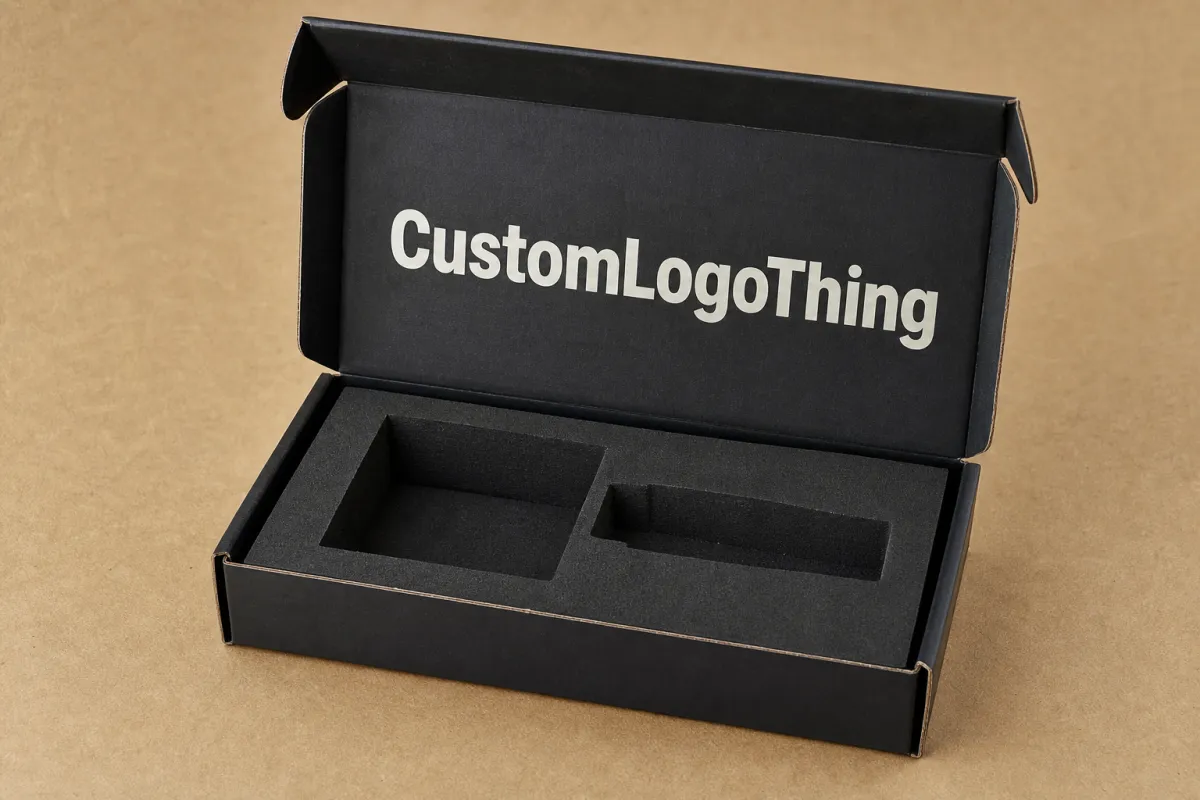
Custom clamshell boxes with inserts are built on a simple split: the outer shell handles presentation, and the insert handles fit. The shell gives the package its rigid feel. The insert decides where the product sits, how it lifts out, and how much movement it can survive before it reaches the customer.
A typical build includes four elements. The first is the outer clamshell or rigid shell. The second is the closure system, which may use a magnetic flap, tuck-in panel, ribbon pull, or friction-fit lid. The third is the insert cavity, shaped to match the item. The fourth is the nesting area, the part that actually holds the product in place. Custom clamshell boxes with inserts work best when those four pieces are planned together instead of being handled as separate afterthoughts.
Insert material changes the result immediately. Paperboard inserts suit lighter products and flatter profiles. Chipboard or rigid board works better when the product needs more structure and a stronger presentation. Molded pulp fits sustainability-led programs and brings a more natural texture. Foam still appears in fragile categories, although it brings tradeoffs: less eco appeal, a more utilitarian appearance in some markets, and a look that can fight against premium branding. The right material depends on both product weight and brand story.
Fit is never a guess. It is a tolerance problem. A sample product that measures 102 mm wide and varies by 2 or 3 mm in production cannot live in a cavity cut at exactly 102 mm and called close enough. That is how corners get abraded, lids bow upward, and pack-out teams start forcing products into spaces that were drawn on a screen rather than measured from a real object.
Opening behavior matters as much as structure. Custom clamshell boxes with inserts create a staged reveal: the lid opens, the product appears centered, and the customer sees a purposeful layout instead of filler or a stray accessory. That sequencing changes perceived value. It also makes retail packaging feel more disciplined, especially when one outer box format is used across several SKUs and only the insert changes.
Speed on the fulfillment line is another reason these packages matter. A well-cut insert reduces guesswork. The product drops into place the same way every time. No extra tape. No crumpled paper. No worker spending 20 extra seconds per unit trying to persuade a bottle, device, or accessory to cooperate. Labor cost has a way of hiding inside “small” problems.
A pretty box that rattles is still a bad box. The customer may never ask about board thickness, but they will notice movement, edge wear, and the hollow feeling of a lid that opens onto empty space.
Brands that care about consistency usually want custom clamshell boxes with inserts to make pack-out boring. That sounds unglamorous, and it is. Boring means repeatable. Repeatable means fewer mistakes. Fewer mistakes mean fewer returns and fewer awkward conversations with operations after launch.
Key Factors That Shape Fit, Look, and Performance
Start with the product, not the packaging fantasy. Custom clamshell boxes with inserts only work when the box is built around the real item, including protrusions, labels, seams, closures, and normal manufacturing variation. A glass bottle is not a perfect cylinder. A charger is not a perfect rectangle. Even a simple accessory tends to have a cable bend, a zipper pull, or a molded edge that changes how the insert should grip it.
Weight changes the build in obvious ways that still get ignored. A light cosmetic compact may fit comfortably in a 350gsm paperboard insert, while a metal tool or fragrance bottle often needs a thicker board, laminated structure, or a foam-backed cavity. Heavier products need more resistance to vertical bounce and side-to-side drift. Custom clamshell boxes with inserts are less about ornament and more about restraint.
Fragility adds another layer. Glass, ceramic, polished metal, and screen-sensitive electronics all need enough clearance to avoid pressure points, but not so much room that the item moves during transit. That is why dimensional accuracy matters so much. A cavity that is too tight creates abrasion. A cavity that is too loose creates impact damage. There is no hidden fix later in the process.
Material choice also carries a brand message. Paperboard feels lean and clean. Chipboard feels sturdier and more premium. Molded pulp feels modern in a sustainability-minded way, though not every luxury brand wants that texture. Foam protects well, yet it often reads as less refined unless the category expects it. For FSC-conscious programs, choose stock with the right chain-of-custody documentation and confirm the supplier can support the claim. The FSC standard tends to become a serious discussion only after the mockup looks right, which is a common packaging reversal.
Finishes change perception quickly. Soft-touch lamination makes custom clamshell boxes with inserts feel more polished. Matte film gives the package a cleaner retail profile. Foil, embossing, and spot UV can elevate package branding, but each one adds cost and handling risk. Too much finish on a small package can turn premium into crowded. Strong branded packaging usually picks one focal detail and lets the rest breathe.
Assembly speed deserves more attention than it gets. A beautiful insert that requires three hand motions, repeated alignment checks, and a bit of hope is a bad production decision. Custom clamshell boxes with inserts should be designed for the actual line, not for a render. If your team is packing 2,000 units, saving 5 seconds per unit becomes meaningful almost immediately. That is payroll, not theory.
Testing catches what polished mockups conceal. Transit testing through programs such as ISTA helps expose weak corners, loose cavities, and closure failures before a customer sees them. A simple vibration and drop check often reveals the truth early. If the package survives the lab but fails in the truck, the design was never ready.
Check these items before sign-off:
- Actual product measurements, including labels, seams, and any hardware that protrudes.
- Allowable tolerance, usually 1-3 mm depending on item size and material behavior.
- Opening direction, so the reveal matches the intended visual layout.
- Closure strength, especially if the box will ship flat or move through distribution centers.
- Pack-out sequence, so the insert does not slow the line down.
Custom clamshell boxes with inserts are not a decoration choice. They are a fit system, a labor system, and a perception system. One weak link changes the whole experience.
Production Steps and Timeline for Custom Clamshell Boxes With Inserts
Most projects move through the same path: brief, structure, insert layout, artwork, sample, revision, production, and delivery. Custom clamshell boxes with inserts usually take longer than standard folding cartons because the outer structure carries more complexity and the insert has to fit the product with real precision. That delay is not a flaw. Precision costs time.
A clean spec sheet saves days. Include product dimensions, weight, photos from several angles, fragility notes, and any retail or shipping constraints. If the item includes multiple pieces, list them separately. A cosmetic kit with six components is not the same as one bottle and a leaflet. Custom clamshell boxes with inserts need the full picture from the start, or the sample process turns into expensive guessing.
Once the brief is complete, structural design begins. Box size, wall thickness, hinge style, and insert footprint all get locked in here. For rigid-style custom clamshell boxes with inserts, board thickness often falls around 1.5 mm to 2.5 mm, though the right spec depends on crush resistance and the premium feel you want. Lightweight paperboard builds may use 350gsm to 400gsm stock, while heavier presentation pieces usually move to laminated board.
Sampling causes most delays. A loose fit in the first sample usually means the cavity depth needs revision. A product that sits too low changes the reveal. A closure that feels too tight can bow the lid. Those problems are fixable, but they often require another round. Simple custom clamshell boxes with inserts may move from proof approval to final production in about 12-18 business days. More complex builds, especially those with special finishes or custom tooling, can stretch to 20-30 business days or longer.
People add delay too. Artwork changes after sampling slow the schedule. Late approvals slow the schedule. Incomplete packaging design files slow the schedule. Packaging teams love to say “just a small tweak,” as if a small tweak does not create three downstream edits and two new proof files. It always does.
Production generally includes printing, die-cutting, laminating, insert fabrication, assembly, and final QC. For custom printed boxes with rigid features, every stage creates another handoff point. A clear approval trail matters because a shell can be approved while the insert is still being revised, and the job is not actually finished until both are locked.
A practical timeline frame:
- 1-3 days for brief review and quoting, assuming the specs are complete.
- 3-7 business days for a structural or fit sample, depending on complexity.
- 2-5 business days for revisions if the cavity or closure needs adjustment.
- 12-30 business days for production, depending on materials, volume, and finish choices.
- Transit time that varies by origin, shipping method, and seasonal congestion.
Build a buffer into the schedule. Custom clamshell boxes with inserts are not the place to gamble on a launch date. One failed fit check can stall the entire project, and nobody wants to explain that to sales when inventory is already booked.
If you want to compare structure options before you commit, our Custom Packaging Products page is a useful place to narrow the format. If you are deciding between more presentation and more protection, custom clamshell boxes with inserts usually land between those two poles, which is exactly why the sample matters so much.
Cost, Pricing, MOQ, and Quote Drivers for Custom Clamshell Boxes With Inserts
Pricing for custom clamshell boxes with inserts comes down to a handful of levers, and none of them are mysterious. Size, board thickness, insert complexity, print coverage, finish, and labor all move the quote. Larger boxes use more material. Thicker boards demand stronger construction. More insert cutouts mean more tooling and more assembly. It is math, dressed in packaging language.
MOQ matters because setup costs have to be spread across the run. A 500-unit order and a 5,000-unit order do not carry the same per-piece burden, even when the box looks identical. That is why a small batch can feel unusually expensive on a per-unit basis. You are paying for prep, tooling, proofing, and labor across fewer pieces. Custom clamshell boxes with inserts feel this effect more than simpler formats because the insert often adds separate die-cut or assembly steps.
Here is a rough comparison of common insert options for custom clamshell Boxes with Inserts:
| Insert Type | Best For | Typical Cost Behavior | Strengths | Tradeoffs |
|---|---|---|---|---|
| Paperboard | Light accessories, cosmetics, compact sets | Usually the lowest cost; often adds about $0.08-$0.20 per unit at mid-volume, depending on complexity | Clean look, light weight, easy print matching | Less cushioning for fragile items |
| Chipboard / rigid board | Midweight products, premium retail packaging | Moderate cost; often roughly $0.12-$0.30 per unit at mid-volume | Better structure, premium feel, good for presentation | Can increase box weight and shipping cost |
| Foam | Fragile items, electronics, instruments | Often higher than board because of material and cutting requirements | Strong cushioning, strong product lock | Less eco-friendly, less luxury-looking in some categories |
| Molded pulp | Sustainability-led programs, natural presentation | Can be economical at scale, though tooling and setup can be meaningful | Recyclable, lightweight, good movement control | Texture may not fit every premium brand |
Those ranges are planning numbers, not promises. Final pricing depends on quantity, market, freight, and whether the insert requires extra hand assembly. A multi-cavity insert with thumb notches and layered build-ups costs more than a flat die-cut tray. That becomes obvious after the invoice lands, which is annoying but not mysterious.
Shipping weight can quietly reshape the budget. Custom clamshell boxes with inserts made from rigid board or foam can add meaningful pounds to a carton load. That affects freight, storage, and fulfillment. A heavier retail package may improve perception while making logistics more expensive at the same time. Packaging does that often enough to be frustrating.
Watch the quote for hidden costs. Extra proof rounds add time. Soft-touch lamination and foil stamping add cost. Magnetic closures increase material spend. More insert components mean more labor. If one vendor offers a suspiciously low number, check whether the insert is included, whether the sample is included, and whether freight is included. A quote that omits one of those is not cheaper. It is incomplete.
Ask for pricing in layers:
- Outer box only, so the shell cost is visible.
- Insert only, so the cavity cost is separated out.
- Assembly and finishing, so labor is easy to see.
- Freight, so shipping does not appear later as a surprise.
That breakdown makes custom clamshell boxes with inserts easier to compare against other retail packaging formats, including plain tuck boxes or simpler product packaging options. If you are looking at Custom Packaging Products, this is where the tradeoff becomes real: premium feel versus unit economics.
Common Mistakes to Avoid With Custom Clamshell Boxes With Inserts
The biggest mistake is designing the outer box first and treating the insert as a side note. That is how teams end up with a beautiful shell and a product that sits crooked inside it. Custom clamshell boxes with inserts should be engineered as one system. The shell and the cavity belong together from the beginning.
Ignoring product tolerance causes another round of problems. A sample that fits one perfect unit may fail on the production line once normal variation shows up. If your supplier says the product can vary by 1.5 mm, that figure has to shape the cavity design. Otherwise the insert squeezes too hard or allows too much motion. Neither outcome helps conversion.
Over-design shows up constantly. Brands add foil, embossing, soft-touch coating, layered inserts, and magnetic closure hardware because each feature sounds premium on paper. The final package becomes heavy, expensive, and awkward to pack. Custom clamshell boxes with inserts should earn the features they carry. If a finish does not support the product or the brand story, it should go.
Packing-line friction is another quiet failure. A gorgeous insert that requires three hands to load is not a win. If the worker has to angle the item, press the edges, and check alignment every time, production speed drops and error rates climb. The best custom clamshell boxes with inserts make the packing motion simple enough to repeat without thought.
Transit testing gets skipped more often than it should. No drop test, no vibration test, no packed-carton check, and everyone acts surprised when a corner crushes or an item slides loose. If the package needs to arrive clean, it should be tested under realistic handling conditions. A quick internal trial can reveal a closure that opens too easily or an insert that flexes under load. Formal ISTA-style testing helps because it exposes the same kinds of failures customers will not forgive.
Branding inconsistency is another easy miss. The shell may look right, but the insert stock, print color, or finish does not match the rest of the package branding. That mismatch can make the package feel cheaper than it is. In custom printed boxes, color consistency and material consistency are part of the product, not extra decoration.
Watch for these red flags:
- Loose product movement when you shake the sample gently.
- Corner scuffing after a short transit or drop trial.
- Bulging walls from an insert that is too tight.
- Slow pack-out that creates line bottlenecks.
- Finish overload that raises cost without improving the unboxing experience.
Custom clamshell boxes with inserts can fail in subtle ways. They do not always collapse dramatically. Sometimes they just feel slightly off. Slightly off is enough to hurt conversion and repeat purchase, especially in categories where unboxing is part of the product story.
Next Steps: Spec, Sample, and Order Smarter With Custom Clamshell Boxes With Inserts
If you want custom clamshell boxes with inserts to do their job, start with a tight spec. List product dimensions, weight, component count, fragility level, shelf display needs, and shipping constraints. Include photos. Include notes about labels, caps, cords, and any irregular shape. The more complete the brief, the less likely you are to burn a sampling round on a preventable mistake.
Gather reference images for the visual direction too. “Premium” can mean three different things depending on the category. For cosmetics, it may mean soft-touch, foil, and a neat reveal. For electronics, it may mean hard edges, precise fit, and a clean molded insert. For gift sets, it may mean layered presentation and careful color coordination. Custom clamshell boxes with inserts should reflect the product category rather than fighting it.
Ask for a sample or prototype before full production. That step is not optional if the insert has to protect anything real. One fit sample can save you from an entire run of bad inventory. If the product shifts, request a revised cavity. If the lid closes with too much pressure, adjust the structure. If the insert feels too flimsy, move up in material. Cheap mistakes become expensive fast after the order is cut.
Compare quotes on the same specification. Same dimensions. Same board grade. Same insert type. Same finish. Otherwise you are not comparing pricing; you are comparing guesswork. When the specs match, the real differences become visible: one supplier may be stronger on assembly efficiency, another on finish quality, another on freight or minimum order quantity. That kind of comparison helps. Vague quotes do not.
Think beyond the first sale. If the item will sit in retail packaging, move through a distributor, or ship individually after launch, the insert and closure need to survive more than one handling cycle. That is where custom clamshell boxes with inserts earn their place. They protect the product, preserve the unboxing, and keep the brand from looking careless in front of a paying customer.
For teams still narrowing the direction, our Custom Packaging Products page can help you compare structure options before you request a spec. It also works as a check on whether your project needs a full rigid setup, a simpler carton, or custom clamshell boxes with inserts that split the difference between display and protection.
Custom clamshell boxes with inserts are not the cheapest route. They are the smarter route when the product, the brand, and the delivery experience all matter at once. Define the product clearly, request a sample, confirm the fit, and lock the spec before you order. If you do that, the box stops being a design idea and starts functioning like a packaging system that holds up in the real world.
FAQ
Are custom clamshell boxes with inserts better than standard tuck boxes?
Yes, when protection and presentation matter more than the lowest possible unit cost. Custom clamshell boxes with inserts usually feel sturdier, keep the product from shifting, and deliver a more premium reveal. Tuck boxes are simpler and cheaper, but they usually do less for fragile, heavy, or multi-piece items.
What insert material works best for custom clamshell boxes with inserts?
Paperboard works well for light products and keeps costs controlled. Foam is better for Fragile Items That need stronger cushioning, though it is usually less eco-friendly and less elegant-looking. Molded pulp is a strong middle ground for sustainability, although it does not suit every luxury presentation.
How long do custom clamshell boxes with inserts usually take to produce?
Simple projects move faster than complex ones. A basic sample may take a few business days, while production after approval often runs in the low-to-mid teens for simpler builds and longer for premium finishes or custom tooling. Sampling, artwork approval, and structural revisions are the usual time sinks.
What drives the price of custom clamshell boxes with inserts?
Size, board thickness, insert material, print coverage, finishes, and assembly labor are the main drivers. MOQ matters because setup costs get spread across the order quantity. Freight can also become meaningful if the package is heavy or the insert is complex.
Can I order custom clamshell boxes with inserts in a small batch?
Usually yes, though the unit price will be higher because setup costs are spread across fewer boxes. Keep the structure simple if you want to control cost on a small run. A sample or short pilot order is a smart way to validate fit before committing to a larger purchase.

