For apparel teams, custom Hang Tags for Clothing b2b sourcing is not a minor print purchase. It is one of the first signals that a garment belongs to a brand with a clear point of view. The tag sits on a rack, in a warehouse carton, or in an unboxing moment where buyers make quick judgments about quality, margin, and consistency.
That makes the sourcing conversation more technical than many expect. Hang tags have to fit the product, support the brand story, survive handling, and still land at a unit cost that works across multiple SKUs. Miss one spec and you may only get a small correction. Miss two and the schedule starts slipping.
For wholesale buyers, private-label teams, seasonal programs, and retail-compliant assortments, the work is part creative, part operational. Better briefs usually produce cleaner quotes. Cleaner quotes usually mean fewer surprises after production begins.
Why hang tags matter in wholesale and retail clothing programs
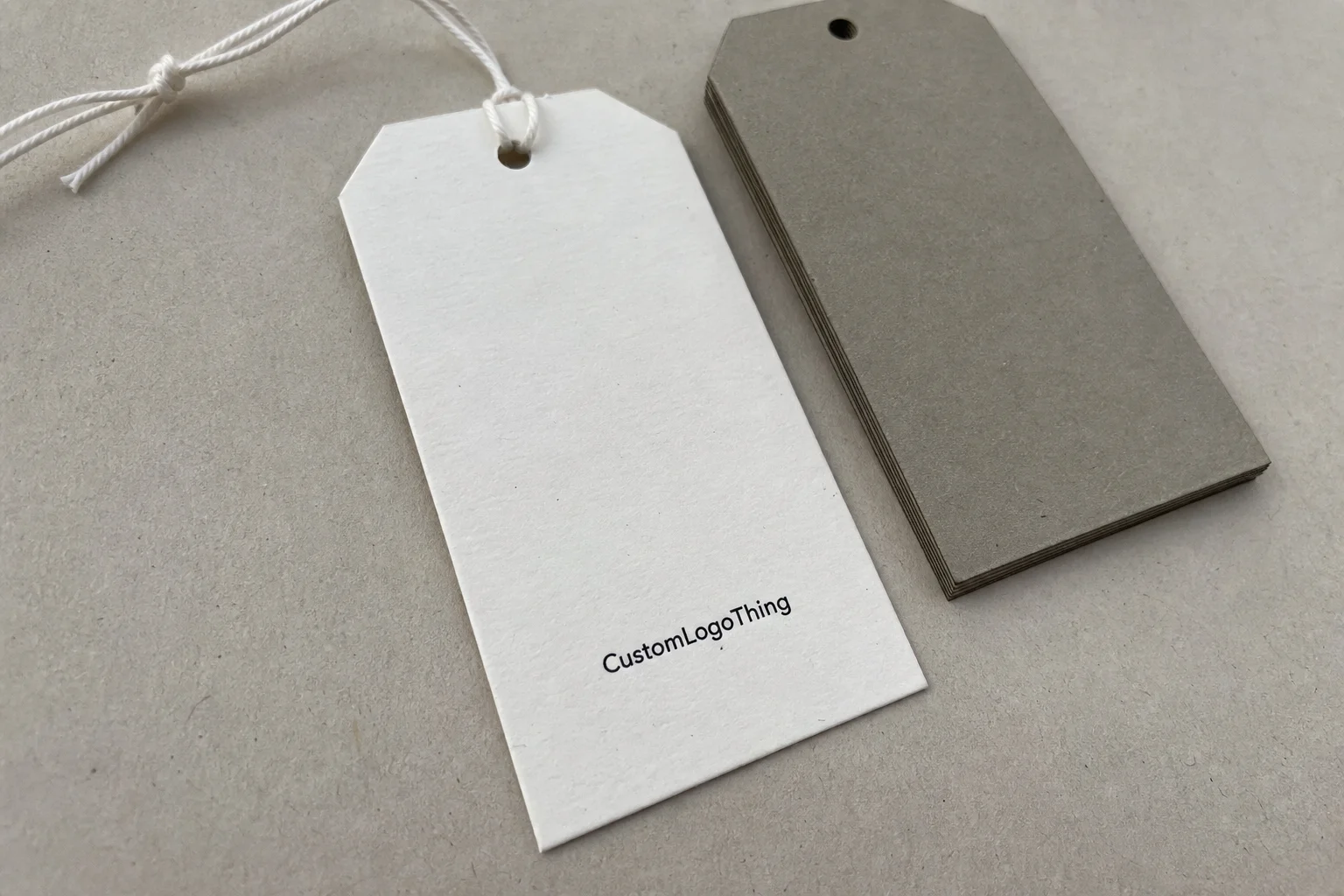
A hang tag is often the first physical brand impression a customer sees. It is smaller than the garment, but it carries disproportionate weight. On a crowded retail rack, a good tag helps a product look intentional. In a warehouse or distribution center, it helps staff identify SKU, size, and style quickly.
Some buyers still treat tags as an afterthought because the unit price looks low. That is a mistake. A hang tag can support pricing confidence, reinforce a premium fabric story, and keep a multi-style assortment visually coherent. If a collection includes basics, seasonal fashion, and licensed items, the tag system should feel like one family rather than a patchwork of unrelated print jobs.
There is also a practical distinction that matters during sourcing. A hang tag is not a care label, not a swing ticket in the old-school sense, and not a packaging insert. Care labels are compliance-driven and usually sewn in. Inserts sit inside the package. Hang tags are exposed, visible, and often attached with string, plastic fasteners, or branded cords. They can carry barcode data, retail price, fiber claims, country of origin, or size cues depending on the channel.
From a packaging buyer’s perspective, the best tag specification depends on how the product moves. A direct-to-consumer brand may want a more tactile finish because the tag becomes part of the unboxing experience. A wholesale program may prioritize barcode clarity and pallet-friendly packing. A retailer-facing line might need to follow strict vendor manual rules. The tag is a small format, but it touches merchandising, compliance, and product packaging at once.
“In apparel, the tag is rarely just decoration. It is a communication tool, a pricing cue, and a consistency check all in one.”
If you are building a broader branded packaging system, it helps to think of hang tags alongside other assets such as Custom Labels & Tags, Custom Packaging Products, and matching Wholesale Programs for retail-ready shipments. The strongest programs are coordinated, not isolated.
What suppliers need to quote custom hang tags accurately
If you want a quote that holds up, the supplier needs more than “we need a tag.” They need a short spec sheet. The most useful details are size, shape, quantity, stock, print method, finish, and attachment style. Without those, most quotes are only estimates, which is where revision cycles begin.
Here is the core information most suppliers should see on day one:
- Finished size and shape: square, rectangle, round-corner, custom die-cut, folded, or booklet style.
- Quantity by SKU or total run, because a mixed order can change setup logic.
- Stock: 300gsm art paper, 350gsm C1S, textured board, kraft, recycled stock, or specialty paper.
- Print method: offset, digital, foil stamping, emboss/deboss, or a mixed process.
- Finish: matte, gloss, soft-touch lamination, aqueous coating, spot UV, foil, or uncoated.
- Attachment style: string, cotton cord, plastic loop, metal pin, or custom fastener.
Artwork matters just as much as the physical spec. Clean vector files reduce prepress problems. Brand colors should be referenced with Pantone numbers if consistency matters. If the design includes small legal copy, care icons, QR codes, or barcodes, those elements need to be checked early because tiny text behaves differently across paper stocks and print methods. What looks fine on a screen may fail on press.
Dielines deserve special attention. Suppliers need to know where folds, holes, and trim lines sit before they can quote accurately. A tag with a standard rectangle cut and one hole is not priced the same as a folded, custom die-cut shape with three positions for stringing. If you are grouping multiple SKUs into one program, give the supplier a clear breakdown. Otherwise, the quote may assume the wrong setup and come back inflated later.
Some details can wait until after the first sample. Exact wording on promotional copy, for example, can often be finalized later if the layout is stable. The structural items should be locked first: size, stock, print method, hole position, and whether the barcode must scan from a specific distance. That is the difference between a quick proof round and a messy one.
Custom hang tags for clothing B2B sourcing: pricing, MOQ, and cost drivers
Pricing for Custom Hang Tags for clothing b2b sourcing usually comes down to a handful of variables, and most are predictable. Quantity is the biggest driver. A 10,000-piece run spreads setup costs far better than a 1,000-piece run. Stock choice is next. A basic 300gsm art paper tag costs less than textured board or recycled cotton stock with visible fiber. Printing complexity, finishing, die cutting, and packing format all move the number.
As a rough sourcing range, simple tags on standard stock may land around $0.05-$0.12 per unit at higher quantities, while more finished tags with foil, embossing, soft-touch lamination, or custom cutting can climb to $0.18-$0.40 per unit depending on volume and spec. Short runs, especially below 1,000 pieces, usually carry higher unit pricing because setup costs are spread over fewer tags. That is normal, not a warning sign.
The MOQ question is where buyers often lose time. Minimums vary by supplier and by print method. Digital jobs can sometimes support lower quantities. Premium offset jobs with foil or specialty finishing usually need larger runs to stay economical. If a vendor offers a very low MOQ on a complex tag, check what is included. Sometimes the low minimum excludes custom finishes, special paper, or full packaging.
| Spec level | Typical MOQ | Common unit range | Best fit |
|---|---|---|---|
| Simple 1-color tag on standard board | 500-1,000 pcs | $0.05-$0.10 | Basics, replenishment, test runs |
| Full-color printed tag with matte finish | 1,000-3,000 pcs | $0.08-$0.18 | Core retail ranges, multi-SKU programs |
| Foil, emboss, custom shape, premium stock | 3,000-5,000 pcs+ | $0.18-$0.40+ | Premium apparel, giftable product packaging |
Comparing quotes on a like-for-like basis is where many buyers save the most money. Ask whether the quote includes prepress, plate or die charges, samples, carton packing, and freight. One supplier’s low unit price can become the expensive option once setup, shipping, and rework are added. A slightly higher unit cost with all-in clarity is usually the safer number.
Premium finishes are worth paying for when the tag is part of the brand story and the garment sits in a competitive retail environment. A soft-touch laminated tag on a fashion line can support positioning. For basics, understudies, or volume-driven programs, a cleaner, simpler tag often protects margin without hurting presentation. Good packaging design is knowing where to spend and where to stop.
Buyers should also watch packing format. Tags packed loose in cartons cost less to produce than tags pre-strung or pre-punched in bundles by SKU, but loose packing can create labor later in the warehouse. That trade-off matters in apparel operations because receiving teams are already handling size runs, barcodes, and allocation logic.
A practical note on unit economics: when a job gets highly customized, the difference between paper grades can be smaller than the difference between finishing steps. In other words, a standard board with foil and embossing may cost more than a premium stock with simple print. Setup time, tooling, and inspection are often where the budget goes.
How the approval, production, and delivery workflow works
The workflow is usually straightforward, but it breaks when handoffs are sloppy. A typical project starts with the brief and quote, then moves to artwork proofing, sample or digital proof approval, production, finishing, packing, and dispatch. The fastest jobs are the ones where the first proof matches the buyer’s brief and nothing needs reworking.
Prepress checks are a quiet but valuable step. A good supplier will review bleed, trim, font size, barcode legibility, image resolution, and dieline alignment before anything prints. That is not just courtesy; it reduces waste. If the proof shows a barcode too close to a fold or a logo too close to the edge, fix it then. A press run is a costly place to discover it.
Approval records matter more than many buyers expect. Keep the approved file version, note the date, and keep the supplier’s confirmation. If you are managing multiple styles or multiple seasons, that record becomes the reference point for reorders. It also helps if internal teams handle retail packaging, product packaging, and store allocation separately.
In the packing stage, carton labeling should support receiving. Clear SKU counts, style references, and carton marks reduce warehouse confusion. Some buyers also request inner packing by style or colorway so the tag sets can be issued directly to the line or distribution center. That sounds mundane. It is. And it saves time.
For buyers concerned about standards, some finishing and shipping practices can align with broader industry expectations around paper sourcing and transport durability. For example, FSC-certified paper or board may be useful for sustainability reporting, and transport testing references from ISTA help teams think about how packaged goods survive movement through the supply chain. Packaging itself is not glamorous. It is measured, stacked, dropped, and handled.
A clean workflow also reduces the chance of mixed-version production. If a supplier receives one artwork file, a second revised file, and a verbal update about barcode placement, the job can go wrong even before press. Version control is boring, but it is often the difference between a routine run and a reprint.
Lead time planning for launches, seasonal drops, and reorders
Hang tag lead time depends on complexity, supplier location, and how disciplined the approval process is. A simple digital tag might move from proof approval to shipment in about 7-12 business days. A more complex offset job with foil or custom die cutting often sits closer to 12-20 business days, sometimes longer if the supplier is waiting on sign-off or sourcing a special stock.
Offshore sourcing can reduce unit cost, but it usually adds freight time, customs handling, and more planning overhead. Domestic suppliers may cost more per tag, yet they can be useful for tight launch windows, restocks, or samples needed for sales meetings and buyer line reviews. That trade-off is real. It is not always worth chasing the cheapest number if the calendar is the real constraint.
Rush orders are possible, but they come with trade-offs. You may have fewer stock options, limited finishing choices, or a higher cost for priority production. If you are pushing for a launch, map backward from the non-negotiables: product arrival, photo shoot, retailer submission, distribution center intake, and shelf date. The tag deadline usually sits earlier than the clothing deadline because you do not want to be finishing printed collateral after the garments are already moving.
Seasonal drops are especially unforgiving. A holiday capsule with apparel, custom printed boxes, and branded packaging pieces needs synchronized timing. If hang tags arrive late, the rest of the program can still ship, but the presentation falls apart. That is why experienced buyers build in buffer time. Five extra business days can be the difference between calm and chaos.
Reorders are usually easier, but only if the approved spec is locked. If the first order was a 5,000-piece run and the reprint drops to 1,500 pieces, the price per tag may rise. If the supplier has to remake the die, reprofile colors, or source a different board, you are no longer doing a reorder in the practical sense. You are doing a new job.
Quality checks that protect brand consistency and reduce reprints
Most hang tag defects are preventable. The common ones are color mismatch, poor registration, weak stock, scuffed finishes, and unreadable small text. Some are visual. Some are functional. A tag can look decent at arm’s length and still fail because a barcode will not scan or the hole tears when attached to a heavier garment.
Pantone references help, but they are not magic. Color still shifts with stock choice, coating, ink density, and press calibration. That is why physical samples are so useful. If the brand red must match across hang tags, labels, and other retail packaging, compare printed samples side by side instead of relying only on screen proofs. Digital proofing gets you close. A physical sample tells you what is actually going to land on the product.
Fit and function checks are easy to overlook. Hole position matters because it affects how the tag hangs. String length matters because it affects how the garment displays. Fastener choice matters because a plastic loop may be acceptable for one line and out of place on another. Barcode placement matters because it affects scan speed at retail and in the warehouse.
- Check trim edges for clean cuts and no fiber pull.
- Confirm text size on legal copy and fiber content claims.
- Test the barcode with a scanner, not just a phone camera.
- Verify that SKU counts match the line plan.
- Inspect finish quality under bright light and normal room light.
There is also a supply-chain angle. If you are ordering multiple tag versions for a size run, the warehouse has to receive the right quantities by style and colorway. Mixing counts creates downstream work and raises the chance of mislabeling at pack-out. That is why clean carton labeling and clear pack instructions belong in the spec, not as an afterthought.
If sustainability is part of your brand promise, ask for recycled content, FSC-certified stock, or lower-ink coverage options. FSC is a useful reference point, though not every program needs certification. The right choice depends on your retail channel, claims, and buyer expectations. What matters is consistency between the claim and the physical product.
A final quality point: if a tag will be handled with gloves, shipped with heavy folded knits, or displayed on outerwear, test the attachment strength under realistic use. Light paper on a heavy coat can tear at the hole before it ever reaches the floor. That failure is avoidable if the spec matches the garment weight.
Best practices for supplier comparison and repeat ordering
The cleanest supplier comparisons start with a one-page spec sheet. If every vendor receives the same dimensions, stock, finish, attachment style, barcode requirements, and deadline, the quotes become easier to compare. If not, you are comparing different jobs and pretending they are the same thing. That is how buyers get misled by low unit prices.
Ask for material swatches, finish references, and sample photos before awarding the work. Real samples tell you more than a polished PDF. They show how the paper feels, how the matte finish behaves under light, and whether the print coverage matches the brand’s tolerance. For a fashion or lifestyle label, those tactile details matter because they affect how the tag sits inside the broader package branding system.
Think in terms of total landed cost, not only factory price. Include shipping, duties if relevant, proof charges, carton packing, and the labor cost of handling loose or mismatched sets. On a small job, freight can outweigh print savings. On a large run, the production cost may dominate. Either way, the number that matters is the one your finance team will actually book.
For repeat ordering, lock the approved spec and save the working files with version control. Keep a note of the exact stock, the finish, the Pantone references, and the approved dieline. That way, when a reorder comes in six months later, the supplier is not guessing whether the tag was 300gsm or 350gsm, gloss or matte, square or rounded corner.
In practice, the best long-term relationships are built on predictability. A supplier that can repeat the same color, the same hole placement, and the same finish across seasons is usually more valuable than one that offers the lowest first-order price. That is especially true for brands that rely on consistent custom packaging and coordinated retail packaging across product families.
For teams planning wider assortments, it can also help to connect hang tags with broader sourcing of branded packaging and other custom printed boxes. The result is a cleaner shelf presentation and fewer one-off decisions per SKU.
One more buyer observation: suppliers who are strong on repeat orders usually have tight internal archives. They can pull the previous dieline, finish notes, and packing method without rebuilding the job from scratch. That saves time and reduces the chance of subtle drift across seasons.
FAQs
What should a B2B buyer include in a hang tag sourcing brief?
Include dimensions, quantity, stock, finish, print method, attachment style, barcode needs, and delivery date. Attach artwork files and note any brand color or compliance requirements. The more complete the brief, the fewer quote revisions you will need.
What drives the price of custom hang tags for clothing?
The biggest drivers are quantity, paper or board stock, print complexity, finishing, die cutting, and packaging. Shipping, proofing, and setup charges can also change the final landed cost. A low unit price can be misleading if those items are missing from the quote.
What MOQ is typical for clothing hang tag orders?
MOQ varies by supplier and spec, with specialty finishes usually requiring larger runs. Digital or simpler jobs can support lower quantities than premium, multi-step finishes. If you need a small run, expect fewer finish options and a higher unit price.
How long does it take to produce custom clothing hang tags?
Simple orders can move quickly once artwork is approved, while more complex finishes take longer. Add time for sampling, proofing, and freight when planning retail launches or seasonal drops. Simple runs may ship in about 7-12 business days after approval; more complex jobs often need 12-20 business days or more.
How can I avoid reprints when ordering hang tags?
Approve a physical or digital proof carefully, check all copy and barcode details, and confirm the dieline. Use Pantone references and written specs to reduce color and finish errors. A scanner test for barcodes is smart, not optional, when the tag must work in retail and warehouse systems.
Should I ask for samples before placing a large order?
Yes, samples help verify paper stock, print quality, finish, and overall brand fit. They are especially useful when comparing suppliers or testing a new tag design. A sample can also reveal whether the hang tag works with the garment weight and attachment method.
For buyers handling Custom Hang Tags for clothing b2b sourcing, the best results usually come from boring discipline: a clear brief, a real proof, a written approval, and a supplier comparison built on the same specs. That is how you get cleaner quotes, fewer reprints, and tags that support the garment instead of fighting it. If the tag is specified well, it stops behaving like a commodity and starts doing a real job.


