Finding a Custom Clothing Hang Tags supplier sounds simple until the first proof comes back with the wrong stock, a hole punched in the wrong spot, or a finish that makes the brand look cheaper than it is. A hang tag is not just cardboard. It is a price tag, brand cue, and retail signal in one small piece of packaging.
That matters because shoppers judge fast. A strong garment can still feel underwhelming if the tag stock is flimsy, the print looks dull, or the hang hole tears after one store visit. Small details do a lot of work in brand presentation and retail packaging.
Buyers should treat hang tags as part of the product system, not as a final decoration. If the item is positioned as premium, the tag has to support that claim. If it is a high-volume basic, the tag still needs to survive handling, scanning, and shipping without creating waste.
What a custom clothing hang tags supplier actually does
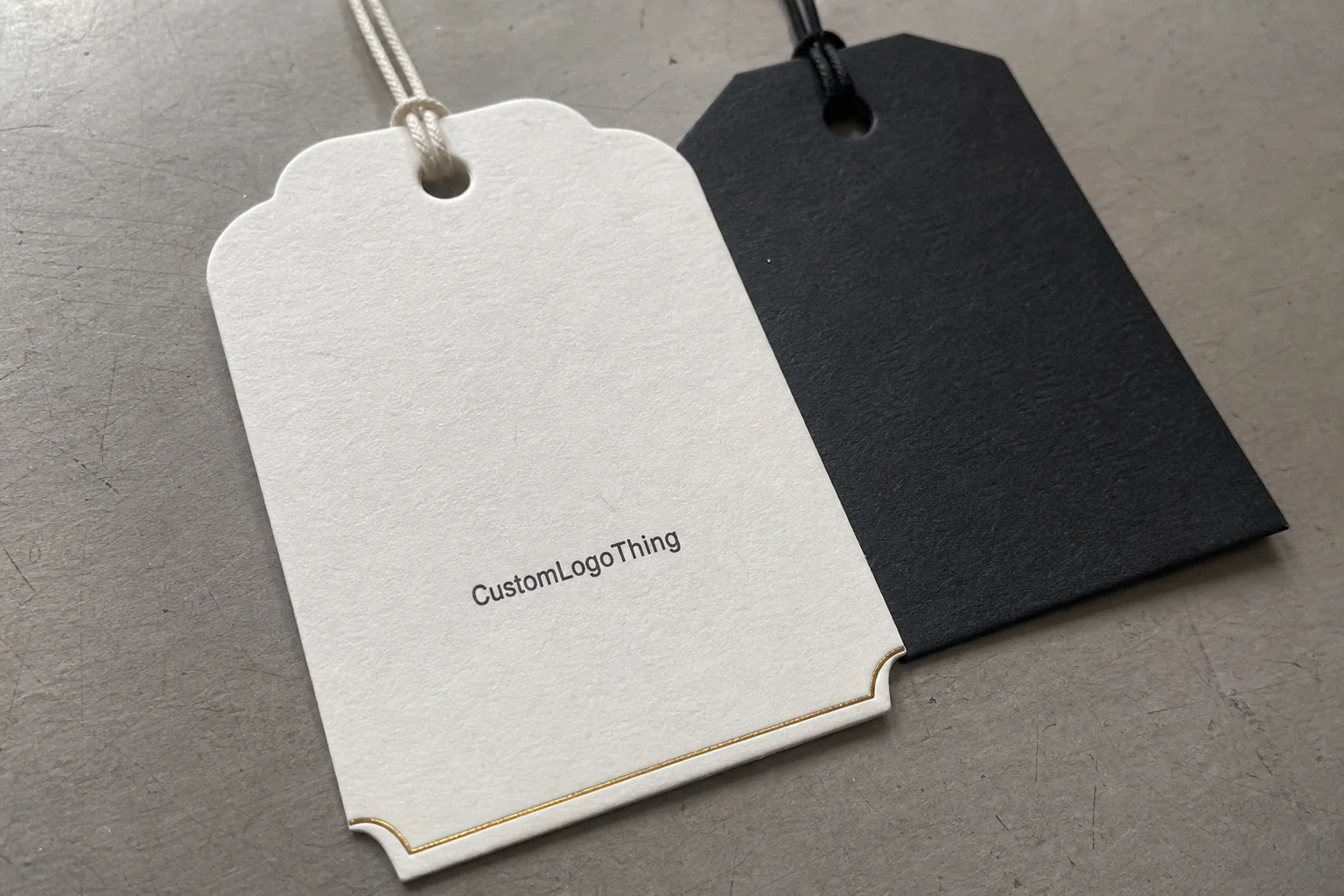
A real custom Clothing Hang Tags Supplier handles more than printing. The job usually starts with material sourcing and ends with finished tags packed and ready to ship. Depending on the order, that can include die cutting, hole punching, stringing, bundling, kitting, carton labeling, and final quality control.
Here is the practical difference: a printer produces the image on the stock. A broker sells the job but may not control the factory schedule. A manufacturing supplier manages the actual production steps and can usually give better answers on lead time, finishing options, and quality tolerances. For brands ordering Custom Labels & Tags, that distinction matters because the real risk is not the quote. It is the gap between the quote and the finished piece.
Hang tags also affect perceived value. A shirt in a plain polybag can still feel elevated if the tag has a crisp matte finish, thick board, and a clean string attachment. On the other hand, a good sweater with a bent, smudged tag looks unfinished. Buyers may not name the problem, but they notice it.
“Most buyers think they are ordering a tag. What they are really ordering is a first impression that has to survive freight, unpacking, and a retail shelf.”
Some suppliers also help with common apparel tag content like barcode placement, country-of-origin text, fiber content, and SKU organization. That does not replace legal review, but it does mean the supplier should understand what normally belongs on the tag and what belongs elsewhere.
How the tag production process and timeline work
The order flow is usually straightforward: Request a Quote, review artwork and specs, approve a proof, then production starts, followed by finishing, packing, and shipping. Delays usually come from unclear dielines, missing file specs, or last-minute changes after proof approval.
A typical simple printed hang tag order often takes about 8-12 business days after artwork approval. Specialty finishes like foil stamping, embossing, spot UV, or soft-touch lamination usually take 12-18 business days. Fully assembled looped tags, especially with custom stringing or kitting, can stretch to 15-22 business days depending on volume and queue time.
Rush orders exist, but they usually cost more and leave less room for proof changes, drying time, and packing checks. If your launch is tied to a seasonal drop, build in a buffer of at least one extra week. Reorders should be placed before inventory gets tight, not after the last carton is opened.
A supplier that knows what it is doing will ask for the essentials right away:
- Tag size and shape
- Quantity
- Stock type and thickness
- Print sides
- Finish
- Stringing or no stringing
- Destination and shipping method
If the supplier does not ask those questions, that is a clue. Not a good one.
Another useful question is whether the quote includes prepress correction. Some teams can clean files and adjust dielines for minor issues, while others expect artwork to be production-ready before they touch it. That difference matters when a launch deadline is already tight.
Custom clothing hang tags supplier pricing: what changes the quote
Pricing usually comes down to quantity, stock, print coverage, finishing, and assembly. The bigger the run, the lower the unit cost. Small runs carry setup costs across fewer pieces, which is why 500 tags can cost surprisingly close to 1,000 in some specs.
For a rough range, simple custom Printed Hang Tags on standard cardstock might land around $0.14-$0.28 per unit at 5,000 pieces. Add foil, embossing, custom shapes, or stringing and you can move into $0.30-$0.75 per unit or more. Premium retail tags with specialty paper, multi-step finishing, and assembly can go beyond that.
MOQ matters too. Minimum order quantity is how a supplier spreads setup time, plate costs, and material prep across the job. If you need a small trial run, ask for low-MOQ options, but be ready to pay more per piece.
| Order type | Typical specs | Approx. unit price | Best for |
|---|---|---|---|
| Economy printed tag | 300-400gsm stock, 1-2 colors, no special finish | $0.10-$0.20 | Basic launches, high-volume basics |
| Mid-range retail tag | 350-450gsm stock, full color, matte or gloss coating | $0.18-$0.40 | Most apparel brands |
| Premium branded tag | Thicker board, foil, embossing, soft-touch, stringing | $0.35-$0.80+ | Luxury, fashion, elevated packaging design |
Shape complexity changes cost too. A square tag with rounded corners is easy. A custom die-cut shape with a neck notch or layered cutout takes more setup and often adds waste. Ask for tiered quotes at 500, 1,000, 3,000, and 5,000 units to see where savings begin.
Also ask what is included. Some suppliers quote the tag only. Others include hole punching, stringing, or packing by bundle. Those differences can make a low quote look attractive until the extras show up later. Compare total landed cost, not just unit price.
Freight can change the picture quickly. A low unit price on the invoice can become expensive once cartons are sized, shipped, and delivered to multiple fulfillment points. For that reason, a quote should always be read alongside carton count, packing method, and destination.
Specs that matter before you approve artwork
This is where a lot of orders go sideways. The artwork may look great on screen and still print badly if the specs are off. Before you approve anything, confirm size, stock thickness, finish, print sides, corner style, and hole size.
Material choice changes feel immediately. A 300gsm tag can work for basics, but many apparel brands prefer 350gsm to 450gsm for a more premium hand feel. Matte stock looks understated and photography-friendly. Gloss adds shine but can reflect light and make text harder to read. Soft-touch lamination feels upscale, though it costs more and can affect how some inks and foil details hold up.
Artwork setup matters as much as the stock. Use the correct color mode, set bleed properly, and keep text inside the safe area. If your supplier gives you a dieline, use it. Vector files like AI, EPS, or print-ready PDF usually work best, while low-resolution JPEGs can cause blurry edges or fuzzy small type. The barcode should remain readable and the legal copy legible.
Useful finish choices include:
- Matte coating for a clean, modern look
- Gloss coating for brighter color and slicker presentation
- Soft-touch lamination for a premium tactile feel
- Foil stamping for logos, marks, or accents
- Embossing/debossing for texture and depth
- Edge painting for high-end fashion presentation
Use those effects with restraint. A tag does not need every finish available. It needs the right one for the brand and the garment price point. A $28 tee does not need the same treatment as a luxury coat.
Also think about content hierarchy. The logo should not have to compete with care instructions, SKU numbers, social handles, and size info all at the same weight. Good branded packaging is clear before it is decorative. If the buyer cannot find the price or barcode fast, the tag is failing a basic retail job.
For apparel in particular, check how the tag will behave after folding, stapling, or stringing. A finish that looks excellent flat may crack at the fold line or rub on edges once handled repeatedly. That is one reason physical samples are more useful than mockups alone.
How to choose the right supplier without getting burned
A decent supplier should be able to answer five questions quickly: what materials do you offer, what is your proofing process, can I see samples, how fast can you turn the order, and what happens if there is a defect? If those answers are fuzzy, keep shopping.
Domestic and overseas production each have tradeoffs. Domestic suppliers often offer faster communication, shorter shipping, and easier revision handling. Overseas suppliers can bring lower unit costs, especially on larger runs, but shipping time, customs, and revision cycles are usually less forgiving. The right choice depends on timeline, order size, and how sensitive your brand is to print variation.
Samples matter more than polished sales language. A sample tells you how the board feels, how sharp the print is, whether the hole tears, and whether the finish behaves under handling. If a supplier will not show samples or recent production photos, that is not a great sign.
Red flags are easy to spot if you slow down for a moment:
- Vague quotes with no material spec
- No dieline guidance
- Promises that sound too fast for the finish level
- No clear reprint policy
- Hidden charges for stringing, hole punching, or kitting
- Zero mention of proof approval before production
Compare suppliers on total landed cost. That means production, assembly, packaging, freight, and any import fees. A cheap unit price can lose once shipping or rework enters the picture. For brands building a wider assortment, it helps to compare hang tags with other Custom Packaging Products so the whole shelf story stays consistent.
If you want a sanity check on materials and sustainability language, the EPA sustainable materials guidance is a useful reference point.
On larger runs, ask how the supplier inspects color consistency from the first sheet to the last carton. Small shade shifts are easy to miss until the tags are stacked beside a garment and the difference becomes obvious.
Common mistakes when ordering custom hang tags
The first mistake is ordering too late. Complex print work takes setup, proofing, drying, cutting, and packing time. If your campaign date is fixed, plan backward instead of hoping production will compress itself.
The second mistake is picking stock based on a screen image. Paperboard that looks elegant online can fold badly, smudge under handling, or feel too thin once it is tied to a garment. Ask for a sample pack and hold it next to the actual product.
Third, hole placement gets ignored more often than it should. If the hole sits too close to the edge, the tag can tear. If it sits too low, the tag may cover size labels or hang awkwardly. String length matters too.
Fourth, too much text kills the design. Buyers sometimes cram in brand story, barcode, care instructions, legal copy, QR codes, and half a paragraph of marketing copy on one small tag. That is not brand storytelling. That is a readability problem.
Fifth, skipping a physical proof is expensive. Monitor the color, finish, and scale before the full run. On screen, soft-touch and matte can look close enough to ignore. In hand, they can feel completely different.
“The cheapest mistake is the one you catch on a proof. The most expensive one is the tag carton you open two days before launch.”
Another mistake is assuming the same tag will work for every SKU. A heavyweight coat, a cotton tee, and a gift set may need different proportions or attachment methods. Reusing one tag design across everything can look tidy in a spreadsheet and awkward in person.
Next steps to get an accurate quote and cleaner result
To get a clean quote from a custom clothing hang tags supplier, send the basics in one message: size, quantity, stock preference, print sides, finish, artwork file, and whether you need stringing or kitting. If you already know the use case, say so. A tag for boutique retail is not the same as a tag for wholesale basics.
Ask for a sample pack or similar past work before committing to a full run. Then ask for the timeline in writing, including proof approval, production, and shipping window. If the supplier cannot give a clear schedule, that is a warning label disguised as a sales reply.
Confirm packing details too. Will the tags be bulk packed or bundled? How many per carton? Will each carton be labeled by style, color, or SKU? If you are sending to multiple locations, that part matters more than people think.
For brands building a broader line, hang tags should match the rest of the retail packaging system. That includes boxes, inserts, mailers, and any label set used across the product range. Consistency makes the brand look organized.
Choose the supplier that gives you the best mix of material quality, proof control, pricing transparency, and timeline reliability. If one quote is cheaper but vague, that is not a bargain. It is a future problem. If you want a cleaner result, ask better questions before you order.
For most apparel teams, the smartest approach is to order a small sample run before scaling up. That gives you a chance to check print sharpness, hole durability, and finish quality without committing the full budget to a spec that only works on paper.
What should I ask a custom clothing hang tags supplier before ordering?
Ask about MOQ, turnaround time, available materials, finishes, and proofing steps. Also confirm whether stringing, hole punching, and kitting are included or charged separately. If possible, request a sample or photos of recent production work before you approve the order.
How much do custom clothing hang tags usually cost?
Price depends on quantity, stock, size, print colors, and finishing. Simple tags cost less per piece at higher volumes, while premium finishes raise the unit cost. A tiered quote at several quantities is the best way to see where savings actually start.
What is a normal turnaround time for custom clothing hang tags?
Simple jobs can be completed faster, while complex finishes and assembly take longer. Proof approval time also affects the schedule, so fast replies help. Rush service is possible with some suppliers, but it usually costs more and gives less margin for error.
What file format do I need for hang tag artwork?
Vector files like AI, EPS, or print-ready PDF are usually best for clean printing. Images should be high resolution, with bleed and safe margins set correctly. If you are using a custom shape, ask the supplier for a dieline before you start designing.
Can I order small quantities from a custom clothing hang tags supplier?
Yes, but small runs usually have a higher unit cost because setup is spread across fewer tags. Some suppliers offer low-MOQ options for launch tests or seasonal drops. If budget matters, compare the cost of a small premium run versus a larger standard run before deciding.


