Buyer Fit Snapshot
| Best fit | Custom Clothing Hang Tags Supplier projects where brand print, material claims, artwork control, MOQ, and repeat-order consistency need to be specified before quoting. |
|---|---|
| Quote inputs | Share finished size, material target, print colors, finish, packing count, annual reorder estimate, ship-to region, and any compliance wording. |
| Proofing check | Approve dieline scale, logo placement, barcode or warning zones, color tolerance, closure strength, and carton packing before bulk production. |
| Main risk | Vague material claims, crowded artwork, missing packing details, or unclear freight terms can make a low unit price expensive after revisions. |
Fast answer: Custom Clothing Hang Tags Supplier: Pricing and Process should be specified like a repeatable production item. The safest quote records material, print method, finish, artwork proof, packing count, and reorder notes in one written spec.
Production checks before approval
Compare the actual filled-product size with the drawing, then confirm tolerance on folds, seals, hang holes, label areas, and retail display edges. Reserve space for logos, QR codes, warning copy, and material claims before decorative graphics fill the panel.
Quote comparison points
Review material grade, print process, finish, sampling route, tooling charges, carton quantity, and freight assumptions side by side. A quote is only useful when the supplier can repeat the same color, closure quality, and packing count on the next order.
Custom Clothing Hang Tags Supplier: Pricing and Process
A custom clothing hang tags supplier does more than print a logo on card stock. It sets the first physical cue a shopper gets before a garment is worn, styled, or even unfolded fully. That cue is fast. Research on first impressions has been pointing to the same awkward truth for years: people decide a lot in a very short window, and packaging gets dragged into that judgment almost immediately.
From a buyer’s seat, the right custom clothing hang tags supplier behaves like a translator between brand intent and factory reality. Brand language goes in; print specs, paper choices, finishing methods, tolerances, and production limits come out in usable form. The best suppliers know where the idea looks lovely on a mood board and where it falls apart on press. They also know that a tag has to survive printing, stringing, bundling, shipping, and shelf handling without turning the job into a mess.
What a Custom Clothing Hang Tags Supplier Actually Does
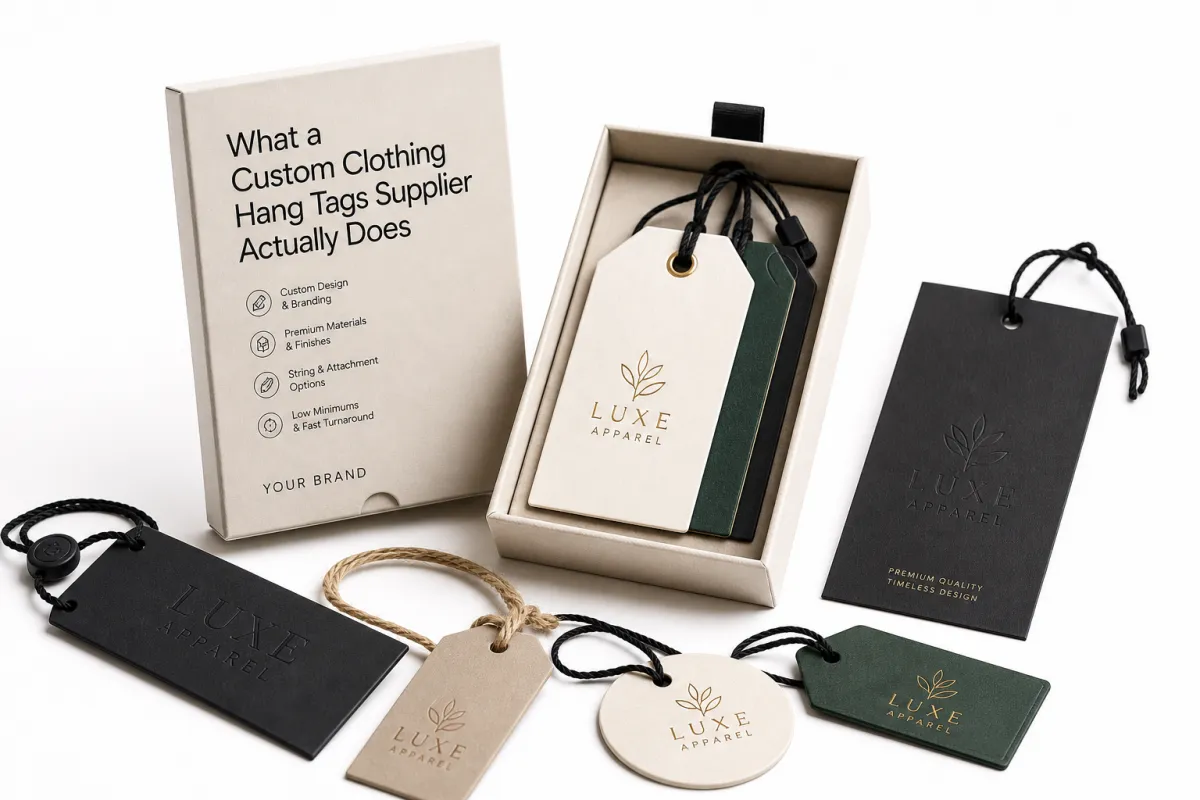
A custom clothing hang tags supplier sits at the junction of branding, print engineering, and apparel operations. The visible object is tiny: a tag tied to a shirt, jacket, dress, cap, or accessory. The invisible work is heavier. The tag may need to carry a logo, price, SKU, barcode, care statement, country of origin, material story, and sometimes a line of copy that explains why the garment costs what it costs. If those elements fight each other, the result looks cramped and forgettable. If they are arranged with discipline, the garment feels more credible before a customer even touches it.
That is why a good custom clothing hang tags supplier does not stop at “send the artwork.” It checks whether the requested size can hold the copy, whether the stock supports the finish, whether the barcode can still scan, and whether the trim tolerances make the layout realistic. A 2 x 3.5 inch tag can look roomy on a screen and then turn claustrophobic on press. Once a barcode, size callout, legal copy, and a logo lockup are all squeezed in, the design can start to gasp for air.
I have seen this happen more than once in review meetings. The buyer swears the layout looked fine in PDF form, and technically it did. Then the printed sample lands on the table and the “premium” tag reads like a coupon. That gap between expectation and output is where a strong supplier earns its keep.
A hang tag is often the first piece of branded packaging a shopper touches directly. It sits in the same family as packaging design, only smaller and more exposed. A tag that curls, prints muddy blacks, or feels flimsy can make a garment look lower in quality than it really is. A tag with crisp edges, balanced typography, and a finish that feels intentional does the opposite. It suggests care, and care travels farther than most buyers expect.
A strong custom clothing hang tags supplier also keeps the whole presentation system in view. Hang tags should not clash with Custom Labels & Tags, and they should sit naturally beside Custom Packaging Products such as tissue, inserts, mailers, and boxes. Customers rarely encounter one touchpoint in isolation. They read the package as a sequence. The tag is one sentence in that sequence, and a bad sentence can pull the paragraph off course.
Custom printed boxes, garment labels, tissue, and hang tags all work together whether the brand planned that harmony or not. When the color palette drifts, the type weights disagree, or the finishes feel unrelated, the package looks assembled rather than designed. A thoughtful custom clothing hang tags supplier helps prevent that by recommending stock, print method, hole placement, and finish options that support the rest of the packaging system.
A hang tag is small enough to ignore and important enough to distort perception. Buyers notice the feel in the hand, the clarity of the information, and the gap between what the tag promises and what the garment delivers.
That practical role is why a custom clothing hang tags supplier should be judged on judgment, not just output. Can the supplier protect barcode scanability? Can it recommend heavier board for outerwear and a lighter stock for fast-turn basics? Can it explain why matte uncoated paper behaves differently from coated paper under dense ink coverage? Those questions sound technical because they are. They affect both the buying process and the final retail impression.
How a Custom Clothing Hang Tags Supplier Works From Brief to Box
The work starts with the brief, and a good custom clothing hang tags supplier asks better questions than most buyers expect. What garment is this for? What price tier does it live in? Is the tag for a premium launch or a replenishment order? How many sizes, SKUs, or barcode versions are needed? The answers shape layout, stock, and finishing long before a proof ever appears.
Artwork review comes next. A capable custom clothing hang tags supplier will check resolution, bleed, dielines, safe zones, and color setup. Raster images should be 300 dpi or better. Vector logos are safer for clean edges. Bleed usually needs at least 1/8 inch because trim variation and Custom Die Cuts leave almost no room for guesswork. If variable data is part of the order, the supplier should explain how the information merges and what proofing format applies to each SKU.
Material selection is where many orders succeed or fail. A good custom clothing hang tags supplier should speak plainly about coated paperboard, kraft stock, premium textured board, and synthetic options. A 14pt or 16pt coated stock works well for sharp, high-contrast graphics. Kraft stock brings a natural, recycled look that fits heritage and outdoor brands. Textured board adds tactility and often reads as more upscale in the hand. Synthetic stock can be useful when moisture resistance or unusual durability matters, though it is not the right answer for every apparel line.
Finishing choices sit on top of that decision. A custom clothing hang tags supplier may suggest spot UV for contrast, foil for a premium signal, embossing for tactile depth, or simple matte lamination when restraint matters more than shine. Stringing, eyelets, drilled holes, perforation, rounded corners, and kitting all add labor. Those details need to be discussed early, because they alter both cost and turnaround. For some brands, the tag becomes a compact piece of product packaging that has to carry the launch look with real precision.
The best suppliers also know when to push back. A special shape can be memorable, but custom silhouettes often raise die cost, waste, and trimming labor. Foil can look sharp, but on a low-margin basic it can erase too much margin. The strongest custom clothing hang tags supplier explains those tradeoffs in plain English instead of hiding behind production jargon. That kind of honesty saves money and reduces rework.
Sustainability questions belong in the conversation too. FSC-certified paper can support fiber traceability, but certification depends on the paper mill and the chain of custody. Ask for documentation if that claim matters to your brand. The FSC site is a practical reference if your team wants to understand the certification framework without the marketing fog. When tags travel with broader retail packaging or folded apparel kits, transit resilience matters as well. The ISTA resource library is useful for buyers who want to understand packaging test logic even when the tag itself is not the item being tested.
And yes, some of this sounds a little fussy. It is kinda fussy. That is the point. The details are what keep a reprint from eating half your week.
Key Factors That Shape Pricing
Pricing from a custom clothing hang tags supplier is usually easier to decode than buyers expect once the cost drivers are visible. Quantity matters most. Setup, proofing, plate work, and die cutting create fixed costs, so unit price drops sharply as volume rises. A 1,000-piece run can cost two to four times more per unit than a 5,000- or 10,000-piece run, even when the design stays identical.
Stock thickness and finishing complexity come next. A custom clothing hang tags supplier will price a simple single-sided tag on 14pt coated board very differently from a soft-touch, foil-stamped, double-sided tag on heavy textured stock. In practice, a prototype or short run often lands around $0.18-$0.55 per unit, while larger production quantities may fall into the $0.04-$0.18 range depending on artwork and finish. That spread is not random. It reflects how setup costs get absorbed across more pieces.
Shape matters more than some buyers realize. A standard rectangle with rounded corners is efficient. A custom silhouette looks distinctive, but it adds die and trim complexity. If the shape is unusual, a custom clothing hang tags supplier may need to quote new tooling, which can add a setup fee of $60-$250 or more. On a premium collection that might be justified. On an everyday line, the extra spend may do little except burn margin.
Here is a practical comparison many packaging buyers use during sourcing. The exact numbers vary by region, paper market, and finishing load, but the structure of pricing tends to follow the same pattern:
| Option | Typical Spec | 1,000 Units | 5,000 Units | Best Use Case |
|---|---|---|---|---|
| Standard coated tag | 14pt-16pt, full color, drilled hole | $0.18-$0.38 each | $0.05-$0.12 each | Core basics, fast replenishment |
| Kraft / natural tag | Heavy kraft board, one or two inks | $0.20-$0.45 each | $0.06-$0.14 each | Eco-led, heritage, outdoor branding |
| Premium textured tag | Textured stock, spot UV or foil | $0.30-$0.75 each | $0.09-$0.26 each | Premium apparel, gifting, launch collections |
| Special shape tag | Custom dieline, custom silhouette | $0.28-$0.80 each | $0.10-$0.30 each | Distinctive branding, limited editions |
Turnaround time also Changes the Quote. A custom clothing hang tags supplier may charge more for rush jobs because the plant has to reshuffle production, pull materials earlier, or expedite shipping. A standard run may take 10-15 business days after proof approval. A rush order might compress that to 5-7 business days, but the premium can move quickly. Sometimes the difference is manageable. Sometimes it wipes out the margin the buyer thought they had.
Hidden costs deserve attention too. A custom clothing hang tags supplier may charge for digital proofs, physical samples, variable-data processing, stringing, bundling, split shipments, or extra proof rounds if artwork changes late in the process. Buyers often compare headline unit prices and miss those extras. That is how a quote that looks attractive at first becomes the expensive one once the final invoice lands.
Print coverage plays a role as well. Heavy ink on dark stock, dense solids, or metallic finishes may require additional passes or a different production method. A custom clothing hang tags supplier should explain whether the quote assumes one-sided or two-sided printing, whether white ink is involved, and whether the barcode needs a no-print zone. Those details sound minor until they alter setup time and labor.
If the line also uses custom printed boxes or shelf-ready inserts, think of the hang tag as part of the same cost map. Strong packaging design is not only about visual polish. It is about deciding where money changes the customer experience and where simpler choices do the job just as well. A good supplier can help protect budget without flattening the brand.
What Should You Ask a Custom Clothing Hang Tags Supplier Before Approving a Quote?
Ask for the parts of the quote that most buyers skip. A careful custom clothing hang tags supplier should be able to break out setup charges, proofing, finishing, stringing, packaging, and freight so you can see what is driving the total. If those costs are hidden in one lump sum, comparison shopping gets muddy fast.
Then ask what the quote assumes. Is the stock coated or uncoated? Is the tag single-sided or double-sided? Are barcode checks included? Does the price cover a standard rectangular dieline, or is a custom silhouette being priced separately? A reliable custom clothing hang tags supplier should answer those questions in plain language, not with a wall of production terms.
A useful final question is simple: what would change the quote the most? If the answer is quantity, finish, or turnaround, that tells you where the control points are. If the answer is unclear, the supplier may not have fully mapped the job yet. That is the kind of transparency that separates a dependable partner from a quote generator.
Step-by-Step Guide to Choosing the Right Supplier
The cleanest way to compare a custom clothing hang tags supplier is to begin with a tight brief. Include garment type, target audience, quantity, size, finish preference, barcode needs, and ship date. A premium blazer should not be spec’d like a promotional T-shirt tag. A seasonal capsule should be planned around launch windows, not wishful thinking or loose assumptions about lead times.
Once the brief is set, ask for side-by-side quotes using identical specs. A reliable custom clothing hang tags supplier should be able to price the same size, stock, finish, hole style, and quantity as a competitor. If one quote comes in lower, ask what changed. Sometimes the answer is ordinary: a simpler stock, fewer proof rounds, lighter paper. Other times a necessary step was quietly removed, such as bundling the tags or checking barcode scans before shipment.
Samples are worth the wait. A sample pack tells you more than a price list ever will. Compare paper feel, edge quality, ink density, and how the finish catches light. A good custom clothing hang tags supplier should be willing to show a digital mock-up and, for larger orders or premium projects, a physical sample so you can judge actual texture. Buyers in retail packaging know the difference instinctively: a photo flatters, a sample reveals.
A simple scorecard helps keep the comparison honest. One practical way to rate a custom clothing hang tags supplier is by communication speed, prepress guidance, production capability, and consistency. A supplier that replies in an hour but sends a sloppy proof is not better than one that replies in a day and catches a barcode issue before print starts. Speed matters. Accuracy matters more.
Here is a useful scorecard approach for buyers:
- Communication: Do replies arrive quickly, and do they answer the actual question?
- Prepress support: Does the supplier check bleed, dielines, font outlines, and barcode legibility?
- Production fit: Can the plant handle the stock, finish, quantity, and shape you need?
- Consistency: Do color and trim quality hold across reruns?
- Commercial clarity: Are setup charges, shipping, and packaging fees clear up front?
Category fit matters too. A custom clothing hang tags supplier that serves luxury fashion may not be the best match for price-sensitive basics, and the reverse is just as true. The right partner should align with your brand tone. For one line, that means a heavy textured board and restrained foil. For another, it means a clean, direct tag with strong scannability and a lower unit price. The best supplier can handle both logics without mixing them together.
One final test is revealing: ask what the supplier would change if the budget had to drop by 15%. A capable custom clothing hang tags supplier knows which details carry the most value. It might suggest a standard dieline, a different board, or one fewer print pass instead of removing the brand cues that actually support the sale. That answer usually separates production experience from sales talk.
Custom Clothing Hang Tags Supplier Timeline: Quote to Delivery
A realistic timeline begins with the quote request. A responsive custom clothing hang tags supplier can often return a basic estimate within one business day if the brief is complete. Orders with variable data, unusual finishing, or a custom dieline take longer because the supplier has to check tooling, material availability, and production sequence before numbers are locked in.
The proof stage matters more than most buyers expect. A custom clothing hang tags supplier should send a digital proof showing size, copy placement, cut lines, and color intent. If a physical proof is needed, that adds days. The risk is not the proof itself. The real delay comes from uncertainty and repeated revisions. When buyers keep shifting small details - barcode size, hole placement, copy order, finish choice - the calendar slips by days, sometimes a full week.
For straightforward jobs, a custom clothing hang tags supplier may move from approval to production in 5-10 business days. Premium finishes, custom silhouettes, or mixed-SKU variable data can stretch that to 12-18 business days. Shipping adds another layer. Domestic transit may take 1-5 business days depending on distance and service level. International shipping can take longer, and customs clearance can turn a simple tag order into a much bigger administrative event than anyone planned for.
Seasonal planning changes the math. A custom clothing hang tags supplier can only work as fast as the approved files allow. If the tags support a launch date, the buyer should count backward from the on-sale date, not forward from the quote date. That means making room for revisions, file cleanup, material selection, proof approval, and the possibility of reprint. The best teams build a buffer because missing a retail window usually costs more than a rush fee ever will.
Here is a simple stage-by-stage model many brands use:
- Inquiry: Share the brief, files, and quantity target.
- Quote: Compare price, setup, stock, and finish assumptions.
- Prepress: Fix bleed, artwork, barcodes, and dieline alignment.
- Proof approval: Sign off on the final layout and color direction.
- Production: Print, cut, finish, and inspect.
- Packing: Bundle, string, kit, or box the tags for shipment.
- Delivery: Receive and check the finished run against the approved proof.
If the tags are being sent with garments to a distributor or retail center, the supplier should understand the receiving environment. A custom clothing hang tags supplier that knows pack-out logic can help avoid bent corners, mixed SKUs, or loose bundles that slow the receiving team. It sounds small. In a warehouse, that small issue can become a pile of labor.
For traceability-heavy programs, ask whether the supplier keeps a clean record of proof versions, color approvals, and lot information. A good custom clothing hang tags supplier should be able to explain how the job is tracked from approval to box. That record becomes useful later if the brand needs to reorder and wants to match the earlier run closely.
Common Mistakes When Working With a Supplier
The most common error is starting with incomplete artwork. A custom clothing hang tags supplier can do a lot, but it cannot rescue a file with low-resolution imagery, missing fonts, or no bleed. A logo pulled from a website may look acceptable in a browser and fall apart in print. Barcode art pasted into a layout may scan poorly if the quiet zone is too tight. Those problems are avoidable, and they are expensive once they reach production.
Another frequent mistake is taking the lowest quote without checking the specification line by line. A custom clothing hang tags supplier may quote less because the stock is thinner, the finish is simpler, or the quote excludes stringing and packaging. That does not make the quote bad. It does make the comparison incomplete if the buyer assumes every line item matches. Price only means something when material, finish, delivery expectation, and service level are the same.
Vague instructions create another layer of trouble. A custom clothing hang tags supplier needs exact dimensions, hole location, drill size, string length, and any special copy requirements. “Make it premium” is not a production spec. “Use a 16pt matte stock with soft-touch lamination, a drilled 1/8 inch hole, black cotton string, and one spot UV logo hit” is a spec. Precision narrows the room for mismatch.
Late approval is one of the costliest habits. A custom clothing hang tags supplier can usually absorb minor changes early in the process, but not after plates, dies, or print setup are locked. Buyers sometimes wait for internal consensus on tiny copy changes and then discover the ship date has slipped into rush territory. That is avoidable. Structural decisions should come first - size, stock, finish, barcode treatment - and wording should be finalized after the framework is set.
There is also a habit of ignoring how the tag sits within the rest of the package. If the hang tag is glossy and loud while the mailer, tissue, and insert are earthy and understated, the brand story breaks apart. A good custom clothing hang tags supplier will help align the tag with the broader package branding system so the customer sees one coherent presentation from shipping carton to shelf.
One practical warning: not every supplier brings the same level of prepress discipline. Some catch a barcode issue immediately. Others print exactly what they receive. A careful custom clothing hang tags supplier should be willing to question a bad file instead of silently accepting it. That habit protects both sides of the order.
For Brands That Sell through multiple channels, consistency matters even more. A tag used in wholesale should still feel like part of the same visual family as direct-to-consumer product packaging. That continuity keeps the brand legible and reduces the chance that a shopper feels as if the channels belong to different companies.
Expert Tips and Next Steps for Your First Order
The easiest way to get better results from a custom clothing hang tags supplier is to arrive organized. Prepare a quote sheet that lists your top three tag sizes, the expected quantity for each, the preferred stock, any finish preferences, and the required ship date. If you can include a rough budget target, even better. That gives the supplier a boundary and reduces the odds of being quoted across every possible material under the sun.
Ask for three things before approving a full run: a sample, a digital proof, and a production estimate that breaks the timeline into stages. A solid custom clothing hang tags supplier should welcome that request, not resist it. Those three items show whether the supplier understands the real job or only knows how to generate a number. For many buyers, that is the difference between a controlled launch and a last-minute scramble.
I also recommend building a vendor checklist. Rate each custom clothing hang tags supplier on responsiveness, pricing clarity, prepress support, material guidance, and delivery reliability. A supplier that scores well on the first email usually stays organized later. One that replies slowly, asks the same question twice, or sends vague proof notes tends to create friction during the time-sensitive parts of the order.
If your brand is still shaping its visual system, connect the tag work to the wider packaging plan. Think about the finish on the tag, the feel of the tissue, the structure of the box, and the tone of the insert as one combined experience. A supplier that understands custom printed boxes, branded packaging, and apparel presentation can help prevent visual drift across channels. That becomes especially useful for brands moving from simple garment labeling into more layered package branding.
One practical comparison helps here. If the garment is a lower-margin core item, a clean coated tag with strong typography may be the right answer. If the garment sits in a premium tier, the tag can justify a heavier stock, a tactile finish, or a small foil detail. A good custom clothing hang tags supplier will not push the same solution on every buyer. It should match the tag to the product, the margin, and the customer expectation.
From a buying perspective, the next step is simple: gather specs, compare two or three suppliers, and ask each one to explain the price difference in plain language. If one quote is higher, find out whether it includes better stock, better proofing, better packaging, or a faster lead time. If one quote is lower, make sure nothing essential disappeared from the quote. That is how a buyer chooses the right custom clothing hang tags supplier with confidence rather than hope.
For brands building a fuller system, the tag should also fit the rest of the presentation. It should echo the logic of Custom Labels & Tags, support the look of Custom Packaging Products, and sit naturally alongside the garment itself. That alignment makes the whole line feel more deliberate, and that is often what customers read as quality.
My blunt advice: do not treat the hang tag as a tiny afterthought. A thoughtful custom clothing hang tags supplier can protect your budget, keep your launch on schedule, and help your retail presentation feel coherent. The tag is small. The effect is not.
If you are making a first-order decision, lock the specs before chasing price. Size, stock, finish, barcode treatment, and pack-out method should be fixed first; then compare quotes against the same target. That one habit prevents most surprises and gives you a cleaner answer than any discount alone ever could.
FAQs
How do I compare a custom clothing hang tags supplier's quotes?
Compare the same exact specs: size, stock, print colors, finish, quantity, and delivery date. Then check whether the quote includes proofing, setup, stringing, packaging, and shipping. A custom clothing hang tags supplier can look cheaper on paper and still cost more once the missing pieces are added back in.
What should I send to a custom clothing hang tags supplier for an accurate quote?
Send your logo files, tag size or rough dimensions, quantity, finish preferences, and any barcode or care-copy needs. Include garment type and brand positioning so the custom clothing hang tags supplier can recommend the right stock and finish. If you have a budget target, share it early so the quote is grounded in reality instead of guesswork.
How long does a custom clothing hang tags supplier usually take?
Standard jobs are usually faster than custom shapes, premium finishes, or variable-data orders. Artwork approval is often the biggest variable, so incomplete files can add days to the schedule. Ask the custom clothing hang tags supplier for a stage-by-stage timeline so you know when proof approval, production, and shipping will happen.
What affects hang tag pricing the most with a supplier?
Quantity, material thickness, and finish complexity usually have the biggest impact on unit cost. Faster turnaround, special shapes, foil, embossing, or spot UV can increase the price quickly. A custom clothing hang tags supplier can often lower pricing by reusing the same dieline and keeping the color build simpler.
Can a custom clothing hang tags supplier help if I only have a logo?
Yes, many suppliers can build the layout, recommend sizes, and guide you through print-ready setup. They should help you choose stock, finishes, and tag structure based on the garment and brand tone. Bring your logo, copy, and examples you like so the custom clothing hang tags supplier can turn a basic idea into a workable spec.
The right custom clothing hang tags supplier should make the process feel controlled, not confusing. If you choose carefully, you get clearer pricing, better finishing, fewer surprises, and a hang tag that supports the garment instead of competing with it. For any brand that treats presentation seriously, the most useful next step is to freeze the specs, request a sample or proof, and compare quotes on the same terms. That is where the real savings start.

