Custom Clothing Labels for ecommerce brands do more than sit inside a neckline or along a side seam. They shape how the garment feels in hand, how complete the product looks in photos, and how confidently a customer reads the brand after the box has already been opened. For an online brand, that matters because the customer is making value judgments without the benefit of a fitting room, a sales associate, or a close inspection of the fabric before purchase.
The label is one of the few physical elements that stays with the product through shipping, unpacking, trying on, washing, and sometimes a return. That means it has to handle branding, size identification, care instructions, and compliance details without becoming itchy, bulky, or hard to read. A label that feels cheap can undercut a well-designed package system quickly, while a clean, well-built label can make a modest garment feel considered and finished.
If you want the label to support the rest of the packaging system, think like a production buyer instead of a designer-only reviewer. The spec has to work on the garment, fit the budget, and hold up under fulfillment and washing. If you need to see how labels sit alongside other packaging decisions, the Case Studies page is a useful reference point for comparing finishing approaches.
Custom clothing labels for ecommerce brands: what they actually change
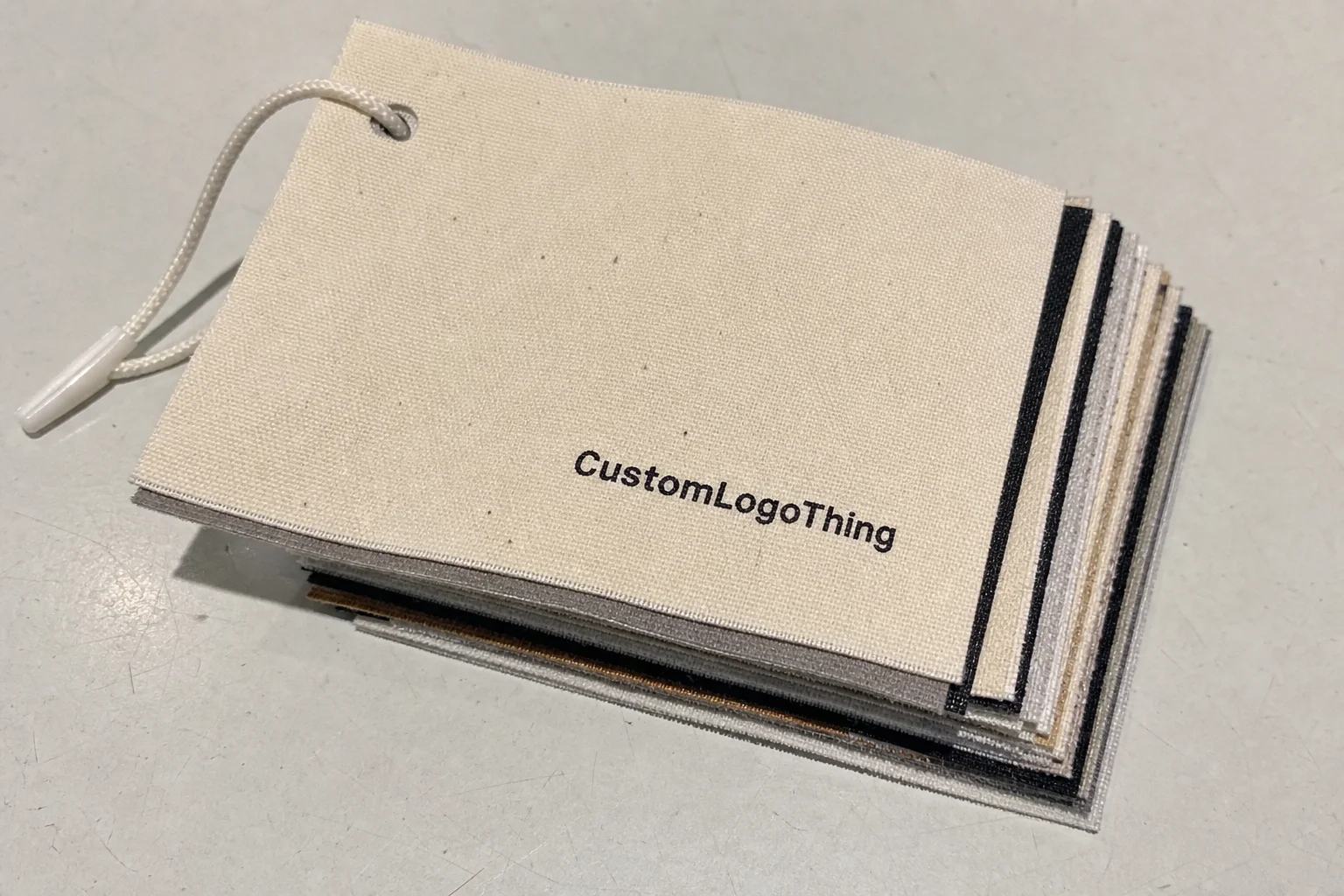
Most people notice a label only when it causes a problem. It scratches at the neck, twists after the first wash, or looks oddly generic on a garment that was supposed to feel premium. That is not a minor detail. For ecommerce, the label is part of the product experience, not an accessory to it.
It also carries more functional work than most buyers realize. A good label should help a warehouse team identify the SKU, help a customer find the size quickly, and give enough care information to reduce avoidable damage. In some markets, it also needs fiber content and country-of-origin information, which leaves very little room for sloppy copy or decorative clutter.
For smaller brands, label placement matters as much as the label type. A neck label on a heavyweight hoodie has different constraints than a side-seam label on a fitted tee or a waistband label on leggings. What feels harmless in a flat mockup can become a pressure point when it sits against skin, hits a seam allowance, or curls inside a narrow garment channel.
- Branding gives the garment identity and helps the item feel like part of a coherent line.
- Size identification keeps picking, packing, and customer use simple.
- Care instructions reduce returns caused by avoidable washing mistakes.
- Compliance details help the product meet market requirements without last-minute rewrites.
The best label spec is rarely the flashiest one. It is the one that matches the garment category and the way people actually wear it. Soft basics usually do better with tagless or low-profile label constructions. Outerwear can handle a more visible woven label. Activewear often needs a smooth finish because friction inside the garment becomes a complaint fast. Kidswear adds another layer: the label has to be readable for adults and comfortable enough not to irritate a child.
A label should disappear into the wearing experience unless the brand is intentionally making it part of the design language. If customers remember it because it scratched, peeled, or folded badly, the label failed its job.
That is why label selection should be tied to the garment and the packaging system together. If the box, tissue, insert, and label all speak the same visual language, the product feels coherent. If the box feels polished but the label feels flimsy, the brand looks inconsistent. For broader packaging support, Custom Labels & Tags are usually selected as part of the finishing stack, not in isolation.
Label types, materials, and finishes that matter most
Most ecommerce brands choose between woven labels, printed satin labels, cotton labels, and heat transfer labels. Each option solves a different problem, and each one has a tradeoff. The right answer depends on feel, durability, legibility, and how much information has to fit on a tiny surface.
Woven labels are the classic choice for a finished, durable look. They are common on premium basics, outerwear, and brand-first collections. Within woven labels, the weave itself matters. Damask is finer and better for small text or detailed logos. Taffeta is usually more economical and slightly less crisp in detail, which can be fine for simple marks or short brand names.
Printed satin labels are smoother and often easier to read when the care copy gets longer. They work well for lightweight garments, loungewear, and pieces where the priority is comfort against skin. The term “satin” here refers to the weave and finish, not silk. Most printed satin labels are polyester-based and can be very clear when the artwork is straightforward.
Cotton labels fit brands leaning into a natural, tactile, or heritage look. They can feel authentic, but they are not always the best choice for fine type or tiny symbols. Cotton also behaves differently in wash testing, so it should be checked in the same laundry conditions the garment will actually see, not an idealized lab setting.
Heat transfer labels are a strong option when a tagless interior is the goal. They are common in athletic wear, kidswear, and lightweight basics where a sewn-in label would be annoying. The caution here is application control. Press temperature, dwell time, pressure, and fabric compatibility all affect whether the transfer stays flat and legible. A good design can still fail if the application settings are off.
Fold style is a small decision with outsized impact. End folds make the label sit cleanly at an edge. Center folds work well when the label is sewn into a seam. Loop folds create more visible surface but demand tighter sewing control. If the fold choice does not match the garment construction, the label can pucker, twist, or show more bulk than intended.
| Label type | Look and feel | Durability | Typical unit price at 5,000 pcs | Best fit |
|---|---|---|---|---|
| Woven | Structured, tactile, premium | High | $0.12-$0.28 | Premium basics, outerwear, logo-first branding |
| Printed satin | Smooth, soft, easy to read | Medium to high | $0.08-$0.20 | Care labels, loungewear, lightweight garments |
| Cotton | Natural, textured, understated | Medium | $0.10-$0.24 | Heritage brands, organic collections, softer retail looks |
| Heat transfer | Flat, tagless, minimal bulk | Medium to high, if applied correctly | $0.15-$0.35 | Athletic wear, kidswear, comfort-first basics |
Those numbers are only useful when the comparison is fair. A woven label with a custom fold, detailed artwork, and sewn finishing is not the same product as a flat printed strip with no finishing. Quotes often look close until one vendor includes setup, folding, inspection, and shipping while another leaves those items to appear later. The lower quote is not always the better one; sometimes it is just incomplete.
If sustainability language matters to your package system, verify claims before printing them on inserts or packaging. The FSC site is a straightforward reference for paper certification language if your boxes or inserts use certified stock. Label materials have their own sourcing questions, but the same rule applies: only print what you can document.
How the process and timeline actually work
The label process is usually simple enough to run well and detailed enough to go wrong if anyone assumes a mockup is the final answer. A normal workflow starts with artwork, moves to a proof, then sample approval, production, quality control, and shipping. The order of those steps matters. Skipping one almost always costs more later.
Artwork gaps are a common source of delay. Missing vector files, unclear placement notes, and vague copy all slow the job down. If the only direction is “make it look premium,” expect extra rounds of clarification. A usable brief includes the garment type, label purpose, size, fold style, quantity, target deadline, and any copy that needs to appear on the label. The more complete the brief, the fewer assumptions the supplier has to make.
Timelines vary by construction and by whether the order is a reorder or a new spec. A simple reorder can often move from proof approval to finished goods in about 5 to 10 business days if the vendor already has the construction on file. A first woven run commonly takes 12 to 18 business days after approval. Overseas production can run 15 to 30 business days before transit, depending on queue length, inspection timing, and whether the art needs revisions.
Samples matter because paper proofs do not reveal how a label behaves inside a garment. A sewn sample shows whether the edges scratch, whether the fold sits right, and whether small text is still readable after stitching. For heat transfer labels, the sample should be applied to the actual fabric, at the real press settings, before anyone approves the full run.
Quality control should be practical rather than ceremonial. Check finished width and length against the approved spec. Pull random pieces from the run and inspect weave consistency, print registration, color match, and edge finish. For sewn labels, confirm that stitch lines do not eat into the logo. For transfers, check adhesion after the first wash and again after a dry cycle. If the label is going to be packed with retail inserts or folded tightly for fulfillment, confirm that it does not curl or telegraph through the garment.
If your products move through a distribution center, carton labeling and count accuracy matter too. Receiving teams need clear style separation, not a mixed box of unlabeled components. If your labels arrive sorted by size or color, specify that in the order. It prevents downstream sorting work that no one budgeted for.
Domestic sourcing can be the right choice when the launch date is fixed and the calendar leaves no room for transit risk. Overseas sourcing often wins on unit price at larger volumes, but the communication loop is longer and the revision cycle can be slower. The right decision is usually not about ideology. It is about which option protects the launch window, cash flow, and inventory plan for that specific SKU.
Custom clothing label cost, MOQ, and unit price tradeoffs
Label pricing changes with material, size, color count, fold style, artwork complexity, and quantity. That sounds basic, but it is the reason two quotes for “the same label” can land far apart. One may include all the production steps, while the other omits the costs that show up later as setup, handling, or freight.
MOQ, or minimum order quantity, has the biggest effect on unit price. Small runs carry higher per-label cost because setup gets spread across fewer pieces. An order of 500 labels will almost always cost more per unit than an order of 5,000 or 10,000. That is normal production math, not a trick.
Many vendors also charge a setup fee or plate fee, often in the range of $25 to $100, with more complex artwork or multi-color woven builds going higher. A short repeat order can be cheap on the surface and still become expensive once shipping and handling are added. Comparing only the unit label price hides the real cost.
The more useful metric is landed unit cost. That includes the label price, setup, freight, inspection, and any sorting or packing charges. If one quote shows $0.11 per label and another shows $0.14, the first quote is not automatically better if it adds $60 in handling and $75 in shipping. Unit price without context is just a partial number.
| Cost factor | Why it matters | Price impact |
|---|---|---|
| Material | Woven, printed, cotton, and transfer all use different inputs | Low to medium |
| Color count | More colors usually mean more setup and more room for error | Low to medium |
| Fold style | End fold, center fold, and loop fold affect labor and handling | Medium |
| Quantity | Higher volume lowers the per-unit cost | High |
| Shipping and setup | Often overlooked until the invoice is issued | Medium to high |
For a test SKU, simplicity often wins. A clean label with limited colors and a standard fold lets you validate placement and customer response without overcommitting. For a hero product or a higher-margin line, it can be worth spending more on a better finish because the label supports the perceived value of the garment itself. In that sense, Custom Clothing Labels for ecommerce brands are a branding expense, but they are also a quality-control decision.
It helps to separate the role of the label from the role of the outer packaging. If your box, insert, and tissue already create a strong unboxing experience, the label can stay more restrained. If the label is the main tactile brand signal inside the garment, it deserves more attention. Custom Packaging Products can carry part of the storytelling, but they do not replace the garment label’s functional job.
Step-by-step ordering workflow from spec to warehouse
Start with a concise spec sheet. Keep it specific: garment type, label purpose, placement, dimensions, quantity by SKU, deadline, and target unit cost. If the label needs to include care instructions or fiber content, write that out before anyone starts quoting. That saves time and avoids a round of back-and-forth over copy length and legibility.
Choose the label type after you think through the wear environment. A performance tee that gets washed often needs a different solution than a woven blouse or a jacket lining label. The right construction should fit the way the garment is worn, washed, and stored. Comfort, durability, and readability all matter. Leaving one out usually creates a problem somewhere else.
Prepare artwork in a format the production team can use. Vector files are safer than raster files for logos and small text. Ask for a proof that shows actual size, fold, stitch allowance, placement, and final copy. A proof that only floats the logo on a white page is not enough for production review.
Request a sample or pilot run if the label is new. Even a well-made proof cannot show every behavior. Real tests reveal whether the edges feel rough, whether the type breaks apart after stitching, or whether the label stays flat after the first wash. For heat transfer labels, test the transfer on the actual garment fabric and under the actual press conditions you plan to use in production.
Confirm warehouse receiving details before the labels ship. If the cartons need to be labeled by size, style, or color, spell that out. If the team expects sorted bundles instead of mixed cartons, say so. Small receiving mistakes can create a lot of hidden labor later, especially when multiple drops are moving at once.
- Write one brief for each SKU or label family.
- Choose the label type based on garment feel, wash profile, and budget.
- Send vector artwork with all copy spelled out clearly.
- Review the proof for size, fold, placement, and contrast.
- Approve a sample or pilot run before full production.
- Confirm carton labeling and warehouse receiving requirements.
- Archive the final spec as the reorder file.
That last step saves the most time over the long run. When the spec is locked, Custom Clothing Labels for ecommerce brands stop being a one-off purchase and become a repeatable part of the launch process. Reorders get faster, mistakes drop, and the packaging system stays consistent from one drop to the next.
Common mistakes that create weak branding or delays
The first mistake is choosing a label that looks elegant in a rendering and feels uncomfortable in the garment. Customers do not separate visual branding from physical experience. If the label scratches or feels stiff, the whole product takes a hit.
The second is compressing too much information into too little space. Tiny logos, thin strokes, and dense care copy all get harder to read once the label is sewn or folded. If the artwork depends on precision that the construction cannot support, the result turns muddy. Small labels need margin. They are not a brochure.
The third mistake is forgetting compliance until the end of the process. Missing fiber content, unclear origin markings, or incomplete care instructions can stall production and force rework. That delay is avoidable. Put the required copy in the brief before quoting starts.
The fourth is ignoring contrast. Dark thread on dark fabric, or pale ink on a bright garment, can make a label hard to read. The issue is not just aesthetics. Readability matters for care instructions and size identification. Clear beats clever inside the garment every time.
The fifth is treating reorders as an afterthought. If your label changes every season and the old version is not archived, the next restock becomes a search party. Keep the final spec in one place, with the approved artwork, dimensions, fold, and color references all stored together. Version control is boring, and it saves money.
There is one more issue that shows up often in ecommerce. The label is evaluated alone, while the garment is packed, folded, and shipped as a system. A label that creates a hard edge or a visible lump can interfere with folding, retail presentation, or the way inserts sit inside the package. The label has to work with the product and the pack-out, not against them.
Next steps to place a smarter label order
Build a single complete brief before asking for quotes. Keep it practical: garment type, label size, placement, quantity, deadline, target unit cost, and any care or compliance text that must appear. If the fabric is delicate or the garment will be washed often, say that too. The more the supplier understands up front, the less guesswork you pay for later.
Ask for at least two comparable quotes. Same material, same fold, same quantity, same placement. If one quote is for woven labels and the other is for printed satin, those are not competing bids. They may both be useful, but they are solving different problems.
Test one sample or pilot run before scaling. Check wash performance, comfort, print clarity, and how the label behaves during packing. If the label has to live alongside a box, insert, or hang tag, confirm that the complete package still feels coordinated. The label should fit the rest of the brand system instead of competing with it.
Roll the spec out on the highest-volume or highest-margin SKU first. That gives you the strongest feedback with the least noise. Once the construction works, expand it to the rest of the line. If the label needs to evolve later, you will have a real reference point instead of a guess.
Keep the final approved version somewhere easy to find. Not in a lost email thread, not in a designer’s personal folder, and not in an old spreadsheet with no version date. Store the final file as the reorder template so the next production run matches the first one. That is how packaging stays consistent as the brand grows.
For ecommerce brands, Custom Clothing Labels for ecommerce brands are a small part with an outsized effect. They influence comfort, perceived quality, compliance, and how polished the finished product feels when a customer first touches it. Get the spec right, and the label becomes one more part of a well-run product. Get it wrong, and every unit keeps repeating the mistake.
What label type works best for custom clothing labels for ecommerce brands?
It depends on the garment and the brand position. Woven labels suit a more structured, premium look. Printed satin works well when comfort and readability matter more. Heat transfer is useful for tagless applications, especially on activewear and kidswear. The best choice is the one that fits the fabric, wash cycle, and amount of copy you need to include.
How much do custom clothing labels usually cost per unit?
Pricing usually ranges from under ten cents for simple high-volume printed labels to around thirty-five cents or more for smaller or more complex constructions. Quantity, material, fold style, and color count all affect the final number. Ask for landed unit cost so setup and shipping are included in the comparison.
What is a realistic turnaround time for custom clothing labels?
A reorder can sometimes finish in about 5 to 10 business days after approval. A new woven label often takes 12 to 18 business days, and overseas runs can take longer once transit is added. Samples, revisions, and seasonality can extend that timeline, so build in a buffer if the labels are tied to a launch date.
Can I put care instructions on the same label?
Yes, if there is enough room and the text stays readable after folding or stitching. For small garments or long care copy, a separate care label is usually cleaner. The goal is to keep the label useful without turning it into a dense block of hard-to-read text.
What should I send to get an accurate label quote?
Send garment type, label dimensions, quantity, placement, artwork file, fold or finish preference, deadline, and any required care or compliance text. If you want a quote you can actually compare, specify whether you need woven, printed satin, cotton, or heat transfer construction so the pricing is based on the same product.


