Buyer Fit Snapshot
| Best fit | Custom Corrugated Box MOQ projects where brand print, material claims, artwork control, MOQ, and repeat-order consistency need to be specified before quoting. |
|---|---|
| Quote inputs | Share finished size, material target, print colors, finish, packing count, annual reorder estimate, ship-to region, and any compliance wording. |
| Proofing check | Approve dieline scale, logo placement, barcode or warning zones, color tolerance, closure strength, and carton packing before bulk production. |
| Main risk | Vague material claims, crowded artwork, missing packing details, or unclear freight terms can make a low unit price expensive after revisions. |
Fast answer: Custom Corrugated Box MOQ: Pricing, Specs, and Lead Times should be specified like a repeatable production item. The safest quote records material, print method, finish, artwork proof, packing count, and reorder notes in one written spec.
Production checks before approval
Compare the actual filled-product size with the drawing, then confirm tolerance on folds, seals, hang holes, label areas, and retail display edges. Reserve space for logos, QR codes, warning copy, and material claims before decorative graphics fill the panel.
Quote comparison points
Review material grade, print process, finish, sampling route, tooling charges, carton quantity, and freight assumptions side by side. A quote is only useful when the supplier can repeat the same color, closure quality, and packing count on the next order.
Custom Corrugated Box MOQ: Pricing, Specs, and Lead Times
If you are comparing quotes for Custom Corrugated Box MOQ, the number on the page is only the opening clue. I have seen a carton price look great on paper and then quietly lose money through wasted cube, poor pallet stacking, and freight that creeps up because the box is just a little too big. A buyer can’t afford to look at minimum quantity in isolation. The real job is to line up the structure, board grade, print method, and replenishment rhythm so the order moves cleanly through production and does not sit around eating cash.
The most useful way to read custom corrugated box MOQ is as a production signal. It tells you how efficiently flat sheets can become finished cartons, but it also reveals something else: setup cost, tooling, and the complexity of the job. Once MOQ is tied to carton footprint, freight cube, and pallet efficiency, the quote becomes much easier to interpret. That is the point here — practical guidance on custom corrugated box MOQ so you can Choose the Right quantity, avoid hidden costs, and move from quote to production without the usual guesswork.
Custom Corrugated Box MOQ: What Buyers Usually Miss
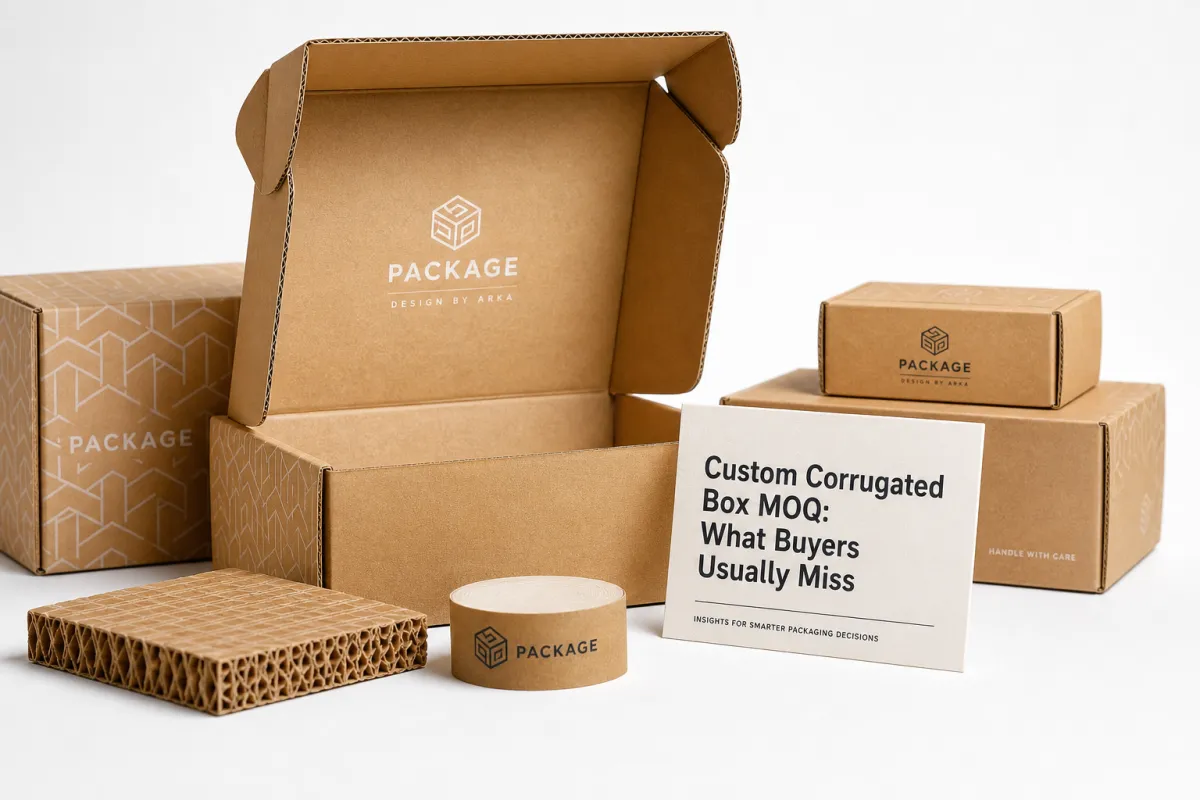
Picture a shipping team trying to protect a product that already runs on thin margins. The first quote that looks attractive may be for a slightly larger carton, because the supplier can run that size efficiently and the unit price lands lower. But if that larger carton leaves two inches of dead space on every side, the result is more void fill, lower pallet density, and a higher freight cost per shipped unit. That is why custom corrugated box MOQ should never be judged on its own. The minimum quantity matters, yes, but so do carton footprint, shipping density, and the way the box behaves after it is stacked, wrapped, and pushed through distribution.
Most buyers miss a simple truth: a low MOQ can still be the wrong commercial choice. If the carton is oversized, the freight cube expands. If the board is too light, the box may pass a basic spec check and still fail under compression on a loaded pallet. If the design is overbuilt, you pay for fiber and converting steps that add no real value. A good custom corrugated box MOQ discussion should include product weight, shipping method, pallet pattern, and the kind of damage you are actually trying to prevent. That is how unit cost stays aligned with total landed cost.
There is also a supply-side reason MOQ exists, and it is not mysterious. Corrugated converting equipment runs best when the job is stable, repeatable, and simple enough to set up cleanly. A regular slotted carton in a standard sheet size is easier to produce than a die-cut piece with glued inserts and heavy print coverage. In practice, MOQ reflects that reality. It is less a gate and more the point where the run becomes practical for both sides. Buyers who understand that usually get tighter pricing and better communication because they frame the order around throughput, not just quantity.
"The cheapest box is not always the best box. The right carton protects the product, fits the pallet, and keeps freight from swallowing the savings."
That is the mindset to bring into custom corrugated box MOQ planning. The rest of this post links MOQ to structure, board grade, print method, and timeline so you can control the parts that matter. If you are comparing options across a packaging program, it also helps to review the broader range of Custom Shipping Boxes and the full set of Custom Packaging Products available for different packaging needs.
For buyers who want a reference point on transit testing and shipping performance, the standards and test methods published by ISTA are a useful benchmark. They help separate a box that looks acceptable from one that holds up under real handling conditions.
What affects custom corrugated box MOQ the most?
The biggest drivers behind custom corrugated box MOQ are box style, board grade, print complexity, and how much setup the job requires. A standard RSC in a common sheet size usually supports a lower MOQ than a die-cut mailer with inserts, coatings, or premium branded packaging finishes. Freight cube and pallet efficiency matter too, because a box that packs poorly can raise the real cost even when the quoted unit price looks attractive.
If you want the MOQ to stay reasonable, simplify the structure first, then refine the print and board spec only as far as the product truly needs. That approach keeps custom corrugated box MOQ tied to production reality instead of overengineering. It also gives you a cleaner basis for comparing quotes across Corrugated Shipping Boxes, retail packaging, and e-commerce packaging programs.
Corrugated Box Styles and Material Options That Fit Your Run
The first choice that shapes custom corrugated box MOQ is the box style itself. A regular slotted carton, or RSC, is usually the most efficient structure because it uses familiar cutting patterns and limited finishing. Mailer-style boxes often need more folding steps and tighter fit tolerances, yet they can deliver a stronger presentation for e-commerce and retail packaging. Die-cut styles, display-ready cartons, and specialty inserts bring in more tooling and setup, which usually pushes MOQ upward. The more unique the structure, the more the converter has to control the job at each stage.
Board choice matters just as much. Single-wall corrugated with common flute profiles like B-flute, E-flute, or C-flute can suit a wide range of product packaging needs, while double-wall constructions are better for heavier loads, longer freight routes, or stacked pallets. A 32 ECT or 44 ECT spec may be enough for many shipping applications, but the right answer depends on product weight, box size, and the amount of top load the carton will see in transit. If the board is too light, the box may crush under stacking pressure. If it is too heavy, you are paying for strength that may never show up in real use. That balance affects custom corrugated box MOQ because stronger or more complex board combinations can change both scheduling and price.
Print method has a direct effect too. An unPrinted Kraft Carton is usually the easiest path, and for many launch programs that is the simplest way to keep custom corrugated box MOQ lower. One-color flexographic branding adds setup but can still work well for moderate runs. Full outside graphics, coated surfaces, and higher-end branded packaging finishes usually require more handling and tighter controls. Those upgrades earn their place when the box is part of the customer-facing experience, especially for subscription, apparel, and premium retail packaging, but they should be chosen with the run size in view.
If you are choosing between a plain shipping box and a more decorative carton, ask what the box actually does. A carton that only lives in the warehouse can stay simple. A box that reaches the consumer may need stronger package branding and cleaner print registration. That is why custom corrugated box MOQ should be discussed alongside the role of the carton in the sales and fulfillment process. The best structure is not automatically the most elaborate one; it is the one that fits the product, the channel, and the replenishment cycle.
When buyers ask for a lower custom corrugated box MOQ, one of the easiest ways to help them is to simplify the structure without compromising protection. A standard RSC often costs less to launch than a custom die-cut mailer because it avoids extra tooling and complex glue patterns. That does not mean every project should default to the simplest box, only that the structure should match the production method. For a deeper look at order-related terminology and common box-selection questions, the FAQ page is a useful starting point.
Specifications That Move Your MOQ Up or Down
Specifications are where many quotes either become accurate or drift off course. Inside dimensions are the first item to lock down because even small changes can alter sheet utilization, board nesting, and the number of cartons that fit onto a pallet. A box that measures 12 x 8 x 6 inches may convert efficiently, while a box that is only slightly different can create waste on the sheet and raise custom corrugated box MOQ pressure. From a manufacturing point of view, those small changes matter because corrugated is built from large sheets that need to be nested efficiently before converting begins.
Product weight is the next control point. A lightweight accessory does not need the same compression strength as a heavy component or a bottled product. Buyers often overspecify board grade because they want extra safety, but that cushion can raise the unit cost without improving real-world performance. Better practice is to define the load, the stacking pattern, and the shipping environment. If the carton is going by parcel service, the stresses are different from a palletized freight move. If the destination is humid or the product will sit in storage, moisture resistance and liner selection matter more. Those details can move custom corrugated box MOQ because they affect setup, testing, and material planning.
Print coverage and finishing are another lever. A simple one-color logo on one panel is easier to schedule than full-coverage graphics on all outside faces. Coatings, aqueous varnish, moisture resistance treatments, and specialty finishes add handling steps that can influence the minimum practical order. Custom inserts, partitions, and glue-applied components can raise the floor too because they introduce assembly work. In buyer terms, the larger the specification stack, the more likely it is that custom corrugated box MOQ will rise.
Here is a practical quoting checklist that speeds up the process and cuts down revision loops:
- Carton style, such as RSC, mailer, die-cut, or specialty display pack
- Inside dimensions and acceptable dimensional tolerance
- Product weight, product shape, and any fragile points
- Board grade target, flute profile, and strength requirement
- Artwork files, print colors, and finish requirements
- Shipping environment, including parcel, LTL freight, or palletized storage
- Target annual demand and preferred replenishment cadence
That list looks basic, but it saves time. A packaging team cannot quote a solid custom corrugated box MOQ without knowing what the box has to protect, how it will ship, and how often it will be reordered. If those points stay vague, the first quote tends to be broad, cautious, and harder to trust.
Testing matters as well. For stacked freight or longer distribution routes, it can be smart to verify performance against the practical expectations behind ISTA and related compression or vibration methods. The goal is not to over-test every box; the goal is to confirm that the selected board and structure match the actual use case. That kind of planning often keeps custom corrugated box MOQ from rising unnecessarily because the specs are based on evidence instead of guesswork.
Custom Corrugated Box MOQ Pricing: What Actually Drives Cost
Pricing for custom corrugated box MOQ is a mix of setup, material, converting, and freight. Setup includes design work, tooling, die creation if needed, print preparation, and machine changeover. Material cost depends on board grade, sheet size, liner combination, and whether the job uses virgin fiber, recycled content, or a specific performance spec. Converting time covers cutting, folding, gluing, printing, scoring, bundling, and palletizing. Freight is the last piece, and it can quietly become the biggest cost driver if the carton footprint is poor.
A higher MOQ usually lowers the unit cost because the fixed setup is spread across more boxes. That part is true. It is only part of the equation, though. If the order is too large for your warehouse, you spend more on storage, handling, and cash tied up in inventory. If the artwork may change next quarter, a big run can create obsolescence risk. The best custom corrugated box MOQ is often the smallest run that still gives an efficient production cost and fits realistic demand.
To make the tradeoffs easier to see, here is a practical comparison of common options. The numbers are directional, not universal, because the actual quote depends on dimensions, board choice, print coverage, and freight lane.
| Box Option | Typical MOQ Range | Best Fit | Common Unit Cost Range | Primary Cost Drivers |
|---|---|---|---|---|
| Plain RSC, unprinted kraft | 250-1,000 units | Launch runs, warehouse shipping, internal logistics | $0.18-$0.40 | Board grade, size, sheet efficiency, freight cube |
| One-color branded RSC | 500-2,500 units | Branded packaging for e-commerce and basic retail packaging | $0.28-$0.65 | Print setup, ink coverage, board utilization |
| Die-cut mailer or specialty carton | 1,000-5,000 units | Retail presentation, subscription, premium product packaging | $0.45-$1.20 | Tooling, finishing, converting complexity, inserts |
| Heavy-duty double-wall shipping box | 500-2,000 units | Bulky or high-weight freight, stacked pallet loads | $0.65-$1.50 | Material weight, compression performance, pallet counts |
Those ranges matter because they show where the jump usually happens. The largest shift in custom corrugated box MOQ pricing typically comes from structure and print complexity, not from a small tweak to the artwork. A plain carton can often stay efficient at a lower quantity, while a die-cut branded box may need a larger run to absorb its setup. If you are trying to keep unit cost under control, standard sheet sizes, fewer SKUs, and simpler print layouts usually do more for the budget than chasing a slightly larger quantity for its own sake.
Materials deserve a careful look too. Sustainable sourcing matters to many buyers, especially those working in retail packaging or e-commerce programs with environmental reporting needs. If recycled content, responsible fiber sourcing, or chain-of-custody documentation is important, check whether the supplier can support the target spec. The FSC system is one common reference point for responsible fiber sourcing. It will not lower custom corrugated box MOQ by itself, but it can shape the spec and the approved vendor pool.
One rule keeps pricing grounded: if the unit cost looks unusually low, ask what was simplified. Sometimes the answer is harmless, like a standard sheet or a more common flute. Sometimes the answer is thinner board, lighter print, or freight assumptions that are too optimistic. A careful buyer uses custom corrugated box MOQ to compare real alternatives, not just quote lines that look good in isolation.
For procurement teams, the smartest comparison is not simply “lowest price per box.” It is “lowest cost to ship, store, and use the box without rework.” That framing changes how custom corrugated box MOQ is evaluated and usually leads to a better choice over time.
Custom Corrugated Box MOQ Process and Timeline
The quote-to-ship process for custom corrugated box MOQ is usually straightforward, but it moves faster when the request is complete. It begins with intake: dimensions, product weight, carton style, print needs, target quantity, and delivery location. Next comes engineering or estimating review, where the team checks whether the proposed structure is practical and whether the board selection fits the load. After that comes pricing, proof approval, and production scheduling. Once the job is released, the boxes move into converting, finishing, packing, and shipment.
The fastest jobs are usually standard-style cartons with no special insert work and clear artwork files. A simple unprinted run may move from approval to production quickly if materials are on hand and the schedule has room. Printed orders generally need more time because there is more prepress work, more setup, and sometimes more sampling. A new dieline, unusual dimensions, or tight retail-ready branding can add time too. In practice, custom corrugated box MOQ and lead time tend to move together: the more complex the order, the more planning it needs.
Here is a practical planning window to keep in mind, with the usual caveat that each job depends on schedule and materials:
- Simple unprinted RSC: often 5-10 business days after approval if the spec is standard and materials are available.
- Printed carton with basic artwork: often 10-15 business days after proof approval.
- New die-cut or insert-heavy run: often 15-25 business days, especially if sample fit or tooling is involved.
- Highly customized branded packaging program: may take longer if preproduction approval, testing, or multiple revisions are needed.
Those windows are not promises. They are a useful way to think about custom corrugated box MOQ planning without guessing. If a launch date is fixed, the earlier the packaging specs are confirmed, the easier it is to protect the timeline. That matters especially for product launches where packaging design has to be locked before fulfillment can begin.
Good communication shortens the cycle. If the product dimensions are verified, if the artwork is final, and if the delivery destination is clear, the quoting team can usually give a sharper answer on custom corrugated box MOQ. If the customer can also share a product sample or a drawing, the fit check becomes much more reliable. That matters because a carton that fits on paper may still fail in practice once inserts, closures, and tolerances are factored in.
From a logistics point of view, the other key variable is the production queue. A job that fits current sheet stock and common converting patterns will generally move faster than one that needs new tooling or a special material. If lead time matters, ask whether the proposed custom corrugated box MOQ depends on a unique step or can move through a standard path. Clear answers there often save days, not just hours.
Why Choose Us for Custom Corrugated Box MOQ Projects
For buyers managing packaging programs, the best partner is one that understands both the manufacturing side and the commercial side. That means giving straight answers about board strength, print method, pallet counts, and freight behavior, not just sending over a price. The goal is to help you choose a custom corrugated box MOQ that fits actual demand instead of pushing you into a quantity that looks efficient on paper but becomes awkward in storage or too slow to turn over in the warehouse.
That practical approach matters because real packaging decisions usually sit at the intersection of operations, marketing, and procurement. Operations cares about fit, protection, and how the boxes stack. Marketing cares about branded packaging, color accuracy, and shelf presence. Procurement cares about unit cost, terms, and supplier reliability. A good custom corrugated box MOQ recommendation should respect all three. Ignore one priority and the order may still move forward, but the result often creates friction later.
What buyers usually value most is precision. They want a quote that reflects the right board grade, the right dimensions, and the right level of print detail. They want fast feedback if a dieline needs correction or if an insert can be simplified. They also want to know whether a smaller launch run is possible before they commit to a larger replenishment order. That kind of support is especially useful for custom printed boxes and retail packaging programs where the first run is as much a learning exercise as a production event.
There is also value in honest engineering. Sometimes a customer asks for a more complex solution than the product really needs. In those cases, the better answer is not always the fancier box. Sometimes it is a stronger board, a simpler closure, or a cleaner print layout that keeps custom corrugated box MOQ and unit cost under control without cutting performance. That kind of recommendation protects margin and keeps the packaging from becoming the most expensive part of the shipment.
"The right packaging partner should tell you where the spec helps and where it only adds cost."
If you are reviewing options for a product launch, a replenishment program, or a rebrand, it helps to work with a team that sees the carton as part of the whole system. The box has to fit the product, protect it in transit, present the brand clearly, and still make financial sense. That is the standard we bring to custom corrugated box MOQ projects, and it is the same standard buyers should expect from any serious packaging supplier.
Next Steps to Lock in the Right MOQ
If you want a quote that actually helps, start with complete specs. Gather the inside dimensions, product weight, carton style, artwork files, target quantity, delivery destination, and any special requirements such as coating, moisture resistance, or inserts. If you are unsure about the exact fit, send a sample product or a dimensional drawing. That one step often makes the difference between a rough estimate and a quote you can use. It also makes custom corrugated box MOQ recommendations more reliable because the supplier can check the real packaging geometry instead of guessing.
It also pays to compare at least two quantity scenarios. One should be a conservative launch run that protects cash and storage space. The other should be a growth run that shows how the unit cost moves when the quantity rises. That comparison reveals where custom corrugated box MOQ starts to improve pricing and where the savings begin to flatten out. In many cases, the second scenario produces only modest unit savings while creating more inventory risk, so the numbers deserve a careful look rather than a quick yes.
Before you approve the final order, review storage space and replenishment cadence. A better MOQ is not always the biggest one. It is the quantity that fits the warehouse, supports the forecast, and gives enough production efficiency to keep pricing sensible. If the box is going into a branded packaging rollout, confirm whether the print file is final and whether the visual direction is locked. Reprints happen, and they are expensive when the cartons were ordered too aggressively. That is one more reason to treat custom corrugated box MOQ as part of the larger packaging plan, not as a stand-alone line item.
For buyers who want to keep the process organized, here is a simple final checklist:
- Verify inside dimensions and acceptable tolerance
- Confirm product weight and load distribution
- Choose the carton style and board grade
- Decide on print method, color count, and finish
- Estimate launch quantity and replenishment timing
- Review freight destination and storage limits
- Ask whether samples, fit checks, or testing are needed
That checklist looks basic, but it is exactly what keeps orders from drifting off course. A clear brief shortens approval time, improves quote accuracy, and gives the production team a cleaner path to scheduling. If you send complete specs, custom corrugated box MOQ becomes much easier to manage, and the chance of rework drops sharply. In the end, the best result is a carton that ships well, prints cleanly, and lands at a unit cost you can defend.
The most practical next move is simple: send a dimensioned drawing or sample, name your target replenishment window, and ask for two quotes — one at a conservative launch quantity and one at the level where production efficiency starts to improve. That comparison shows whether your custom corrugated box MOQ is genuinely helping the business or just making the purchase order look neat.
Frequently Asked Questions
What is a typical custom corrugated box MOQ?
A typical custom corrugated box MOQ depends on the box style, print method, and board grade. Simple unprinted runs can often start lower, while printed die-cut cartons usually need a higher minimum because of tooling and setup. If you are launching a new product, ask for a standard-style option first and then compare it with the branded version so you can see how the minimum changes with complexity.
Can custom corrugated box MOQ be lower with digital printing?
Yes, digital print can sometimes reduce setup pressure because it avoids some plate costs and can make smaller runs more practical. Even so, material choice and structure still matter, so a lower print setup does not always mean the overall custom corrugated box MOQ drops dramatically. The best approach is to compare both a digitally printed and a conventionally printed quote so you can judge total landed cost rather than only the decoration method.
What details do I need to request an accurate custom corrugated box MOQ quote?
Provide inside dimensions, product weight, box style, board strength target, artwork files, shipping destination, and preferred quantity. Include any special requirements such as inserts, coating, moisture resistance, or retail-ready printing, because those details can change both cost and custom corrugated box MOQ. If the specs are not final, send a sample product or a drawing so the packaging team can verify fit before quoting.
Does a higher MOQ always lower the price per box?
Usually the unit price drops as quantity rises because setup is spread across more cartons, but the savings eventually flatten out. A very large run can create storage, cash flow, and obsolescence risk, so the cheapest per-box price is not always the best decision. For most buyers, the best custom corrugated box MOQ is the smallest quantity that still gives an efficient production cost and supports the forecast.
How long does a custom corrugated box MOQ order take?
Lead time depends on whether the box is a standard structure, a new custom die-cut, or a printed carton that needs proof approval. Accurate specs and print-ready files shorten the timeline, while sampling, testing, or artwork revisions can add time before production starts. Ask for a timeline that separates quote approval, prepress, production, and shipping so your custom corrugated box MOQ plan matches the inventory schedule with less guesswork.

