Buyer Fit Snapshot
| Best fit | Custom Corrugated Boxes Wholesale for Shipping Needs projects where brand print, material claims, artwork control, MOQ, and repeat-order consistency need to be specified before quoting. |
|---|---|
| Quote inputs | Share finished size, material target, print colors, finish, packing count, annual reorder estimate, ship-to region, and any compliance wording. |
| Proofing check | Approve dieline scale, logo placement, barcode or warning zones, color tolerance, closure strength, and carton packing before bulk production. |
| Main risk | Vague material claims, crowded artwork, missing packing details, or unclear freight terms can make a low unit price expensive after revisions. |
Fast answer: Custom Corrugated Boxes Wholesale for Shipping Needs should be specified like a repeatable production item. The safest quote records material, print method, finish, artwork proof, packing count, and reorder notes in one written spec.
Production checks before approval
Compare the actual filled-product size with the drawing, then confirm tolerance on folds, seals, hang holes, label areas, and retail display edges. Reserve space for logos, QR codes, warning copy, and material claims before decorative graphics fill the panel.
Quote comparison points
Review material grade, print process, finish, sampling route, tooling charges, carton quantity, and freight assumptions side by side. A quote is only useful when the supplier can repeat the same color, closure quality, and packing count on the next order.
Custom Corrugated Boxes Wholesale for Shipping Needs
One loose carton can turn a profitable shipment into a write-off. With Custom Corrugated Boxes wholesale, buyers can size the shipper to the product, the pallet pattern, and the route instead of forcing everything into a box that was never built for the job. The payoff shows up fast: less void fill, fewer crushed corners, fewer freight surprises, and fewer returns quietly chewing through margin.
From a packaging buyer's point of view, the best box is not the cheapest box on paper. It is the one that lands with the fewest claims, stacks cleanly in the warehouse, and reorders without drama. That is why Custom Corrugated Boxes wholesale matters for shipping programs that need control and repeatability. The cost model is simpler than most teams expect. A better fit reduces empty space, which can lower dimensional weight. Stronger board can cut damage risk on long routes. A consistent carton size can make picking and pallet building faster across several SKUs.
Why Custom Corrugated Boxes Wholesale Can Lower Damage and Freight Costs
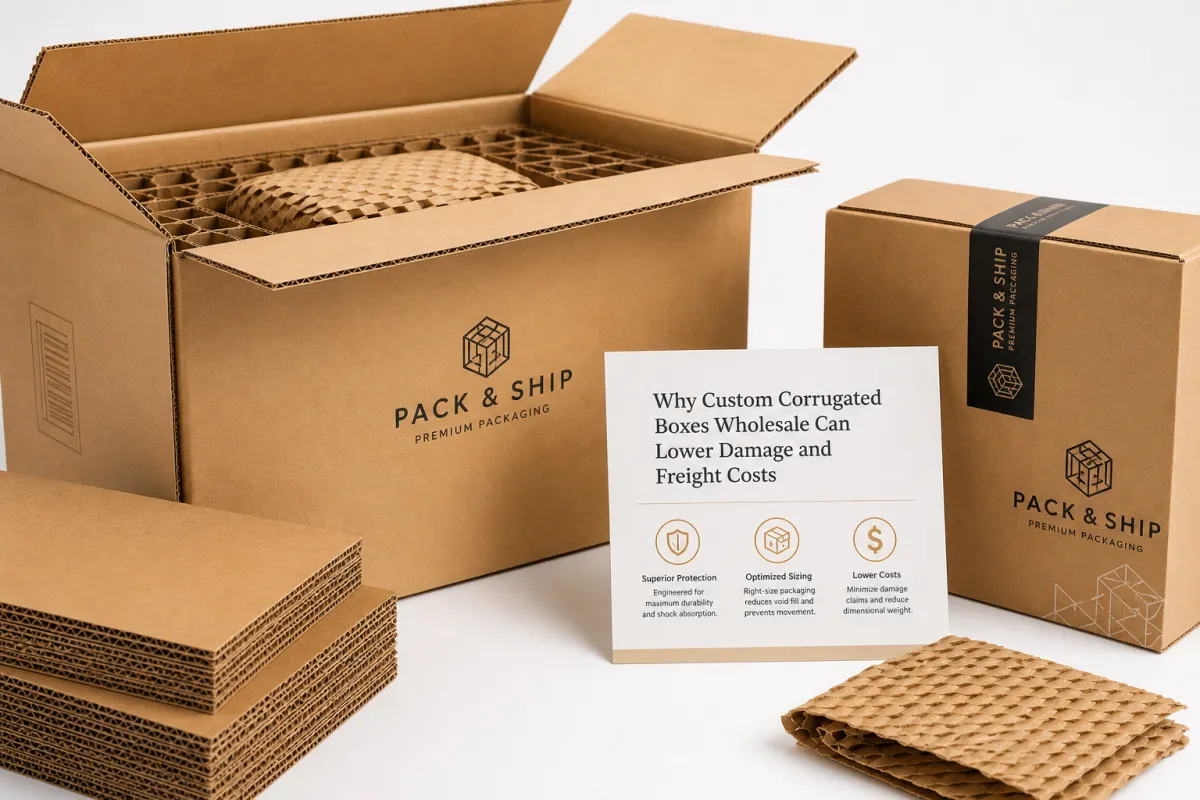
Picture a product that sits neatly on a retail shelf, but rattles inside the carton on a truck route with multiple handoffs. The box is too large, so the packout team adds filler. More filler means more labor. The extra cubic space pushes up dimensional weight. The loose fit lets the product shift, which creates edge wear and breakage claims. That is the kind of mess Custom Corrugated Boxes wholesale is meant to fix.
Most shipping waste starts with mismatch. A carton that is 15 percent too large can require more void fill, more tape, and more time at packout. A carton that is too light can collapse in stacking. A carton that is too heavy can protect the product, but it can also raise freight cost and material spend without adding much value. Custom corrugated boxes wholesale gives the buyer a chance to set the balance: enough strength for the route, enough fit for the product, and enough consistency for reorder planning.
There is a warehouse benefit that gets ignored too often. Standardized box sizes help teams build repeatable carton-pick logic, keep pack stations organized, and reduce decision fatigue during high-volume shifts. If three similar SKUs can share one box family, the operation becomes easier to forecast. That matters more than a tiny unit-price difference. Over a full quarter, the savings often come from labor and fewer claims, not just the carton line on the invoice.
A good shipping carton should do three jobs at once: protect the product, keep freight predictable, and avoid creating extra work for the packing line.
For teams comparing custom corrugated boxes wholesale against generic cartons, the real question is not whether the box looks better. It is whether the packaging lowers total cost per shipped order. That includes damage rates, dimensional weight, pack speed, and how often the same size can be reused across a family of products. In practice, those factors are often worth more than a small savings from a stock-size box that almost fits.
That logic is why many buyers pair corrugated changes with broader packaging design reviews. They look at insert layout, bundle geometry, and even product packaging configuration before approving a new spec. If the product can be nested more tightly, the box can be smaller. If the box can be smaller, freight may improve. If the carton stack pattern improves, the pallet can carry more usable product with less air. That is not theory. It is the day-to-day math of custom corrugated boxes wholesale.
For more context on packaging structures and material choices, the Packaging Corporation of America packaging resources and the broader industry education available through packaging trade groups are useful references. They help buyers think beyond the box price and into the shipment system around it.
What Custom Corrugated Boxes Wholesale Can Include for Your Operation
Custom corrugated boxes wholesale can cover a lot more than a plain brown shipping carton. The most common starting point is the regular slotted container, often called an RSC, because it is versatile and familiar to packers. Plenty of operations do better with die-cut mailers, self-locking bottoms, heavy-duty shippers, or product-specific styles that support a cleaner unboxing moment. The right format depends on the product, the packing speed, and how much presentation matters at delivery.
Customization starts with dimensions. Exact length, width, and depth can remove unnecessary voids and tighten pallet patterns. After that come structural details: inserts, partitions, hand holes, reinforcement panels, dust flaps, locking tabs, and coatings that resist scuffing or moisture. Custom corrugated boxes wholesale can also include printed exterior panels, inside print, simple one-color brand marks, or full-coverage graphics for custom printed boxes and stronger package branding.
That is where the distinction between plain brown corrugated and branded packaging becomes useful. Plain kraft is efficient, economical, and practical for many industrial shipments. Printed corrugated adds recognition and can improve the customer's first impression, especially in ecommerce, subscription kits, and retail replenishment. Neither option is automatically better. The right choice depends on whether the box needs to disappear in transit or support the brand experience at delivery.
- RSC shipping cartons for general fulfillment and palletized freight
- Die-cut mailers for presentation-focused ecommerce and subscription packs
- Heavy-duty shippers for dense parts, equipment, and long routes
- Custom inserts for fragile items, kits, and multi-item orders
- Printed cartons for retail packaging and brand-forward delivery
There is a practical line between standard and custom. If a stock box already fits within tolerance, protects the product, and ships well on the current route, a standard carton may be enough. If the product shifts, stacks poorly, or wastes too much cube, a custom size is usually the better buy. Custom corrugated boxes wholesale earns its keep when the carton is doing more than carrying air.
Many buyers also use custom packaging to support a wider product line. A single box family can cover several SKUs if the internal packout is planned well. That can reduce SKUs at the warehouse level, simplify procurement, and make reorders faster. If you are comparing options, it can help to review Custom Packaging Products alongside Custom Shipping Boxes so the structure, print, and shipment method all align before production starts.
| Box Type | Best Use | Typical Finish | Operational Benefit |
|---|---|---|---|
| Plain RSC | General freight, warehouse shipping | Brown kraft, minimal print | Low cost, fast packout, easy storage |
| Printed mailer | Ecommerce and subscription delivery | One-color to full-coverage print | Stronger brand impression and cleaner presentation |
| Heavy-duty shipper | Dense or fragile products | Double-wall or high-ECT board | Better compression and damage resistance |
| Die-cut custom pack | Kits, samples, premium product packaging | Folded structure with locking tabs | Cleaner fit, easier assembly, improved retail packaging feel |
For buyers who care about sustainability claims, corrugated can fit well into a recycling story, but the details matter. Recyclability is not the same as recovery in a specific market, and fiber sourcing is not the same as recycled content. If those issues matter to your brand, ask about FSC chain-of-custody, recycled fiber content, and local recycling expectations rather than assuming all corrugated performs the same. The EPA's recycling guidance at epa.gov/recycle is a useful starting point for that conversation.
Board Grades, Flutes, and Test Strength: The Specs That Matter
Specification work is where custom corrugated boxes wholesale either saves money or creates problems. The most useful specs are the ones that reflect the actual shipping environment: product weight, route length, handling frequency, pallet height, and whether the cartons are exposed to moisture or compression. Buyers usually hear about ECT, burst strength, flute profile, and wall construction. Those terms matter because they map to different kinds of risk.
ECT, or edge crush test, helps indicate how well the board resists vertical stacking loads. Burst strength looks at puncture and rupture resistance. Flute profile affects cushioning, compressive strength, and print surface quality. Single-wall corrugated is usually enough for lighter to moderate loads. Double-wall makes sense when cartons are heavier, stacked higher, or handled more aggressively. Custom corrugated boxes wholesale is not about choosing the thickest board by default. It is about matching the board to the shipment.
Flute choice also changes how the carton behaves. E-flute gives a smoother print surface and a slimmer profile. B-flute gives better stacking performance in many shipping situations. C-flute is often a practical middle ground for general freight. Double-wall combinations can offer the right mix of strength and cushioning for industrial or bulk shipments. A good buyer will look at the product first, then the route, then the board. That order matters.
Testing is part of the discipline. Samples should be checked with the actual product inside, not just on a flat table. Fit testing can reveal that a box is technically the right size but awkward to pack because the insert does not hold the contents securely. Compression testing, drop testing, and vibration testing can expose weak points before a full run is approved. The ISTA test framework is widely used for transit simulation, and that matters because what survives a desk review does not always survive a real route. I have seen a carton pass on paper and fail after two days in a carrier network. Paper is patient. Conveyor belts are not.
Here is the tradeoff most people miss: under-spec packaging creates damage, but over-spec packaging creates waste. Heavier board can raise material cost, increase freight cost, and make carton handling more difficult. Stronger is not always smarter. The best custom corrugated boxes wholesale spec is the one that protects the product without turning the box into a cost center.
One more point on packaging design: the internal fit often matters as much as the outer box grade. A tight, well-designed insert can let a buyer use a lighter carton. A poor insert can force a stronger carton and still fail. That is why many teams review product packaging, exterior carton, and insert geometry as one system instead of three separate purchases. The truck does not care about your spreadsheet. It cares about physics, and physics is kind of rude that way.
Industry standards help keep the discussion grounded. ASTM methods are often used to validate compression or material performance. ISTA protocols are commonly used to simulate transport events. Those references do not choose the box for you, but they give procurement and operations teams a language for testing, comparing, and approving custom corrugated boxes wholesale specs with less guesswork.
Custom Corrugated Boxes Wholesale Pricing, MOQ, and Cost Drivers
Pricing for custom corrugated boxes wholesale is usually driven by a short list of variables: dimensions, board grade, wall construction, print coverage, coating, insert count, and order volume. A small change in size can affect how many blanks fit on a sheet. A switch from single-wall to double-wall can change both material cost and freight. Full-color printing adds setup and production complexity. None of that is mysterious, but it does mean buyers should compare quotes carefully.
MOQ, or minimum order quantity, depends on the box style and the production method. Simple printed cartons may be available in lower quantities than complex die-cut structures. Pilot runs can be useful if the team wants to validate fit, strength, and packout before committing to a larger program. Larger programs usually lower the unit cost, but only if the forecast is real. A warehouse full of cheap cartons is not a win if the product mix changes and the cartons sit for a year.
Here is a simple way to compare options for custom corrugated boxes wholesale without getting trapped by the sticker price.
| Order Type | Example Volume | Approximate Unit Range | What Drives the Price |
|---|---|---|---|
| Short-run plain carton | 500 to 1,000 units | $0.85-$1.60 | Tooling, setup, and lower production efficiency |
| Standard printed run | 2,500 to 5,000 units | $0.42-$0.95 | Print coverage, board grade, and carton size |
| High-volume wholesale order | 10,000+ units | $0.18-$0.55 | Sheet yield, repeatability, and simpler artwork |
| Heavy-duty double-wall shipper | 2,500 to 5,000 units | $0.95-$2.10 | Board weight, compression spec, and shipping requirements |
Those numbers are broad ranges, not promises. Exact cost depends on carton footprint, ink coverage, and supplier equipment setup. Even so, the pattern is clear: unit cost drops as volume rises, but only if the spec stays stable. That is why custom corrugated boxes wholesale buyers who standardize box sizes across several SKUs often get better pricing than buyers ordering one-off cartons every month.
Compare quotes by landed cost, not just box price. Freight from the carton supplier, sample charges, plate or die charges, inserts, and special coatings can change the real number. A quote that looks lower can end up higher once the shipment lands at the dock. Buyers who ask for both unit price and landed cost usually make better decisions. They also avoid surprises when the first invoice arrives.
Negotiation works best when it is concrete. Share annual volume estimates. Standardize the artwork where possible. Combine two similar carton specs into one family if the fit allows it. Ask whether the supplier can quote a lighter board and a stronger board side by side. That kind of comparison often shows that the most expensive option is not always the most protective. For teams building broader packaging programs, Wholesale Programs can help structure repeat orders more cleanly.
From Quote to Dock: The Process and Timeline
A good quote for custom corrugated boxes wholesale starts with the right information. Product dimensions should be measured in the packed state, not just the bare product size. Weight matters. Shipping method matters. So does stack height, because a carton that works in single-layer shipping may fail once it is palletized. Photos of the current box, if one exists, can speed the process because they show folds, inserts, tape points, and the areas where failure usually starts.
The workflow is usually straightforward. First comes spec review. Then design or die-line confirmation. Next is sample or prototype approval. After that comes production, quality checks, and shipment. The timeline depends on box complexity and how quickly the buyer approves each step. A simple repeat order can move faster than a new custom structure. A print-heavy carton with a new insert usually takes longer. That is normal, and it should be planned that way.
For planning purposes, many buyers should expect roughly 12 to 15 business days from proof approval for a straightforward run, with longer lead times for complex die-cut work or especially large volume orders. If artwork changes late, the clock resets. If dimensions are still being debated, the job stalls. If the sample needs revision, production moves back another step. None of those delays is unusual, but all of them are avoidable with clear inputs. That is one reason custom corrugated boxes wholesale works best when the buyer treats it like a supply-chain project rather than a quick purchase.
Fastest projects usually share a few habits. They start with existing packaging samples. They make decisions in one review cycle instead of three. They send accurate product weights and photographs up front. They also plan repeat demand early, which helps the supplier reserve capacity. If the operation is seasonal, that matters even more. A holiday launch or a product refresh can compress the schedule very quickly.
It also helps to think beyond production and toward inventory. A box that arrives on time but in the wrong quantity creates a different kind of failure. Buyers should ask how the reorder point ties to lead time, safety stock, and peak shipping weeks. That is especially true for custom corrugated boxes wholesale programs that support multiple SKUs or campaigns. The box supply has to match the business rhythm, not just the calendar.
From a packaging operations standpoint, the smartest timeline is the one that leaves room for a sample check. The fastest approval is not always the safest approval. If the carton is supporting ecommerce fulfillment, retail packaging, or replacement shipments, one missed measurement can cascade into packout delays later. Better to catch that on a prototype than on a live shipment.
Why Buyers Choose Our Custom Corrugated Boxes Wholesale Program
Buyers usually stay with a packaging supplier for one reason: the orders arrive the same way every time. Consistency is the real value behind custom corrugated boxes wholesale. That means the dimensions hold, the print matches the proof, the board behaves as expected, and the reorders do not require a fresh round of guesswork. Procurement teams care about that because it reduces risk. Operations teams care because it saves time.
Quality control should cover more than the finished carton. Board verification matters. Print checks matter. Sample comparison matters. A supplier that treats these steps seriously makes it easier to standardize a shipping program across multiple SKUs. That is a bigger advantage than many buyers realize. Once a box family is approved, the warehouse can train around it, the finance team can forecast more cleanly, and the brand team can stop reworking packaging design every time the volume changes.
Clear communication also has measurable value. When a launch shifts, a carton spec changes, or a customer asks for a different print layout, the response time affects the schedule. Suppliers who quote quickly and explain the tradeoffs clearly help buyers make better choices under pressure. That matters especially for branded packaging, where a delay in carton approval can hold back the whole launch.
There is also a practical difference between a supplier that handles one-off orders and one that supports a program. A program approach supports repeat orders, seasonal forecast changes, and SKU rationalization. That means custom corrugated boxes wholesale is not treated as a one-time purchase. It becomes part of the company's operating system. For teams that need to keep shipping standards tight, that is worth more than a flashy presentation.
Buyer proof points should stay concrete. Are damaged shipments down after the carton change? Is tape usage lower? Is packout faster? Are warehouse teams using fewer filler materials? Those are the numbers that matter. If the answer is yes, the box is doing its job. If not, the spec should be revisited. In real shipping operations, a good custom corrugated boxes wholesale program pays for itself through fewer claims, less carton waste, and cleaner handling.
A good packaging partner can support that kind of buying discipline by helping teams align box style, print, and reorder planning before the first run. That matters whether the need is simple brown shipping, branded packaging for a new launch, or a higher-touch retail packaging presentation. The goal is the same: a carton that fits the product and the workflow.
Next Steps to Order the Right Box Program
If you are ready to move from discussion to ordering, start with the basics. Gather product dimensions, packed weight, shipping method, annual usage, and any brand requirements. Add photos of the current carton if you are replacing one. Include whether the product ships individually, in sets, or on pallets. Those details make a quote for custom corrugated boxes wholesale much more accurate and far more useful.
Next, ask for samples or a prototype. A sample reveals fit, stack behavior, insert performance, and print clarity in a way a PDF never can. That is especially true for custom printed boxes, where ink coverage and panel placement can change how the package feels in the hand. If there is any doubt about board strength, request two spec options side by side. One lighter, one stronger. The difference in real handling is often easier to judge than the difference on a spec sheet.
It also helps to compare the box against the full shipping process. Will the cartons be hand-packed or machine-packed? Will they sit in storage before use? Will they travel regionally or nationally? Will they be used for ecommerce, industrial parts, or replacement shipments? Those answers determine whether a lighter carton saves money or a stronger carton prevents pain. Custom corrugated boxes wholesale is most effective when the packaging decision is linked to the shipping method, not made in isolation.
- Measure the packed product, not just the product itself.
- Confirm board grade, flute, and wall construction.
- Request pricing at two volume levels.
- Plan for lead time, safety stock, and seasonal peaks.
- Review the artwork and print coverage before approval.
For buyers who want a cleaner ordering path, it can help to structure the conversation around the supplier's Wholesale Programs and the exact box family being considered. That keeps the focus on repeatability, not just one shipment. It also makes reorder planning easier when demand changes faster than expected.
Here is the simplest way to think about the decision: if the product is shipping well, the box should be invisible. If the carton is creating damage, extra cost, or extra labor, the spec is wrong. The right custom corrugated boxes wholesale program removes friction, supports the brand, and gives the warehouse a package it can use consistently. Send the specs, request pricing, test the sample, and lock the carton decision before the next order cycle starts. That is the part that actually moves the numbers.
What is the minimum order for custom corrugated boxes wholesale?
MOQ depends on the box style, board grade, and whether the design needs a custom die line or print setup. Smaller pilot runs can work for testing, but larger runs usually lower the per-box cost and improve production efficiency. Ask for a quote at two volume levels so you can compare trial pricing versus full-program pricing. For buyers who need custom corrugated boxes wholesale with printed graphics, setup details can affect MOQ more than the carton itself.
How do I choose the right corrugated board grade for my boxes?
Start with product weight, stack height, and shipping distance, then match the board grade to the real handling risk. Higher ECT or stronger construction is usually better for heavier loads, multi-touch shipping, or palletized freight. If you are unsure, request a sample spec comparison before approving production. That is usually the fastest way to avoid overbuilding or underbuilding a custom corrugated boxes wholesale order.
Can I get printed custom corrugated boxes wholesale without a huge run?
Yes, but print method, artwork complexity, and setup requirements will affect MOQ and pricing. Simple one-color or limited-print designs are often easier to produce in smaller quantities than full-coverage graphics. Ask whether the supplier can quote a short-run printed option and a larger volume option for comparison. For many teams, that is the most practical path into custom corrugated boxes wholesale with branded packaging.
How long does production take after approval?
Lead time varies by box type, print complexity, and current factory load, so approval speed matters as much as manufacturing time. Samples or custom die lines can add time at the front end, while simple repeat orders are usually faster. Confirm timing for both production and freight so the delivery date reflects the full process. A well-planned custom corrugated boxes wholesale schedule should always include shipping time, not just manufacturing time.
What information should I send for an accurate quote on custom corrugated boxes wholesale?
Send product dimensions, weight, shipping method, carton count, annual usage, and any special packing or stacking needs. Include artwork files or a rough print idea if branding is required, plus photos of the current box if you are replacing one. The more precise the input, the more useful the quote will be for cost, fit, and timeline planning. That level of detail makes custom corrugated boxes wholesale quotes easier to compare and far easier to approve.

