Buyer Fit Snapshot
| Best fit | Custom Corrugated Boxes Price projects where brand print, material claims, artwork control, MOQ, and repeat-order consistency need to be specified before quoting. |
|---|---|
| Quote inputs | Share finished size, material target, print colors, finish, packing count, annual reorder estimate, ship-to region, and any compliance wording. |
| Proofing check | Approve dieline scale, logo placement, barcode or warning zones, color tolerance, closure strength, and carton packing before bulk production. |
| Main risk | Vague material claims, crowded artwork, missing packing details, or unclear freight terms can make a low unit price expensive after revisions. |
Fast answer: Custom Corrugated Boxes Price: What Really Drives Costs should be specified like a repeatable production item. The safest quote records material, print method, finish, artwork proof, packing count, and reorder notes in one written spec.
Production checks before approval
Compare the actual filled-product size with the drawing, then confirm tolerance on folds, seals, hang holes, label areas, and retail display edges. Reserve space for logos, QR codes, warning copy, and material claims before decorative graphics fill the panel.
Quote comparison points
Review material grade, print process, finish, sampling route, tooling charges, carton quantity, and freight assumptions side by side. A quote is only useful when the supplier can repeat the same color, closure quality, and packing count on the next order.
Custom Corrugated Boxes Price: Why the Number Moves
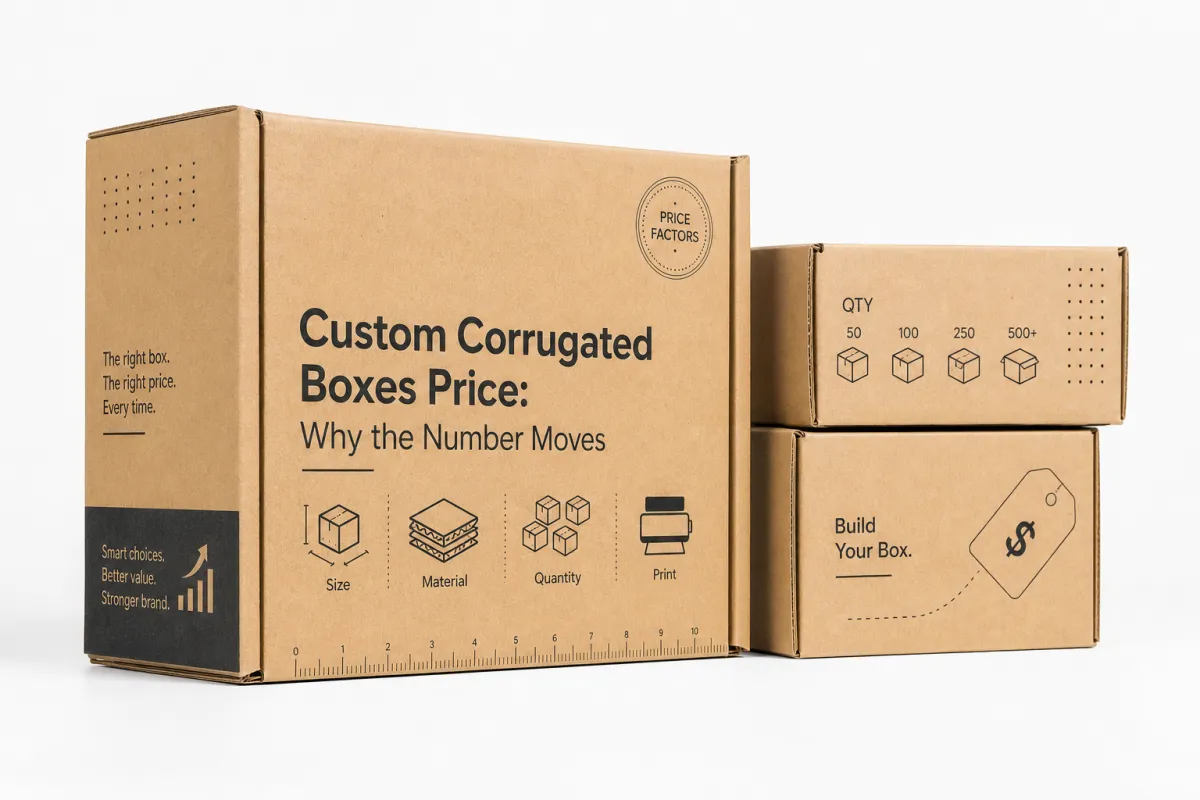
Two brands can order the same footprint and still get very different Custom Corrugated Boxes price quotes. One wants a plain single-wall mailer with a one-color logo. The other wants heavier board, full-panel graphics, and an insert that keeps the product from sliding around like it owns the place. Same outer size. Very different economics.
The main point is simple. Custom Corrugated Boxes price is not random. It comes from material cost, box dimensions, print method, tooling, conversion labor, and freight. Once those inputs are visible, the quote stops looking mysterious. Without them, the number feels pulled out of a hat.
I have seen buyers compare two quotes that looked wildly apart, only to discover one supplier was quoting a basic shipper and the other was quoting a better board grade, a tighter fit, and a print process that could actually hold up on press. That is not a small difference. That is the whole job changing under your feet.
Comparing a custom box to a stock mailer by unit price alone is a nice way to make a bad decision. A stock mailer may look cheaper on paper, but if it needs extra void fill, slows packing, or causes more damage in transit, the real cost per shipped order goes up fast. That mistake shows up all the time in packaging programs that focus on the carton and ignore the shipping system around it.
The better question is not, “What does the box cost?” It is, “What does each packed and delivered order cost after labor, protection, returns, and brand impact are counted?” That is the useful way to think about Custom Corrugated Boxes price.
Custom Corrugated Packaging pays off in specific situations: fragile goods, higher-value products, e-commerce shipments, retail packaging that needs better presentation, and any order where branding matters. If the box is only a container and the product can survive a rough ride, a simpler spec is usually smarter. If the box has to protect, sell, and carry brand messaging, the math changes.
The short version: a competitive custom corrugated boxes price comes from matching the structure to the job, not from chasing the lowest number in your inbox. That holds whether you are buying custom printed boxes for shipping, Branded Retail Packaging, or a hybrid setup that does both.
Custom Corrugated Boxes Price and Product Details
Not every corrugated box is built the same way, and the difference shows up directly in custom corrugated boxes price. A mailer box, a regular slotted carton, a die-cut gift box, and a retail-ready tray all use corrugated board, but they do not travel through the same production path.
A custom corrugated box can mean several formats. It might be a folding mailer for subscription shipments, a tuck-style carton for product packaging, a shipping carton for palletized distribution, or a retail-ready package that needs shelf appeal. Each structure changes how the board is cut, scored, glued, and printed. That affects setup and run-time.
Die-cut styles usually cost more than simple rectangular cartons because they need tooling and tighter conversion control. Complex closures, internal partitions, and display features add labor. A box with a crash-lock bottom and a custom insert will not quote the same way as a plain RSC shipper, even if the outside dimensions are close.
Board choice matters just as much. Single-wall corrugated is common for lighter shipments. Double-wall construction is stronger and more expensive, but it can reduce crush risk, which matters on export lanes and for heavier product packaging. Flute profile matters too. Smaller flutes can improve print quality and presentation, while larger flutes can improve cushioning and stacking strength.
Print changes the number again. A one-color logo on the outside is a different job from full-coverage, full-color brand panels with inside printing and a matte varnish. That is why custom corrugated boxes price climbs faster than buyers expect once the box becomes part of the package branding strategy instead of a plain transit shipper.
If you are choosing between corrugated, folding cartons, and rigid boxes, start with performance. Corrugated usually wins on shipping strength and line efficiency for direct-to-consumer and industrial use. Folding cartons make more sense for lighter retail presentation. Rigid boxes bring a premium feel, but they are not built for the same abuse in transit. For many brands, corrugated lands in the practical middle: strong enough to ship, flexible enough to brand, and easier to scale.
For brands launching a new SKU, the box often ends up doing more than one job. It ships the product, protects the contents, and gives the customer a first impression before they even touch the item. That is why I always look at the box as part of the product experience, not just a shipping line item. If the structure is wrong, the price conversation gets fake real fast.
If you are planning a packaging refresh, it helps to review a broader selection of Custom Packaging Products alongside dedicated shipper formats. For shipping-focused programs, our Custom Shipping Boxes page is a useful baseline for spec decisions.
Specifications That Change Custom Corrugated Boxes Price
Specs are where custom corrugated boxes price becomes measurable. If a buyer sends rough dimensions and a logo, the quote will be rough. If the buyer sends exact internal dimensions, product weight, shipping method, print requirements, and volume, the quote gets cleaner. That alone can save days of back-and-forth.
Dimensions should be the first detail. Internal dimensions matter more than external dimensions because they determine product fit. Leave enough clearance for easy packing, but not so much that the product rattles and needs extra void fill. Carrier limits matter too. If a box crosses parcel thresholds, freight costs can jump faster than the box price itself.
Board grade is the second major lever. A lightweight board may be enough for a small, low-risk item. A heavier board or double-wall option may be needed for stacked storage, heavier contents, or export shipping. Buyers often stare at the material line item and stop there, which is a mistake. A stronger board can lower breakage, reduce returns, and protect margin. That belongs in the true custom corrugated boxes price picture.
Flute profile changes performance too. E-flute often gives a cleaner print surface. B-flute can improve rigidity. C-flute and double-wall structures are common where compression strength matters more than a smooth retail face. There is no universal winner. The right choice depends on product weight, handling, and the route the box will travel.
Printing adds another layer. One-color flexographic print is usually less expensive than full-coverage graphics. White ink on kraft, inside printing, metallic accents, and coated finishes can all raise the number. If a design uses large solid areas, some suppliers may recommend board or print adjustments to avoid show-through or rubbing in transit.
Then come the extras: die-cuts, perforations, hand holes, tear strips, inserts, dividers, and special openings. Each feature can add tooling or labor. Some are worth it. A tear strip can improve the unboxing experience. A divider can prevent damage. But every added element should earn its place in the quote.
For compliance and distribution planning, ask whether the box needs to meet a stacking target, an export requirement, or a test protocol such as ISTA testing standards. For fiber sourcing and sustainability claims, FSC certification may matter to your brand and retail customers. Those requirements do not just affect messaging; they can influence board choice, supplier eligibility, and custom corrugated boxes price.
One detail buyers tend to underestimate is artwork placement. A simple logo on one panel is cheap to run. Print that wraps across multiple panels, crosses score lines, or needs tight registration, and the quote moves. That is not a markup trick. It is production reality. The press operator, die room, and finishing team all pay for complexity.
The best packaging spec fits the product, the shipment lane, and the brand promise without paying for features that do not improve performance. That discipline keeps custom corrugated boxes price in check.
Pricing, MOQ, and How to Read a Quote
The cleanest way to read a custom corrugated boxes price quote is to break it into parts. Board cost. Print setup. Tooling. Conversion. Kitting, if needed. Freight. If the quote does not separate those pieces, ask for a line-by-line explanation. A supplier should be able to show where the money is going.
Most pricing improves as quantity rises because setup costs get spread across more units. A run of 500 boxes can look wildly more expensive per unit than a run of 5,000. The box itself may not cost twice as much to make; the fixed costs just have fewer pieces to absorb them. That is the basic math behind custom corrugated boxes price.
MOQ behavior changes by process. Digital short runs can support lower quantities, especially for simple art and fast-turn jobs. Flexo and die-cut production usually prefer higher quantities because the prep work is real and the line needs enough volume to justify setup. If a buyer only needs a pilot run, a short-run method may be the better move. If the program is stable, a larger run often drops the effective box cost enough to matter.
Below is a practical comparison buyers can use as a starting point. These are illustrative ranges, not promises, because the final custom corrugated boxes price depends on board grade, location, freight, and artwork complexity.
| Box profile | Typical order range | Illustrative unit price trend | What usually drives the cost |
|---|---|---|---|
| Plain mailer, standard size, one-color logo | 1,000-5,000 pcs | $0.45-$0.90 | Standard die, light print coverage, lower finishing time |
| Custom size shipper, branded outside print | 1,000-10,000 pcs | $0.65-$1.35 | Custom tooling, tighter fit, more press setup, shipping-grade board |
| Double-wall or retail-ready box with inserts | 2,500-10,000 pcs | $1.10-$2.50 | Heavier board, more conversion steps, insert assembly, higher material use |
Use the table as a decision aid, not a final quote. A surprisingly common mistake is comparing only unit price and missing included services. Does the quote include samples? Is the dieline included? Are plates or tooling separate? Is freight prepaid, quoted separately, or estimated only? Those answers change the real custom corrugated boxes price more than many buyers expect.
Hidden costs deserve special attention. Artwork revisions can add fees if the file needs structural changes. Rush orders can trigger a surcharge. Freight may be quoted on a best-case basis, then rise if fuel or carrier accessorials apply. Even sample shipping can add up if multiple prototypes are needed. A quote that looks lower can end up more expensive once these items are added.
A lower box price is not always a lower packaging cost. If the box arrives under-specified, the business pays later through damage, rework, packing labor, or customer complaints. The quote should be judged on total landed value, not just the first number on the page.
That matters even more for branded packaging programs. A slightly better board grade or a better-fitting structure can reduce filler use and improve line speed. Over a quarter, those savings can outweigh a modest increase in custom corrugated boxes price. Buyers who track cost per shipped order usually make better decisions than buyers who track box price alone.
If you want a cleaner quote, request two or three spec options. A supplier can show how custom corrugated boxes price changes if you move from a heavier board to a lighter one, or from full-coverage graphics to a single-color print. Those comparisons make the economics visible instead of guessed. That is a lot better than squinting at one number and hoping it magically works out.
Process and Timeline for Custom Corrugated Boxes
Good packaging programs run on a clear process. If that process is vague, custom corrugated boxes price can shift late in the cycle, which usually means delays and avoidable costs. The more precise the brief, the easier it is for a supplier to quote accurately and keep the job on schedule.
It starts with the product brief. The supplier needs target dimensions, product weight, how the box ships, the required quantity, and the print goal. If the box must fit a specific mailer rate, say so. If the item is fragile or top-heavy, say that too. A packaging partner can only recommend the right structure if the use case is clear.
Once the brief is in hand, the next step is the dieline and artwork direction. Some suppliers can supply a dieline template. Others will ask for a sample pack or a CAD drawing. If the structure is custom, a prototype sample may be needed before print approval. That sample step can be the difference between a smooth launch and a scramble.
A typical timeline for a straightforward custom corrugated box program might look like this: a few days for quoting, several days for structure confirmation, a few more days for artwork and proofing, then production and freight. Simpler jobs move faster. Complex jobs with internal partitions, unusual closures, or high-coverage print move more slowly. In many cases, the delay is not the manufacturing step itself; it is the revision loop before manufacturing begins.
The most common delay points are predictable. Missing dimensions. Late artwork changes. Unclear print files. A product sample that does not match the stated weight. Carrier congestion at the shipping end. None of those problems are mysterious, and all of them can change the final custom corrugated boxes price if they force rework or rush shipping.
Planning ahead matters because corrugated programs are often tied to other deadlines: product launches, seasonal demand, retail resets, or subscription schedules. If the box has to arrive before a shipment launch, the buyer should ask for pricing early enough to absorb proofing, sample approval, and transit. Waiting until the last week is expensive. That delay narrows options and usually pushes the price up.
There is a simple rule worth following. The more custom the structure and print, the earlier the quote request should happen. A plain mailer with minimal print can move quickly. A retail-ready, full-color design with inserts should be treated as a project, not a purchase order. That mindset keeps the custom corrugated boxes price conversation realistic.
Experienced buyers often build a buffer into the schedule for one reason: packaging touches too many departments. Marketing wants the logo right. Operations wants the box to run fast on the line. Shipping wants the carton to hold up. Finance wants the quote controlled. A good timeline gives each group enough room to approve without forcing a rush fee at the end.
I have also seen packaging launches derailed by a tiny mismatch that should have been caught before production. The box looked fine in the mockup, but the product sat a quarter inch too high and bowed the top panel. That kind of issue is boring, expensive, and completely avoidable. Which is kind of the point of planning properly.
Why Choose Us for Custom Corrugated Boxes
Buyers do not just need a box supplier. They need a partner who can translate a packaging brief into a spec that performs in transit and still respects budget. That is the difference between chasing the lowest quote and managing custom corrugated boxes price with discipline.
Our approach is built around quoting accuracy, material clarity, and straightforward communication. If a box needs extra protection, we say so. If a lighter board will do the job, we say that too. That kind of honesty matters because overbuilt packaging quietly inflates costs, while underbuilt packaging pushes expense into damage and replacements.
Good custom corrugated boxes work harder when the structure is right the first time. That means the supplier should be able to review dimensions, recommend the right flute and board grade, and flag issues before print approval. A strong packaging partner does not just take an order; it helps shape the spec so the box matches the use case.
For brands that care about presentation, custom corrugated packaging can support both shipping performance and retail packaging goals. For brands that care about throughput, the focus may be on fold speed, carton fit, and stack strength. For brands that care about consistency, print control and repeatability matter most. The right supplier should be able to balance all three without turning the job into a circus.
Here is the real value: experienced vendors reduce total landed cost. They do that by preventing over-specification, lowering damage risk, and helping buyers avoid last-minute redesigns. A box that ships well and prints cleanly is usually worth more than a box that is merely cheap on paper. That is why the best custom corrugated boxes price is not always the lowest unit number.
We also know packaging design is rarely isolated. Many buyers need a coordinated system that includes branded packaging, inserts, shippers, and retail display elements. That is where a broader view helps. If you are building a full product packaging program, compare structural options alongside the printed finish and the logistics plan. The quote should support the business, not just the graphics.
For buyers comparing suppliers, ask direct questions. How many revision rounds are included? What board grades are available? Are samples available before production? What testing standards can be supported? How is freight handled? Clear answers are a good sign that the supplier understands how custom corrugated boxes price behaves in the real market.
Most people get this part wrong: they focus on the box and forget the system. The box is one part of the shipping experience, not the whole story. Our job is to help you make that system pay off in fewer damages, better presentation, and a more predictable custom corrugated boxes price.
Next Steps to Get an Accurate Custom Corrugated Boxes Price
If you want a quote that is actually useful, send better inputs. That is the fastest path to a reliable custom corrugated boxes price. A vague brief gets a vague number. A precise brief gets a quote you can compare and defend internally.
Start with product dimensions and weight. Use the exact item size, not a guess. Add the amount of clearance needed for safe packing. Then identify the shipping method. Parcel, ground freight, palletized freight, and retail shelf delivery all create different box requirements. A box optimized for one lane may be a poor fit for another.
Next, define the quantity. A quote for 1,000 units is not a substitute for a quote at 5,000 units. Setup amortization changes the economics. If storage allows, ask for a couple of quantity breaks so you can see where the custom corrugated boxes price starts to improve. That comparison can be more useful than a single number.
Then decide on print goals. Do you need a logo only, a full-coverage branded panel, or inside print? Do you want a plain shipping look or a more polished retail-facing appearance? Those choices materially change the final line. They also affect how the box supports package branding and the unboxing experience.
When you request a quote, ask for the following items in writing:
- Unit price by quantity break
- Tooling or die cost
- Sample or prototype cost
- Minimum order quantity
- Lead time from proof approval
- Freight assumptions and destination
- Board grade and flute profile
- Print method and number of colors
That list helps you compare suppliers on equal terms. It also keeps hidden costs from surfacing too late. If two quotes differ sharply, look at the spec first. Many price gaps are really differences in board grade, print coverage, or included services. Compare the whole package, not just the box.
Ask for two or three options if you are still deciding. One lighter spec. One mid-range spec. One higher-protection spec. That approach makes the tradeoffs visible and keeps the custom corrugated boxes price discussion grounded in data instead of assumptions.
Final rule: choose the lowest total cost per shipped product, not the lowest box price. If a stronger carton lowers breakage, improves packing speed, and reduces filler, it may be the better financial choice even if the unit price is a bit higher. That is the logic that separates an informed packaging buy from an expensive one.
Send the exact dimensions, quantity, print needs, and destination together, then ask for a quote built around the actual shipping job. That single step usually does more to control custom corrugated boxes price than any spreadsheet trick or last-minute negotiation.
What affects custom corrugated boxes price the most?
The biggest drivers are box size, board grade, print coverage, order quantity, and whether the design needs die-cut tooling. A heavier board, more print, and lower volume usually raise custom corrugated boxes price quickly.
How can I lower my custom corrugated boxes price without sacrificing quality?
Reduce unnecessary print coverage, standardize dimensions, choose the lightest board that still protects the product, and increase order quantity if storage allows. A better fit can also cut void fill and labor, which lowers total packaging cost even if the box itself is not the absolute cheapest.
Is there a minimum order quantity for custom corrugated boxes?
Yes, most custom jobs have an MOQ, but the exact number depends on the box style, print method, and whether tooling is required. Short-run digital options may support lower quantities, while die-cut or flexo programs often need more volume to keep custom corrugated boxes price efficient.
How long does it take to get custom corrugated boxes made?
Timing depends on artwork approval, sampling, production schedule, and freight. Simple boxes can move faster, while complex printed or die-cut boxes need more setup and proofing. The cleanest way to stay on schedule is to approve specs early and avoid late artwork changes.
What should I send for the most accurate custom corrugated boxes price quote?
Send product dimensions, weight, quantity, box style, print details, shipping destination, and any packaging or branding requirements. If you already know the shipping method and whether the box must meet a test protocol, include that too. Better inputs usually mean a cleaner custom corrugated boxes price quote.

