Buyer Fit Snapshot
| Best fit | Custom Corrugated Boxes Lead Time projects where brand print, material claims, artwork control, MOQ, and repeat-order consistency need to be specified before quoting. |
|---|---|
| Quote inputs | Share finished size, material target, print colors, finish, packing count, annual reorder estimate, ship-to region, and any compliance wording. |
| Proofing check | Approve dieline scale, logo placement, barcode or warning zones, color tolerance, closure strength, and carton packing before bulk production. |
| Main risk | Vague material claims, crowded artwork, missing packing details, or unclear freight terms can make a low unit price expensive after revisions. |
Fast answer: Custom Corrugated Boxes Lead Time: What Really Delays It should be specified like a repeatable production item. The safest quote records material, print method, finish, artwork proof, packing count, and reorder notes in one written spec.
Production checks before approval
Compare the actual filled-product size with the drawing, then confirm tolerance on folds, seals, hang holes, label areas, and retail display edges. Reserve space for logos, QR codes, warning copy, and material claims before decorative graphics fill the panel.
Quote comparison points
Review material grade, print process, finish, sampling route, tooling charges, carton quantity, and freight assumptions side by side. A quote is only useful when the supplier can repeat the same color, closure quality, and packing count on the next order.
Custom Corrugated Boxes Lead Time: What Actually Slows It Down
Custom Corrugated Boxes lead time sounds simple until you actually have to pin it down. Then it turns into a chain of little decisions, each one pretending to be harmless. Spec cleanup. Proof approval. Board sourcing. Tooling. Print method. Freight. A box order is never just a box order.
From a packaging buyer's point of view, Custom Corrugated Boxes lead time is the full span from approved artwork and final dimensions to boxes landing at your dock. That can mean a week for a repeat order with an existing dieline. It can also mean several weeks for a new build with inserts, coating, or a tighter production window. The spread is normal. The chaos usually comes from sloppy inputs.
A lot of buyers assume "custom" automatically means slow. Not always. A plain mailer with a clean spec can move pretty fast. I have seen orders get delayed for days over something dumb, like a barcode placed on the wrong panel or a coating request that nobody mentioned until proofing. The box was never the problem. The missing detail was.
The better question is not whether Custom Corrugated Boxes lead time is long. The better question is which parts are under your control, which parts are locked into production, and which delays show up because nobody got specific early enough. That is where a tidy project stays tidy. The rest turns into a date-staring contest.
Most delays do not happen on the corrugator. They happen before production starts, while people are still arguing over a dieline, a shade match, or who gets final approval.
The fastest orders usually have three things settled right away: dimensions, artwork readiness, and shipping destination. If one of those is still floating, Custom Corrugated Boxes lead time starts stretching before anyone has priced the job correctly. Pretty annoying. Also very common.
- Buyers can speed up the spec sheet, artwork readiness, and approval chain.
- Factories control board sourcing, setup, queue time, and production scheduling.
- Freight adds its own delay if the truck type, pallet count, or dock appointment is unclear.
That is the frame for the rest of this piece: what custom corrugated boxes lead time means in plain language, what moves it, and how to stop wasting days on avoidable back-and-forth.
How Custom Corrugated Boxes Lead Time Works
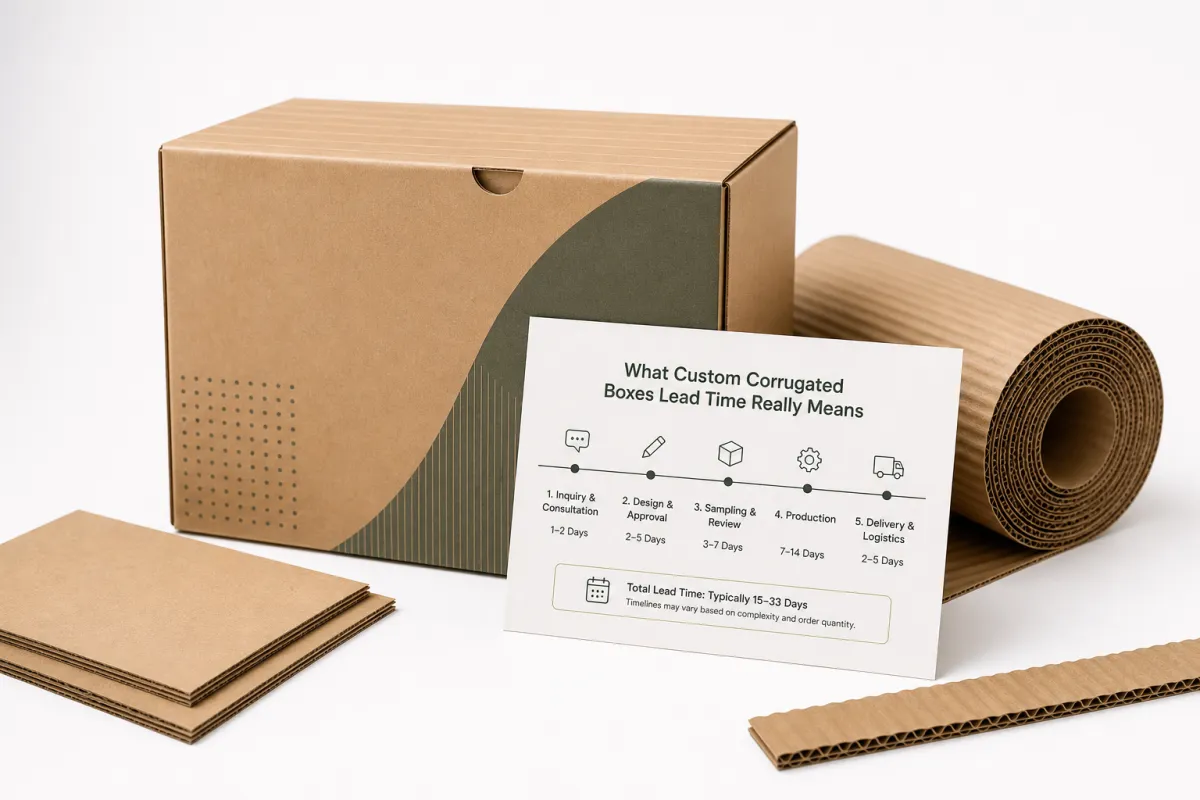
Custom corrugated boxes lead time usually happens in stages, not one giant block of time. That matters because some stages can overlap and some cannot. If you do not separate them, the calendar gets underestimated fast.
- Quote and feasibility review: Usually 1-2 business days if the specs are clear. If dimensions, quantity, or print coverage are vague, the quote can bounce back and forth longer.
- Structural review: Often 1-3 business days for a standard RSC or mailer, longer for heavy-duty custom builds, inserts, or unusual dimensions.
- Artwork prep and proofing: Commonly 1-4 business days. This is where a lot of custom corrugated boxes lead time gets lost, because one revision creates another review cycle.
- Production scheduling: If the plant is already queued, your job may wait 2-5 business days before it starts, even when approval is done.
- Printing, converting, and finishing: Usually 3-10 business days depending on print method, coatings, die-cutting, and whether inserts are part of the order.
- Shipping: Another 1-5 business days domestically, more if freight needs a liftgate, a dock appointment, or a long LTL route.
That is why two jobs with nearly identical box sizes can ship on very different schedules. One might use an existing dieline, one-color print, and a standard board. The other might need a new die, a specialty finish, and artwork changes that took three rounds to settle. Same category. Very different custom corrugated boxes lead time.
Repeat orders usually move faster. The dieline already exists, the art is already approved, and the vendor knows the previous spec. First-time jobs do not have that cushion. They need more checking, which means custom corrugated boxes lead time tends to be longer even when the order is not especially large.
Rush requests change the workflow, but they do not erase the workflow. A rushed order still needs complete information. If the artwork is messy, if the board grade is unclear, or if the delivery address keeps changing, custom corrugated boxes lead time will still slip. The only thing a rush request really buys is priority, and priority is not magic.
For repeat packaging design, the fastest path is usually to reuse the existing structure and change only what truly needs changing. That is why many buyers keep a library of approved specs for product packaging, retail packaging, and package branding. It keeps custom corrugated boxes lead time from being rebuilt from zero every time.
For a deeper starting point, the Custom Packaging Products catalog is useful when you want to compare structure options before you request a quote. If your project is shipping-focused, the Custom Shipping Boxes page can help narrow the field before the back-and-forth begins.
One more detail people miss: the proof stage and the production stage are not the same thing. A proof can be approved in an hour, but custom corrugated boxes lead time still includes queue time, tooling, and the actual run. If the plant is busy, approval does not teleport the order onto the machine. I wish it did. It does not.
What Changes Custom Corrugated Boxes Lead Time
Custom corrugated boxes lead time changes for a handful of predictable reasons, and most of them are not dramatic. They are boring. That is exactly why they get ignored until they create a problem.
- Board grade: A standard 32 ECT single-wall box is usually easier to source than a heavier 44 ECT or double-wall build.
- Box style: A regular slotted container is usually faster than a complex mailer, display-ready retail carton, or a box with custom inserts.
- Print complexity: One-color print is easier than full coverage, multi-color registration, or special effects.
- Coatings and finishes: Aqueous coating, varnish, soft-touch lamination, and spot treatment all add process time.
- Inserts and fitments: Extra dividers, pads, or trays mean more tooling, more checking, and a longer schedule.
- Test requirements: If the job needs drop testing, compression targets, or transit validation, custom corrugated boxes lead time usually stretches.
Unusual dimensions are another common drag. A box that is only slightly oversized on paper can create a sourcing headache if it does not fit standard sheet sizes well. That is where custom corrugated boxes lead time gets longer for no obvious reason. The job is still printable, but it is less efficient to run. Plants can make a weird size. They just do not enjoy it.
Artwork problems show up often. Low-resolution files, missing bleed, incorrect dieline layers, vague copy, and mismatched PMS colors can each add a day or two. Put three of those together and custom corrugated boxes lead time starts slipping while everybody waits for a "quick fix" that is never quick.
For branded packaging, clean art files matter because the print side is unforgiving. A nice-looking screen mockup does not tell the press operator where the bleed starts or whether a barcode will scan after the corrugation flutes shift the visual edge. Good package branding starts with files built for production, not just for a pitch deck.
Supply-side constraints matter too. Paper mill availability, converter queue time, and freight bottlenecks are the invisible part of custom corrugated boxes lead time. Buyers usually see the quote and the final ship date. They do not see the line of other orders sitting ahead of theirs, or the pallet space that ran out before the week did.
Quantity cuts both ways. A very small run can be easy to approve, but not always easy to slot into production because changeovers are inefficient. A larger run may be more attractive for the plant, but it also needs more board, more line time, and more freight planning. Custom corrugated boxes lead time is not a straight line between "small" and "fast."
There is also a quality-control layer. If the box is for retail packaging or direct-to-consumer use, the supplier may check fit, print registration, and transit durability more carefully. If your order is tied to shipping performance, it is worth asking whether the supplier references ISTA testing and transit validation practices; the International Safe Transit Association is the common place to start at ISTA.
For fiber sourcing, the board itself can matter as much as the print. If your brand needs certified paper claims, FSC-certified fiber is a practical detail, not a marketing garnish. See the Forest Stewardship Council at FSC if that is part of your packaging standard.
None of this means custom corrugated boxes lead time is unpredictable. It means the schedule is sensitive to input quality. Better inputs reduce surprises. Sloppy inputs create them. Packaging is rude that way.
Custom Corrugated Boxes Lead Time vs Cost: Where Pricing Moves
Custom corrugated boxes lead time and cost are tied together more tightly than most buyers want to admit. Faster schedules usually cost more because they interrupt normal production runs. There is no elegant way around that. Someone has to move the order up, and moving things up usually costs money.
| Option | Typical Lead Time | Typical Cost Impact | Best Fit |
|---|---|---|---|
| Standard unprinted corrugated | 5-8 business days | Lowest setup cost | Simple shipping needs, temporary launches, warehouse use |
| Single-color custom printed boxes | 7-12 business days | Moderate plate and setup cost | Branded packaging, simple product packaging, repeat runs |
| Full-color printed boxes with coating | 12-18 business days | Higher setup and finishing cost | Retail packaging, premium unboxing, strong package branding |
| Rush production with expedited freight | 4-8 business days | Highest premium overall | Launch deadlines, inventory gaps, retailer appointments |
What drives those numbers? Setup fees, tooling, print plates, labor, shipping method, and board selection. A new die can add $75-$250 or more depending on size and complexity. Plates may run $50-$150 per color. Expedited freight can add another $100-$500+, especially if you need LTL with special accessorials. Those ranges are directional, not a quote. Your plant, your lane, and your carton spec can move the number.
That is why custom corrugated boxes lead time is often cheaper when the order is less fussy. Standard board, one-color print, no coating, no inserts. That is the clean path. Add a soft-touch finish, a complex insert, and a last-minute freight change, and the quote stops looking friendly very quickly.
There is a point where paying more is the smart move. If a retailer appointment is fixed, if a product launch date is locked, or if a stockout is more expensive than the premium, then custom corrugated boxes lead time becomes a business-risk issue, not a packaging preference. Missing the date can cost more than the rush fee.
Cheaper is not always better. The lowest quote might reflect slower production, a less efficient board spec, or a freight plan that only works if nobody blinks. The fastest quote is rarely the cheapest. That is not a moral lesson. It is just how production math works.
If the budget is tight, the lever is usually design simplification. Reduce ink coverage. Remove a finish. Use a standard flute or board grade. Keep the structure standard and let the artwork do the heavy lifting. That approach often trims both price and custom corrugated boxes lead time without making the package look plain.
For buyers balancing both schedule and spend, the goal is not to find the magical low-cost rush option. It is to make the job easier to run. Easier jobs cost less. Easier jobs also tend to keep custom corrugated boxes lead time inside the window you promised your team.
Step-by-Step: How to Plan Your Box Order Without Delays
Custom corrugated boxes lead time improves when the planning is done in the right order. That sounds obvious, but a lot of delays come from doing the steps backward. People request quotes before they have a real spec, then wonder why every quote comes back with a different assumption.
- Lock the dimensions first. Internal size, fit allowance, and board thickness should be confirmed before design starts. If the product is fragile, add the clearance now instead of pretending it can be fixed later.
- Choose the structure. RSC, mailer, self-locking carton, tray, sleeve, or custom insert. Structure decisions affect custom corrugated boxes lead time more than most people realize because they drive tooling and print layout.
- Prepare the artwork for production. Use the correct dieline, bleed, safe area, and color values. Do not hand over a design file that only looks good on a screen.
- Set the approval chain. Marketing, procurement, legal, and operations should know their deadline before the proof is sent. If the proof sits in an inbox for three days, custom corrugated boxes lead time just got longer.
- Confirm freight details early. Delivery address, dock hours, liftgate needs, pallet count, and appointment requirements should be settled before production is done.
A spec sheet saves time because it keeps everyone from guessing. At minimum, it should include inside dimensions, board grade, print method, quantity, finish, delivery location, and whether the job is for shipping or retail packaging. If you want a supplier to compare apples to apples, give them the same job description every time.
It also helps to separate internal approval time from plant time. Those are not the same thing. A vendor might be ready to start in two days, but custom corrugated boxes lead time still depends on your own team approving proof lines, shipping terms, and final art. That is the part buyers often forget to budget for.
Build buffer into the schedule. If the box absolutely must arrive on Friday, do not approve the proof on Tuesday and hope for heroics. Give yourself margin for one revision, a freight delay, or a missed scan on the barcode. Planning like everything will go right is how people create avoidable emergencies.
For buyers comparing options, use the vendor's catalog to narrow the structure first and the finish second. The Custom Packaging Products page is useful for that, and the Custom Shipping Boxes category is a practical filter if your order is built around transit performance instead of shelf appeal.
Here is the order I recommend, plain and simple: finalize the structure, then the artwork, then the finish, then the freight method. That sequence keeps custom corrugated boxes lead time from getting tangled up in revisions that could have been avoided with one early decision.
- Quote approved: Same day to 2 days, if the spec is locked.
- Proof approved: Often 1-3 days, depending on how many stakeholders are involved.
- Production started: Typically after queue placement and tooling confirmation.
- Ship date confirmed: Confirm this before anyone assumes the job is done.
That checkpoint rhythm makes custom corrugated boxes lead time visible. Visible schedules are easier to manage. Invisible schedules are where deadlines go to get surprised.
Common Mistakes That Blow Up Custom Corrugated Boxes Lead Time
Most schedule problems are self-inflicted. That is the annoying part. Custom corrugated boxes lead time rarely blows up because the plant suddenly forgot how to make a box. It blows up because the order was not fully ready when it entered the queue.
The first mistake is requesting quotes before the spec is real. If the dimensions are still shifting, the quantity is not firm, or the print area is undecided, every quote becomes a moving target. Then the buyer compares numbers that were never based on the same job. That wastes time and guarantees confusion.
The second mistake is letting revisions drift without ownership. Someone changes the dieline. Someone else changes the copy. Another team switches the barcode placement. A few days later, custom corrugated boxes lead time is longer and no one can explain why. I can explain why: because the file never stopped changing.
The third mistake is leaving inserts, coatings, or shipping constraints for later. Those details are not decoration. They affect tooling, setup, and freight. If the order needs a divider set or a specific pallet pattern, say so early. Waiting until production has started is how custom corrugated boxes lead time gets expensive and awkward.
The fourth mistake is approving a proof too fast. A proof that looks clean can still hide a bad barcode placement, an unreadable caution note, or a fit problem that only shows up when the box is assembled. One bad approval can create the kind of delay that no amount of rushing can clean up later.
The fifth mistake is forgetting about payment and PO timing. Production may be ready, but the job cannot move if the PO is not issued or the payment approval is stuck in finance. That does not show up on the press sheet, but it absolutely shows up in custom corrugated boxes lead time.
If the spec is vague, the schedule will be vague too. Packaging teams do not need more optimism; they need better inputs.
There is also a subtle mistake that hurts branded packaging projects: using a consumer-facing mockup as though it were a print file. Pretty render, wrong format. That gap is one of the fastest ways to add avoidable days to custom corrugated boxes lead time. The art team thinks the file is ready. The plant disagrees. Everyone loses.
For product packaging that has to move through retail, the stakes are higher. A minor issue in print registration can turn into a shelf problem. A minor issue in transit testing can turn into damage claims. So the more visible the box, the more disciplined the file and proof process should be.
Expert Tips and Next Steps for Faster Turnarounds
Custom corrugated boxes lead time gets easier to control once the work is treated like a sequence of decisions, not one giant order form. Start with the structure. Then lock the dimensions. Then clean up the artwork. Then choose finishes. Then set freight. That order keeps the project from wobbling.
One practical tip: ask suppliers for a timeline map that separates approval time from production time. Those are different clocks. If you only ask, "How long will it take?" you get a fuzzy answer. If you ask, "How long for proofing, how long for production, and how long for shipping?" you get something usable.
Another practical move is to choose standard materials whenever the deadline matters more than the finish. A standard board grade, a common flute, and simple print can trim custom corrugated boxes lead time fast. Fancy is fine. Fancy just should not be the thing holding the schedule hostage.
If the box is for retail packaging, decide what actually needs to be premium. Sometimes the structure needs to be strong, but the print can stay simple. Sometimes the print needs to sell, but the coating can stay minimal. Not every box needs every bell and whistle. That is how people accidentally buy time-consuming packaging design choices they did not need.
For shipping-heavy programs, make sure the box is being judged on transit performance, not just appearance. There is a reason the industry still talks about board grade, compression strength, and drop tests. A pretty box that fails in transport is expensive theater.
If you need a practical source of materials or box styles, use the product pages to narrow the decision before the artwork work starts. That cuts down on revisions and keeps custom corrugated boxes lead time from getting padded by guesswork. It is less glamorous than a flashy mood board, but it works.
Here is the short version of what actually helps:
- Provide complete specs before asking for pricing.
- Use press-ready artwork with the correct dieline and bleeds.
- Approve quickly and keep the approval chain small.
- Pick standard materials if the timeline is tight.
- Tell the supplier the real deadline, not just the day you want to place the order.
That is the difference between a job that feels controlled and one that eats your week. Custom corrugated boxes lead time is not mysterious. It is just sensitive to bad input and late decisions. Clean those up, and the schedule usually behaves.
For buyers trying to keep branded packaging, custom printed boxes, and product packaging on schedule, the safest plan is boring in the best way: lock the spec, review the proof once, and approve with a buffer instead of at the last minute. If you do that, custom corrugated boxes lead time stops being a guessing game and starts acting like a real plan.
If the launch date matters, track custom corrugated boxes lead time from the first draft of the spec, not from the day you remember to ask for a quote. Work backward from the dock date, keep one owner on the approvals, and do not let the file keep wandering after it hits the vendor. That alone prevents a lot of nonsense.
How long is the typical custom corrugated boxes lead time?
It depends on complexity, but a straightforward order often moves faster than a printed box with coatings, inserts, or special construction. The biggest variable is usually approval speed, not machine time. Repeat orders with existing specs usually ship faster than first-time jobs. A clean, standard job can move in days; a fussy one can stretch well past that.
What can shorten custom corrugated boxes lead time the most?
Send complete specs up front: dimensions, board grade, print details, quantity, and delivery address. Use press-ready artwork and respond to proofs quickly. Standard materials and fewer late changes also help keep custom corrugated boxes lead time under control. If you only change one thing, make it the spec sheet. That is usually the bottleneck.
Does a rush order always cost more for custom corrugated boxes?
Usually yes, because rush jobs can disrupt scheduled production and freight planning. The premium is often driven by setup changes, overtime, or expedited shipping. If the order is simple and already spec'd, the rush surcharge may be smaller than expected. If the job is messy, the premium climbs fast.
Why do artwork approvals affect corrugated box lead time so much?
Production cannot start until the design is approved. Every revision adds another round of review and pushes the job back in the queue. File problems like missing bleeds, wrong colors, or unreadable text can add avoidable days to custom corrugated boxes lead time. The press does not care that the file looked fine on a laptop. It cares whether it can be built.
How should I plan if my custom corrugated boxes need to arrive on a fixed date?
Work backward from the delivery date and add buffer for proofing and freight. Lock the structure and artwork early, then set internal approval deadlines. Tell the supplier the date you must receive the boxes, not just the date you want to order, so custom corrugated boxes lead time is planned against the real deadline. That is the least glamorous answer, and also the one that works.

