Buyer Fit Snapshot
| Best fit | Custom Corrugated Boxes with Spot UV projects where brand print, material claims, artwork control, MOQ, and repeat-order consistency need to be specified before quoting. |
|---|---|
| Quote inputs | Share finished size, material target, print colors, finish, packing count, annual reorder estimate, ship-to region, and any compliance wording. |
| Proofing check | Approve dieline scale, logo placement, barcode or warning zones, color tolerance, closure strength, and carton packing before bulk production. |
| Main risk | Vague material claims, crowded artwork, missing packing details, or unclear freight terms can make a low unit price expensive after revisions. |
Fast answer: Custom Corrugated Boxes with Spot UV: Design, Cost, Fit should be specified like a repeatable production item. The safest quote records material, print method, finish, artwork proof, packing count, and reorder notes in one written spec.
Production checks before approval
Compare the actual filled-product size with the drawing, then confirm tolerance on folds, seals, hang holes, label areas, and retail display edges. Reserve space for logos, QR codes, warning copy, and material claims before decorative graphics fill the panel.
Quote comparison points
Review material grade, print process, finish, sampling route, tooling charges, carton quantity, and freight assumptions side by side. A quote is only useful when the supplier can repeat the same color, closure quality, and packing count on the next order.
Custom Corrugated Boxes with spot UV are one of the few packaging choices that can look expensive without acting fragile. The structure still has to survive shipping lanes, stack pressure, and the occasional rough handoff. The shine lands only where it matters, so the box gets attention without pretending to be a display prop. For branded packaging, that combination is hard to beat. For custom corrugated boxes with spot uv, the real craft is restraint.
A polished box can trigger the wrong assumption fast: premium means flimsy. The opposite is usually true. A well-built corrugated shipper can take abuse, hold its shape, and still create a strong first impression the moment it is opened. In practice, Custom Corrugated Boxes with spot uv work best when the board does the structural work and the finish handles the visual hook. That is packaging doing a job, not decoration pretending to be strategy.
Product launches, subscription kits, retail mailers, and influencer sends all ask the same question in different clothing. The question is not whether spot UV looks good. It does. The question is whether the artwork survives die cutting, folding, gluing, and transit without losing its edge. A logo that looked crisp on screen can turn muddy if the finish placement is sloppy. Custom corrugated boxes with spot uv either feel deliberate or they feel like a near miss. There is not much middle ground.
A sensible rule of thumb: choose custom corrugated boxes with spot uv when the package is part of the brand story and the customer will see the box before it disappears. Plain industrial shipping does not need it. Retail packaging, launch kits, and premium direct-to-consumer boxes often do. The finish pays for itself when the box is doing visible work.
For a wider sourcing comparison, it helps to line this format up against other Custom Packaging Products and a standard Custom Shipping Boxes build. Sometimes the smartest answer is a stronger board or a cleaner print layout. Sometimes the premium finish earns its keep. Sometimes it does not. Packaging decisions get expensive when every choice is treated like a status symbol.
What Are Custom Corrugated Boxes with Spot UV?
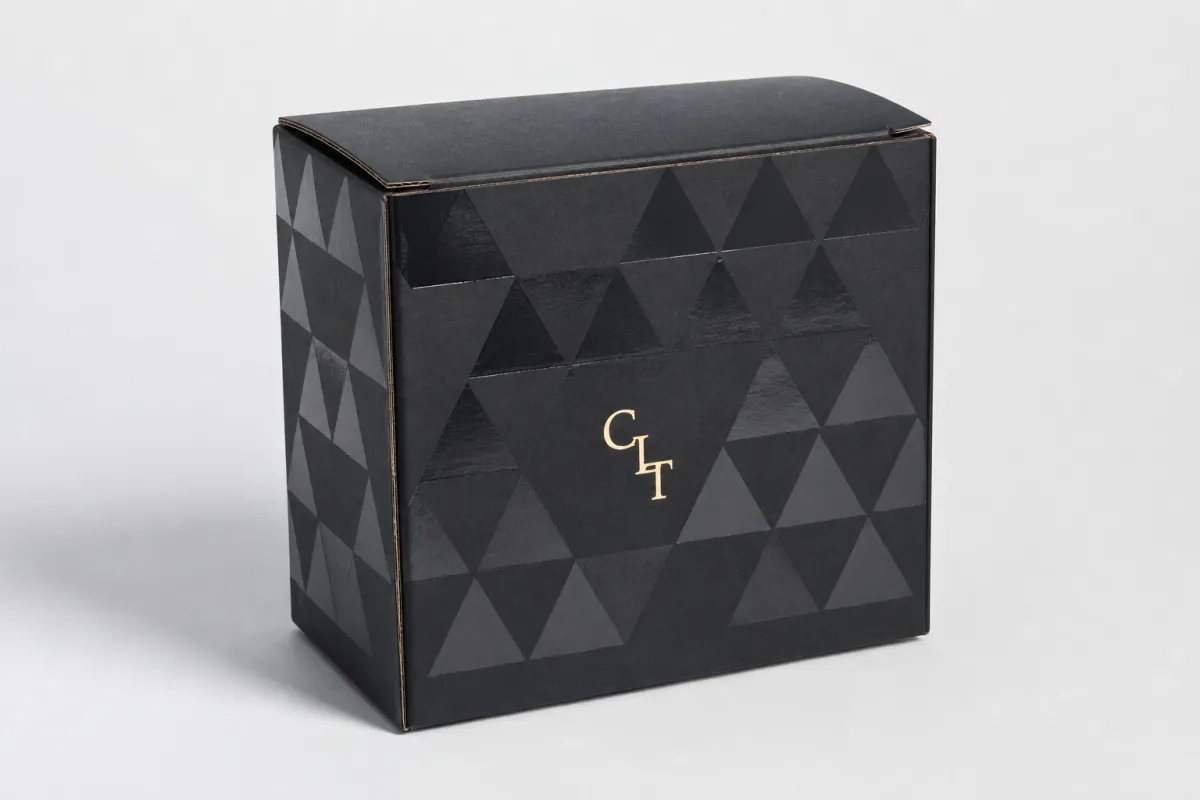
Custom corrugated boxes with spot uv are corrugated cartons finished with a clear glossy coating on selected parts of the artwork. Logos, icons, type, borders, or image details can catch the coating while the rest of the panel stays matte or uncoated. The effect is simple but sharp. Light hits the coated section differently, so the eye reads it first.
The structure beneath the finish is still corrugated board, which means strength comes from the flute, liner, board grade, and box style. That point gets missed often. The finish is visible; the board is doing the real labor. Custom corrugated boxes with spot uv only work because the underlying carton can handle stacking pressure, vibration, and shipping stress. The gloss is the accent, not the engine.
From a buyer’s perspective, that pairing is useful because protection and presentation stay in the same package. E-flute can create a cleaner retail feel. B-flute adds more cushion. Heavier boards step in for bigger loads. Then custom corrugated boxes with spot uv add a branding layer without pushing the box into brittle presentation territory. A package can look refined and still survive a courier route. That is the whole appeal.
Subscription boxes, beauty kits, tech accessory shippers, premium apparel packaging, gift sets, and launch samples all fit this format well. Retail Packaging That Ships to stores uses it too, especially when the opening face needs to look polished before the product ever reaches the shelf. If the carton will sit in a customer’s hands, on a counter, or in a photo, custom corrugated boxes with spot uv make sense.
Contrast drives the effect. A matte, lightly printed, or uncoated background gives the gloss room to stand out. Heavy artwork can swallow the finish. Dense color blocks, busy photography, and overcrowded linework often flatten the impact. The best custom corrugated boxes with spot uv usually look controlled, not loud. A box can have presence without trying to shout over itself.
Good packaging is a system. Board, print, finish, and assembly all have to work in the same direction. Push one piece too hard and the box starts to feel improvised, even if the artwork is polished.
People often ask whether custom corrugated boxes with spot uv are worth the extra cost. The better question is simpler: what does the box need to do first? If it must ship safely, structure wins. If it must signal premium value in one glance, finish matters. If it has to do both, custom corrugated boxes with spot uv sit in a very practical middle ground.
White-liner and clay-coated surfaces usually give a cleaner, crisper result than natural kraft. Kraft can still work beautifully, but the effect reads more restrained and earthy than high-gloss luxury. That difference matters. A skincare brand and an outdoor gear brand should not chase the same visual tone just because the coating is available. Packaging has to sound like the product, not like a template.
Spot UV often appears alongside embossing, foil, or soft-touch lamination, though it does not need those extras to feel premium. In many cases, custom corrugated boxes with spot uv look strongest when the design is disciplined and the coating is used sparingly. Quiet confidence tends to print better than overfilling every surface.
How Custom Corrugated Boxes with Spot UV Work
Production usually begins with the board, then moves into print, then the spot coating stage, then finishing. Depending on the printer setup, UV can be applied after the main print pass or through a separate coating step. The job stays the same either way: place a clear gloss only where the artwork calls for it.
The effect comes from reflection. A coated area catches light differently than the surrounding surface, so a logo can stand out without another ink color. That is why custom corrugated boxes with spot uv work so well for package branding. The package does not need more noise. It needs contrast, texture, and light doing the right thing at the right time.
A standard production stack might include linerboard, corrugated medium, print method, spot UV application, curing, die cutting, scoring, folding, and gluing. Nothing about that sequence is mysterious, and that is part of the point. The finish is only one step in a chain. If the artwork is poorly prepared, the coating will not save the job. It will only reveal the mistakes more clearly.
Some projects use printed sheets with a separate UV pass. Others rely on inline finishing or a combined process that keeps registration tighter. For custom corrugated boxes with spot uv, registration is critical because the coating has to land exactly on the planned artwork. A shifted gloss edge can make a logo look cheap in seconds. No one wants a halo around a brand mark.
Bold shapes usually perform better than tiny details. Large logos, clean icons, simple lines, and short text hits are easier to keep crisp. Very fine linework can break down on corrugated surfaces, especially if the liner has texture or the artwork is crowded near a fold. Custom corrugated boxes with spot uv reward clean decisions. They punish clutter.
Negative space matters more than many buyers expect. Leave the matte or uncoated area breathing room and the gloss will look sharper. The finish does not need to fight for attention across the whole carton. That is where a lot of custom printed boxes go wrong: too many effects, too little hierarchy, no clear path for the eye. The result feels busy instead of premium.
Designing in layers helps. Start with the box structure. Add the print image. Place the glossy hit. Then test the shipping reality. That order keeps the project grounded. Custom corrugated boxes with spot uv can look flawless in a mockup and still fail if the logo crosses a seam, the type is too small, or the coating lands too close to a flap. Production has a habit of exposing wishful thinking.
For surface treatment comparisons, the short version looks like this:
- Spot UV only gives a crisp contrast with a controlled budget.
- Matte plus spot UV usually creates the strongest premium look.
- Soft-touch plus spot UV adds a richer feel, though cost rises.
- Embossing plus spot UV adds tactile depth, but setup gets more complex.
Not every project needs the full mix. In fact, custom corrugated boxes with spot uv often look strongest when one idea is executed well rather than three ideas fighting each other. If the box will be seen from arm’s length or photographed on a desk, a simple glossy logo panel can carry the entire presentation.
Key Factors That Affect the Final Look
Board type shapes the result first. Kraft, white, and coated linerboards behave differently under spot UV. White or clay-coated liners generally produce the sharpest contrast because the gloss sits on a cleaner surface. Kraft can still work, but custom corrugated boxes with spot uv on kraft usually feel more natural and understated than dramatic. That may be exactly the right tone for a brand that dislikes flash.
Print coverage comes next. Dense ink coverage can create stronger drama, especially if the box uses a dark matte field with a bright gloss logo on top. Heavy artwork across the whole panel, though, can bury the effect. A box packed edge to edge with color and detail gives the gloss nowhere to breathe. Custom corrugated boxes with spot uv need open space or the finish disappears into the noise.
Surface pairing matters more than many buyers expect. Spot UV works best against something flatter. Matte lamination, soft-touch film, or an uncoated paper feel gives the gloss a place to stand out. If every surface shines, nothing feels special. That design truth shows up fast in custom corrugated boxes with spot uv, because the contrast either exists or it does not.
Artwork placement is another common pressure point. A glossy element too close to a fold, edge, seam, or glue flap can shift during assembly or show distortion after the carton is made. The risk rises on boxes with complex die cuts. Good die cutting supports the finish; bad die cutting fights it. Premium packaging is picky like that.
Durability matters too. A box that will be handled often, stacked in a warehouse, or shipped through several nodes needs a finish that can withstand contact. Spot UV is durable enough for many applications, but it is still a surface treatment. It should be tested under conditions that resemble the actual order, especially for subscription programs or direct-to-consumer product packaging.
Humidity, storage time, and freight conditions can alter the final appearance. A pallet left in a damp warehouse does not behave like a proof card on a desk. That is why custom corrugated boxes with spot uv should be judged as a system rather than as a single sample. A polished proof looks promising. A pallet of finished cartons tells the truth.
For a practical benchmark, these board choices come up often:
- E-flute for slimmer mailers and cleaner retail-looking panels.
- B-flute for more cushion and a sturdier shipping feel.
- 32 ECT for lighter loads and lower compression demands.
- 44 ECT or stronger for heavier items or tougher transit conditions.
If the aim is premium rather than flashy, keep the glossy accent limited to one or two focal zones. A logo on the lid. A pattern on the opening panel. A product name with a small secondary icon. That is often enough. Custom corrugated boxes with spot uv do not need to scream. They need to be noticed, then remembered.
For testing references, trusted bodies like the ISTA packaging test standards help with transit performance, while the FSC supports responsible fiber sourcing. Buyers do not need to memorize the acronyms. They do need to ask better questions before approving a run.
Process, Timeline, and Lead Time for Custom Corrugated Boxes with Spot UV
The workflow for custom corrugated boxes with spot uv is straightforward, but sloppy prep slows it down fast. It usually starts with a brief, then a dieline, then artwork setup, then proofing, then print and coating prep, then production, then final inspection. Miss a step, blur a specification, or leave a dimension vague, and the schedule starts slipping. Boxes are not mysterious. They are just unforgiving.
Bad input is the main reason projects lose time. Missing dimensions, low-resolution artwork, unclear finish placement, and half-finished revisions will slow a job far more than the coating itself. I have seen custom corrugated boxes with spot uv lose days because someone said “make the logo pop” and never marked the exact area. That is not direction. That is a wish with a budget attached.
Simple runs can move quickly once the artwork is approved. Custom sizes, complex structures, multiple print sides, and special finishing add days. A unique closure style, custom insert, or extra structural support requires more planning. If the design includes embossing or several glossy elements, setup time rises again. Custom corrugated boxes with spot uv reward clear decisions and punish backtracking.
Prototyping matters whenever the dimensions are tight or the branding must land in specific spots. If the logo has to line up with the lid front, sample it. If the box has an unusual tuck or locking tab, sample it. If the carton will be opened on camera, sample it. That sounds obvious, yet custom corrugated boxes with spot uv still get approved from PDFs every week, and then everyone acts surprised when the gloss lands a few millimeters off.
Leave room for freight, launch dates, and approval cycles. Holiday demand can push the schedule. So can a late artwork swap or a change in print coverage. For direct-to-consumer product packaging, extra time is cheaper than a missed launch. Perfect schedules are a comforting myth.
A practical timeline framework for custom corrugated boxes with spot uv looks like this:
- Spec and dieline: 1 to 3 business days if the size is clear.
- Artwork and proofing: 2 to 5 business days, depending on revision count.
- Prototype approval: 3 to 7 business days if a sample is needed.
- Production: often 10 to 15 business days after final approval for standard runs.
- Freight and receiving: add time based on distance, carton count, and season.
Those ranges are not promises. They are the practical ranges that keep launches from turning into apologies. Custom corrugated boxes with spot uv are easy to schedule when the information is complete and the job is not overcomplicated. Trouble tends to appear when everyone tries to save two days and loses two weeks.
Cost and Pricing for Custom Corrugated Boxes with Spot UV
Price comes down to a predictable cluster of variables: box size, board grade, print coverage, spot UV area, order quantity, structure complexity, and shipping method. Custom corrugated boxes with spot uv are not priced like plain shipping cartons because the finish adds setup and handling steps. The money goes into execution, not just paper.
The funny part is that the finish itself does not use much material. The cost increase usually comes from registration, prep, and finishing labor. In plain terms, custom corrugated boxes with spot uv cost more because they demand more careful work. Clean finishes rarely appear by accident. The team has to keep everything aligned, and alignment has a price.
Small runs carry higher setup costs per box. Large runs spread those costs out, so unit price usually drops as quantity rises. A run of 500 custom corrugated boxes with spot uv pays for flexibility. A run of 5,000 or 10,000 tends to bring the price into a friendlier lane. That is how print economics behave, whether the quote likes it or not.
The smartest budget move is usually not to remove the premium effect. It is to focus it. Put the gloss on the lid logo, the hero icon, or the opening face. Leave the rest of the carton calm. Custom corrugated boxes with spot uv that concentrate the coating on high-visibility zones often look cleaner and cost less than full-panel gloss with little visual payoff.
Here is a practical comparison table for buyers building a quote:
| Box Style | Typical Finish | Best Use | Approx. Unit Range at 1,000 pcs | Approx. Unit Range at 5,000 pcs |
|---|---|---|---|---|
| Printed corrugated mailer | Full print, no premium finish | Basic branded shipping | $0.55-$1.10 | $0.28-$0.62 |
| Matte printed box with spot UV | Gloss accent on logo or panel | Retail packaging, premium mailers | $0.78-$1.45 | $0.38-$0.82 |
| Soft-touch box with spot UV | Velvet feel with gloss contrast | Beauty, tech, gift sets | $0.92-$1.75 | $0.45-$0.95 |
| Heavy-duty shipper with spot UV | Stronger board, limited accent finish | Heavier product packaging | $1.10-$2.10 | $0.60-$1.25 |
Those figures are planning ranges, not quotes. Even so, they help buyers avoid fantasy budgeting. A small run of custom corrugated boxes with spot uv can look expensive per unit because setup costs have nowhere to hide. A larger run usually lowers the unit cost enough to make the finish feel much easier to justify.
There are hidden cost traps too. Rush production can trigger fees. Repeated artwork revisions consume time and money. Oversized cartons raise freight. Full-panel spot UV sounds dramatic until the quote arrives and the shine costs more than the structure underneath it. Custom corrugated boxes with spot uv should earn their premium through visible impact, not wasted coverage.
If you are choosing between finishes, ask what the customer sees first. The opening panel? The logo on the lid? The inside print? Put the effect there. If the box is part of a retail display or influencer mailer, the first photo matters. If the box is mostly a shipping vessel, keep the finish tight. That is the cleanest way to balance branded packaging and budget.
For buyers comparing options across a larger program, it helps to review other Custom Packaging Products alongside custom corrugated boxes with spot uv. Sometimes the cost difference earns its keep. Sometimes a simpler custom printed box with a cleaner structure does the job better. Spend where the customer notices. Save where the customer never looks.
Common Mistakes with Custom Corrugated Boxes with Spot UV
The first mistake is covering everything in gloss and calling it premium. It usually reads as busy rather than elevated. Custom corrugated boxes with spot uv are strongest when the gloss acts like an accent, not a blanket. Once the whole surface shines, contrast disappears and the design loses its punch.
The second mistake is chasing tiny details. Thin lines, small type, delicate icons, and crowded micro-patterns can lose clarity on corrugated surfaces. Board texture and registration limits soften the result. Custom corrugated boxes with spot uv need clean shapes and enough scale to survive production. If the logo needs a microscope, it is too small.
The third mistake is ignoring the dieline. Artwork that crosses a fold or lands too close to a seam can shift when the box is made, folded, or glued. A good idea can still fail if the structure is treated like an afterthought. Good packaging design respects the carton. Custom corrugated boxes with spot uv are not posters. They move, crease, and close.
The fourth mistake is skipping a physical sample. Digital proofs help, but they do not show how light behaves across the finish, how the board feels in hand, or how the gloss sits beside matte areas. Custom corrugated boxes with spot uv should be reviewed on a real sample before a full run. You would not buy shoes by looking only at the silhouette. The same logic applies here.
The fifth mistake is focusing only on decoration. If the box is weak, too large, hard to assemble, or awkward to pack, the finish will not rescue it. People sometimes treat custom corrugated boxes with spot uv like makeup for bad engineering. That is a bad trade. Structure first. Finish second. Mood board last.
Sustainability can get mishandled too. Not every premium-looking box needs every premium-looking effect. Over-finishing adds waste and complicates recycling more than necessary. If recycled content, FSC sourcing, or simpler end-of-life behavior matters to your buyer, keep the spec disciplined. Custom corrugated boxes with spot uv can still fit a responsible packaging strategy if the rest of the build stays sensible.
Another common issue shows up when teams approve a single hero angle and ignore the whole carton. That works until the side panel looks unfinished, the back panel gets cramped, or a fold line cuts through the logo. Retail packaging and shipping packaging both need the whole object considered. A pretty front face helps. A coherent box matters more.
Use this quick prevention checklist:
- Keep glossy areas large enough to read from arm’s length.
- Leave safe space away from folds, seams, and glue zones.
- Use a sample before production approval.
- Match the board grade to product weight and transit stress.
- Design the entire carton, not just the panel shown in the mockup.
Those checks remove a lot of risk. They turn custom corrugated boxes with spot uv into a controlled branding tool instead of a gamble dressed up as a purchase order. That matters, especially for product launches and seasonal campaigns where there is no room for avoidable mistakes.
Expert Tips for Better Results and Next Steps
Use spot UV as a signal, not a costume. One strong glossy logo hit often does more work than coating half the box. Custom corrugated boxes with spot uv feel premium when the shine is selective and confident. Spread the gloss everywhere and the design starts to wobble.
Design for viewing distance. Most recipients see the box from a few feet away before they touch it, and many customers meet it first through a photo or video. The glossy element should read from arm’s length. The first impression of custom corrugated boxes with spot uv is usually a silhouette, a logo, and a contrast cue. Build for that moment.
Match the finish to the category. Beauty, skincare, tech accessories, gift sets, and subscription packaging usually benefit from clean contrast and controlled shine. Rugged industrial products often do not need it. Understated branding can still use a glossy accent, but it should stay disciplined. Custom corrugated boxes with spot uv are flexible, not magical.
Think about the inside experience too. The outside can carry the premium signal, while the interior stays efficient or features a simpler printed message. That split often gives the best value. Every panel does not deserve the same budget. Spending evenly across a box is often the least interesting choice available.
For projects that may grow, begin with a pilot run. A smaller order lets you test fit, fold performance, print clarity, and finish behavior before committing to larger volume. If the product changes, the insert changes, or the shipping profile changes, it is easier to adjust early. Custom corrugated boxes with spot uv are much easier to refine on a pilot than on a pallet of regret.
A practical launch sequence looks like this:
- Lock the box size and flute grade.
- Request the dieline and place the artwork carefully.
- Mark the spot UV zones with exact notes.
- Approve a sample, not just a PDF.
- Compare one alternate finish or board option before final sign-off.
That sequence cuts guesswork sharply. It also makes it easier to decide whether custom corrugated boxes with spot uv are the right fit or whether another finish belongs in the mix. Sometimes a clean matte print is enough. Sometimes a soft-touch box with one gloss accent is the better answer. Sometimes the smarter move is to keep the shipping carton simple and put the premium spend into the insert or the retail sleeve.
If you are building a broader packaging line, custom corrugated boxes with spot uv can sit beside other custom printed boxes without creating visual clutter, as long as the brand rules stay consistent. One finish system. One color logic. One hierarchy. That is how a package suite looks intentional instead of improvised.
My blunt advice: do not chase fancy for its own sake. Chase fit, function, and visual clarity. Then use the gloss to sharpen the story. That is how custom corrugated boxes with spot uv stop feeling like a novelty and start doing actual branding work. And yes, that takes a little discipline, which is kinda the point.
FAQ
Are custom corrugated boxes with spot UV strong enough for shipping?
Yes, if the board grade and flute type match the product weight and transit conditions. Spot UV is a surface finish, not a structural layer, so the strength still comes from the corrugated build. For heavier or fragile items, ask about crush resistance, wall thickness, and insert options before getting attached to the shine. That sequence keeps the project grounded.
What artwork works best on custom corrugated boxes with spot UV?
Bold logos, clean geometric patterns, large icons, and short text hits usually perform best. Very fine linework and tiny typography can lose clarity once the coating is applied, especially on rougher liners. A matte background with a glossy accent usually gives the strongest result for custom corrugated boxes with spot uv, because the contrast does the heavy lifting.
How much do custom corrugated boxes with spot UV usually cost?
Pricing depends on size, quantity, print coverage, board type, and how much area gets coated. Small runs carry higher setup cost per box, while larger orders usually reduce the unit price. For planning, custom corrugated boxes with spot uv often land in the ranges shown earlier, but the cleanest way to control price is to keep the gloss focused on one or two high-visibility areas.
What is the typical lead time for custom corrugated boxes with spot UV?
Lead time varies by quantity, structure complexity, proofing speed, and whether a prototype is needed. Simple projects move faster after artwork approval, while custom sizes, multiple revisions, or special finishing can add days. Build in extra buffer if custom corrugated boxes with spot uv are tied to a launch, seasonal campaign, or a freight deadline that will not care about your optimism.
Can I use spot UV on kraft custom corrugated boxes?
Yes, but the effect is usually more subtle because kraft has a natural texture and darker base tone. Designs with strong contrast and simple artwork tend to work better on kraft than delicate details. If maximum shine contrast matters, white or coated linerboards usually give a more dramatic result. If the goal is understated branded packaging, kraft with custom corrugated boxes with spot uv can look excellent without trying too hard.
What is the smartest first step before placing an order?
Start with the box size, the product weight, and the exact spot UV placement. Then request a dieline and a sample before final approval. That sequence saves money, avoids structural mistakes, and keeps custom corrugated boxes with spot uv from turning into a guess dressed up as a purchase order. If the sample looks right and the fit works, the rest of the run is usually much easier to trust.

