Buyer Fit Snapshot
| Best fit | Custom Corrugated Mailer Trays projects where brand print, material claims, artwork control, MOQ, and repeat-order consistency need to be specified before quoting. |
|---|---|
| Quote inputs | Share finished size, material target, print colors, finish, packing count, annual reorder estimate, ship-to region, and any compliance wording. |
| Proofing check | Approve dieline scale, logo placement, barcode or warning zones, color tolerance, closure strength, and carton packing before bulk production. |
| Main risk | Vague material claims, crowded artwork, missing packing details, or unclear freight terms can make a low unit price expensive after revisions. |
Fast answer: Custom Corrugated Mailer Trays: Film, Print, MOQ, and Carton Packing should be specified like a repeatable production item. The safest quote records material, print method, finish, artwork proof, packing count, and reorder notes in one written spec.
Production checks before approval
Compare the actual filled-product size with the drawing, then confirm tolerance on folds, seals, hang holes, label areas, and retail display edges. Reserve space for logos, QR codes, warning copy, and material claims before decorative graphics fill the panel.
Quote comparison points
Review material grade, print process, finish, sampling route, tooling charges, carton quantity, and freight assumptions side by side. A quote is only useful when the supplier can repeat the same color, closure quality, and packing count on the next order.
Custom Corrugated Mailer trays solve a packaging problem that looks simple until the first damage claim lands on your desk: how do you hold product, present it cleanly, and keep fulfillment moving without adding loose parts, unnecessary dunnage, or extra handling steps? For brands trying to cut plastic, reduce clutter, and make the opening moment feel deliberate, custom corrugated mailer trays can do the work of an insert and part of the presentation layer at the same time. That makes them relevant to sustainability targets and to daily packout speed, which is a combination generic inserts often miss.
They show up in more places than most buyers expect. Subscription kits need repeatable placement so every box opens the same way. Cosmetics need upright bottles, protected shoulders, and sharp presentation. Small parts need a layout that prevents mix-ups before the carton is closed. Food-service assortments need to stay square through storage and transit. From the packaging buyer’s side, a tray is never just corrugated. It is a fit problem, a protection problem, and a labor problem wrapped into one design decision. A good tray changes the pace at the packing table. A bad one creates small delays that compound into real cost.
A tray should do three jobs at once: hold the product, protect it, and speed up packout. If it only does one, the structure is probably carrying too much material for too little return.
The larger system matters too. A tray performs best as part of a package, not as a standalone part with no context. In practice, that means evaluating it with Custom Packaging Products, the outer carton, and the shipping method the order will actually take. The result can be tighter product packaging and more controlled retail packaging, especially when package branding needs to feel polished without turning every panel into a print-heavy billboard.
Why custom corrugated mailer trays matter in shipping
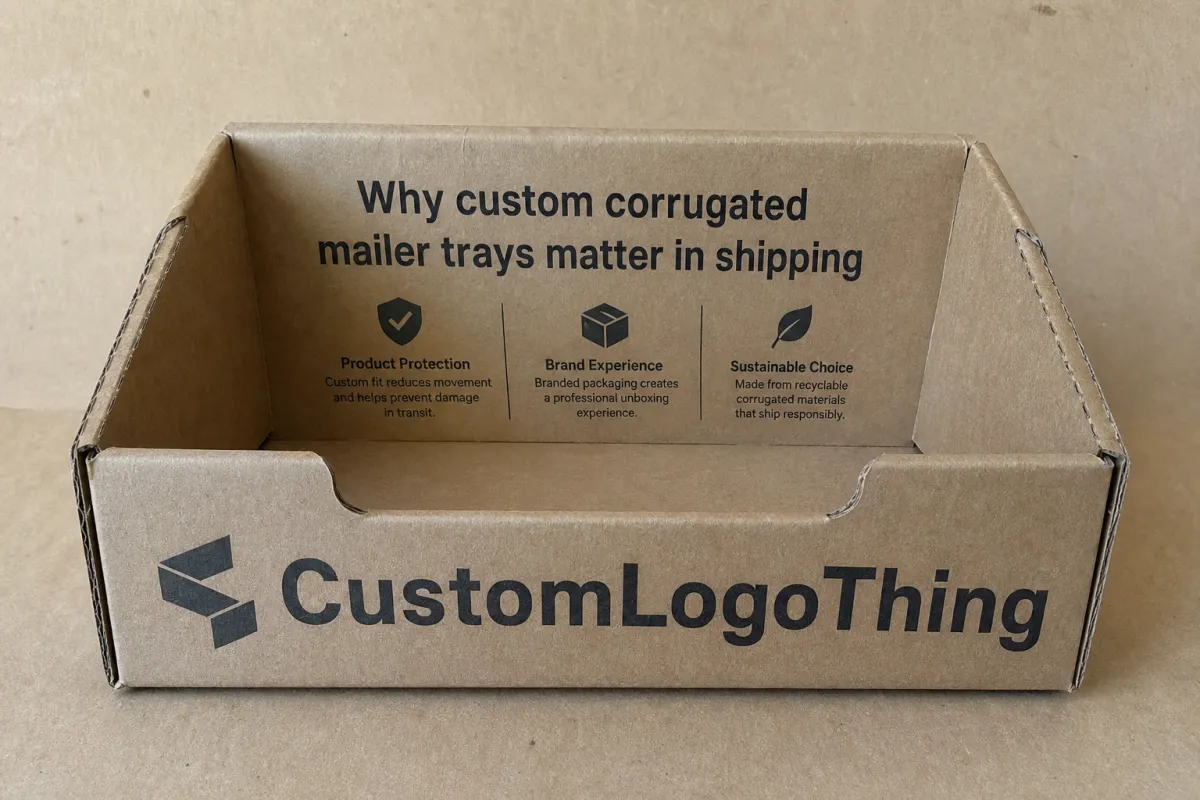
The easiest way to understand a tray is to look at what it replaces. In many packouts, one component centers the item, another protects the edges, and a third creates the branded reveal. Custom Corrugated Mailer trays can absorb more than one of those jobs, which is why they often reduce material use while improving presentation. A well-built tray can cut void fill, reduce plastic inserts, and remove loose parts that slow the line or make the customer experience feel improvised.
For a subscription box, that can mean the product lands in the same orientation every time, with less rattling and less chance of a shifted insert. For cosmetics, it can keep a bottle or jar upright without a foam nest. For parts and hardware, one tray can hold several SKUs in a repeatable layout so the fulfillment team does not have to sort on the fly. For food-service items, the gain is usually cleanliness and speed: fewer wraps, fewer moving pieces, fewer chances for a crushed corner or a dented lid.
There is also a sustainability angle that goes beyond marketing copy. Fiber-based structures are easier to explain than mixed-material packaging, and in many regions they are easier to recycle when the construction stays simple. That does not mean every tray is recyclable in every market. It does mean corrugated usually gives brands a clearer story than hybrid inserts built with adhesives, plastic windows, or bonded foam. The Environmental Protection Agency has useful guidance on contamination and material recovery at EPA recycling guidance, and the practical message is plain: end-of-life depends on both the material and the local collection system.
From a buyer’s point of view, the real payoff is often less dramatic and more measurable: fewer packout errors, lower damage rates, and less time spent adding dunnage by hand. That can matter as much as the carton itself. A tray that fits the product and the mailer footprint correctly can remove steps from the line, and those saved seconds turn into real labor savings over thousands of units. In a 20,000-unit program, even a six-second reduction per packout adds up to more than 33 labor hours.
The phrase to keep in mind is system thinking. A tray should not be judged only by its material cost. It should be judged by what it changes across the full packout: how much it stabilizes the load, how much it supports branding, how much filler it replaces, and how well it works with Custom Shipping Boxes or a branded outer mailer. That is where thoughtful package branding starts to look like a commercial advantage instead of a decorative choice.
How custom corrugated mailer trays work inside a packout
Inside a finished packout, a tray is doing structural work that is easy to miss if you only look at the dieline. Board choice, flute direction, fold geometry, and friction points all affect whether the product stays still or shifts under vibration. A good tray uses those mechanics to create a cradle, a stop, or a nest around the item. The outer mailer then becomes part of the load path instead of a shell around a loose insert.
That distinction matters. When the tray and the mailer are engineered together, the package behaves like a system rather than a pile of unrelated parts. The tray can add compression resistance, help distribute top load, and reduce side-to-side movement. It can also improve visual order, because a product that sits squarely in the tray usually looks more premium when the customer opens the box. In branded packaging, that small alignment shift can change the first impression more than another printed panel ever will.
Open trays and closed trays solve different problems. An open tray is easier to load and often easier to inspect, which is useful for kitting and high-speed fulfillment. A closed tray gives more surface contact and can hold small or irregular items better, especially when the outer carton will see rough handling in transit. In many programs, a one-piece die-cut tray is the better answer because it is faster to convert, simpler to recycle, and less likely to create assembly friction. A glued assembly can still make sense when the geometry is complicated or when the brand wants a more exact presentation face.
One-piece designs usually win on speed and end-of-life simplicity. Glued or multi-piece assemblies may offer stronger structure, but they can add handling time, more chances for misfolds, and more points of failure during approval. There is no universal winner. The right choice depends on product weight, the shipping route, the assembly skill on the line, and whether the tray needs to function as retail packaging after the customer receives it.
The practical question is not, “Does it look clever?” It is, “Does it keep the product safe while making the packout easier to repeat?” That is why corrugated trays are often part of a broader product packaging strategy instead of a one-off insert. They can reduce returns when they prevent scuffs, loosened caps, dented corners, and broken components that would otherwise trigger replacement shipments. Fewer returns are not only a service win; they are also a waste reduction win.
Where the tray earns its keep
In real packouts, the tray earns value at three points: loading, transit, and unboxing. During loading, it can present the product in a predictable orientation. During transit, it can keep the item from migrating inside the mailer. At the customer’s table, it can make the contents feel organized rather than improvised. That last part is easy to underestimate, yet it often separates packaging that feels intentional from packaging that feels generic.
If the shipment is fragile or premium enough to justify testing, teams often compare the tray-mailer combination against transit profiles used in ISTA test methods or against ASTM-style drop testing. Those references do not guarantee success, but they do give everyone a shared language for risk. A tray that looks perfect in CAD but fails in a real drop, vibration, or compression sequence is not ready for production, no matter how clean the drawings are.
There is a reason experienced packaging teams insist on physical samples. Corrugated behaves differently once it is folded, creased, loaded, and closed inside the final carton. A pocket that looks generous in a drawing can become tight once board thickness and product tolerances are accounted for. The reverse happens too: a design that appears snug on screen can leave too much movement in the finished packout. That gap between the concept and the hand-built sample is where many preventable issues are found.
Key factors that shape performance, fit, and protection
Product dimensions come first. Weight comes second. Center of gravity comes third. If a tray is built around the wrong assumptions in those three areas, everything else gets harder. A lightweight item with a high center of gravity may tip even if the footprint is correct. A dense item with sharp edges may punch through weak board. A mixed set of components may need separate pockets or a stepped geometry instead of one flat cavity.
The board grade and flute profile are the hidden variables that change the outcome. E-flute is often chosen for finer print and a slimmer profile; B-flute can offer better crush resistance; double-wall structures may be justified when stack strength or long-distance distribution is part of the brief. Caliper matters because it affects not only strength but also how the tray fits inside the outer carton. Too thin, and the tray can flex or collapse. Too thick, and the mailer footprint can become crowded, forcing awkward folds or extra paperboard use.
Here is the part buyers sometimes miss: the cheapest board is not always the cheapest outcome. If a lighter sheet leads to scuffing, box failure, or crushed product, the replacement cost can wipe out the savings quickly. The same is true for moisture and temperature swings. Corrugated is fiber-based, which makes it practical and recyclable, but it still reacts to humidity. Warehouses, cross-docks, and summer delivery routes can all change how the tray behaves. Compression performance can drop enough to matter once humidity climbs, especially with lighter board grades.
Branding sits behind structure, not ahead of it. Print is valuable, especially when the tray contributes to a polished reveal or reinforces package branding at the moment the box opens. Still, print coverage should be treated as a secondary decision after protection and material efficiency are solved. A minimal print spec on a well-engineered tray often beats a heavily printed tray that needs too much board or too much ink coverage to stay economical.
If sustainability is part of the decision, the claim needs to be specific. Recycled content, recyclability, and source certification are not the same thing. A tray can be recyclable but contain no post-consumer recycled content. Another can use recycled fiber but still face local contamination issues if it is glued, laminated, or paired with non-fiber components. FSC-certified sourcing can support responsible fiber procurement, but it does not replace the need to think about what the tray actually does on the line.
For a lot of programs, the strongest spec comes from a short list of controlled variables:
- Product dimensions with tolerances, not just nominal size.
- Weight per unit and total packout weight.
- Ship method such as parcel, LTL, or retail-ready distribution.
- Exposure risk including humidity, stack load, and temperature swings.
- Assembly time target per unit for the fulfillment team.
- Print and branding requirements that do not compromise structure.
If those variables are unclear, the tray spec will drift into guesswork. That is where many packaging design projects lose time. Teams talk about sustainability, but they do not define the shipping environment. They ask for branded packaging, but they have not agreed on the level of print coverage. They want fewer materials, but they have not said what the damage threshold is. Better inputs produce cleaner tray designs.
It also helps to name the handling environment with some precision. A tray intended for a subscription kit moving through parcel carriers does not need the same structure as one riding in a retail replenishment lane or a regional distribution network. A design that survives one route may not be efficient on another. That is not a failure of corrugated; it is a reminder that the shipping lane is part of the specification.
Production process and lead time: how to spec custom corrugated mailer trays
Good tray programs start with discovery, not a dieline. Before anyone sketches a layout, the supplier should understand the product sample, the outer carton or mailer footprint, the shipping method, and the sustainability target. If the product is fragile, the team should also define what failure looks like: scuffing, corner crush, leakage, movement, or outright breakage. That definition determines how aggressive the tray structure needs to be.
From there, the process usually moves through concept, prototype, sample approval, testing, revision, and final production sign-off. Each step sounds straightforward until you get into the details. A concept can be technically correct and still load too slowly. A prototype can fit the product and still fail on line because the fold sequence is awkward. A sample can pass a bench test and still fail once the outer shipper is added. Packaging development is often about removing those surprises before a full run starts.
- Share the basics - product dimensions, photos, weight, product fragility, and target ship method.
- Confirm the packout - tray only, tray plus mailer, or tray inside a larger retail-ready carton.
- Select materials - flute type, board grade, print coverage, and any recycled-content target.
- Prototype quickly - use a physical sample to check fit, hand-feel, and loading speed.
- Run tests - compression, drop, vibration, or route-specific trials where they matter.
- Lock the spec - approve the artwork, dieline, and production tolerances before ordering.
Lead time depends on complexity, capacity, and how many rounds of adjustment the project needs. Simple trays can sometimes move from approved measurements to production in roughly 10-15 business days after sign-off if standard materials are in stock and the cut is uncomplicated. More engineered programs, especially those with print, special board, or multiple sample rounds, often run closer to 3-6 weeks. If the project needs custom tooling, special coatings, or structural testing, more time should be budgeted.
A faster project usually has one thing in common: the buyer brought accurate information early. That may sound mundane, but it is where many timelines slip. Missing dimensions, unclear fold orientation, unapproved artwork, and changed product weights all slow the process. If the supplier has to guess, the sample count rises and the calendar stretches.
One useful rule: treat the first sample as a measurement tool, not a final answer. It should tell you whether the cavity depth is right, whether the tray locks cleanly, and whether the package still closes with reasonable tolerance. It should also reveal whether a line operator can build the tray repeatedly without stopping to interpret the design. That kind of feedback is often more valuable than an attractive mockup.
What to send before asking for a quote
Think of the supplier brief as a small evidence packet. It Should Include the product sample if possible, the exact outer mailer or carton dimensions, the expected annual volume, the target shipping channel, and any need for retail display or shelf readiness. If you already know whether the tray must work with custom printed boxes or a simpler shipper format, say so. The quote will be cleaner, and the sample will be closer to reality.
It also helps to share the operating constraints. For example: “Assembly time must stay under 12 seconds per unit,” or “The tray has to survive a 36-inch drop without product shift,” or “We need a recycled-fiber spec that can support current sustainability reporting.” Those details turn a vague packaging request into an engineering brief that someone can actually build from.
If the supplier is expected to help with testing, send the route details as well. Parcel and LTL are not interchangeable. A tray that performs well in a short parcel journey can react differently when stacked on a pallet for regional distribution. The more specific the shipping environment, the less likely the final structure will be overbuilt or underbuilt.
Cost and pricing: what drives unit cost and MOQ
Pricing for corrugated trays is usually driven by five levers: size, board grade, cut complexity, print coverage, and order quantity. If the tray is small, simple, and unprinted, the unit cost can stay relatively low. If it includes multiple cavities, tighter tolerances, heavy graphics, or special board, the price climbs quickly. That is not a flaw in the market. It is the cost of turning flat fiber into a precise protective structure.
The minimum order quantity matters because setup costs have to go somewhere. A supplier may have to cover sampling, design work, tooling, die cutting, and production changeover before the first tray ever ships. Spread across 10,000 units, those costs are easier to absorb. Spread across 500 units, they can make the first order feel expensive. That is why small programs sometimes look cheaper on paper with a generic insert, even though the total system cost may be worse once damage and labor are included.
Simple constructions and engineered tray formats also price differently. A basic roll-end or tuck-style tray can be efficient if the geometry is forgiving. A tray with multiple folds, locking tabs, product-specific cavities, or integrated display faces takes more design time and more production control. Add print, and the quote can shift again because ink coverage, color matching, and press setup all change the economics.
| Tray Type | Typical Use | Approx. Unit Cost at 5,000 Pieces | Setup Complexity | Notes on Sustainability and Handling |
|---|---|---|---|---|
| Simple die-cut tray | Lightweight kits, parts, and low-risk product packaging | $0.18-$0.30 | Low | Often fast to convert; a good candidate for single-stream corrugated fiber if the design stays simple. |
| Engineered cavity tray | Cosmetics, bottles, mixed SKUs, and tighter fit requirements | $0.28-$0.48 | Medium | Better product control and presentation, but more board shaping and stricter sample approval. |
| Printed branded tray | Retail packaging, subscription kits, premium mailers | $0.35-$0.65 | Medium to high | Supports package branding and unboxing, though print coverage can raise cost and change lead time. |
| Double-wall or heavy-duty tray | Heavier goods, long transit lanes, stack-loaded shipments | $0.45-$0.90+ | High | Stronger compression resistance; often justified when damage risk is more expensive than board. |
Those numbers are ranges, not promises. Board market swings, freight, labor, and regional capacity all affect the quote. Still, they are useful because they give buyers a frame of reference. If a quote comes in far outside the range, the first question should be: what is different about the structure, the board, or the service level?
Hidden expenses matter too. Freight can be material if the trays are bulky or ship on low-density pallets. Warehousing can matter if finished trays take up more space than a flatter design would. Assembly labor can matter even more if the tray is tricky to set up. Damage-related replacement costs can erase the savings from a cheap quote in a hurry. A tray that saves two cents but increases returns is not a savings program.
To compare quotes fairly, keep the following identical across suppliers:
- Same product dimensions and tolerances.
- Same board grade and flute profile.
- Same print coverage and color count.
- Same ship method and test requirement.
- Same quantity and delivery window.
That looks basic, but it prevents false comparisons. One supplier may be quoting a heavier board or a more refined fold sequence. Another may be excluding sample work. A third may be assuming no testing. Apples-to-apples comparison is the only way to tell whether the lower number is truly lower or just less complete.
Buyers also tend to undercount the cost of rework. If a tray requires hand-adjustment during packing, the labor delta can overwhelm a small unit-price advantage. The same is true if the package performs acceptably in the warehouse but fails after the first carrier handoff. A quote only matters once it survives real operating conditions.
Common mistakes when ordering custom corrugated mailer trays
The most common mistake is designing to the product alone and ignoring the outer shipper, cushioning needs, and fulfillment line. A tray can fit the item perfectly and still fail if the mailer is too loose or the packout uses too much dead space. Packaging lives in context. The tray is only one part of the system, and the outer box or mailer can amplify weak decisions just as quickly as it can support strong ones.
Another frequent error is under-specifying board grade. Buyers sometimes shave cost by choosing a lighter sheet, then pay for it later in breakage, scuffing, or collapsed corners. This shows up quickly in retail packaging where appearance matters. It also shows up in shipping, where the customer may never see the tray until the product has already been damaged. A lighter board is not automatically wrong, but it should be chosen with eyes open.
Over-engineering is the other side of the same coin. Extra folds, extra layers, and extra material can create more waste than protection. They also slow loading and can make the finished packout feel clumsy. If a tray is complicated enough that the fulfillment team needs repeated coaching, the design may be solving a technical problem by creating an operational one. That is a poor trade.
Vague artwork causes trouble too. If the dieline is unclear, the print file is not aligned to the folds, or the labeling requirement is not documented, approvals stall. Production rework is usually more expensive than the original mistake. It also creates frustration because the whole schedule has to shift for a problem that could have been caught earlier with a sample or a proof.
And then there is the easy-to-miss issue of testing the wrong thing. A tray may look fine as a CAD drawing. It may even feel fine in your hand. None of that proves it will survive the warehouse, the carrier, and the customer’s desk. Real packouts need real trial runs. Put the tray in the mailer. Load the exact product. Move it through the same handling sequence the actual shipment will face. If the product shifts, crushes, or scuffs, the design is not ready.
A practical failure checklist can save time:
- Does the product move when the carton is shaken?
- Do corners or caps touch the outer wall?
- Can the packer load the tray without force or guesswork?
- Does the tray remain stable after a drop or compression event?
- Is the finished package still on-brand after real handling?
If any answer is shaky, the tray needs adjustment. Sometimes that means a heavier board. Sometimes it means changing the cavity depth. Sometimes it means redesigning the outer shipper as well. The right fix depends on the failure mode, not just on the budget.
One more mistake deserves mention because it is so common: teams approve a tray before they have agreed on the exact product tolerance. That leaves too little room for manufacturing variation, and the result is a packout that works on one sample but not on the full run. Corrugated is forgiving in some ways, but not forgiving enough to make tolerance math optional.
Expert tips and next steps for custom corrugated mailer trays
Build a physical prototype early. That sounds almost too simple, but it is the fastest way to see whether the tray supports the product, the hand-feel, and the assembly process. A sample can reveal friction points that a drawing will not show. It can also uncover branding issues, like a product sitting too low in the cavity or a printed panel disappearing once the outer mailer closes.
Request transit-test or drop-test data when the item justifies it. Fragile products, high-value kits, and shipments with a high replacement cost deserve more scrutiny than a generic paperboard insert. Even if you do not need a full lab program, ask whether the supplier can reference an ISTA-style transit profile or a basic ASTM drop sequence. That is often enough to separate an attractive concept from a production-ready spec.
Be careful with sustainability language. Recyclable does not always mean recycled. FSC-certified fiber is useful, but it does not tell the whole story. Recycled content helps, but it does not guarantee that the tray will be cleanly accepted in every local stream. Ask for material specs, finish details, and any coatings or adhesives that might affect recovery. Sustainable packaging should be easy to explain, not just easy to print on a sales sheet.
For brands that also use Custom Poly Mailers, it is worth checking whether the tray is even the right answer for every product class. Sometimes the right system includes a tray for rigid items and a lighter mailer for soft goods. Sometimes the better path is a mix of tray-based kits and simpler Custom Packaging Products that keep the overall program balanced. Good packaging strategy is not about forcing one format everywhere. It is about matching the structure to the job.
A useful buyer workflow looks like this:
- Audit the current packout and document damage, returns, and assembly time.
- Define success metrics: product movement, setup speed, board usage, and customer presentation.
- Gather product samples, outer carton dimensions, and a few reference photos of the current flow.
- Ask for two or three quotes using identical specs so the numbers are comparable.
- Approve a real prototype before scaling to a full production order.
That sequence keeps the project grounded. It also helps the tray work as part of the larger branding system. When the structure, Print, and Ship method line up, the package feels more intentional. The unboxing is cleaner. The product is safer. The line moves faster. Those are the practical benefits that matter most.
For most teams, the strongest conclusion is straightforward: custom corrugated mailer trays work best when protection, speed, and lower material use are designed together, not chased one at a time. If you are reviewing a new packout or trying to replace mixed-material inserts, start with the product, test the tray in the real shipper, and let the numbers decide whether the design belongs in production. A tray that saves time in the cartoning step, survives transit, and reduces damage claims is doing real work. One that only looks efficient is not enough.
What are custom corrugated mailer trays used for?
They hold products in place during shipping, storage, or kitting while using a fiber-based format that is often easier to recycle than mixed-material inserts. They are common for cosmetics, parts, subscription boxes, and retail-ready shipments where fit and presentation matter. They also reduce shifting, which can lower damage rates and improve the unboxing experience.
How do I know if a corrugated mailer tray is strong enough?
Start with the product weight, dimensions, and fragile points, then match the board grade and flute profile to the shipping risk. Test the tray in the actual outer mailer and carrier method, not just as a standalone insert. If the item moves, crushes, or scuffs during trial packouts, the tray needs a redesign or stronger material.
What affects the price of custom corrugated mailer trays the most?
Size, board grade, cut complexity, print coverage, and order quantity usually have the biggest impact on price. Lower volumes often carry a higher unit cost because setup and sampling are spread over fewer pieces. Assembly labor and freight can matter almost as much as the carton itself.
How long does it take to produce custom corrugated mailer trays?
Simple projects can move quickly if product measurements are ready and the design uses standard materials. More complex projects take longer because they need sampling, testing, approval revisions, and production scheduling. Lead time usually shortens when the buyer provides accurate dimensions, target ship conditions, and clear artwork files.
Are custom corrugated mailer trays recyclable?
Usually yes, if they are made from single-stream corrugated fiber and do not include hard-to-separate coatings or inserts. Recyclability depends on local waste rules and how much contamination the packout picks up during use. Ask suppliers for material specs and recycled-content details before assuming a sustainability claim.

