Custom Cuffed Knit Beanies Bulk Order: Pricing, Specs A Custom Cuffed Knit Beanies Bulk order works best when the knit holds its shape, the cuff stays flat, and the logo lands where it can be read from a normal conversation distance. That sounds obvious. In practice, those three details separate a product people wear from one they leave in a desk drawer. Warmth matters, but so does the first impression: yarn quality, stitch consistency, and whether the branding looks intentional or rushed.
Why custom cuffed knit beanies bulk order beats one-off merch
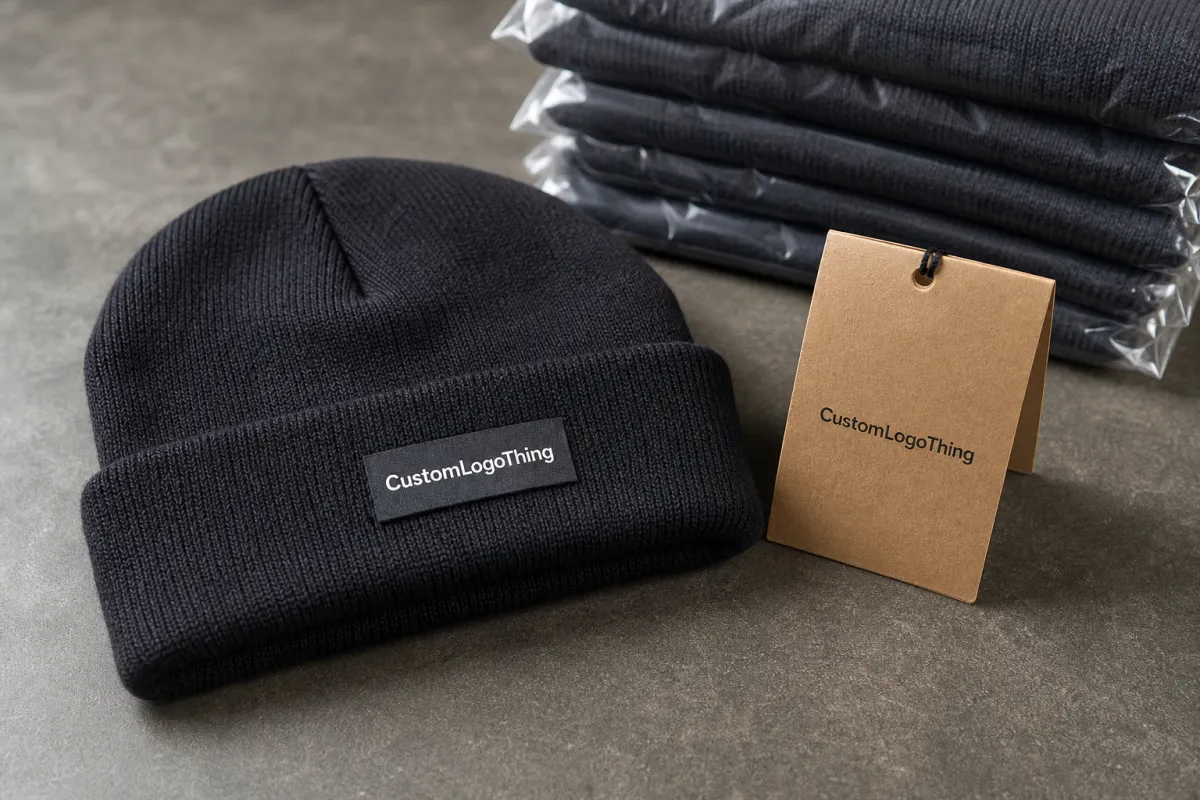
Cuffed beanies sit in an unusual spot in branded merchandise. They are practical enough for winter use, visible enough for branding, and forgiving enough to fit most adults without a sizing matrix. That last point is doing real work. Apparel orders often get bogged down in size splits and exchanges; a beanie avoids most of that friction.
They also get used outdoors, which is the best possible scenario for a logo. A beanie shows up at a job site, on a commute, at a school pickup line, or in a crowd where people notice color and shape before they read fine print. If the yarn pills quickly, the cuff twists, or the decoration sits crooked, the problem is public.
For teams, seasonal promotions, campus programs, retail drops, and employee gifts, the format is hard to beat. One size fits most. Storage is simple. Shipping is lighter than hoodies or jackets. The product has perceived value because it feels useful instead of disposable, and useful merchandise tends to stay in circulation longer.
The comparison with one-off merch is not subtle. A single custom piece can survive on novelty. A bulk program cannot. Once the order scales, tiny production flaws become visible patterns. One sloppy seam looks accidental; fifty look like a process problem. That is why buyers should judge the build first and the branding second.
A crooked cuff or a fuzzy logo does more damage than a plain design ever could.
Product details buyers should lock before requesting a quote
The basic structure is simple: a knit body, a fold-over cuff, and enough stretch to fit a wide range of head sizes without distorting the shape. Most cuffed beanies are single-layer or double-layer knit, depending on warmth and budget. The cuff is the part that matters most for decoration because it gives the logo a flatter surface and keeps the mark visible when the beanie is worn.
Material choice changes the end result more than many first-time buyers expect. 100% acrylic is the common budget option: light, easy to source, and stable for color matching. Acrylic-wool blends feel warmer and more premium, but they usually cost more and can introduce more variation in dye lots. Recycled yarns may be a fit for sustainability programs, though they need early approval because recycled fiber can shift texture and color slightly from sample to bulk run. None of these is automatically better. The right choice depends on budget, warmth, hand feel, and the level of finish the order needs.
Decoration method is the next decision point. Embroidery is still the most common because it is durable and reads cleanly on a cuff. Woven labels work well for detailed logos or small type that would get lost in stitches. Patches give more contrast and can hide minor surface irregularities, but they add a more structured look. Knit-in graphics are the most integrated visually, though they require simplified art and larger order volumes to make sense. Tiny letters, thin lines, and complex gradients usually fail here. If the logo only works at poster size, it is not ready for knitwear.
Stitch density is another factor buyers often miss. A tighter gauge gives a cleaner face and steadier dimensions. A looser gauge feels softer and more casual, but it can blur fine details and make the cuff less predictable. The same logo can look sharp on a 9-gauge knit and muddy on a chunkier 7-gauge body. The proof may look fine on screen and still fail in yarn.
Before requesting a quote, send the essentials together so the pricing is based on the actual job, not a guess:
- Quantity with expected breakpoints if you are comparing tiers.
- Artwork in vector format, ideally AI, EPS, or a clean PDF with outlined fonts.
- Logo placement on cuff, front panel, side, or patch position.
- Color reference with Pantone if you need a close yarn match.
- Packaging needs such as polybags, hang tags, barcode stickers, or retail labeling.
The more complete the brief, the fewer quotes come back full of assumptions. Missing artwork is the easiest delay to avoid, and it is still one of the most common causes of back-and-forth.
Fit, gauge, and decoration specs that prevent rework
Fit is where a lot of bulk beanie orders quietly go wrong. A standard adult cuffed beanie often lands around 8.5 to 10 inches tall, with a cuff depth near 2.5 to 3.5 inches, though oversized styles and heavier yarns can move outside that range. Youth sizing needs to be specified directly. Do not assume a shorter adult beanie will work for younger wearers. It often sits too loose at the crown or too shallow over the ears.
The right fit is partly a comfort issue and partly a presentation issue. If the cuff is too shallow, the logo gets cramped. If the crown is too long, the beanie slouches in a way that may not match the intended look. Retail buyers notice this immediately. So do anyone ordering for uniforms or gifting programs, because a bad fit makes the item feel cheaper than it is.
Decoration placement needs the same discipline. A logo placed too high disappears into the fold; too low, and the cuff cuts it off. Ask for actual dimensions in inches or millimeters, not words like “large” or “prominent.” A 2.75-inch-wide mark that reads clearly is usually better than a stretched graphic that tries to occupy too much space. On knitwear, restraint wins more often than scale.
Color control deserves a realistic conversation. Yarn is not flat ink. Pantone matching can be approximated, but heather and melange yarns will always show variation. Solid colors are easier to control than speckled or marled yarns. If the order needs tight visual consistency, request a strike-off or pre-production sample. That extra step is often cheaper than discovering a mismatch after 1,000 hats are finished.
For quality control, buyers should confirm more than one sample point. Check cuff height, knit tension, seam placement, label position, and whether the logo distorts when the fabric stretches. A logo that looks fine on a flat proof can bow or compress once it is sewn into a cuff. That is especially true with embroidered designs that contain small text or thin outlines.
If the beanies are going into gift sets or retail bundles, packaging should be approved at the same time as the garment spec. Loose polybags are fine for some programs. Others need barcode labels, hang tags, or individual retail-ready folding. Soft goods can arrive with crushed cartons and wrinkled labels even when the beanie itself is perfect, so pack-out deserves more attention than it usually gets. Transit damage is not limited to hard goods.
Custom beanie cost, MOQ, and unit-price breakpoints
The price on a custom Cuffed Knit Beanies bulk order depends on quantity, yarn choice, knit complexity, decoration method, number of color changes, and packaging. That list is long because each item changes production time. Buyers sometimes focus on the lowest unit price and miss the real total, which includes sample fees, setup charges, freight, labeling, and revision costs.
Minimum order quantity changes the economics quickly. At lower volumes, setup work gets spread across fewer pieces, so the per-unit cost stays high. As volume rises, the order usually drops into clearer breakpoints. Those steps vary by supplier, but the pattern is consistent: the jump from 100 to 300 pieces is often dramatic, the move from 500 to 1,000 is usually easier to justify, and orders above 2,500 often gain the most from streamlined setup. The exact number matters less than the step between tiers.
| Order size | Typical unit price range | Best fit | What usually pushes cost up |
|---|---|---|---|
| 100-299 pcs | $5.50-$8.50 | Small teams, pilot runs, short seasonal tests | Setup spread across fewer units, extra proofing, freight impact |
| 300-499 pcs | $4.25-$6.50 | Campus groups, local promotions, employee gifts | More color changes, patch work, upgraded packaging |
| 500-999 pcs | $3.75-$5.75 | Resellers, event programs, branded merchandise drops | Multi-color artwork, better yarn, hang tags, polybagging |
| 1,000-2,499 pcs | $3.10-$4.80 | Wholesale programs, retail programs, recurring seasonal buys | Premium finishing, custom labels, split color runs |
| 2,500+ pcs | $2.60-$4.20 | Large campaigns and retail replenishment | Complex knit patterns, multiple SKUs, detailed packaging spec |
The cheapest quote is not always the lowest-cost order. A plain embroidery hit on a standard acrylic body may be the best value for a simple campaign. A knit-in graphic with three or four colors costs more because the machine setup is heavier and the production run takes longer. Patches sit somewhere in the middle. Add custom labels, contrast cuffs, or retail packaging, and the number rises again. That is not a markup problem; it is a production reality.
For a meaningful comparison, ask for the whole stack, not just the headline price:
- Unit price at the actual quantity you need.
- Sample or strike-off fee if one applies.
- Decoration setup and whether it is included.
- Freight estimate to the final delivery point.
- Pack-out costs for polybags, hang tags, or insert cards.
For packaging inserts or outer cartons, FSC-certified stock is a practical option if the program is trying to align material choices across the order. It will not make the beanie warmer, but it can make the presentation feel more deliberate.
Production steps and lead time from proof to shipment
The process is straightforward in theory: brief, artwork review, proof, sample or strike-off if needed, bulk production, inspection, and shipment. The delay usually appears between those steps, not inside them. A clean order moves because the buyer responds quickly and the spec is complete. A messy one slows down because the factory is waiting for files, approvals, or a decision on packaging that should have been made earlier.
For simple designs and normal quantities, lead time after proof approval often falls around 12 to 15 business days before freight. More complex knit patterns, multiple colorways, or special packaging can extend that. Seasonal demand also matters. Winter orders stack up fast, and the calendar can add one to two weeks before anyone notices. Near holidays, the queue gets worse.
The most common delays are repetitive and avoidable. Missing vector art. Slow color sign-off. Changing quantity after the quote is issued. Adding labeling late. Approving a proof with vague language and then requesting revisions after production starts. That is not a workflow problem; it is a coordination problem.
There is a better order of operations. Finalize the artwork. Confirm the quantity tier. Decide whether the cuff will carry embroidery, a woven label, a patch, or knit-in graphics. Lock packaging early if the beanies need to arrive retail-ready. Then treat approval like a deadline, not a suggestion. If the order must hit an event or launch date, build in one revision cycle and a freight buffer from the start.
One practical caution: soft goods can move faster through production than hard goods, but the shipment stage still depends on carton counts, labeling, and destination changes. A split delivery or last-minute address change can eat more time than the knit itself. The fabric may be done; the logistics may not be.
How to choose a supplier and lock the final order details
A dependable supplier gives clear proofs, stable yarn sourcing, consistent cuff height, and a believable ship date. A poor one gives vague answers and a quote that looks inexpensive only because it left out half the job. Those are not the same thing. If the seller cannot explain the decoration method, will not show comparable samples, or keeps changing the timeline, the price is probably buying uncertainty.
Before placing the order, ask for a line-item quote that separates setup, unit cost, packaging, and freight. Ask for the proof in a way that shows artwork size, placement, and color references. Ask whether the production run can tolerate a small quantity swing without being repriced from scratch. These are simple questions, but they reveal a lot about how the order will behave once it is underway.
It also helps to confirm the failure points up front. What happens if the knit color is slightly off? What if the approved logo file needs a small redraw for stitchability? What if the delivery address changes and the cartons need to be split? Good suppliers answer with process. Weak ones answer with optimism.
The last check is practical rather than glamorous:
- Confirm the final quantity tier.
- Approve the logo file and placement.
- Lock the closest yarn match or color reference.
- Choose packaging: polybag, hang tag, retail pack, or gift box.
- Verify the ship date and destination details.
A custom Cuffed Knit Beanies bulk order usually goes well when the spec is specific and the approvals are disciplined. That is not a slogan; it is how production actually behaves. Most of the expensive mistakes come from vague instructions, not from the knitting machine.
What is the minimum order for custom cuffed knit beanies bulk order?
The minimum order quantity depends on decoration method, yarn type, and how many colors the knit uses. A simple embroidered beanie can often start lower than a fully custom knit pattern, which needs more setup and machine time. Ask for tiered pricing so you can see how unit cost changes as volume rises.
How long does a custom cuffed knit beanies bulk order take?
Most lead times include proofing, sample approval if needed, production, inspection, and freight. Straightforward orders can move in roughly 12 to 15 business days after proof approval, while complex colorwork, packaging, or seasonal congestion adds time. The safest plan is to finalize artwork before asking for a firm delivery date.
Which decoration method works best on cuffed knit beanies?
Embroidery is usually the most durable and versatile choice for clean logos. Woven labels and patches work better when the artwork is detailed or when the buyer wants a more retail-style finish. Very small text and thin lines often need to be simplified so they stay readable on knit fabric.
Can you match Pantone colors on bulk cuffed beanies?
Pantone matching can be approximated, but yarn does not behave like printed ink. Solid yarns are easier to control than heather or melange blends, which naturally show variation. A pre-production sample or strike-off is the best way to confirm the closest practical match before the bulk run starts.
What do you need to quote custom cuffed knit beanies bulk order pricing?
Send the quantity, artwork file, logo placement, color count, and target delivery date. Include packaging details such as polybags, hang tags, or retail labeling if those affect the final cost. The cleaner the brief, the faster the quote and the fewer surprises later.
Bulk beanie orders reward clarity. The best results come from a tight spec, a readable logo, a realistic timeline, and packaging that matches the intended use. Skip one of those pieces and the rest of the order usually starts compensating for it. Keep them aligned and the product does what it is supposed to do: stay warm, look considered, and hold up long enough to be worth the spend.

