A custom Poly Mailer Bags bulk order can be a smart purchase or an expensive habit. The difference usually shows up after the quote, not before it. A low unit price looks attractive until the wrong size increases postage, the film tears in transit, or the warehouse ends up with cartons that do not fit the products being shipped.
For brands with steady shipment patterns, bulk buying is usually the cleaner path. The artwork is already approved, the dimensions are known, and the packing team is not reinventing the same decision every month. That stability matters more than people expect. A packaging spec that stays fixed for six months often saves more than a tiny price reduction ever could.
That does not mean every company should chase the largest run possible. It means the order size should match the product flow. A mailer that moves fast earns its keep. A mailer that sits in storage for a year becomes a reminder that forecast errors can be expensive and oddly heavy.
Why bulk buyers stop overpaying
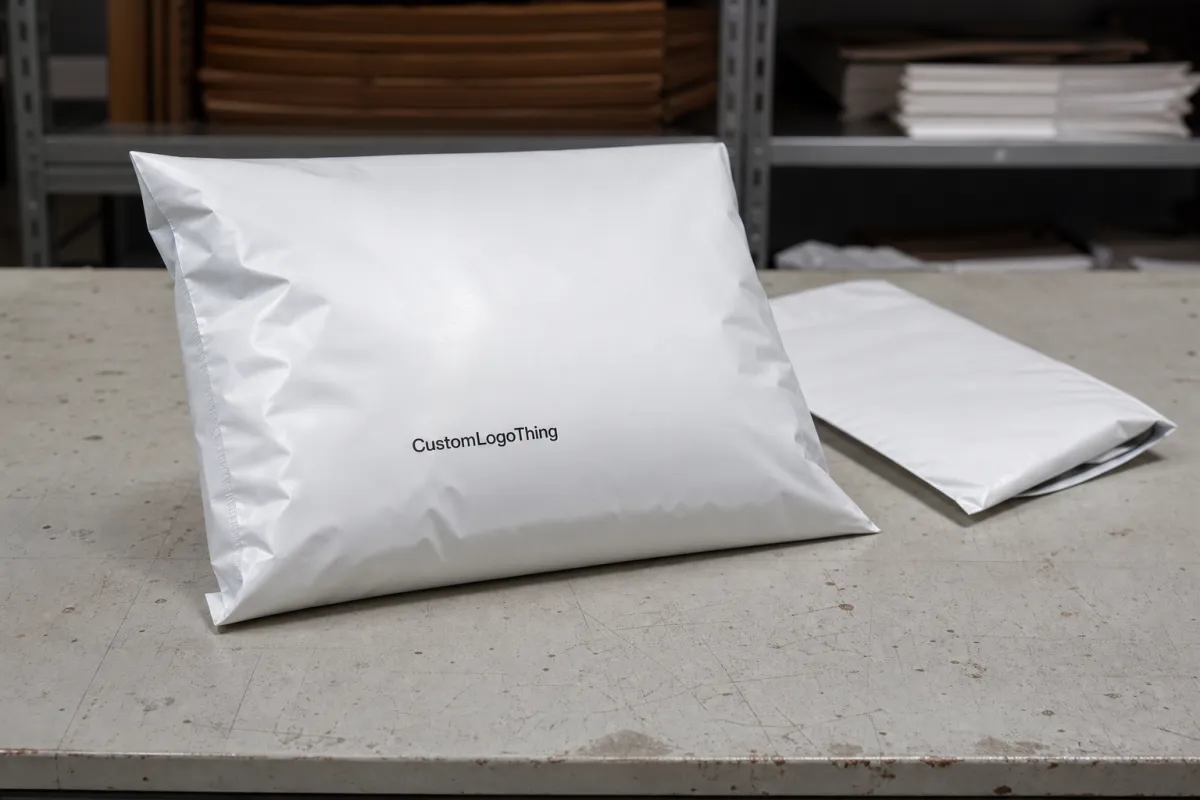
The cheapest quote is not always the cheapest outcome. A bag that saves a fraction of a cent can create a much larger cost if it is too small, too thin, or poorly sealed. Then come the secondary expenses: a damaged return, a replacement shipment, more customer service time, and the hidden cost of warehouse rework. Packaging budgets rarely blow up all at once. They leak.
That is why experienced buyers look at the total route, not the unit price alone. A soft good shipped in a properly sized mailer may travel with lower dimensional weight than the same item forced into a box. A cardboard carton can be the safer choice for rigid items, but for folded apparel and similar products, a poly mailer often wins on both space and freight efficiency. The savings are real, though they depend on fit.
Bulk ordering also reduces the churn that comes from repeated small buys. Small reorders tend to trigger rushed artwork checks, inconsistent color matching, and higher freight per unit. Larger runs spread setup costs across more bags and make inventory planning less noisy. If the design is stable and the product line is not changing every quarter, the case for bulk gets stronger quickly.
In practice, the best candidates are apparel, socks, beauty accessories, soft goods, and other flat or flexible items. A 10 x 13 inch bag may suit folded tees. A 12 x 15.5 inch size may be better for thicker knits or multiple pieces. A sweatshirt, especially if it is tightly folded, may need a larger format and a thicker film. The wrong size is expensive in a way that design can never fully fix.
The real savings are not in the bag itself. They are in the shipping lane, the packing bench, and the number of times a team has to touch the order.
That is also why standardization helps. Once a company settles on a small number of proven sizes, the purchasing team can compare quotes more accurately, the warehouse can pack faster, and the brand gets the same unboxing experience more consistently. Consistency sounds dull. In packaging, dull usually means profitable.
If you want a baseline for shipping reliability, look at the testing mindset used by groups such as ISTA. Not every mailer needs formal lab qualification, but the logic is useful: understand the product weight, the route, the handling conditions, and the likely failure point before placing a large order.
Mailers, print finishes, and closure options that actually matter
Most Custom Poly Mailers are made from polyethylene film with a pressure-sensitive adhesive flap. That sounds simple because it is. The harder part is deciding which details deserve attention and which ones merely look impressive on a spec sheet. Thickness, seam strength, opacity, and closure design matter far more than decorative extras.
There are a handful of decisions that influence performance and cost more than most buyers expect. Plain bags are usually the least expensive. Printed bags create stronger brand recognition. Matte finishes tend to hide scuffs and fingerprints better. Glossy finishes catch the eye faster, though they also reveal handling marks more easily. None of those choices matter much if the bag size is wrong, but they matter a great deal once the dimensions are set.
Return-strip closures deserve a serious look for brands with frequent exchanges or returns. The second adhesive strip allows the customer to reseal the bag without hunting for tape. That small detail can reduce repack time and make returns feel less awkward. It costs more, yes. Still, if return volume is high enough, the tradeoff is sensible.
Not every product belongs in a poly mailer. Soft and flexible goods usually do well. Rigid items, sharp-edged products, glass, and anything that can puncture film usually need another format. A padded mailer, corrugated box, or molded insert may be a better fit. The point is not to force one package style into every use case. It is to choose the format that survives the route with the fewest surprises.
| Option | Typical Use | Tradeoff | Relative Cost |
|---|---|---|---|
| Plain poly mailer | Internal shipping, low-brand visibility | Lowest decoration cost, least branding | Lowest |
| Printed matte mailer | DTC apparel, cleaner retail feel | Better presentation, more setup attention | Moderate |
| Printed glossy mailer | Bright branding, strong color impact | Shows scuffs more easily | Moderate to higher |
| Double-adhesive return-strip mailer | High exchange volume | More cost, better returns workflow | Higher |
Logo placement matters most on customer-facing mailers. A full-wrap print can look stronger than a tiny corner logo, but only if the artwork files are clean and the color expectations are realistic. Inside print is less common, although it can work well for a more restrained outer face. Decoration should support the packaging job, not distract from it. Loud packaging is easy. Controlled packaging is harder.
Size, thickness, and performance specs to lock before quoting
Before anyone prices a custom Poly Mailer Bags bulk order, the core specs should be fixed. Finished width, finished length, flap size, film thickness, print area, closure type, and whether a return strip is needed all shape the quote. Guessing from a product photo is one of the fastest ways to create waste. The bag ends up too large, too small, or more expensive to ship than it should be.
Thickness is not a vanity metric. It influences puncture resistance, seam strength, and the feel of the package in the hand. For lightweight apparel, 2.5 to 3 mil is often enough. Heavier garments or products that travel through rougher handling conditions may need 3.5 to 4 mil. If the item has zippers, metal trim, or other sharp components, stronger film is the safer decision. A more attractive print will not stop a tear.
There are also practical details that only become obvious after a bad run. Barcode visibility matters if labels need to scan cleanly. Adhesive performance matters in cooler warehouses and humid storage conditions. If the mailer is being packed on a machine, curl, stiffness, and static can all affect throughput. Those issues do not make for exciting sales copy, but they are exactly the problems buyers remember.
Specification format should be consistent across orders. A bag listed as 12 x 15 inches is not identical to one listed as 12 x 15.5 inches once it is folded, filled, and sealed. Half an inch can affect fit, which can affect labor, and then freight, because a poor fit often leads to larger outer cartons or wasted void space. Small inconsistencies are cheap in isolation and expensive in aggregate.
- Confirm the finished size: width, length, and flap rather than just the artwork area.
- Confirm the film gauge: 2.5 mil, 3 mil, 3.5 mil, or 4 mil depending on product weight.
- Confirm the print method: one-color, multi-color, or full-wrap coverage.
- Confirm the closure: standard adhesive seal or double-adhesive return-strip.
- Confirm the ship route: direct-to-consumer, warehouse pack-out, or retail distribution.
Material efficiency also matters. A better-fitting mailer usually uses less material and occupies less space than a larger one filled with air. The U.S. EPA has general guidance on waste reduction and material efficiency at epa.gov. That does not replace package testing, but it reinforces the basic point: smaller, better matched packaging is often the cleaner choice.
Pricing, MOQ, and unit cost tradeoffs for bulk runs
Pricing for a custom Poly Mailer Bags bulk order usually moves with six variables: quantity, size, film thickness, print colors, finish, and shipping destination. Change any one of them and the quote changes. Change several, and the price can move faster than the first estimate suggests. That is normal, not a sign that the vendor is being difficult.
MOQ, or minimum order quantity, exists because setup work has to be amortized across enough units to make production efficient. Printing plates, color calibration, changeovers, proof handling, and machine time all cost something. A simple one-color bag can often support a lower MOQ than a complex design with multiple inks, specialty finishes, or a return strip. Buyers sometimes hear “minimum” and assume it is arbitrary. Usually it is math.
The practical question is not whether the MOQ is high or low. It is whether the inventory will move quickly enough to justify the run. A 1,000-unit order may feel safer, but a 5,000- or 10,000-unit order often lowers the unit cost sharply if the design is stable and the demand is predictable. If the bag is likely to change next month, smaller runs make sense. If the packaging will stay in rotation for several seasons, larger runs usually win.
One-color printing is generally the least expensive branded option. Two or more colors add complexity. Full-wrap coverage, metallic inks, soft-touch finishes, and very precise color matching all push the quote higher. Sometimes the cost is justified because the package is part of the brand story. Sometimes it is just ornament. Honest buyers separate those two reasons before approving the artwork.
The hidden costs deserve equal attention. Artwork revisions after proof approval can bring extra charges. Samples may be billable. Freight can be significant if the order is bulky. Rush production often carries a premium. A quote that looks unusually good should trigger a second look at the exclusions. The cheapest line on the page is not always the cheapest outcome once the rest of the job is added back in.
For brands shipping the same products repeatedly, standardizing around one or two mailer sizes is often the best route. It keeps inventory easier to manage, supports faster reorders, and reduces the chance of mismatched packaging across channels. Some teams pair mailers with matching custom printed boxes for heavier or breakable items and reserve poly mailers for flexible goods. That kind of split system is usually more efficient than forcing one format to do every job.
Process, proofing, and lead time from quote to shipment
The order flow should be straightforward: submit specs, receive a quote, review the proof, approve a sample if needed, move into production, inspect, and ship. The timeline depends heavily on the quality of the information sent at the beginning. A buyer who submits final dimensions, clean artwork, print colors, delivery ZIP code, and quantity on day one gets a faster response than one who sends a screenshot and asks the supplier to “figure it out.”
Delays usually come from predictable places. Missing artwork files slow proofing. Vague color targets create extra revision rounds. Peak season stretches queue times. Changes after proof approval can force the job back into the production line, which adds days and sometimes weeks. The process is not mysterious. It is just sensitive to incomplete information.
For planning, a clean order often spends a few business days in quote and proof review, then moves into production once approved. Add time for complex print, samples, or special closures. Freight is a separate clock. Air shipping is faster and more expensive. Ocean shipping is slower and usually more economical for larger bulk shipments. The right choice depends on the launch date and the cash flow, not on which option looks best in a spreadsheet.
Quality control matters at several points. During proofing, the buyer should check artwork placement, bleed, spelling, and color targets. Before shipment, it helps to confirm carton counts, outer case labeling, and the finished bag size against the approved spec. A small number of production defects is possible in any print run. The practical question is whether the vendor has a clear inspection step and a process for catching obvious errors before cartons leave the plant.
Speed and precision are often in tension. Rush orders can be done, but speed leaves less room for mistakes to be caught early. Buyers who want a predictable result usually earn it by being specific. That means sending vector files, final dimensions, preferred finish, quantity, and the exact shipping destination. If the package must work with a fulfillment line, say so. If a sample is required before production, ask early. The timeline improves when the specification is complete.
What to confirm before you place the bulk order
Good packaging sourcing is mostly careful alignment. The bag has to fit the product, the print has to match the brand, and the shipping spec has to survive the route. That may sound simple, but the number of order mistakes shows otherwise. Most problems are not dramatic failures. They are ordinary mismatches that became expensive because they were multiplied across thousands of units.
Before approving the purchase order, confirm the basics in this order: finished bag size, quantity, film thickness, print colors, finish, closure type, delivery ZIP, and target ship date. If the mailer will face the customer directly, ask for a proof or sample kit. If the job needs a return strip, say so early. If the packaging is being compared with other formats, make the comparison on functionality and freight, not on habit or aesthetics alone.
There is a simple way to think about a bulk packaging decision. Fit first. Protection second. Branding third. That order may sound unromantic, but it prevents most of the mistakes that make bulk buying feel risky. A well-sized mailer with the right film and a sensible print treatment is usually more valuable than an oversized, heavily decorated bag that ships poorly.
For teams trying to make the program repeatable, the long-term goal is not just lower unit cost. It is fewer surprises. Fewer surprises at packing. Fewer surprises at receiving. Fewer surprises in freight. That is where a well-managed custom Poly Mailer Bags bulk order earns its place in the packaging system.
What is the MOQ for custom poly mailer bags bulk orders?
MOQ usually depends on size, print complexity, and film thickness rather than bag count alone. Standard sizes with one-color print often qualify for lower minimums than fully custom specs. Larger quantities usually improve unit pricing because setup costs are spread across more bags.
How thick should bulk custom poly mailer bags be for apparel?
Lightweight apparel usually fits well in 2.5 to 3 mil film. Heavier garments or shipments that face rougher handling often need 3.5 to 4 mil for better puncture resistance. If the product includes sharp hardware or trim, stronger packaging is the safer choice.
How long does a custom poly mailer bags bulk order usually take?
Lead time depends on proof approval, artwork readiness, production queue, and shipping method. A clean order moves faster when final dimensions, print colors, and delivery details are confirmed up front. Freight time can add several days or weeks depending on whether the shipment goes by air or ocean.
Can bulk custom poly mailer bags include a return strip?
Yes, many mailer specs support a second adhesive strip for returns or exchanges. A return strip is useful for brands with high exchange volume or repeat customers. It adds cost and may affect MOQ, so it should be confirmed during quoting.
What do you need to quote custom poly mailer bags bulk pricing?
Send the finished bag size, quantity, film thickness, print colors, and closure type. Include artwork files, preferred finish, and the delivery ZIP so freight can be estimated correctly. If you need samples, rush production, or a return strip, mention that early as well.

