A custom cuffed knit Beanies Bulk Order is one of those purchases that looks simple until the details start multiplying. On paper, it is just a hat. In production, the cuff depth affects logo visibility, the yarn changes warmth and hand feel, and the decoration method can add or remove a full price tier. That is why the best orders are usually the ones that start with a spec sheet, not a mood board.
The appeal is straightforward. Cuffed Knit Beanies have a built-in branding zone, a forgiving fit, and enough winter utility to avoid feeling like throwaway merch. The cuff makes the logo easier to read from a distance, and the knit structure covers sizing mistakes better than most apparel categories. For buyers ordering in volume, that combination matters more than flashy design language.
There is also a practical cost argument. Once setup is spread across more pieces, the unit price drops fast. That is especially true for simple embroidery or a standard woven patch. A small run can tolerate experimentation. A larger run rewards discipline.
What a custom cuffed knit beanies bulk order really delivers
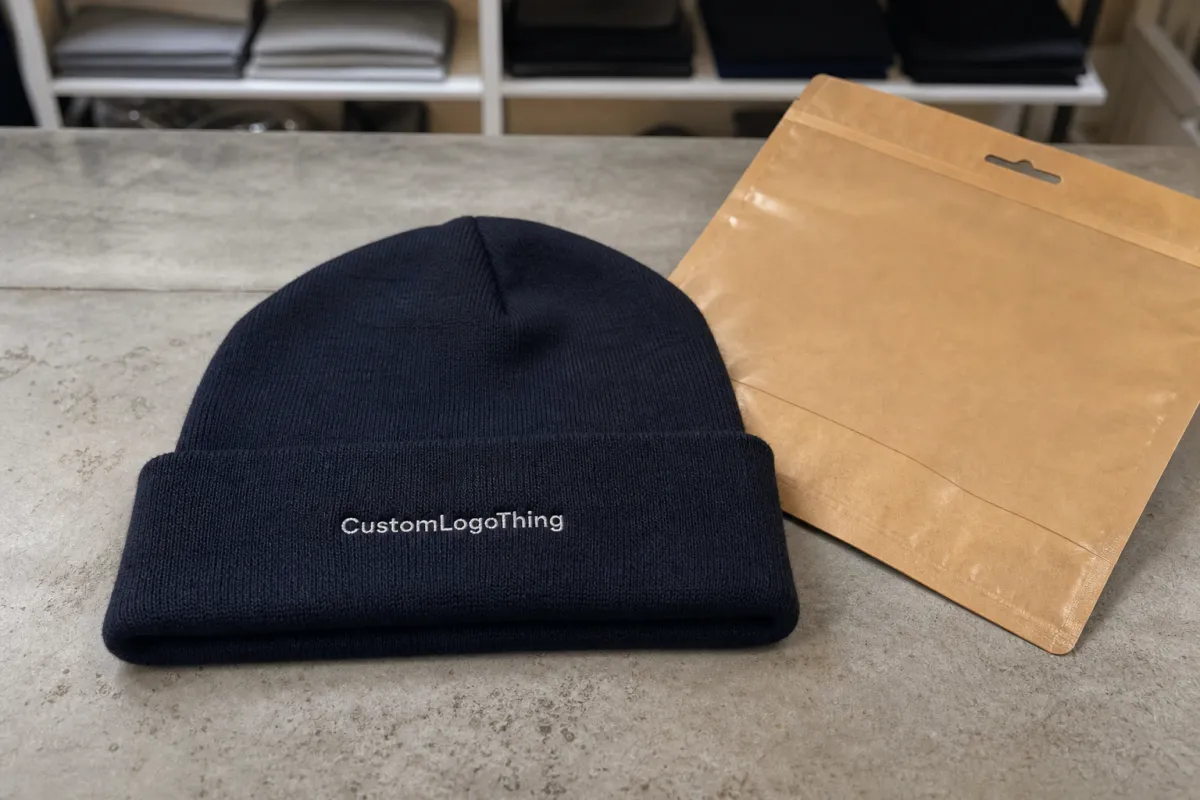
The cuff is the part most buyers underestimate. It is not just folded fabric. It is the visual anchor that turns a cold-weather basic into branded merchandise. A logo on the cuff reads as intentional because the surface is flatter, the placement is predictable, and the beanie still functions as a normal winter accessory. That is a better balance than a large center-front mark that can look loud on knitwear.
Bulk orders also reduce three common headaches at once. First, they lower unit cost by distributing setup across more hats. Second, they make color control easier because every piece is drawn from the same yarn lot or approved color match. Third, they reduce fit uncertainty. Knit beanies stretch, recover, and adapt to heads better than structured headwear, which is useful when one order has to serve adults across a wide size range.
The strongest buyers usually have a clear use case before they request pricing:
- Retail shops that want a winter staple with repeatable color and logo placement.
- Team stores that need matching gear for players, staff, and fans.
- Hospitality groups that want cold-weather merch with a more polished feel.
- Campus programs that care about fast recognition and easy reorder control.
- Event programs and winter drops that need strong shelf impact without a luxury price tag.
The weakest orders usually begin the other way around. The buyer starts with the logo and asks about everything else later. That is how people end up with a beautiful mark on the wrong cuff width or a patch that looks good on screen and awkward on the hat. A 3-inch cuff and a 4.5-inch cuff are not cosmetic differences. They change the whole layout.
The cuff is not decoration space alone. It is what makes the decoration look like part of the product.
If the beanies are meant for retail, one more layer deserves attention: packaging. A plain polybag protects the product, but it does little for presentation. Fold banding, hang tags, barcode stickers, carton labels, and consistent pack-outs can turn a basic knit hat into a line item that moves cleanly through a store or fulfillment center. Ignore packaging until the end and it becomes the thing that slows the order down.
Cuff construction, yarn weight, and fit specs that change the look
Cuff depth changes the visual weight of the hat. A shallow fold looks cleaner and more fashion-forward, but it leaves less room for a logo. A deeper cuff gives the art more breathing room and usually lands in the 2.5 to 4.5 inch range. That extra space matters if the mark must stay visible across a room or on a crowded retail wall.
Yarn selection matters just as much. Acrylic is the common starting point because it is cost-efficient, warm enough for most winter programs, and available in a wide color range. Polyester tends to feel a little smoother and is often chosen for durability or a lighter hand feel. Wool blends sit higher on the price ladder, but they bring a more premium texture and a better perceived value. In production terms, there is rarely a perfect material. Each one trades something away.
Knit density is another quiet decision with visible consequences. A tighter knit usually produces a cleaner face and gives embroidery a more stable base. It can also make the hat feel less soft and push the price upward. A looser knit is often cheaper and more relaxed, but the surface can wrinkle under dense stitching. The logo may also look slightly distorted if the stitch count is too ambitious for the knit.
Fit should be treated as a spec, not an assumption. Most adult cuffed beanies work as one-size because the knit stretches enough to cover a broad head range. Youth sizing, oversized silhouettes, and slouchier styles need more caution. The body length, crown height, and cuff proportion should be sampled before approval, not guessed from a product image. A beanie that looks balanced flat on a table can sit too tall or too short once worn.
Useful checks before approving a sample:
- Cuff depth: enough room for the logo without crowding the fold.
- Body length: long enough for coverage, but not so long that it collapses.
- Stretch recovery: the knit should bounce back after a few pulls.
- Hand feel: soft enough for retail, but not so fuzzy that decoration sinks into it.
- Size profile: adult one-size, youth fit, or an intentionally oversized silhouette.
A good sample often answers more questions than a spec sheet. It shows whether the cuff stays flat, whether the yarn pills quickly, and whether the logo still reads clearly at arm's length. That is why production buyers treat sampling as a control step, not an optional courtesy.
Decoration methods that hold up after wear and wash
Embroidery remains the default for a reason. It is durable, familiar, and usually the most economical choice for simple logos. On a cuffed knit beanie, a clean one-color or two-color embroidered mark has enough texture to feel substantial without pushing the product into overly premium territory. For many team shops and retail basics, that balance is hard to beat.
Woven patches work better when the design has fine lines, small text, or details that embroidery would blur. They give the artwork a sharper edge and can look more retail-friendly on close inspection. Leather labels suit minimal branding and often create a stronger premium impression than the art itself. Rubber patches and appliques add volume and contrast, which helps when the hat needs a bolder shelf presence.
The choice is not only about aesthetics. It changes production behavior. Embroidery is quicker to set up and easier to repeat. Patches introduce extra steps: cutting, attaching, alignment, and sometimes adhesive or sewing reinforcement. That means a more complex quality check, but also a finish that can better preserve small artwork.
As a rule, the more dimensional the decoration, the more the hat feels like a finished product and the less it feels like a giveaway. That can help if the buyer is aiming for retail margin. It can hurt if the target is an inexpensive promotional item that needs to stay under a strict unit budget.
Buyers should also think about how the decoration interacts with packaging. A beanie in a plain bag ships fine. A retail program usually needs better structure: insert cards, fold direction, barcode labels, and carton counts that match the receiving system. Those details do not sound glamorous, but they decide whether the product arrives ready to sell or ready to be fixed.
If the order depends on broader packaging controls, ask whether paper components are available through FSC-certified sources and whether the shipper can support ISTA-style transit testing. Neither one improves the knit itself, but both can reduce avoidable damage and packaging complaints. The hat is one product; the unboxing and shipping experience are another.
Pricing, MOQ, and unit-cost levers that move the quote
Pricing on a Custom Cuffed Knit Beanies Bulk order usually turns on three variables first: material, decoration, and quantity. Packaging and custom color matching come next. That hierarchy matters because a low quote can hide setup charges, art fees, or packing labor that appear later. The cheapest number on the page is not always the cheapest order.
For many programs, minimums begin around 48 to 100 pieces. Below that, setup costs do not spread far enough to keep the price attractive. A simple stock acrylic beanie with embroidery can land in one range, while a wool blend with a patch or label moves into another. The difference is not arbitrary. It is the sum of materials, labor, and the number of production steps.
| Quantity tier | Stock acrylic + embroidery | Patch or label build | Premium wool blend | Notes |
|---|---|---|---|---|
| 48-99 pcs | $8.50-$13.50 | $9.75-$15.00 | $11.50-$18.00 | Setup costs still carry a lot of weight. |
| 100-299 pcs | $6.25-$9.25 | $7.00-$10.50 | $9.00-$13.50 | Common range for team shops and small retail tests. |
| 300-999 pcs | $4.25-$6.75 | $5.00-$7.75 | $6.75-$10.25 | Better spread on setup, packing, and freight prep. |
| 1000+ pcs | $3.20-$5.20 | $3.85-$6.10 | $5.50-$8.75 | Best when the spec stays fixed across reorders. |
Those numbers move with thread count, stitch density, yarn stock, and packaging requirements. A one-color embroidered cuff is cheaper than a multi-color patch with Custom Hang Tags. A stocked yarn shade is cheaper than a custom-dyed match. A single pack-out format is cheaper than three different carton instructions for three different sales channels. The pattern is consistent even when the exact price is not.
The biggest savings usually come from the least exciting choices:
- Fewer thread colors: less setup and fewer chances for alignment problems.
- Standard yarn colors: stocked shades are easier to source than custom matches.
- Simple artwork: solid shapes and bold lettering outperform tiny details.
- One pack-out format: mixed labels or mixed carton counts add labor fast.
- Higher volume: setup gets spread over more pieces, which is where bulk pricing works.
A useful quote should show the unit price at each quantity tier, setup charges, sampling fees, production cost, and shipping. If those pieces are missing, the quote is incomplete. A vendor that hides the parts most likely to change the total is not doing the buyer any favors.
Production steps, proofing, and lead time: what happens after approval
Once the artwork is approved, the workflow should become predictable. A good production process starts with a mockup, moves through color confirmation, then validates the logo placement, and ends with a final sign-off before any mass production begins. Skipping one of those steps shifts risk back to the buyer. That is usually the wrong place for it.
- Review the logo file and clean up any low-resolution artwork.
- Approve the mockup with cuff placement, logo size, and decoration direction.
- Confirm yarn color, cuff fold, fit, and label details.
- Approve the final proof before production starts.
- Allow for finishing, packaging, carton labeling, and shipment booking.
Lead time depends on whether the order is built from stock materials or from a more custom spec. A stocked acrylic beanie with straightforward embroidery often lands in the 10 to 15 business day range after proof approval. More customized builds, including specialty patches, harder-to-source yarns, or retail-ready packaging, can run closer to 3 to 5 weeks. If the order includes printed boxes or multiple pack-out styles, add time. Packaging often slows the schedule more than the knitting itself.
The usual delay points are predictable:
- Missing vector files that force artwork cleanup.
- Color descriptions like "close to navy" instead of a defined reference.
- Quantity changes after the quote has already been built.
- Artwork revisions after proof approval because another stakeholder joined late.
- Packaging instructions that arrive after production has begun.
The fastest order is the one that stops changing.
A clean approval process matters even more when the project includes retail packaging or label requirements. If the fold direction, barcode placement, and carton count are settled before production starts, the order moves faster and the rework rate drops. That is a boring advantage, which is usually the best kind.
What separates a dependable knit supplier from a cheap quote
A cheap quote is easy to write. A dependable one is harder because it has to explain what it includes and what it does not. The strongest suppliers are specific about materials, clear about setup, and willing to show proof rather than rely on polished marketing language. That alone cuts down on surprises.
Quality control for Cuffed Knit Beanies should focus on a few concrete checks. Stretch recovery matters because a cuff that warps after a few pulls will not hold its shape on a shelf. Logo alignment matters because even a small shift is obvious on a folded cuff. Color consistency matters because mismatched cartons look like mixed inventory, not one run. None of these issues are dramatic, but they are the ones buyers notice first.
Before paying a deposit, it helps to ask direct questions:
- Who owns the artwork setup and reorders?
- Does the approved spec stay on file?
- What changes the price after approval?
- How are packaging and carton counts handled?
- Can the same knit, cuff, and logo placement be repeated next season?
Watch for the obvious red flags. Vague lead times. Hidden setup charges. No sample stage. Quotes that change every time a detail gets clarified. A supplier who cannot explain the production path is usually leaving out the part that costs you later. That pattern is common, and it rarely improves once the deposit is paid.
There is also a difference between a supplier that can make a hat and one that can support a program. For a one-off order, almost anyone can say yes. For a repeat buy, the useful questions are about file retention, spec consistency, and whether the same yarn and decoration setup can be recreated without starting over. The second category saves time, which is usually the scarcest resource in bulk purchasing.
What to send for a fast, accurate quote and clean reorder
Quotes get faster when the intake is clean. Send the quantity, color count, logo file, decoration method, delivery ZIP code, target date, and packaging requirements in one pass. If you already know whether the order is for retail, a team shop, or a giveaway, include that too. Context reduces back-and-forth, and back-and-forth is where most schedules start to slip.
The smartest buyers lock the top three decisions first: beanie style, decoration method, and packaging level. After that, the rest becomes easier to compare. If you are still deciding between embroidery and a patch, ask for both. If you are not sure whether the beanie needs retail packaging, compare a plain bulk ship with the simplest shelf-ready option. That gives you an honest cost difference instead of a guess.
Compare quotes on the same terms:
- Material: acrylic, polyester, or wool blend.
- Decoration: embroidery, woven patch, leather label, or rubber applique.
- Packaging: loose bulk, polybagged, banded, or retail boxed.
- Shipping: delivery ZIP, carton counts, and whether freight is included.
- Timeline: proofing, production, and ship date, not a vague promise.
For a clean reorder, keep the approved spec in one place. Save the yarn color, cuff depth, logo size, decoration method, and packaging details together. That way the next run is a repeat, not a new project with the same SKU name. The difference shows up months later, when someone needs more hats and the original order can be recreated without detective work.
A well-managed bulk program also protects margin. Reorders with stable specs typically avoid new artwork charges, reduce sample time, and shorten approval cycles. That is the quiet advantage of building the first order carefully.
What is the usual MOQ for custom cuffed knit beanies bulk orders?
Many runs start around 48 to 100 pieces, though the actual minimum depends on decoration and material availability. Custom labels, specialty patches, or multiple colorways usually push the minimum higher because setup time is the expensive part. Lower quantities are possible in some cases, but the unit price rises quickly.
How much do prices change by quantity?
They usually fall in clear tiers. The biggest drop often happens between a small run and a mid-size run because setup gets spread across more hats. If you want a real comparison, ask for pricing at several breakpoints, not just one number.
Which decoration method lasts best on cuffed knit beanies?
Embroidery is usually the most durable and the simplest to repeat. Woven, leather, or rubber patches are better when the artwork needs sharper detail or a more premium finish. Tiny text and fine lines should be simplified before production, because knitwear is not a flat canvas.
How long does production usually take?
After artwork approval, a stocked acrylic beanie with basic embroidery often takes about 10 to 15 business days. More customized orders can run 3 to 5 weeks, especially if they need specialty patches or retail packaging. Missing files, color revisions, and late packaging changes are the most common reasons schedules slip.
What do you need for accurate pricing?
Send the logo file, quantity, preferred colors, decoration method, delivery ZIP code, and any packaging requirements. If you know the target date, include that as well. A complete brief makes a Custom Cuffed Knit Beanies bulk order easier to quote, easier to approve, and less likely to need corrections later.

