Custom Dad Hats with logo patches usually look more finished than flat embroidery because the patch gives the front panel a cleaner, more deliberate surface. That matters when the goal is a hat that feels retail-ready instead of like a generic giveaway.
For bulk buyers, the useful questions are the ones that affect the finished product and the invoice: blank quality, patch material, attachment method, artwork complexity, MOQ, lead time, and shipping. Those details decide whether the order looks premium in hand and whether the quote still works after setup and freight are added.
Patch hats are also forgiving in a practical way. They can handle simple logos, help standardize a run across different blanks, and create a consistent front panel when embroidery would be too small or too busy. That is why they show up often in merch, staff kits, and resale programs.
What custom dad hats with logo patches actually are
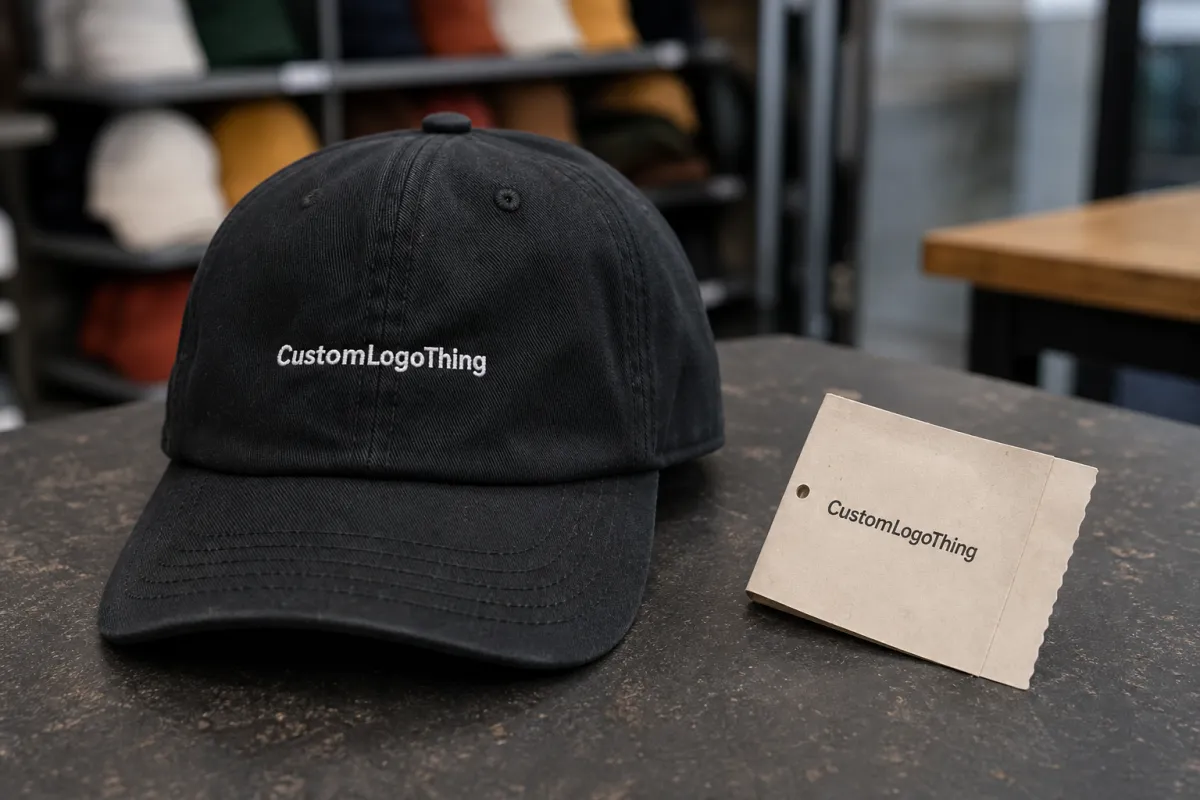
Custom Dad Hats with logo patches are low-profile, usually unstructured caps with a branded patch attached to the front crown. The patch may be sewn on, heat-applied, or produced as part of a mixed method depending on the material and factory setup. Most buyers choose a six-panel cap with a curved brim because it fits broadly and keeps the look casual.
The patch does most of the branding work. Woven patches sharpen fine detail. Embroidered patches add texture. Leather and suede push the cap toward a more premium, lifestyle look. PVC gives a molded finish with more dimension. The right choice depends less on trend and more on whether the logo needs detail, texture, or a cleaner surface.
Good patch hats feel balanced. If the patch is too large, the crown is too soft, or the logo is too intricate, the hat starts to look crowded. A solid spec should read clearly from a few feet away and still hold up when someone inspects the stitching and edge finish up close.
“If the patch looks sharp from across the room, the spec is probably working. If it only reads well in a close-up, the logo or sizing needs another pass.”
That balance is why blank shape matters as much as patch type. A firmer front panel holds a patch better. A softer, broken-in crown can look casual and comfortable, but it also sags faster and can make the logo sit less cleanly.
Patch materials and hat blanks that hold up best
The safest patch choices for most logos are embroidered and woven because they keep pricing manageable while staying readable and durable. Leather and suede work better for simple marks. PVC gives a modern, dimensional look. Sublimated patches can handle gradients and full-color art, but they need strong artwork or the result can look busy.
| Patch type | Best for | Tradeoff | Typical add-on cost |
|---|---|---|---|
| Embroidered | Bold logos, textured branding | Small details can blur | Low to moderate |
| Woven | Tiny type, crisp line art | Less texture than embroidery | Moderate |
| Leather / suede | Simple marks, premium retail looks | Poor fit for fine detail | Moderate to higher |
| PVC | Modern, molded branding | Not right for every brand | Higher |
| Sublimated | Gradients, full-color art | Can look loud if the design is weak | Moderate |
For the blank, cotton twill, garment-washed cotton, and brushed chino are the most common choices. Cotton twill keeps its shape well. Garment-washed cotton feels softer from day one. Brushed chino sits in the middle and usually gives a cleaner retail look than a very soft cap.
If the patch needs to stay crisp, a firmer front panel is usually the better call. Soft hats break in nicely, but they can sag and reduce logo readability over time. That is fine for casual merch. It is less ideal for uniforms or resale, where the cap needs to look consistent after repeated wear.
Performance fabrics can work for outdoor brands or activewear programs, but the front panel still needs to support the patch. Too much stretch, shine, or texture can make the patch look added on instead of integrated into the design.
For buyers who also care about packaging and inserts, FSC is a useful reference point for certified paper materials: FSC-certified paper sourcing.
Production process and turnaround: what happens after you approve art
The process is usually straightforward: artwork review, digital proof, approval, patch production, attachment to the hat blanks, packing, and shipping. The schedule can still slip if the logo file needs cleanup, the spec changes after proofing, or the order includes multiple variants.
File quality is the biggest variable. A clean vector file moves quickly. A screenshot or low-resolution logo slows everything down. Every revision adds time, and patch complexity adds production time on top of that. If you change thread color, patch shape, hat color, or attachment method after proof approval, expect the timeline to expand.
For uncomplicated orders, lead time often lands around 10-15 business days after proof approval. More complex patch types, limited blank stock, or larger quantities can stretch that to 15-25 business days. Rush service can shorten the window, but it usually increases cost enough that it only makes sense when the deadline is fixed.
Ask separately for production time and shipping time. They are not the same thing, and it is easy to plan around the wrong number if you only hear one estimate. If the order will travel far or ship in cartons that need to survive rough handling, vendors familiar with ISTA transit test standards usually have fewer surprises in packing and freight durability.
Inventory also affects turnaround. If the exact blank is in stock, the job moves faster. If it needs to be sourced, a few extra days can disappear before production even starts.
Cost, MOQ, and unit pricing: what changes the quote
Pricing for Custom Dad Hats with logo patches usually breaks into the blank, the patch, and the labor to attach or decorate it. After that come art setup, sampling, packaging, and freight. The cheapest quote is often just the one that left out part of the order.
The more complex the patch, the higher the unit price tends to be. A simple embroidered patch on an in-stock blank is usually the most economical path. A custom PVC patch with several colors, stitched edge finishing, and a specific hat color costs more. Premium presentation is rarely cheap.
| Quantity | Typical unit price behavior | What usually happens |
|---|---|---|
| 25-50 | Highest per-unit price | Setup is spread across fewer hats |
| 100 | First meaningful price break | Most buyers start seeing better value here |
| 250 | Noticeably better unit pricing | Patch and labor costs amortize more efficiently |
| 500+ | Best pricing tier for many programs | Good fit for resale, large events, or uniforms |
Ballpark pricing for a mid-range order often lands around $6 to $12 per hat at 100 pieces, depending on patch type, blank quality, and attachment method. Smaller runs can cost more per unit. Simpler builds can land lower. If a quote looks unusually cheap, check what is not included.
Common add-ons include:
- Art setup: often $25-$75 if the logo needs cleanup or digitizing.
- Sample or pre-production proof: sometimes $40-$120, occasionally credited back.
- Rush fee: usually a percentage bump or a flat surcharge.
- Shipping: can vary a lot by carton count and destination.
- Special packaging: useful for retail kits or gift sets, but not included by default.
If the hats are part of a launch box, staff kit, or retail bundle, branded inserts or mailers from Custom Packaging Products can help the order feel more intentional without changing the hat spec itself.
Artwork, sizing, and placement rules for clean patch hats
Artwork is where many orders lose clarity. A patch is not a billboard. Clean vector art, simple outlines, and readable type matter more than decorative detail. If the logo depends on tiny serif text, thin lines, or gradients, it may need to be simplified before it will work well on a patch.
For most dad hats, a front patch around 2.25 to 2.75 inches wide is common, with height adjusted to fit the shape. That gives the logo enough room to read without overwhelming the crown. If the patch gets too large, the hat stops looking balanced.
Placement changes the tone quickly. Center front is the safest choice for uniforms and resale. A slightly raised placement can feel more fashion-forward. Side patches or back-strap branding are useful when the front is already busy or when a subtler look is better for the brand.
Proofing should cover more than the logo itself. Check the edge finish, background color, thread or print match, and whether the patch is sewn, heat-applied, or both. Those details are easy to miss in a mockup and very easy to notice once the hats arrive.
Packaging should follow the same logic. The hat, patch, and box should feel like they belong to one system. If your paper components already use a specific color or finish, carry that through to the cap so the full order feels consistent.
Step-by-step buying checklist for a smooth order
Start with the use case. Resale, employee uniforms, event merch, and client gifts all have different priorities. A retail drop can justify a better patch and cleaner packaging. A tradeshow giveaway may need a simpler build and tighter unit cost.
- Lock the quantity range. Pick a real number before comparing quotes.
- Choose the hat blank. Decide on color, structure, and fabric first.
- Pick the patch type. Match the patch to the logo and budget.
- Prepare one clean logo file. Vector art reduces revisions and delay.
- Confirm placement and size. Ask for exact patch dimensions in the proof.
- Check the turnaround window. Separate production time from shipping time.
Compare quotes only when the specs match. A washed cotton cap with a woven patch is not the same product as a structured twill cap with an embroidered patch. That sounds obvious, but it is where a lot of price comparisons go wrong.
If you want mixed hat colors, ask whether the MOQ applies per color or per style. Mixed runs are often possible, but they can increase sorting and setup costs. Keep the patch artwork consistent first, then vary the hat color if you need flexibility.
For inserts, mailers, and other paper components, FSC-certified stock is a sensible ask when sustainability or sourcing transparency matters.
Common mistakes that make patch hats look cheap
Oversized artwork is the easiest mistake to make. If the logo takes over the front panel, the hat stops looking considered and starts looking forced. Leave enough space around the patch so the branding can breathe.
Weak artwork is another common failure. Busy gradients, microscopic text, and thin line work often collapse when translated into a patch. A production team can simplify the logo, but only to a point. If the design depends on tiny detail, it may need a cleaner version before it will hold up on the hat.
Color mismatch causes problems too. A patch that blends too closely into the blank can disappear. A patch that clashes too hard can look loud for the wrong reason. The best combinations usually have enough contrast to stay readable without feeling harsh.
Skipping samples or detailed proofs is a costly habit. For launches, events, or retail runs, a sample is usually cheap insurance. It is easier to catch a shape issue, color mismatch, or bad proportion before 250 hats arrive than after.
Packaging can make the same mistake. Even a good hat feels underwhelming if it ships in a plain polybag with no context. For customer-facing orders, branded packaging and a simple insert can improve the presentation without changing the cap spec.
FAQ
What patch type works best for custom dad hats with logo patches?
Embroidered and woven patches are usually the safest choices because they balance durability, detail, and cost. Leather and suede can look premium, but they work better for simple marks than tiny text or detailed artwork. PVC gives a molded finish and can look sharp, but it is not right for every brand.
How many custom dad hats with logo patches should I order?
If unit cost matters, 100 pieces is often the first quantity where pricing improves in a noticeable way. For events or employee kits, 25 to 50 can work, but the per-hat cost will be higher because setup is spread across fewer units. Order for actual use, not wishful thinking.
How long does production usually take after artwork approval?
Simple orders can move quickly, but patch complexity, stock levels, and approval delays are what usually stretch the schedule. Ask for both production time and shipping time so you know the real delivery window. If the hats are tied to a launch or event, build in buffer time for revisions and sample review.
Do logo patches cost more than embroidery on dad hats?
Usually yes, because patches add an extra production step and often an attachment step. The price gap depends on material, detail level, quantity, and whether the patch is sewn, heat-applied, or both. Embroidery can be cheaper for simple logos, but patches often win when the design needs a cleaner or more premium look.
Can I mix hat colors or patch shapes in one order?
Sometimes yes, but mixed colors and shapes can raise the price because they may require separate setup or sorting. Ask whether the MOQ applies per color or per style before building a mixed order. If you want flexibility, keep the patch artwork consistent and vary the hat color first.

