Buyer Fit Snapshot
| Best fit | Custom Die Cut Box Sleeves projects where brand print, material claims, artwork control, MOQ, and repeat-order consistency need to be specified before quoting. |
|---|---|
| Quote inputs | Share finished size, material target, print colors, finish, packing count, annual reorder estimate, ship-to region, and any compliance wording. |
| Proofing check | Approve dieline scale, logo placement, barcode or warning zones, color tolerance, closure strength, and carton packing before bulk production. |
| Main risk | Vague material claims, crowded artwork, missing packing details, or unclear freight terms can make a low unit price expensive after revisions. |
Fast answer: Custom Die Cut Box Sleeves: Board, Finish, Dieline, and Unit Cost should be specified like a repeatable production item. The safest quote records material, print method, finish, artwork proof, packing count, and reorder notes in one written spec.
Production checks before approval
Compare the actual filled-product size with the drawing, then confirm tolerance on folds, seals, hang holes, label areas, and retail display edges. Reserve space for logos, QR codes, warning copy, and material claims before decorative graphics fill the panel.
Quote comparison points
Review material grade, print process, finish, sampling route, tooling charges, carton quantity, and freight assumptions side by side. A quote is only useful when the supplier can repeat the same color, closure quality, and packing count on the next order.
Custom Die Cut Box Sleeves: Design, Cost, and Fit That Sell
Plain cartons do a job. Custom Die Cut Box sleeves do something more deliberate: they turn a basic shipper, tray, or folding carton into packaging that feels branded from the first glance without forcing a full rebuild of the structure underneath. That matters because a lot of product launches do not stumble over the product itself. They get held back by presentation gaps, slow approvals, or packaging budgets that simply cannot absorb a complete carton redesign. A sleeve can sharpen shelf presence, strengthen package branding, and keep the production plan grounded at the same time.
For buyers comparing Custom Packaging Products, the sleeve format sits in a useful middle ground. It carries more visual authority than a label, usually costs less than a fully printed custom carton, and often moves quickly enough for seasonal drops, promotional kits, and limited-run product packaging. The real work is understanding where the savings come from, where the hidden costs live, and how to specify Custom Die Cut box sleeves so the finished piece fits, runs, and sells the way you expect.
What Are Custom Die Cut Box Sleeves?
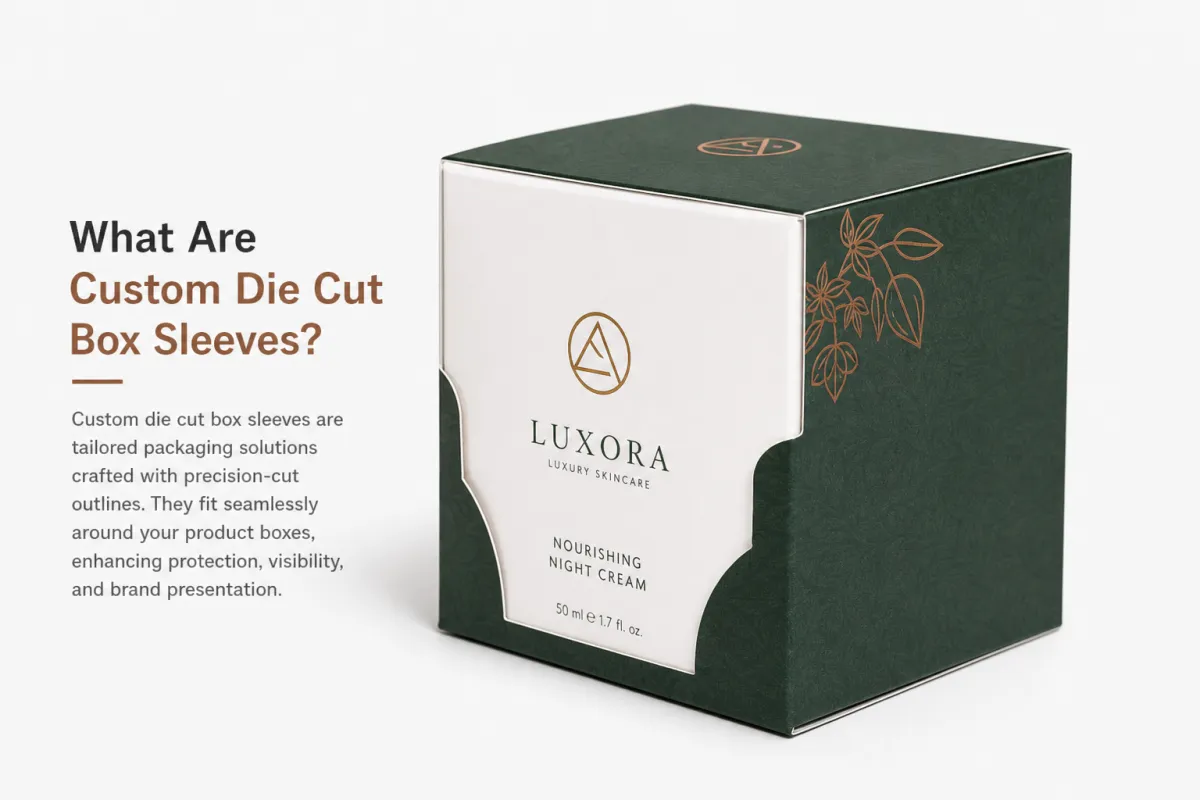
custom die cut box sleeves are printed wraps that slide around a box, tray, or bundled product to add graphics, messaging, and a little structural definition without changing the inner pack. They sit between a sticker and a fully printed carton, which makes them easy to underestimate. In practice, they show up in subscription kits, cosmetics, food gifting, electronics accessories, and promotional bundles because the outer layer needs to do more visible work than the inner container without making the pack harder to handle than it needs to be.
The structure usually starts as a flat printed sheet with score lines and a die-cut shape that lets the sleeve wrap tightly around the pack. Some versions are open-ended and rely on friction. Others use tuck tabs, small cutouts, locking features, or a window that reveals the product below. A well-made sleeve can reinforce the item, guide the eye to the logo, and make the whole package feel more intentional. It will not replace a protective box when cushioning is the main job, but it can improve retail packaging in a very visible way when presentation carries weight.
From a packaging design standpoint, the appeal is practical. Plenty of brands already have a carton or tray that protects the product well enough. What they lack is shelf impact. custom die cut box sleeves let teams upgrade that visual layer without resetting tooling, lead time, or inventory planning. That becomes especially useful for brands testing new flavors, colors, sizes, or short-run packaging campaigns and trying to avoid excess stock for every version.
There is a cost logic here that buyers sometimes miss. A fully printed custom carton can deliver stronger all-over graphics, but it usually asks for more setup, more board, and more operational change. A sleeve can behave more like a graphic system than a structural redesign. For many launches, that is the better trade. It gives the product enough identity to compete on shelf while keeping the structure underneath stable, which is one reason custom die cut box sleeves often punch above their weight in branded packaging programs.
In the strongest versions, the sleeve does three jobs at once: it brands, it organizes, and it differentiates. Crowded aisles give a shopper only a second or two of attention, so every fraction of clarity matters. If the sleeve helps the brand read faster, the package has a better chance of being picked up, scanned, or remembered. That is exactly what good custom die cut box sleeves are meant to do.
How Custom Die Cut Box Sleeves Work
The process starts with a dieline. That dieline maps cut lines, score lines, tabs, and special features such as windows or perforations. For custom die cut box sleeves, the dieline needs to match the actual outer dimensions of the box or tray, not just the nominal dimensions listed on an artwork brief. Board thickness, fold tolerance, and the force needed to slide the sleeve on all affect the final fit. If those details get ignored, the sleeve can arrive loose, bowed, or too tight to apply consistently.
Most sleeve constructions are glue-free, which keeps assembly straightforward and lowers the chance of adhesive failure. Some use a tuck tab or locking end to hold the shape closed. Others depend on a wrap-and-friction design that grips the carton once it is folded. The right choice depends on the pack, the handling conditions, and whether the sleeve needs to come off easily for the consumer. custom die cut box sleeves are not just printed paper. They are engineered shapes that have to live with a product in the real world.
The fit process usually follows a predictable sequence. First, the supplier confirms final pack measurements. Then the dieline is built around those measurements, including allowances for board caliper and fold behavior. After that comes a blank sample or prototype, which is test-fitted on the actual carton or tray. If the sleeve catches on a corner, gaps at the seam, or bunches at the fold, the dieline gets adjusted. That extra round is not wasted time. It is the least expensive way to protect the job before print production starts on custom die cut box sleeves.
Application deserves attention as well. Short runs are often hand-applied, which works fine if the sleeve is easy to orient and the pack is small enough to handle comfortably. Larger volumes may use semi-automated placement, a carton line insert, or a simple fixture that speeds up positioning. If the sleeve will travel through shipping and then sit in storage before sale, the design should account for scuffing, edge wear, and crush resistance. A sleeve that looks clean on a flat proof can still fail if it is awkward on the line. For that reason, suppliers should ask early whether the sleeve is a display piece, a shipping face, or both.
"A sleeve only earns its keep if it fits without creating work." That line stays true in packaging. Any graphic idea that slows assembly or creates a return problem is not a branding win; it is a hidden cost.
For larger programs, it helps to think of custom die cut box sleeves as part of a production system rather than a single printed component. The outer sleeve, the inner carton, the label area, and the pack-out method all affect one another. A sleeve that looks beautiful but collapses in transit is a weak choice. A sleeve that is a little simpler yet holds alignment, survives handling, and keeps the brand readable is usually the better business decision. For many teams, that difference separates attractive packaging from functional packaging.
In my experience, the projects that go best are the ones where everyone agrees on the job the sleeve is supposed to do before anyone starts worrying about finish samples. That sounds basic, but it saves a lot of backtracking. If the sleeve is there to create shelf pop, the structure can stay lean. If it also has to protect the face of the carton or carry compliance copy, the spec has to be tighter.
What Drives Custom Die Cut Box Sleeves Cost and Pricing?
Pricing starts with structure. The more complex the shape, the more time goes into die making, prepress checks, and proof approval. A simple rectangular sleeve with one score and a clean wrap usually costs less than custom die cut box sleeves with windows, shaped edges, micro-perfs, or specialty folds. That is only the beginning, though. Board grade, print coverage, finishing, quantity, and the number of SKUs sharing the same structure all shape the final quote.
Material choice has a major effect. A 14pt C1S paperboard sleeve is often less expensive than a thicker SBS or a kraft-based structure with heavier caliper. If the design calls for high ink coverage, dark solids, metallic ink, foil, or soft-touch coating, the price rises again. Specialty finishes can lift perceived value, but they also add process steps and can slow line speed. A strong quote for custom die cut box sleeves should be built from a full spec sheet, not a vague note like "premium finish."
Quantity changes the economics quickly. On short runs, setup costs land heavily on each unit. On medium and larger runs, those same setup costs spread out and the unit price drops. A useful rule of thumb is that a sleeve quote for 500 units should not be compared directly with a 10,000-unit quote without adjusting for setup, waste, and finishing complexity. For many programs, the price range might sit around $0.55-$1.20 per unit at 1,000 pieces, then drop to roughly $0.18-$0.42 at 5,000 pieces, and potentially $0.11-$0.26 at 10,000 pieces, depending on print coverage and finish. Those are planning ranges, not guarantees, but they are realistic for custom die cut box sleeves when the specs are well defined.
To compare suppliers fairly, use the same assumptions across every quote. Keep the dimensions, board thickness, print colors, coating, die complexity, and quantity identical. One quote may look lower because it excludes tooling or uses lighter board. Another may include better fit control and more consistent finishing. The cheapest line on the page is not always the best value. A sleeve that saves three cents but jams on the line costs more by the end of the run.
| Option | Best For | Typical Unit Range | Setup / Tooling | Notes |
|---|---|---|---|---|
| Simple wrap sleeve | Promo kits, seasonal offers, basic retail packaging | $0.11-$0.26 | Lower die and prepress costs | Best when graphics matter more than special features |
| Mid-structure sleeve | Subscription boxes, cosmetics, bundled SKUs | $0.18-$0.42 | Moderate setup, standard finishing | Balanced choice for most custom die cut box sleeves |
| Premium sleeve with special finish | Gift sets, premium retail packaging, launch pieces | $0.28-$0.75 | Higher tooling and finishing costs | Foil, embossing, or soft-touch can lift perceived value |
| Complex custom shape | Irregular packs, display-heavy retail programs | $0.35-$0.95 | More expensive die and proofing | Useful only if the shape genuinely adds performance |
Waste is another layer of pricing. A sleeve with a wide tolerance window may run faster, while one that needs tighter registration or more exact folding can create more spoilage during startup. That waste has to be priced somewhere. Buyers who ask how the supplier handles setup waste, proof rounds, and die replacement usually get better visibility into true cost. For custom die cut box sleeves, that visibility matters more than a low headline number because hidden costs tend to show up late, right when the launch schedule is already locked.
It also helps to think about the role of the sleeve. If it is mostly decorative, a simpler stock and finish may be enough. If it is expected to protect the carton face during transport or repeated handling, the material may need better stiffness or abrasion resistance. If it carries detailed product information, the design may need more print real estate and tighter control. The right quote for custom die cut box sleeves reflects the actual job, not the most aggressive number in a spreadsheet.
How to Plan the Process and Timeline
The fastest sleeve projects begin with a clean brief. Product dimensions, pack photos, quantity, target launch date, artwork files, and a simple description of how the sleeve will be used all belong in that brief. If a buyer waits until the art is finished before confirming measurements, the schedule can slip quickly. With custom die cut box sleeves, the sequence matters: measure first, build the dieline second, and finalize artwork after the structure is stable. Reversing that order usually creates rework.
A typical workflow includes discovery, measurements, structural concept, dieline creation, proofing, prototype approval, print production, finishing, and shipment. Simple sleeves can move through that sequence quickly if the artwork is ready and the specifications are clean. More complex runs take longer, especially if the pack shape is unusual or the sleeve includes windows, foil, embossing, or multiple versions. A straightforward job may move from approval to delivery in about 10-15 business days, while more detailed custom die cut box sleeves can stretch beyond that if the job requires several proof rounds.
Delays usually show up in familiar places. Artwork is not final. The carton size changed after sampling. The buyer wants to compare two finish options. The retailer asks for a compliance note at the last minute. Those issues are common, and they are manageable if they show up early. They become a problem only when they appear after tooling has already been approved. A good supplier should ask pointed questions up front because small uncertainties at the beginning can become expensive delays later on.
Suppliers need specific inputs early: finished outer dimensions, board preference, quantity, shipment destination, required arrival date, assembly method, and any retailer or shipping test requirements. If the sleeve must survive transport, ask whether the pack should be tested against ISTA or comparable protocols; the ISTA testing framework is a useful reference point for shipping performance. For brand owners managing multiple SKUs, a master spec sheet makes sense so every version of custom die cut box sleeves follows the same measurement logic and the same quality expectations.
Artwork approval is the second timeline issue that gets overlooked. A strong sleeve can still fail if the final files are rushed. Bleed, safe area, barcodes, small legal copy, and color expectations should be checked before print. If the sleeve is meant for a launch, the proof stage should include someone who understands both the brand story and the mechanical fit. That is how you avoid a situation where the graphics look good on screen but the seam lands in the wrong place once the wrap is folded.
Key Design Factors That Make or Break Performance
Fit is the first design decision that matters. If custom die cut box sleeves are too loose, they look cheap and can shift during handling. If they are too tight, operators slow down, corners crease, and the sleeve may damage the carton edge. There is a narrow sweet spot in between. Experienced packaging teams usually insist on a blank sample before artwork is signed off, because adjusting a score line is far easier than explaining a misfit after print.
The second factor is shelf behavior. Where does the logo land? Does the product name read from arm's length? If the sleeve rotates on the pack, does the design still make sense? A sleeve that depends on one exact front-facing position can feel fragile in a retail environment where staff, shoppers, and shipping all handle it differently. Many brands solve that by designing custom die cut box sleeves with a strong front panel, a clear side message, and a back panel that carries details such as ingredients, features, or instructions. The result feels complete without becoming noisy.
Material and coating choices come next. A stiffer board can hold edges more cleanly, but too much stiffness can make folding awkward. A matte coating can reduce glare and improve readability, while soft-touch can add tactility that suits premium gift sets. Gloss can pop on shelf, though it also shows scratches more easily. If the sleeve will be handled by consumers, store staff, or fulfillment teams, scuff resistance should stay in view from the start. A coating that looks elegant in a proof but marks up in transit is a poor fit for real retail packaging. The same goes for inks and varnishes that do not survive the supply chain.
Sustainability claims should be grounded, too. If the structure needs to be recyclable, the supplier should be clear about inks, coatings, and board choices. FSC-certified paperboard can support responsible sourcing, and the certification chain is worth checking through FSC if that matters to the buyer or retailer. The EPA also has useful material on packaging waste reduction and recycling best practices at epa.gov. None of that makes custom die cut box sleeves automatically sustainable, but it does give teams a better basis for honest claims and cleaner material choices.
Contrast deserves more attention than it usually gets. A sleeve can be structurally perfect and still fail visually if the logo disappears into the background. Dark-on-dark palettes can look premium in a mockup and unreadable under store lighting. Small text can vanish when the carton sits under a glossy coating. Strong package branding depends on legibility first, decoration second. That matters especially for custom die cut box sleeves used on crowded shelves, where the brand has only a brief moment to be recognized.
Here is the practical test I use: if a shopper sees the sleeve for two seconds from six feet away, what is the one message they should retain? If the answer is unclear, the design is trying to do too much. Good custom die cut box sleeves do not need to shout. They need to organize the eye, land the logo, and create a clean visual hierarchy that works in motion, not just in a render.
There is also a human factor that shows up once the line starts running. A sleeve can be technically correct and still frustrate the people placing it on boxes if the lead edge is hard to grab or the fold sequence is awkward. I have seen a simple thumb notch save more time than an expensive finish ever could. That kind of practical detail rarely gets praised in a mockup, but it absolutely matters in the plant.
Common Mistakes to Avoid with Custom Die Cut Box Sleeves
The most expensive mistake is designing before the final pack dimensions are locked. It sounds obvious, yet it happens often. A carton depth changes by a few millimeters, the board caliper shifts, and suddenly custom die cut box sleeves no longer fit the intended product. On paper, that seems minor. In production, it can mean a new dieline, fresh proofs, and a delay that runs straight into the launch window.
The second mistake is over-design. A sleeve is not a miniature billboard, and it is not a full carton pretending to be one. Too much text, too many icons, and too many competing graphics can make the piece harder to read and more expensive to print. Simple is not the same as bland. A sleeve with one strong message, one clear visual focus, and a disciplined layout often outperforms a crowded one. That becomes especially true for custom die cut box sleeves competing for attention in retail packaging or direct-to-consumer unboxing.
Operational mistakes are just as common. Some teams forget to ask how the sleeve will be assembled. Others approve a premium finish and then find out it scuffs during packing or rubs in transit. Some overlook the retailer's handling requirements or skip a basic ship test because the project feels small. Small runs still need discipline. If the sleeve is expected to hold up under shipping and storage, the team should think about compression, abrasion, and pack-out conditions. Industry references such as ISTA and ASTM help because they put language around performance instead of guesswork.
There is also a habit of treating every sleeve as a one-off. That makes each SKU feel custom, but it slows production and raises costs. A better approach is to create a sleeve system with shared dimensions, shared board stock, or a consistent structural family. That gives the brand flexibility without forcing the manufacturer to reinvent the wheel for every variant. For brands that need several seasonal versions, this is where custom die cut box sleeves become especially efficient: the structure stays stable while the graphics change.
Finally, do not assume a beautiful sample proves the whole program. A single hand-folded prototype can hide line-speed problems, misregistration risk, and handling wear that show up only in larger production. Ask what the sleeve will look like after 100 touches, not just on the sample table. A packaging buyer who thinks that way will make better decisions and avoid the most common failure points in custom die cut box sleeves programs.
Expert Tips and Next Steps Before You Order
If the goal is to buy well rather than buy fast, start with a checklist. Confirm final dimensions, product weight, packing method, target quantity, launch date, and the exact role the sleeve must play. Is it mainly a branding layer? Does it need to protect the pack face? Should it carry retailer-required information? Those answers shape every downstream choice. The clearer the brief, the easier it is to spec custom die cut box sleeves that arrive on time and perform the way the business needs.
Next, ask for a dieline before artwork is finalized. Review a blank sample or prototype if the shape is at all unusual. Compare at least two or three suppliers using the same spec sheet so you are not comparing different constructions by accident. Ask about plate charges, die charges, rush fees, and shipping terms. Those line items can move the real cost more than a small unit-price difference. For buyers building out a broader packaging program, it can help to review Custom Packaging Products alongside the sleeve spec so the inner and outer pieces stay aligned.
A smart sourcing sequence usually looks like this: brief, structural review, sample approval, final artwork, production, then delivery. The projects that go smoothly are usually the ones where the team respects that order. If the artwork is locked too early, the fit can drift. If the fit is locked too late, the launch can slip. custom die cut box sleeves reward buyers who treat structure and graphics as a single decision, not two separate ones.
One more point deserves a place here. Good packaging design should not only look polished; it should reduce friction for the brand, the plant, and the customer. That is why some of the most effective custom die cut box sleeves are not the flashiest pieces in the room. They are the ones that fit cleanly, print clearly, assemble efficiently, and hold up through the actual supply chain. If you have the measurements, the budget range, and the launch date, the next move is straightforward: request a dieline, approve a sample, and lock the schedule before final artwork goes out. That is the point where custom die cut box sleeves stop being a concept and start becoming a working part of product packaging.
For teams comparing options across a launch calendar, that practical sequence is often the difference between a sleeve that looks good in a presentation and one that performs in the market. Build around the actual pack, keep the spec sheet tight, and choose the material and finish for the job in front of you. Done well, custom die cut box sleeves can raise shelf impact, support retail packaging goals, and keep the production plan sensible at the same time. If you want the cleanest path forward, lock the carton dimensions first, then prototype the sleeve around that real structure before committing to final print.
How do custom die cut box sleeves differ from standard paper sleeves?
custom die cut box sleeves are built around exact structural measurements, so they fit a specific box or tray instead of acting like a generic wrap. They can include cutouts, locking features, and fold logic that improve both presentation and assembly. Standard sleeves are usually simpler and less tailored, which can limit fit consistency and brand impact.
What material is best for custom die cut box sleeves?
Most projects use paperboard or folding carton stock because it prints cleanly and folds sharply. The best choice depends on product weight, handling, and whether the sleeve needs a premium tactile finish. For custom die cut box sleeves, ask for material options that match the visual goal and the amount of wear the pack will actually face.
How much do custom die cut box sleeves usually cost?
Pricing depends on size, board type, print coverage, finish, quantity, and die complexity. Setup costs matter more on short runs, while per-unit pricing improves as volume rises. The safest comparison is a quote built from the same specs, because two custom die cut box sleeves quotes may look similar while covering very different constructions.
How long does it take to produce custom die cut box sleeves?
Simple jobs move faster than custom shapes, specialty finishes, or projects with multiple approval rounds. The timeline usually includes artwork setup, dieline review, sampling, production, and shipping. The fastest way to avoid delays is to submit final specs early so the supplier can build custom die cut box sleeves around stable measurements.
Can custom die cut box sleeves work for small production runs?
Yes, they can work well for small runs when the design is straightforward and the supplier supports short quantities. Short runs often make sense for launches, regional tests, seasonal promos, or limited-edition kits. Expect higher unit costs on lower volumes, but custom die cut box sleeves can still be the right choice when speed, flexibility, and shelf impact matter more than absolute lowest price.

