Buyer Fit Snapshot
| Best fit | Custom Die Cut Cartons Wholesale for Stronger Branding projects where brand print, material claims, artwork control, MOQ, and repeat-order consistency need to be specified before quoting. |
|---|---|
| Quote inputs | Share finished size, material target, print colors, finish, packing count, annual reorder estimate, ship-to region, and any compliance wording. |
| Proofing check | Approve dieline scale, logo placement, barcode or warning zones, color tolerance, closure strength, and carton packing before bulk production. |
| Main risk | Vague material claims, crowded artwork, missing packing details, or unclear freight terms can make a low unit price expensive after revisions. |
Fast answer: Custom Die Cut Cartons Wholesale for Stronger Branding should be specified like a repeatable production item. The safest quote records material, print method, finish, artwork proof, packing count, and reorder notes in one written spec.
Production checks before approval
Compare the actual filled-product size with the drawing, then confirm tolerance on folds, seals, hang holes, label areas, and retail display edges. Reserve space for logos, QR codes, warning copy, and material claims before decorative graphics fill the panel.
Quote comparison points
Review material grade, print process, finish, sampling route, tooling charges, carton quantity, and freight assumptions side by side. A quote is only useful when the supplier can repeat the same color, closure quality, and packing count on the next order.
Custom Die Cut Cartons Wholesale for Stronger Branding
For brands that need shelf presence and shipping performance to work together, Custom Die Cut cartons wholesale is not a cosmetic extra. It is a packaging decision with direct cost consequences. A carton that holds the product securely can reduce scuffing, keep the presentation consistent, and cut down on damage claims that quietly eat into margin. In packaging reviews, the expensive problem is often not the print quality; it is the fit. I have seen teams spend more on filler, tape, and repacking labor than they ever planned to spend on the carton itself, all because the structure was chosen as an afterthought. That is why custom Die Cut Cartons wholesale keeps showing up in serious packaging plans for retail packaging, ecommerce, and product packaging programs that need repeatable results.
Buyers usually feel the difference in three places: fewer returns, less repacking labor, and a cleaner first impression. Those gains are easy to dismiss until a product starts shifting inside a standard box and the issue snowballs into crushed corners, extra dunnage, and customer complaints. If your team needs branded packaging that looks deliberate and ships with less chaos, Custom Die Cut cartons wholesale deserves a close look. For teams comparing packaging design options, the economics usually become clearer once the product sets the structure instead of forcing the structure to adapt. If you are building a broader sourcing plan, the Wholesale Programs page is a useful place to begin.
Why Custom Die Cut Cartons Wholesale Beat Standard RSC Boxes
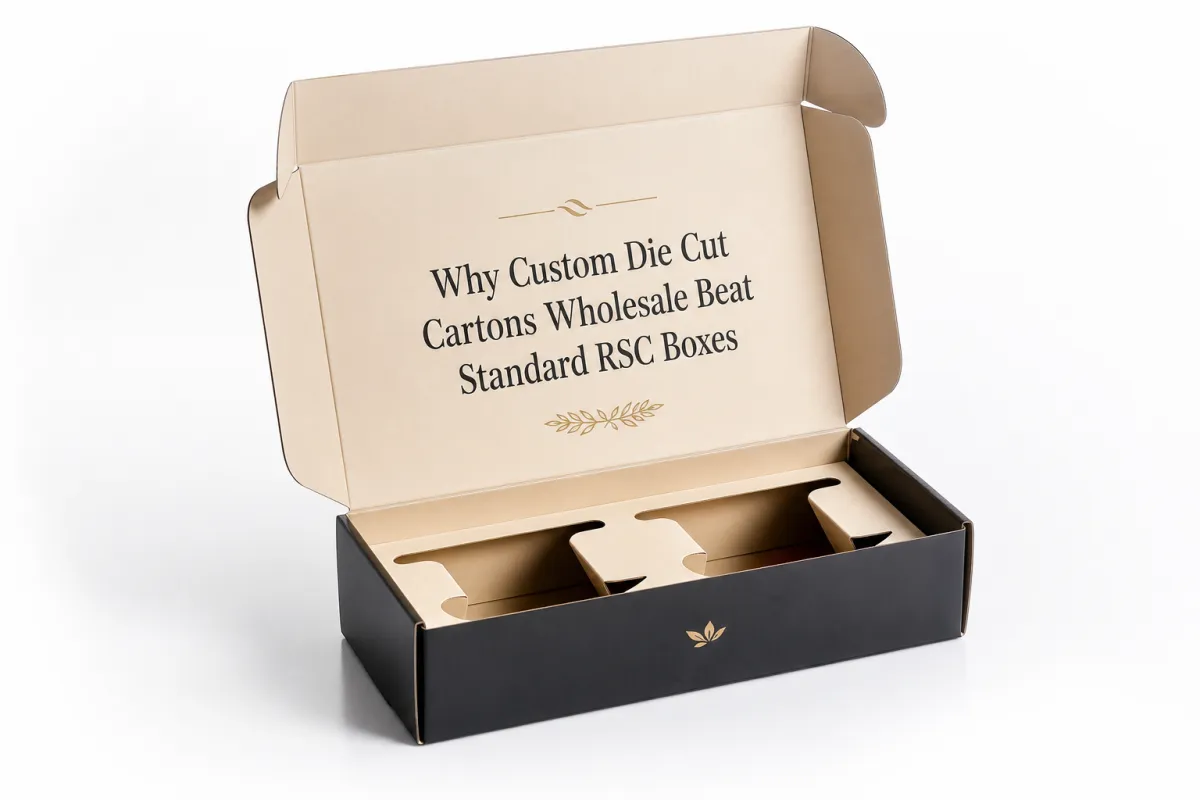
Standard RSC boxes solve a basic shipping problem, but they do not solve a branding problem and they often make fit issues worse. Too much packaging waste starts with a product that shifts inside a box because the cavity was chosen first and the item was forced to fit later. That is a classic use case for Custom Die Cut cartons wholesale. Exact die cutting reduces the need for void fill, lowers the odds of corner crush, and gives the product a more controlled presentation from the first touch to the final unboxing.
Fit matters more than many buyers expect. A carton that is only a few millimeters off can allow movement, especially for rigid cosmetics, glass bottles, electronics, or printed inserts. Those small gaps become expensive in practice. They can mean extra dunnage, slower packout, and more inconsistent shelf geometry. Custom die cut cartons wholesale is not only about appearance. It is about locking the product into a repeatable structure so warehouse teams are not solving the same problem on every run. If the fit is off by even a little, you are gonna feel it in the packout line almost immediately.
Wholesale buying also changes procurement behavior. Piecemeal box purchasing creates SKU chaos quickly: one size for launch, another size for a seasonal bundle, another for a repack, and then another after the first artwork revision. By contrast, custom die cut cartons wholesale lets buyers standardize dimensions, lock in a spec sheet, and make replenishment more predictable. That consistency supports package branding because the carton becomes part of the product story instead of a disposable afterthought. It also makes reorder conversations easier, which is one of those unglamorous wins that saves a lot of time over a year.
Channel needs matter as well. Retail packaging wants shelf geometry and face-up presentation. Ecommerce needs protection and low damage rates. Subscription and influencer send-outs need a strong reveal. Custom die cut cartons wholesale can support all three, but the structure has to match the channel. A mailer-style carton can feel premium in direct-to-consumer fulfillment. A tuck-end carton can be a smart choice for retail shelves. A locking-tab design can add integrity for heavier contents. Better structure usually means fewer downstream headaches, and that is true whether the carton is headed to a boutique shelf or a fulfillment center with a fast-moving pick line.
“Most packaging failures are fit failures. Printing gets blamed because it is visible, but the real issue is usually the carton geometry.”
If you want a technical benchmark for transit testing, check the current test framework at ISTA. Standards do not guarantee success, but they give teams a common language for drop, vibration, and compression performance. That matters when custom die cut cartons wholesale is part of a larger packaging program that cannot afford guesswork. I would still test with the actual product whenever possible, because lab standards and real-life handling rarely feel identical.
Custom Die Cut Cartons Wholesale Product Details and Use Cases
A die cut carton starts from a pre-cut sheet that is scored and folded into the final structure. The shape, closure style, and locking points are engineered around the product rather than around a stock box inventory. That is the practical difference. With custom die cut cartons wholesale, buyers can specify the internal cavity, the fold pattern, the closure, and any insert or compartment needed to keep the item secure.
Common formats include tuck end cartons, mailer-style cartons, locking tab boxes, display cartons, and cartons with inserts or dividers. Each format addresses a different need. Tuck end cartons are efficient for lightweight retail items. Mailer cartons are stronger for ecommerce and subscription programs. Locking tab cartons bring more mechanical integrity. Display cartons keep the product visible on shelf. The right structure depends on how the carton will be handled, stacked, and opened. A pretty box that collapses during assembly is not a win, no matter how good it looks in a mockup.
Use cases stretch across a wide range of products, though some categories benefit more than others. Cosmetics often need precise fit and strong visual branding. Supplements require clear labeling and practical bottle control. Food packaging may need grease resistance or food-safe substrates. Electronics usually need protection from movement and static-sensitive handling. Apparel accessories and promotional kits often need a mix of presentation and organization. In all of these cases, custom die cut cartons wholesale gives the brand a controlled footprint and a more polished unboxing sequence.
Branding surfaces matter too. Many buyers focus on the outer panel and stop there, but custom cartons can use the inside lid, side panels, insert faces, and hidden message areas to create a fuller branded packaging experience. That flexibility is one reason custom die cut cartons wholesale works so well for custom printed boxes and package branding programs that want the product to feel intentional at every step. A plain brown shipper can move merchandise. A well-planned carton supports perception, and perception matters more than people like to admit.
There are cases where a die cut carton is not the right answer. If the product is heavy, sharp-edged, or unusually fragile, a corrugated shipper or a double-wall structure may be the smarter path. If the main job is bulk transit, a simpler carton can be enough. Honest buying starts with the use case. Custom die cut cartons wholesale is strongest when structure, branding, and fulfillment all need to work together. It is not a cure-all, and that honesty usually leads to better decisions.
For buyers building out a product line, the broader Custom Packaging Products catalog can help align carton style with the rest of the package family. That matters because consistency across units often helps teams reduce design churn and keep custom die cut cartons wholesale aligned with future reorders. It also gives operations teams fewer one-off surprises when a line expands or a SKU gets refreshed.
Specifications: Materials, Dimensions, and Print Options
Specification work is where strong packaging programs separate from average ones. Custom die cut cartons wholesale succeeds or fails on the details: substrate, thickness, coating, print method, fold allowances, and tolerance. If the spec is fuzzy, the quote will be fuzzy too. Worse, the finished carton may look fine on screen and fail in hand.
Board selection comes first. SBS is common for premium print quality and a clean surface. CCNB is often chosen for value-oriented retail packaging. Kraft gives a more natural look and can signal sustainability. Corrugated options, including E-flute or B-flute, add protection and stiffness for heavier products. In many projects, 14pt to 24pt paperboard covers the common range for cartons, while corrugated structures are selected when compression resistance or ship-ready strength matters. The right choice depends on weight, stack height, and how much abuse the carton will take in transit.
Dimensions need to be measured, not estimated. Product height, width, depth, closure overlap, clearance for inserts, and fold allowance all need to be locked before quoting begins. A box that is 2 mm too tight can cause assembly issues. A box that is too loose can create movement and a sloppy presentation. Custom die cut cartons wholesale works best when the buyer can provide an exact sample or a dimensional drawing. That is usually the fastest route to a spec that holds up in production.
Print and finish options shape the final look. CMYK covers most full-color artwork, while PMS matching helps with brand consistency across custom printed boxes and other packaging design assets. Aqueous coating adds protection and a practical finish. Matte lamination can create a softer, more premium feel. Gloss lamination gives punch and color depth. Foil, embossing, debossing, and soft-touch treatments can push the carton into higher-end retail packaging territory, though each effect adds cost and lead time. Custom die cut cartons wholesale should balance finishing ambition with the realities of the supply chain, because pretty finishes mean very little if the schedule slips or the budget gets bent out of shape.
Compliance matters, especially for food-safe or regulated applications. Barcode placement has to remain readable after print and coating. Recycling marks should be placed correctly. If the carton will sit on a shelf, panel hierarchy should support the retail environment. If the project involves sustainability claims, sourcing details may need documentation, and buyers often ask for FSC-certified materials. You can review certification basics at FSC. That does not replace legal review, and it should not be treated as one, but it helps buyers ask better questions about responsible sourcing.
Prepress files deserve attention too. A clean dieline, proper bleed, safe zones, and vector artwork reduce the chance of misregistration or trimmed copy. Bitmap files alone are usually not enough for production. If the artwork wraps across panels, panel mapping needs careful checking. That is especially true for custom die cut cartons wholesale, where fold lines, cut lines, and print boundaries have to work together. Good prepress saves time later. Poor prepress turns a simple box into a revision cycle.
- Best practice: confirm the final product sample before approving the dieline.
- Best practice: keep all typography inside safe zones away from cuts and folds.
- Best practice: request print-ready proofs when color accuracy matters across repeated runs.
Custom Die Cut Cartons Wholesale Pricing, MOQ, and Quote Factors
Price is rarely just a number per unit. For custom die cut cartons wholesale, the real cost reflects material grade, carton size, print coverage, finishing complexity, insert count, and run volume. A simple one-color kraft carton may sit at a very different cost base than a four-color laminated carton with foil accents and a custom insert. The quote should expose those variables clearly, otherwise the buyer is comparing apples to oranges.
MOQ matters because setup costs have to be recovered somewhere. Die cutting, plating, setup, and sampling are easier to absorb across larger runs, so unit cost usually falls as quantity increases. Smaller runs can still make sense, especially for launches or seasonal tests, but the buyer should expect a higher per-carton burden. For many programs, custom die cut cartons wholesale becomes more attractive once the order crosses the threshold where setup is spread over enough units to stabilize pricing.
Here is a practical way to compare options without getting lost in the noise:
| Option | Typical Use | Relative Unit Cost | Operational Impact |
|---|---|---|---|
| Standard RSC box | Basic shipping, low branding need | Lowest | Often needs filler and manual adjustments |
| Custom die cut carton | Retail, ecommerce, subscription, promo kits | Moderate | Better fit, better presentation, cleaner packout |
| Die cut carton with inserts | Fragile, multi-item, premium sets | Higher | Improves protection and layout control |
| Laminated premium carton | High-end retail packaging | Highest | Strong shelf impact, more finishing time |
Hidden costs deserve a place in the conversation. Tooling, plates, proofing, freight, warehousing, and kitting can all affect the landed price. A quote that looks low on paper can turn expensive once shipping and revisions are added. This is why custom die cut cartons wholesale should be quoted on the same basis every time: same dimensions, same board, same quantity, same finish, same delivery term. Without that discipline, the comparison is not useful.
My advice is blunt: finalize the carton size and artwork before asking for pricing. Every late change risks a new proof, a revised die line, or a longer schedule. That is where budget drift starts. If the project has launch pressure, custom die cut cartons wholesale should be treated like any other sourced component: lock the spec early, then manage the order against the spec. That discipline usually saves more than aggressive haggling does. It also keeps the conversation grounded in reality instead of wishful thinking.
Production Process, Timeline, and Lead Time
The production path for custom die cut cartons wholesale is straightforward, but it breaks down quickly if one step is rushed. The normal sequence starts with a brief, then a dieline, then artwork, then prepress, then sample creation, then approval, manufacturing, finishing, quality control, packing, and shipment. When each stage is clear, the schedule is easier to hold.
Artwork revisions are a common delay. Missing dimensions and late changes to finishes also slow things down. If the dieline is still moving while the design team is finishing copy, the job can slide by days or weeks. The same problem shows up when the product sample is not available for fit verification. Buyers who keep the spec stable usually move faster through custom die cut cartons wholesale than buyers who keep refining the concept after the quote is accepted.
Sample types deserve a quick distinction. A flat mockup helps confirm print area and basic layout. A structural prototype checks fold behavior and fit. A pre-production proof is the most valuable when color, registration, and assembly need to be validated before the full run. For a premium brand, that step is worth the time. For a cost-sensitive run, it can still prevent expensive mistakes. In either case, custom die cut cartons wholesale benefits from a sample that mirrors the real carton as closely as possible.
Lead time is not one-size-fits-all. Simple runs with standard board and basic print can move relatively quickly. Larger quantities, specialty finishes, complex inserts, and multiple approval cycles take longer. Rather than chasing a single promised number, buyers should ask for a timeline tied to the actual spec. That is the honest approach. If the launch date is fixed, ask what must be finalized before production can begin and what changes would reset the schedule. That question alone can save a lot of friction in custom die cut cartons wholesale projects.
Rush production may be possible, but only if the non-negotiables are already settled: final artwork, approved dieline, confirmed dimensions, and payment authorization. If any of those are still open, the rush fee often buys very little. The smartest teams use speed where it matters and keep the rest controlled. That is usually how custom die cut cartons wholesale stays both reliable and commercially sensible. The short version: speed is useful only when the details are already nailed down.
Why Choose Us for Custom Die Cut Cartons Wholesale
Buyers do not just want a box. They want a packaging partner who can reduce risk. That is the most practical reason to source custom die cut cartons wholesale through a team that understands structure, prepress, and production discipline. One clear point of contact for design guidance, dieline accuracy, and replenishment planning can eliminate a surprising number of errors.
Quality control should be visible, not implied. Dimensional verification, color checks, closure testing, carton integrity inspection, and packout review all matter before shipment leaves the floor. Small discrepancies are easier to catch early than after a pallet has moved across the country. For branded packaging, that discipline protects more than paperboard. It protects the launch itself. For teams evaluating custom die cut cartons wholesale, that is often the real value of choosing a specialist.
Responsive estimating matters too. When a buyer is trying to hit a retail date or a shipping window, fast answers are worth money. A slow quote can delay artwork, approvals, and purchase orders. A clear estimate with matched specs is better than a vague low number that gets revised later. In practice, custom die cut cartons wholesale performs best when communication is direct and the quote is built around the actual job, not a guess.
Sustainability and scalability should also be part of the decision. Recyclable substrates, optimized board usage, and repeatable specs all support a cleaner program over time. That does not mean every carton has to be the same forever. It means the buyer should know how the box will be reordered, how the artwork will be maintained, and how the packaging design will scale as the line expands. A smart custom die cut cartons wholesale program usually makes future orders easier, not harder.
If you are comparing supply options across a broader portfolio, it helps to think in systems. Fewer handoffs usually mean fewer mistakes. Fewer mistakes usually mean lower total packaging cost. That is why a coordinated custom die cut cartons wholesale program often outperforms a patchwork of one-off box buys. The carton becomes part of the operating model, not a last-minute purchase.
For teams exploring related packaging formats, the right mix of Custom Packaging Products can support a more consistent shelf story and a more efficient replenishment cycle. That consistency matters more than people admit, especially once the brand grows beyond a single SKU and starts to depend on repeatable custom die cut cartons wholesale orders.
Next Steps for Ordering Custom Die Cut Cartons Wholesale
The cleanest quote requests arrive with the right inputs. Before placing a custom die cut cartons wholesale order, gather the product dimensions, weight, shipping environment, target quantity, brand files, and any finish preferences. If the product is fragile or irregular, include photos and a sample if possible. That saves back-and-forth and improves the first quote.
Then decide what the carton must do. Does it need to sell on shelf, survive parcel shipping, or do both? That one decision changes the structure, material, and finishing approach. A carton designed for retail packaging may not be the best choice for rough parcel handling. A shipper that protects well may not be the best face for branded packaging. Custom die cut cartons wholesale works best once the use case is clear.
Ask for a sample or prototype before approving the full run. Check fit. Check fold behavior. Check closure strength. Check print placement. If the carton is part of a premium launch, test the unboxing sequence with someone who has not seen the design before. Their reaction will tell you more than a slide deck will. That is especially useful in custom die cut cartons wholesale projects where presentation and protection have to carry equal weight.
A short ordering checklist can keep the process tight:
- Confirm final product dimensions and weight.
- Select the board grade and finish.
- Approve the dieline before design work starts.
- Prepare vector artwork with bleed and safe zones.
- Set quantity, timeline, and delivery location.
Once those steps are complete, the order process becomes much cleaner. That is the main advantage of custom die cut cartons wholesale: it gives packaging teams control over cost, product protection, and presentation in the same system. Done well, it supports launch confidence. Done poorly, it creates avoidable waste. The difference is usually in the prep, not the press sheet. If your team is ready to move, start with the spec, ask for the sample, and build the reorder plan around custom die cut cartons wholesale from day one.
The practical takeaway is simple: lock the product dimensions, choose the carton structure around the real handling conditions, and approve a sample before the full run. That sequence keeps custom die cut cartons wholesale from becoming a guess and turns it into a repeatable packaging system that can hold up through reorder after reorder.
Frequently Asked Questions
What is the MOQ for custom die cut cartons wholesale orders?
MOQ depends on carton size, board type, print method, and finishing complexity, so there is no single universal minimum for custom die cut cartons wholesale. Smaller runs usually carry a higher unit cost because setup expenses are spread over fewer cartons. Ask for pricing at two or three quantities so you can see where the cost curve improves.
How much do custom die cut cartons wholesale packages usually cost?
Unit cost is driven by dimensions, board grade, print coverage, finishing, inserts, and total order volume. Freight, tooling, plates, and proofing can materially affect the real landed cost, not just the carton price. The cleanest comparison is a quote broken out by specification, quantity, and shipping term for custom die cut cartons wholesale.
How long does production take for custom die cut cartons wholesale?
Lead time depends on artwork readiness, proof approval, quantity, and whether specialty finishes are involved. The quickest way to delay production is to change dielines or artwork after samples have been approved. If the launch date is fixed, confirm the schedule before order placement and keep all specs final for custom die cut cartons wholesale.
Can I get a sample before placing a custom die cut cartons wholesale order?
Yes, a flat sample or structural prototype can confirm sizing, fold behavior, and product fit before full production. A pre-production sample is especially useful when the carton must protect fragile or premium products. Testing the sample helps catch problems before you commit to the full MOQ in custom die cut cartons wholesale.
What artwork files are needed for custom die cut cartons wholesale packaging?
Vector artwork is preferred, along with a dieline, bleed, safe zones, and any Pantone references needed for color control. High-resolution images alone are usually not enough when the carton requires precise registration or panel alignment. Confirm the template before design work starts so the final file matches the production spec for custom die cut cartons wholesale.

