Buyer Fit Snapshot
| Best fit | Paper Belly Bands With Logo projects where brand print, material claims, artwork control, MOQ, and repeat-order consistency need to be specified before quoting. |
|---|---|
| Quote inputs | Share finished size, material target, print colors, finish, packing count, annual reorder estimate, ship-to region, and any compliance wording. |
| Proofing check | Approve dieline scale, logo placement, barcode or warning zones, color tolerance, closure strength, and carton packing before bulk production. |
| Main risk | Vague material claims, crowded artwork, missing packing details, or unclear freight terms can make a low unit price expensive after revisions. |
Fast answer: Paper Belly Bands With Logo: Branding, Cost, and Fit should be specified like a repeatable production item. The safest quote records material, print method, finish, artwork proof, packing count, and reorder notes in one written spec.
Production checks before approval
Compare the actual filled-product size with the drawing, then confirm tolerance on folds, seals, hang holes, label areas, and retail display edges. Reserve space for logos, QR codes, warning copy, and material claims before decorative graphics fill the panel.
Quote comparison points
Review material grade, print process, finish, sampling route, tooling charges, carton quantity, and freight assumptions side by side. A quote is only useful when the supplier can repeat the same color, closure quality, and packing count on the next order.
A plain carton can look far more expensive with one well-placed detail. For many brands, paper belly bands with logo do more to raise perceived value than a full packaging redesign, because they frame the product, sharpen the brand mark, and leave the rest of the pack clean. That matters for teams that need to move quickly, keep costs in check, and still present a package that feels deliberate on shelf, in customer photos, and during fulfillment.
In my experience, the packaging decisions that feel modest on a spreadsheet often do the heaviest lifting in the real world. A tidy box, a kraft sleeve, or a glass jar can already be doing its job, but it may still look a little quiet. Add paper belly bands with logo, and the product reads differently right away. The package does not become crowded. It becomes easier to understand. That distinction matters, because most buyers want branding that signals quality without pushing them into a costly custom carton program.
Paper Belly Bands With Logo: What They Are and Why They Stand Out
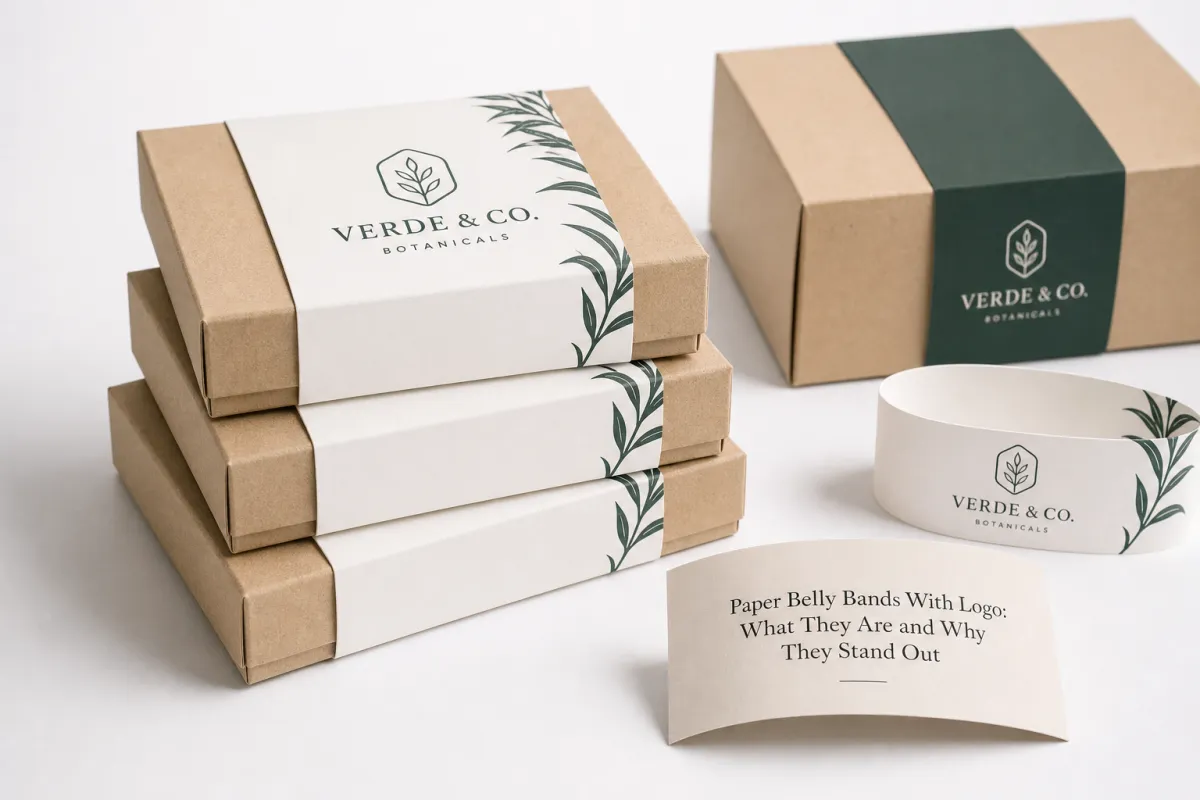
Paper belly bands with logo are printed paper strips that wrap partway around a product, bundle, sleeve, or carton. They can identify the brand, keep components together, support seasonal messaging, or simply make a package feel more finished. The idea is simple. The effect is not. A well-designed band can turn a plain container into packaging that looks planned, priced correctly, and ready for retail.
What makes paper belly bands with logo stand out is the mix of restraint and visibility. They use less paper than a custom box, less ink than a fully printed carton, and less production complexity than a rigid pack or specialty sleeve. Even so, they still create a strong visual break across the face of the product. That break gives the eye a place to land, and it can make a small logo feel confident instead of tentative.
That efficiency is a big reason the format keeps showing up in product launches, limited runs, and seasonal updates. If a brand wants to test a scent, flavor, size, or campaign without committing to a full packaging rebuild, paper belly bands with logo offer a practical middle path. They also fit companies that rotate SKUs often. One base package can support several versions if the band carries the variant name, a color cue, or a short product story.
There is a quieter advantage that buyers often overlook. A band can create a premium feel by improving design discipline, not by piling on more material. A clean logo, correct spacing, and the right paper stock do more work than a crowded art file ever will. That is why paper belly bands with logo are such a useful packaging tool: they let the branding look intentional while keeping the production path simpler than a full custom carton.
One more thing, and this comes up a lot: a belly band is not automatically the right answer for every pack. If the product will live in a damp cooler, get handled roughly, or travel through a distribution chain with a lot of abrasion, paper alone may need help from the rest of the structure. That is not a flaw in the format. It just means the use case has to match the material.
The best belly band does not look like an add-on. It should look like it belonged on the pack from the start.
If you are weighing whether this format suits your product line, the real questions are usually practical: How much will it cost? What size should it be? How long will it take? What paper stock will hold up? What mistakes lead to reprints? Those are the questions that matter most, because paper belly bands with logo succeed or fail on fit, timing, and clarity more than on abstract design theory.
How Paper Belly Bands With Logo Work on Packaging
The mechanics are straightforward. A strip of paper wraps around the product or bundle, then stays in place through adhesive, a tuck-in fold, a die-cut lock, or the compression of the package itself. That means paper belly bands with logo can be added after filling or final assembly, which is a real operational advantage. If the product changes often, the outer package can stay stable while the band handles the variable details.
They show up across a wide range of categories. Boxes use them to signal a collection or gift set. Candle jars use them to carry fragrance names, burn times, or safety notes. Bakeries use them on sleeves and bakery boxes. Cosmetic brands use them for bundle identification. Apparel companies use them for folded shirts, accessory sets, or multi-item kits. In each case, paper belly bands with logo help the product look coordinated without forcing every surface to become a branding canvas.
The visual role goes beyond decoration. The logo can sit centered for quick recognition, repeat as a pattern for texture, or pair with product details, QR codes, batch names, or campaign copy. That matters for products that need a fast read at retail. The band can tell shoppers what the item is, what version they are holding, and why it matters before they even pick it up. Paper belly bands with logo do that with very little material.
Operationally, these bands solve a common packaging problem: change without chaos. A team may have one carton, one jar, or one tray, but six scents, four flavors, or three promotional versions. Reprinting a whole package for every variation is expensive and slow. Reprinting paper belly bands with logo is usually much easier. That is why they are common in short-run commercial packaging and in businesses that need frequent seasonal refreshes.
They can also organize information in a way customers actually use. A fragrance line might use the band to identify scent families. A food brand might use it to show flavor, allergen callouts, or serving notes. A subscription box might use it to group contents by theme. In other words, paper belly bands with logo are not just a branding move. They are a packaging management tool.
Cost and Pricing Factors for Paper Belly Bands With Logo
Pricing usually comes down to six variables: size, quantity, paper stock, ink coverage, finishing, and whether the band needs die-cutting or special folds. Paper belly bands with logo can be affordable or distinctly premium depending on those choices. A narrow one-color band on standard uncoated paper is a very different job from a wide, full-bleed band on textured stock with a matte coating and precise folds.
Short runs almost always cost more per unit. That is not a penalty; it is how production works. Setup time, proofing, and prepress are spread across fewer pieces, so the unit price rises. Larger orders lower the per-unit price because those fixed costs get distributed across more bands. For paper belly bands with logo, the break point usually depends on whether the design stays consistent across multiple SKUs or can be reused across a series.
Here is a practical pricing snapshot for a common commercial order, assuming a band around a small-to-medium product and standard print preparation. These are planning ranges, not promises, because artwork coverage and finishing can move the numbers quickly.
| Paper Stock | Typical Use | Approx. Unit Price at 5,000 Pieces | What It Signals |
|---|---|---|---|
| Kraft uncoated, 80-100 lb text | Natural, earthy, minimal branding | $0.14-$0.22 | Practical and understated |
| White uncoated, 90-120 lb text | Clean color contrast and readable type | $0.16-$0.26 | Crisp and versatile |
| Matte coated, 100-130 lb text | Sharper graphics and stronger color density | $0.20-$0.32 | Polished retail look |
| Textured or specialty paper | Gift sets, premium lines, limited editions | $0.28-$0.55 | Higher perceived value |
That table hides a useful point: the cheapest band is not always the best value. If a brand needs to sell at a higher shelf price, a slightly better stock can pay for itself through stronger presentation. Paper belly bands with logo often cost far less than changing the entire package structure, yet they can still raise perceived value enough to justify the spend.
Buyers also tend to miss the hidden costs. Artwork revisions can add time and fees if the logo is not final. Proof changes can trigger another round of review. Rush production may carry a premium. Shipping becomes meaningful when the order is bulky or the bands need careful packing to avoid edge damage. If paper belly bands with logo are being used for a launch, those extras should be budgeted before the quote goes out, not after approval.
There is a practical business logic behind this format that makes it attractive for both small and larger brands. A full custom carton may require new tooling, a longer lead time, and a larger storage commitment. A belly band often avoids most of that. For many programs, paper belly bands with logo are the fastest route to stronger brand presence without locking the company into a more expensive packaging structure.
If I had to give one cost-control rule from the production side, it would be this: keep the design stable and move the variables into the band, not the whole package. That keeps reorders simpler, which is a nice little quality-of-life win for operations teams and a very real savings over time.
Process and Timeline for Ordering Paper Belly Bands With Logo
The standard workflow is simple enough, yet each step matters. It usually starts with a quote request, then size confirmation, artwork submission, proof review, approval, production, and shipping. The fastest projects are the ones where the buyer sends clear specs early. With paper belly bands with logo, a missing measurement or a vague fold instruction can slow the schedule because the printer cannot confidently position the seam or confirm the final fit.
Most delays come from the same small set of problems. Dielines are missing or wrong. Logos are low resolution. Color references do not match. Fold lines are unclear. A seam lands directly on a key word because nobody checked the wrap direction. These look minor in a file and become expensive in production. For paper belly bands with logo, the artwork is not finished until the physical wrap has been mentally mapped onto the actual package.
Timing is easiest to understand in three phases: proofing, production, and shipping. Proofing can take a day or several days, depending on revisions. Production can take a week or more, depending on quantity and finishing. Shipping depends on the destination and whether the bands are going flat or in protective cartons. A realistic expectation for many custom runs is often 12-15 business days from proof approval, though that depends on the plant, the season, and the job complexity. For paper belly bands with logo, the approval date is usually the real starting line, not the quote date.
There is a second timeline issue that buyers should not ignore: sample testing. If the bands are meant for a launch, trade show, or seasonal retail reset, one missed fit test can create a chain reaction. The band may look fine in the file and still fail on the line. It may shift during wrapping, catch on a corner, or cover a barcode. That is why early sampling matters so much for paper belly bands with logo. A day spent testing is usually cheaper than a week spent reprinting.
Plan backward from the launch date, not forward from the order date. Start with the final pack-out day, subtract time for proofing, subtract production, subtract shipping, and leave margin for a test run on the actual packing line. If the product has a shelf date, a launch event, or a retailer appointment, build in extra time. In practice, paper belly bands with logo are easy to order too late because they look simple. Simple does not mean instant.
If transit is a concern, it helps to think like a packaging engineer for a moment. For bundles and retail-ready packs, ask whether the finished product needs to survive vibration, compression, and repeated handling before it reaches the end user. The ISTA test framework is one of the best-known references for transport validation, and it is useful to know whether the band will stay put under real distribution conditions. For responsible paper sourcing, the FSC chain-of-custody system is the standard many brands recognize. Those references do not replace practical testing, but they help buyers ask better questions about paper belly bands with logo.
Choosing Materials, Sizes, and Finishes for Paper Belly Bands With Logo
Material choice should match the brand story. Kraft paper signals earthy, handmade, or natural positioning. White stock gives crisp contrast for bright color and fine type. Specialty papers can push the line toward premium or giftable territory. The right stock for paper belly bands with logo depends on what the product should say before the buyer reads the details. A coffee roaster does not need the same finish as a luxury candle brand, and neither should choose by habit.
Size selection is where the real fit decisions happen. Narrow bands work well if the goal is identification and a clean brand mark. Wider bands help when the band needs to carry ingredients, campaign copy, a QR code, product variants, or promotional graphics. If paper belly bands with logo are being used across several products, it is smart to standardize a core width and adjust only when the package dimensions force it. That keeps the brand system coherent and production simpler.
Finish changes perception more than many buyers expect. Matte finishes tend to feel quiet and controlled. Gloss can increase visual punch and make color appear brighter. Soft-touch or lightly textured finishes add a tactile premium effect, though they can change the way ink sits on the sheet and may require a different proof strategy. For paper belly bands with logo, the finish should support the brand tone, not fight it. A dramatic surface on a minimalist identity can feel off, while a plain stock can make a luxury line look underdeveloped.
Fit and function matter just as much as appearance. The band should wrap cleanly without buckling, slipping, or masking key package information. A design file that looks centered on screen can land awkwardly once it meets an actual box corner, jar curve, or sleeve seam. That is why a physical sample is more valuable than a mockup alone. With paper belly bands with logo, the real question is whether the band still reads well once it touches a real object and moves through a real packing line.
Channel choice should shape the spec. Retail shelves tend to reward sharper contrast and stronger legibility. Shipping boxes need better abrasion resistance. Subscription packaging benefits from a clean unboxing reveal, but it also needs bands that do not tear while the customer opens the package. Multi-channel brands should resist the urge to pick one universal spec and hope it covers everything. In many cases, paper belly bands with logo need a retail version, a shipper version, or at least a design that can be adapted across the two.
Common Mistakes When Ordering Paper Belly Bands With Logo
The most common mistake is designing for the artwork file instead of the actual package. A band that seems perfect in a flat layout can become too loose, too tight, or badly aligned once it wraps around the product. The measurement has to come from the object itself, including any clearance or overlap required for the chosen closure method. Paper belly bands with logo do not forgive guesswork.
Logo placement goes wrong more often than people admit. Buyers center the mark on the mockup and forget that a seam, fold, closure point, or round jar curve can shift the visual center in real life. A beautiful band can lose its balance if the logo lands on a corner or sits too close to the edge. For paper belly bands with logo, the seam should be treated as a design element, not an afterthought.
Another mistake is trying to make the band do everything. It should not carry a full label program, a full marketing story, a technical insert, and a holiday message all at once. That usually leads to overcrowding, smaller type, and weak hierarchy. Better to keep the layout disciplined. A clean mark, one supporting message, and one useful detail often outperform a crowded panel. That is especially true for paper belly bands with logo, where the limited surface is part of the appeal.
Color proofing matters more than many teams expect. Paper color changes the final look. Ink coverage changes the saturation. Texture changes how the eye reads the print. A design that feels bright on screen may print calmer on kraft, and a dark logo may lose contrast on an uncoated stock. If the brand is particular about color, physical proofing is worth the time. With paper belly bands with logo, the final look comes from paper, ink, and press behavior working together, not from one design choice alone.
Then there is the classic rush order. A team approves the artwork before testing one sample on the finished product, and suddenly the band needs a revision that consumes a week. That is how avoidable reprints happen. A simple test pack can reveal whether the band slides, wrinkles, or covers too much of the label. In packaging, that test is cheap insurance. For paper belly bands with logo, one physical check on the real package is often the difference between a smooth launch and a costly reset.
A band that fits the package is better than a band that merely fits the file.
Expert Tips and Next Steps for Paper Belly Bands With Logo
Start with one core size and one or two controlled variants. That keeps the brand system consistent while still covering multiple products. If the first order performs well, the structure can expand. If it does not, the mistake stays contained. That approach works especially well for paper belly bands with logo because the format is flexible enough to scale without requiring a full packaging overhaul.
Ask for a physical sample or at least a hard proof if the band will appear in retail, gifting, or photo-heavy e-commerce settings. Screens hide alignment issues. A real sample shows how the paper bends, how the ink sits, and whether the logo reads from a normal viewing distance. For paper belly bands with logo, a sample often answers the question that a PDF cannot: does this actually look like a finished product?
It also helps to build a simple spec sheet before requesting quotes. Include package dimensions, desired band width, paper preference, logo files, finish notes, target quantity, and any fold or seam instructions. The more complete the brief, the less likely the job is to bounce back with questions. Buyers who order paper belly bands with logo regularly often keep a master sheet for each SKU family, because it saves time and reduces versioning errors.
Test the band on the packing line, not just on a desk mockup. Speed changes everything. A design that slides perfectly when one person wraps it by hand may behave differently when a team is packing dozens per hour. Alignment, friction, and handling all matter. This is one reason paper belly bands with logo should be evaluated under production conditions, even if the order itself is small.
Before placing the final order, compare two or three material options, confirm the proof timeline, and decide whether the band needs a retail-grade finish or a more economical production spec. That small amount of comparison work can prevent expensive surprises. For many brands, paper belly bands with logo are the sweet spot between a bare package and a fully custom box, but only if the fit, finish, and timing are handled carefully.
If the packaging program is likely to grow, think ahead about repeatability. Can the same band system support new flavors, new scents, or a holiday edition? Can the logo placement stay consistent across sizes? Can the same stock be kept in inventory for future orders? Those questions matter because paper belly bands with logo are strongest when they become part of a repeatable packaging system instead of a one-off design stunt.
My practical takeaway is pretty simple: decide what the band needs to do, measure the package in the real world, and approve a physical sample before production. If those three steps are handled carefully, paper belly bands with logo can lift presentation fast without creating avoidable headaches for the team that has to pack, ship, and reorder them later.
How much do paper belly bands with logo usually cost per unit?
Unit cost depends on quantity, paper stock, print coverage, and finishing. Smaller runs usually cost more per band because setup fees are spread across fewer pieces. Bulk orders lower the per-unit price, especially when the design stays consistent across many packages. For many brands, paper belly bands with logo land in the range of roughly $0.14-$0.55 per unit, but the exact number depends on size and production details.
What size should paper belly bands with logo be for my packaging?
Measure the full wrap distance around the package, then add overlap or closure allowance if needed. Choose band width based on how much branding or product information you want visible. Test the size on a physical sample so you can check fit, seam placement, and readability. In practice, paper belly bands with logo should be sized from the actual object, not from a flat layout alone.
How long does it take to produce paper belly bands with logo?
Timeline usually includes proofing, production, and shipping, so plan for each stage separately. Artwork delays and revision rounds are the most common reasons schedules slip. If the bands are needed for a launch or event, build in extra time for sample approval. Many buyers find that paper belly bands with logo are fastest when the artwork is final before the quote is requested.
Can paper belly bands with logo work for small businesses?
Yes, because they can make simple packaging look branded without a full custom box order. They are useful for limited runs, seasonal products, and businesses that change SKUs often. They also let small brands upgrade presentation while keeping packaging costs controlled. For a smaller operation, paper belly bands with logo are often one of the most efficient ways to look more established without overcommitting.
What makes paper belly bands with logo look more premium?
Clean sizing, sharp logo placement, and a paper stock that matches the brand tone make the biggest difference. Matte, textured, or specialty finishes can add perceived value without a major redesign. Keeping the layout uncluttered usually looks more polished than crowding the band with too much text. In short, paper belly bands with logo look premium when the design is disciplined and the material feels intentional.
If you want a packaging detail that changes the first impression without forcing a full rebuild, paper belly bands with logo are hard to beat. The best next move is to measure one finished pack, request a sample with the exact stock you want, and check the wrap on the real product before ordering the full run. That one test usually tells you whether the band is ready or whether the spec needs a small fix first.
Related packaging resources
Use these related guides to compare specs, costs, quality checks, and buyer decisions before making the final call.


