Buyer Fit Snapshot
| Best fit | Custom Die Cut Mailers Wholesale for Better Branding projects where brand print, material claims, artwork control, MOQ, and repeat-order consistency need to be specified before quoting. |
|---|---|
| Quote inputs | Share finished size, material target, print colors, finish, packing count, annual reorder estimate, ship-to region, and any compliance wording. |
| Proofing check | Approve dieline scale, logo placement, barcode or warning zones, color tolerance, closure strength, and carton packing before bulk production. |
| Main risk | Vague material claims, crowded artwork, missing packing details, or unclear freight terms can make a low unit price expensive after revisions. |
Fast answer: Custom Die Cut Mailers Wholesale for Better Branding should be specified like a repeatable production item. The safest quote records material, print method, finish, artwork proof, packing count, and reorder notes in one written spec.
Production checks before approval
Compare the actual filled-product size with the drawing, then confirm tolerance on folds, seals, hang holes, label areas, and retail display edges. Reserve space for logos, QR codes, warning copy, and material claims before decorative graphics fill the panel.
Quote comparison points
Review material grade, print process, finish, sampling route, tooling charges, carton quantity, and freight assumptions side by side. A quote is only useful when the supplier can repeat the same color, closure quality, and packing count on the next order.
Custom Die Cut Mailers Wholesale for Better Branding
A mailer that folds cleanly can save real minutes across a pack line, and Custom Die Cut mailers wholesale are built for that kind of efficiency. The structure is shaped around the product instead of asking the product to make do with a generic carton. In high-volume fulfillment, that difference shows up in the small places first: fewer adjustments, fewer stalled hands at the table, and a more consistent unboxing moment for the person who opens the package.
Packaging buyers usually notice the visual side first, then the operational side follows. Custom Die Cut mailers wholesale do both. They support faster pack-out, improve how the item sits inside the shipper, and give the outer package a cleaner face before it enters the carrier network. That matters for branded packaging in subscription kits, retail launches, direct-to-consumer boxes, and repeat-order programs where the package has to arrive looking deliberate rather than improvised.
The business case is plain once you look past the print surface. A well-engineered mailer can reduce insert mistakes, cut tape use, and hold its shape better than a loose stock mailer that depends on extra filler. Teams that care about speed, presentation, and damage control at the same time often find that custom die cut mailers wholesale bring a steadier pack-out without making the package feel oversized or wasteful. That is why buyers often compare them with standard folding cartons and other die cut packaging options before they place a larger order.
I have seen brands save less than a second per pack and dismiss it as trivial. Then the math shows up. At 10,000 units, a half-second gain is almost 1.4 hours of labor recovered, and that is before you count the fewer mistakes that tend to happen when a carton is fighting the person assembling it. Tiny changes can be kinda annoying to track, but the savings stack fast.
What Are Custom Die Cut Mailers Wholesale?
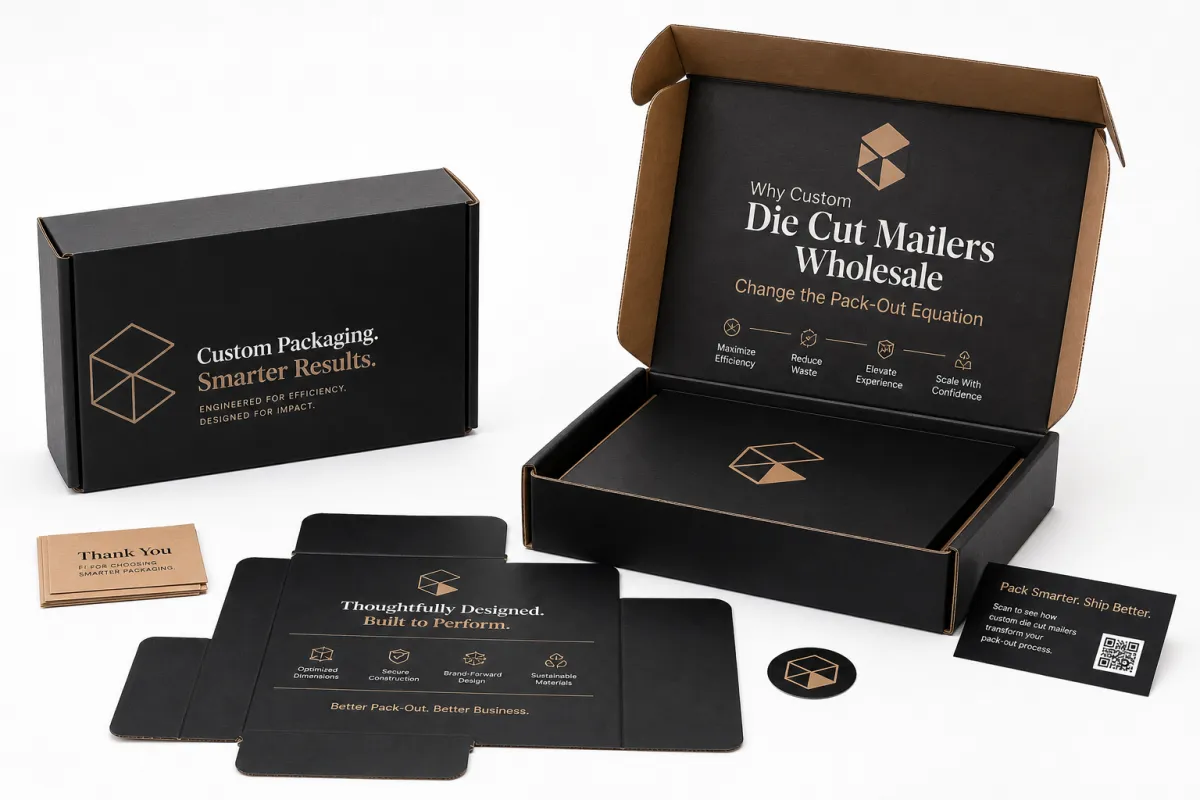
Custom die cut mailers wholesale are pre-scored, pre-cut mailers made to a product-specific dieline so they fold quickly, close consistently, and fit the item without excess space. The structure is built around a known footprint, which makes loading and assembly more predictable across a wholesale run. In practical terms, that means fewer adjustments on the line and a cleaner package when it reaches the customer.
These mailers are used when a brand wants a more polished presentation than a standard stock mailer can provide. They are a strong fit for custom packaging programs where speed matters, but so does the final reveal. For many teams, custom die cut mailers wholesale sit in the middle ground between a plain shipper and a premium retail carton: efficient enough for fulfillment, refined enough for branding.
If you need a short definition, this is the simplest version: a custom die cut mailer is a made-to-fit carton that arrives flat, folds to a specific shape, and supports a repeatable pack-out process. That repeatability is one of the reasons custom die cut mailers wholesale are used for Subscription Box Packaging, apparel, cosmetics, samples, and promotional kits. The form is simple. The payoff is in the consistency.
That consistency matters more than many people expect. In a warehouse, every extra decision slows someone down, even if it is only for a moment. A structure that folds the same way every time removes a small layer of uncertainty, and in fulfillment, uncertainty is expensive.
Why Custom Die Cut Mailers Wholesale Change the Pack-Out Equation
Die cut mailers earn their keep because the structure does part of the labor. Scores, flaps, and locking points are already placed where they need to be, so the carton opens, folds, and closes the same way again and again. That sounds small. On a production floor, it is not small at all. A few extra seconds per unit becomes a measurable drag across a wholesale run, and custom die cut mailers wholesale reduce that friction by matching the shape to the item and keeping assembly steps clear.
The branding benefit is easy to spot, but the operations benefit is usually what buyers remember after the first few pallets move through the warehouse. A mailer designed for a specific product keeps the presentation more consistent from one unit to the next. That consistency strengthens package branding because every customer gets a similar opening experience instead of a package that looks packed three different ways by three different hands. It also helps cut down on insert errors, one of the more common low-level problems in fulfillment.
Think through the impact in practical terms. Better first impressions can support repeat orders. A cleaner outer package can make an ordinary item feel more intentional. A mailer that arrives folded, crisp, and ready to present often fits retail packaging better than a soft or misshapen shipper that looks like it was assembled in a hurry. That is why custom die cut mailers wholesale are frequently selected by brands that want a premium presentation without moving into more expensive multi-part packaging systems.
- Faster pack-out: fewer touches, fewer corrections, and less guesswork on the line.
- Cleaner presentation: the outside looks intentional, which supports stronger brand perception.
- Better fit: the mailer can be built around the actual product footprint instead of a broad size range.
- Lower error risk: consistent folds and closure points help reduce packing mistakes.
A good mailer should close without a fight. If the structure needs too much force, too much tape, or too much guessing, the line slows down and the customer feels the drag in the final package.
For wholesale buyers, that is the real equation behind custom die cut mailers wholesale: not just a nicer printed surface, but a carton that fits production rhythm, shipping demands, and brand expectations at the same time. If your order volume is large enough to justify setup and tooling, the return often comes from the little gains that happen on every single unit.
Custom Die Cut Mailers Wholesale Product Details
A die cut mailer begins as a flat sheet that has already been cut, scored, and shaped so it can fold into a specific form with minimal effort. That is what sets it apart from a generic mailer. Instead of forcing a standard carton to adapt to the product, custom die cut mailers wholesale are built around a known footprint, which makes loading, folding, and closing more controlled. The result is a tighter fit, cleaner edges, and less wasted space.
Structural details matter here. Common features include tuck flaps, dust flaps, locking tabs, thumb notches, and score lines that guide the fold without tearing the board. Some designs are made for self-mailing, while others work as outer shippers around a sleeve or inner tray. Once the product size is fixed, those structural choices can make custom die cut mailers wholesale much easier to use than a generic mailer that depends on filler or extra tape.
Material selection matters just as much as shape. Paperboard grades such as 16pt to 24pt SBS or C1S are common for lighter items and presentation-first packaging, while corrugated options such as E-flute may fit better when the product needs more crush resistance. Finish choices also change how the package performs: aqueous coating helps with scuff resistance, matte lamination gives a softer look, gloss can sharpen color, and soft-touch lamination adds a more premium feel. For custom die cut mailers wholesale, the right board needs to balance stiffness, print quality, and transit durability.
These mailers are a strong fit for apparel, cosmetics, samples, subscription kits, gifts, and promotional items that need a tidy reveal. They also work well for lightweight direct-to-consumer orders where the package itself is part of the brand experience. If the item is too heavy, oddly shaped, or especially fragile, another structure may make more sense. For a lot of commercial programs, though, custom die cut mailers wholesale give the right mix of presentation and efficiency.
Buyers who compare other structures often benefit from looking at the broader family of Custom Packaging Products and weighing whether a mailer, sleeve, tray, or specialty carton fits the load better. In some programs, a mailer wins on speed and presentation. In others, a more rigid format does a better job protecting the product. The right call depends on the item, the shipping method, and how much visual weight the package needs to carry.
Custom die cut mailers wholesale also sit inside a larger packaging system rather than acting as an isolated purchase. If the outer shipper has to work with inserts, printed literature, tissue, or a nested product tray, those parts should be discussed together. That prevents the common mistake of approving a mailer that looks fine in isolation but becomes awkward in the packing area.
Specifications to Confirm Before You Order
The fastest route to avoiding rework is to lock down the right dimensions early. For custom die cut mailers wholesale, that means more than the outside size printed on a quote. You want inside dimensions, real product clearance, panel depth, score positions, and any allowance for inserts, tissue, or protective wrap. A carton can look perfect on a spec sheet and still feel tight once the actual product is inside it.
Finishing choices should follow the shipping path, not the other way around. A mailer that will sit in a warehouse stack and move through carrier handling needs a different surface treatment than one that lives mostly on a shelf or ships inside a second shipper. Print method, coating, and lamination all affect how the piece looks and how well it stands up to abrasion. If the package is part of a retail presentation, custom die cut mailers wholesale often benefit from stronger color control and a finish that resists scuffing in transit.
Before you approve anything, answer a few structural questions. What is the target weight? Does the mailer need a lock closure, a tuck closure, or tamper-evident behavior? Is assembly done by hand or by a packing station that wants a quick fold sequence? Will the item be packed with tissue, foam, paper inserts, or a molded insert? These details are not minor. They change how custom die cut mailers wholesale behave in production.
- Measure the finished product with all inserts, sleeves, and protective materials included.
- Confirm inside dimensions before signing off on the dieline.
- Check closure behavior so the mailer opens and shuts cleanly during pack-out.
- Review artwork placement for folds, glue zones, and any hidden panels.
- Approve a sample when the structure is new or the product is unusually shaped.
That sample step matters more than many buyers expect. A quick prototype or pre-production proof lets you test fold memory, closure tension, and artwork alignment before the wholesale run begins. For custom die cut mailers wholesale, sample approval is the stage that protects you from an expensive mismatch later. If the fit is off by even a few millimeters, the whole pack-out can feel wrong.
For transit-related testing, the standards published by the International Safe Transit Association are a useful reference point. Not every job needs a formal distribution test, but a structured approach to compression, vibration, and drop risk is smart when the packaging must survive real shipping conditions. If sustainable sourcing is part of the brief, FSC-certified paper options can matter too; the FSC system gives buyers a clear way to verify responsible fiber sourcing.
Skip these details and the bill usually arrives later as extra packing time, waste, or returns. Confirm them early and custom die cut mailers wholesale become easier to quote, easier to produce, and easier to use at scale.
Custom Die Cut Mailers Wholesale Pricing and MOQ
Pricing for custom die cut mailers wholesale comes down to a few core drivers: size, board grade, print coverage, finish complexity, quantity, and whether the job needs custom tooling or unusual structural features. More material and more post-press work usually push unit cost upward. A plain one-color mailer on standard board will cost far less than a fully printed piece with a specialty coating, complex fold sequence, or heavy ink coverage.
MOQ is tied to setup economics. A die cut job has fixed costs in tooling, press setup, cutting, and folding preparation, so tiny runs can be disproportionately expensive. For many custom die cut mailers wholesale programs, a practical MOQ often lands around 500 to 1,000 units, although some structures need more to make the math work. Larger runs usually bring the per-unit price down because the fixed setup cost is spread across more pieces.
Buyers should compare quotes carefully and avoid focusing only on the carton line item. Freight, proofing, tooling, coating, die cutting, and any post-press folding or packing should all be visible. A quote that looks low at first can become expensive after add-ons appear. With custom die cut mailers wholesale, the most useful comparison is landed cost per finished unit, not just the print quote.
| Run Size | Typical Unit Price | Best Fit | Notes |
|---|---|---|---|
| 500 units | $1.10 - $2.20 | Testing, launches, short campaigns | Setup cost is spread over fewer pieces, so unit cost stays higher. |
| 1,000 units | $0.78 - $1.45 | Early-stage wholesale programs | Often the point where custom die cut mailers wholesale start to feel practical. |
| 5,000 units | $0.34 - $0.72 | Steady reorder volume | Material choice and print coverage drive most of the price difference here. |
| 10,000+ units | $0.22 - $0.48 | High-volume fulfillment | Best economics usually require stable specs and predictable storage space. |
Those numbers are planning ranges, not fixed quotes, and they move with board grade, finish, and complexity. Even so, they help buyers compare custom die cut mailers wholesale against other packaging options. A more elaborate carton may cost more per unit, yet if it removes a second pack step, protects the product better, or lifts the brand presentation enough to support conversion, it can still be the better buy.
Storage and reorder planning matter too. A lower MOQ is not always the smartest move if the brand will use the package steadily for months. It is often better to size the run so it fits the warehouse, keeps the artwork current, and avoids emergency reorders. For custom die cut mailers wholesale, the best price is the one that fits your usage rate and your storage footprint.
One practical wrinkle: paperboard pricing can shift with fiber markets, coating availability, and freight. That is not glamorous, but it is real. If a quote looks unusually low, ask what assumptions are baked in. I have seen more than one buyer get surprised by a rate that only worked if the run stayed on a very narrow spec path.
Process and Timeline for Custom Die Cut Mailers Wholesale
The usual sequence is simple enough, but every step depends on clean input. It starts with an inquiry, moves into specification review, then dieline confirmation, artwork setup, proof approval, production, and shipment. For custom die cut mailers wholesale, that process works best when the buyer has product dimensions, print expectations, finish preferences, and target quantity ready from the start.
Delays usually come from missing information. Late artwork changes, unclear finish instructions, and unconfirmed measurements can push a job back by days or even weeks. A complete brief lowers that risk. The cleaner the brief, the smoother the proof stage. In practice, custom die cut mailers wholesale move faster when the structural decision is made early and the artwork is prepared to fit the approved dieline instead of forcing the dieline to chase the art.
Sample reviews are one of the most useful parts of the schedule. A pre-production sample shows how the folds behave, whether the lock tabs hold the way they should, and whether the printed areas land where they belong after scoring. If the job is new, or if the board is heavier than usual, a sample can save a lot of trouble. That matters with custom die cut mailers wholesale because even a strong visual design can fail if the structure does not behave well in the hand.
Timelines vary with tooling, quantity, and print method, but a realistic planning window for many projects is often 12 to 15 business days after proof approval for simpler jobs, with more complex structures taking longer. Full custom structures, specialty coatings, or large wholesale volumes may stretch beyond that. The right way to think about timeline is as a chain of approvals rather than a single date. If one step slips, the rest usually slips too.
A few questions help set a better schedule from the start:
- Is this a first-run structure or a reorder of an existing dieline?
- Are the artwork files final, or are revisions still likely?
- Does the mailer need extra testing for weight, fit, or transit handling?
- Will the production run require a special finish or extra post-press work?
For brands that want a tighter handoff between design and production, it helps to keep the packaging conversation connected to the rest of the line. A mailer should coordinate with inserts, labels, and supporting pieces such as tissue or belly bands. That is where custom die cut mailers wholesale prove their value: they are not just a carton, they are a controlled part of the whole pack-out system.
One thing that is easy to miss: a fast timeline is useful only if the team can actually approve things quickly. If your artwork still needs a dozen rounds of polishing, the schedule is gonna drift. The cleanest projects are usually the ones where structure, copy, and finish are decided before the press date gets locked.
Why Choose Us for Custom Die Cut Mailers Wholesale
Good wholesale packaging support should feel specific, not vague. Buyers need clear specification guidance, honest feedback on structural fit, and production that stays aligned with the approved sample. That is the kind of support that matters when comparing custom die cut mailers wholesale and deciding where to spend money for the best visible return. A package that fits well and folds properly saves more time than a glossy promise ever will.
Communication is part of the product. Straightforward quoting, timely proof feedback, and practical notes about board grades or coating choices help buyers avoid overbuilding the mailer. It is easy to overspec a carton if the discussion stays too abstract. It is just as easy to underbuild one if the item weight, closure pressure, or shipping abuse are not discussed honestly. With custom die cut mailers wholesale, the right answer is usually the one that fits the actual product and the actual shipment path, not the fanciest spec on paper.
Packaging knowledge also matters. A team that understands fold direction, score recovery, print trap, and transit wear can spot problems early. That counts when the order is large enough that one wrong assumption becomes expensive. Buyers do not need hype; they need a partner who knows how packaging behaves after it leaves the press and enters the warehouse. That is especially true for custom die cut mailers wholesale, where structure, finish, and presentation all have to work together.
The best wholesale mailers are the ones that make the operator feel calm. If the fold is obvious, the close is clean, and the fit is predictable, production stays steady and the customer sees a better package.
We also know some projects are better served by different formats. If a brand needs a softer shell or a lightweight shipping option, Custom Poly Mailers may be the more efficient choice. If the project calls for a full branded system, you can compare broader Wholesale Programs and choose the mix that matches your volume, storage, and presentation goals. For some brands, the right move is a mailer. For others, it is a carton, sleeve, or hybrid system. The point is to match the packaging to the job instead of forcing one format to do everything.
That practical approach is why many buyers come back to custom die cut mailers wholesale after trying simpler stock formats. Once a business needs a cleaner handoff between fulfillment and the end customer, the benefits are hard to ignore. The right structure does not just look better; it helps the shipping process behave better.
Next Steps to Order Custom Die Cut Mailers Wholesale
If you are ready to move forward, start by gathering the details that affect fit and cost. The most useful inputs are product dimensions, target quantity, artwork files, any insert or tissue requirements, and whether the package needs special handling in transit. That information makes quoting custom die cut mailers wholesale faster and more accurate, which saves time for everyone involved.
Before you lock the run, compare one structural sample or dieline against the actual product. That single step can expose a loose closure, a tight fold, or an artwork issue before the full order is in production. It is a small amount of work for a large amount of risk reduction. For custom die cut mailers wholesale, fit always deserves more attention than the prettiest mockup.
Then make your decisions in the right order. First confirm structure and dimensions. Next confirm material and print method. After that, refine finishes, color expectations, and presentation details. This sequence keeps the project grounded and helps prevent expensive changes late in the process. It also makes the wholesale order easier to reorder later, because the core packaging design stays stable.
If your goal is a package that looks cleaner, packs faster, and supports a stronger brand story without unnecessary bulk, custom die cut mailers wholesale are a practical place to start. Review your specs, confirm MOQ, approve the proof, and schedule the run once the structure is right. The real takeaway is simple: choose the mailer that fits the product, the line, and the shipping route, then let the design do the quiet work.
Frequently Asked Questions
What are custom die cut mailers wholesale used for?
They are used for branded shipping or presentation packaging that needs a custom fold, fit, or closure. Custom die cut mailers wholesale work well for lightweight retail items, kits, apparel, samples, and direct-to-consumer orders, especially when the package needs to look more intentional than a standard stock mailer. When sized correctly, they improve both product protection and the unboxing experience.
How do I choose the right size for custom die cut mailers wholesale?
Measure the product plus any inserts, tissue, sleeves, or protective padding. Confirm inside dimensions, not only the outside finished size, before approving the dieline. For custom die cut mailers wholesale, the goal is enough clearance for easy loading while keeping the package snug enough to prevent shifting during shipment.
What affects custom die cut mailers wholesale pricing the most?
Quantity, board grade, print coverage, and finishing choices have the biggest impact. Custom tooling or specialty structural features can add setup cost, and freight, proofing, and post-press steps should also be checked before comparing quotes. In most custom die cut mailers wholesale jobs, the quote is shaped as much by structure and finish as by raw material.
What is the typical MOQ for custom die cut mailers wholesale?
MOQ depends on the structure, material, and production method used for the job. Higher quantities often lower the per-unit cost because setup is spread across more pieces. The best MOQ for custom die cut mailers wholesale is usually the smallest quantity that still fits your storage plan, reorder timing, and budget.
How long does production take for custom die cut mailers wholesale?
Timeline depends on artwork readiness, proof approval, tooling needs, and order size. Simple reorders can move faster than fully custom structural jobs, while new structures or specialty finishes usually take longer. Fast approval of specs and proofs is the best way to keep custom die cut mailers wholesale on schedule.
Are custom die cut mailers wholesale always the best packaging choice?
No. They are a strong fit when fit, presentation, and repeatable pack-out matter, but some products need more crush resistance, moisture protection, or shipping efficiency than a mailer can provide. In those cases, another carton style or even a different material family can be the better call.

