Buyer Fit Snapshot
| Best fit | custom drawer boxes with logo branding for packaging buyers comparing material specs, print proof, MOQ, unit cost, freight, and repeat-order risk where brand print, material, artwork control, and repeat-order consistency matter. |
|---|---|
| Quote inputs | Share finished size, material target, print colors, finish, packing count, annual reorder estimate, and delivery region. |
| Proofing check | Approve dieline scale, logo placement, barcode or warning zones, color tolerance, and any recyclable or compostable wording before bulk production. |
| Main risk | Vague material claims, crowded artwork, or missing packing details can create delays even when the unit price looks attractive. |
Fast answer: Custom Drawer Boxes with Logo Branding: Dieline, Finish, Proof, and Buyer Review should be specified like a repeatable production item. The safest quote includes material, print method, finish, artwork proof, carton packing, and reorder notes in one written spec.
What to confirm before approving the packaging proof
Check the product dimensions against the actual filled item, not only the sales mockup. Ask for tolerance on folds, seals, hang holes, label areas, and retail display edges. If the package carries a logo, QR code, warning copy, or legal claim, reserve that space before decorative graphics fill the panel.
How to compare quotes without losing quality
Compare board or film grade, print process, finish, sampling route, tooling charges, carton quantity, and freight assumptions side by side. A lower quote is only useful if the supplier can repeat the same color, closure quality, and packing count on the next order.
Custom Drawer Boxes with logo tend to look simple until you set them beside a standard folding carton and feel the difference right away. The product suddenly seems more deliberate, more giftable, and a little more expensive before anyone even touches the item inside. That shift is why brands keep returning to custom drawer boxes with logo for launches, retail displays, and branded packaging. The format does more than hold a product; it shapes the first impression before the sale is even complete.
The appeal is practical as much as visual. A drawer box gives you an outer sleeve, an inner tray, and a reveal that changes the pace of the opening. That structure gives the customer a small pause, and that pause matters in package branding. A line of Custom Printed Boxes for cosmetics, jewelry, candles, tech accessories, or PR kits usually gains more usable branding space and a stronger opening moment than a basic tuck box. If you want to compare structures while you read, our Custom Packaging Products page is a good place to browse ideas.
What custom drawer boxes with logo actually are
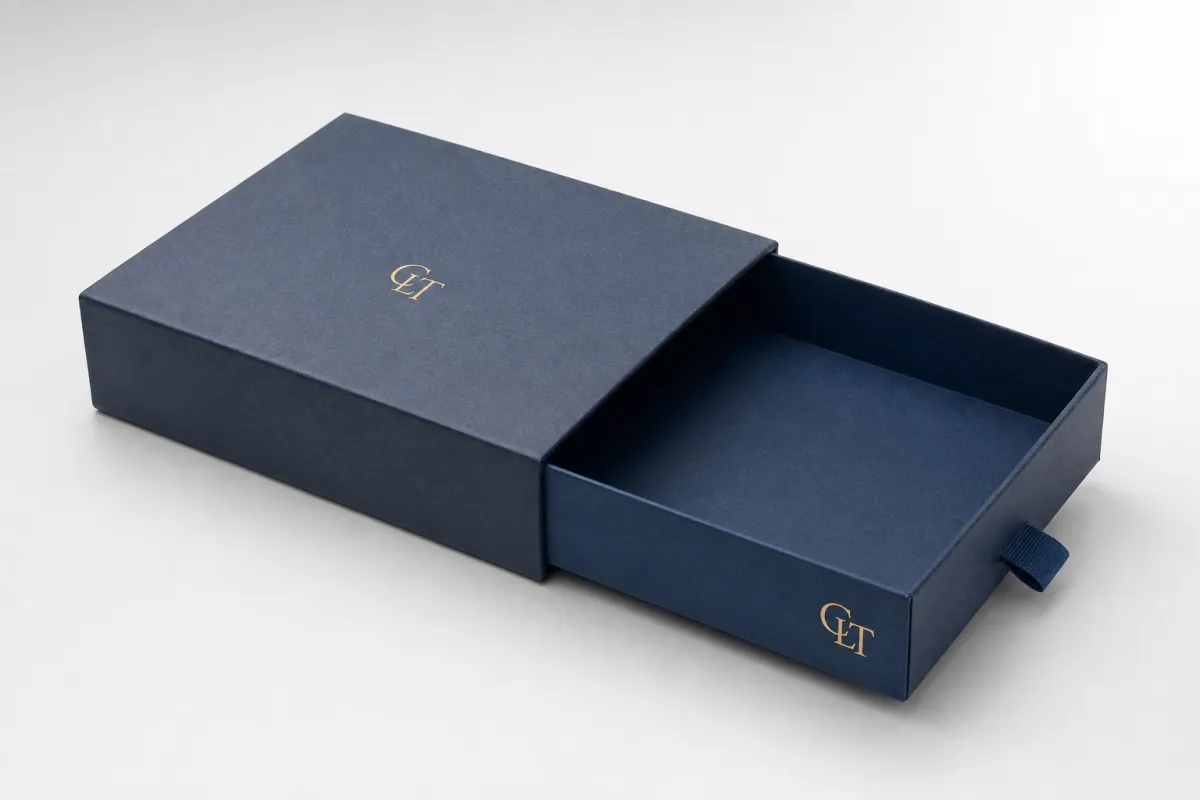
At the simplest level, Custom Drawer Boxes with logo are rigid or semi-rigid boxes built with a sliding inner tray. The outer shell stays fixed while the tray moves out from one end with a ribbon, thumb notch, or finger pull. That motion is the whole point. It slows the reveal, and that small delay makes the product feel considered. Packaging design often works through subtle psychological cues, and this one is especially effective.
Most brands choose custom drawer boxes with logo because the format solves two problems at once. It protects the product and it presents the product with a sense of occasion. The outer sleeve can carry the main logo, a pattern, or a restrained brand mark. The drawer face can hold a second message, a foil stamp, or a quieter detail. Two visible surfaces give you more room to communicate without crowding the design, which is handy when the product already has a strong identity of its own.
Drawer boxes are often treated as luxury-only packaging, though that idea misses a lot of real use. Cosmetics, jewelry, candles, and gift packaging use them often, yet custom drawer boxes with logo also appear in subscription kits, influencer mailers, small electronics, apparel accessories, and event sets. The format works especially well for products that benefit from a reveal, a clean fit, or a little bit of theater. That is why custom drawer boxes with logo have become a steady retail packaging choice instead of a one-off special edition.
There is also a material difference that buyers notice immediately. These boxes are usually thicker and heavier than folding cartons. A standard folding carton relies on paperboard and ships flat. Drawer boxes are closer to rigid box construction. They cost more, use more material, and feel much more substantial in the hand. That is the tradeoff. You pay more, but the package sends a stronger signal that what is inside deserves attention. In branded packaging, that signal does real work.
Custom drawer boxes with logo are also easier to brand without making the package feel loud. A simple logo on the sleeve can read calm and premium. A foil stamp along the drawer edge can feel like a small reward. A printed interior can create surprise without turning the outside into an advertisement. That balance is one reason custom drawer boxes with logo continue to show up in packaging design for premium launches, even when the rest of the category goes in a flashier direction.
How custom drawer boxes with logo work in real packaging
The structure is simple enough, but each part earns its place. The outer sleeve protects the product and gives the box its main visual face. The inner tray holds the item and governs how the box opens. The insert keeps everything from shifting. A ribbon, thumb notch, or pull tab helps the drawer move cleanly. In custom drawer boxes with logo, opening the package is part of the value, not an afterthought.
That motion changes the way the customer reads the product. A standard box says, “Here it is.” A drawer box says, “Take your time.” That tiny delay creates anticipation, which is exactly why custom drawer boxes with logo work so well for gifting, launches, and social content. Unboxing videos respond well to a controlled reveal because it looks polished on camera and feels intentional in person. The packaging starts marketing the product before the product is visible, which is kinda the whole trick.
Construction choices shape that experience. A one-piece rigid wrap is common when you want a clean exterior and dependable structure. Two-piece assemblies can suit certain production setups, especially when cost and presentation need to be balanced carefully. Paper-wrapped chipboard is a common choice for custom drawer boxes with logo because it delivers a rigid feel without the highest luxury-box price point. The right build depends on product weight, display needs, and how rough the shipping route will be.
Branding methods vary in useful ways. Hot foil stamping gives a crisp, reflective mark. Embossing adds depth without depending on heavy ink coverage. Spot UV can highlight a logo or pattern. Full-color print gives you a more expressive surface, though it is easy to overdo. Minimal logo stamping often makes the most sense if the product already carries a busy visual identity. The strongest custom drawer boxes with logo usually do one or two things well instead of trying to use every finish available.
Insert choice is not a small detail. Foam offers high-security presentation, though it can look too technical for some brands. Molded pulp is a better fit for certain sustainability goals and works well for a number of shapes. EVA creates a precise cradle for heavier products. Paperboard inserts can work surprisingly well if the item is not especially fragile. The insert should hold the product securely without making the package feel overbuilt. For custom drawer boxes with logo, the insert should support the story rather than compete with it.
For sourcing and transit testing, the baseline checks are worth reviewing through the ISTA test standards. If the box will move through parcel shipping or retail distribution, test compression, drop resistance, and fit before you approve a full run. I have seen beautiful packaging arrive with crushed corners because nobody checked the carton spec against the shipping path. Expensive packaging that arrives damaged is just expensive disappointment.
Key factors that shape custom drawer boxes with logo
Strip away the surface styling and custom drawer boxes with logo come down to six variables: board thickness, wrap material, drawer fit, insert style, print coverage, and finishing method. Those are the settings that control feel and cost. A packaging buyer who understands them usually gets cleaner quotes and fewer surprises. A buyer who skips that step usually pays for revisions later.
Board thickness is one of the first decisions that changes the whole box. A rigid build often uses chipboard in the neighborhood of 1.5 mm to 2.5 mm, depending on size and load. Thicker board feels more substantial, though it adds weight and can raise freight costs. A light product may not need the heavier structure. A heavier or fragile item usually does. Cutting corners here is false economy. Custom drawer boxes with logo need to fit the object they hold, not only the mood board.
The outer wrap affects both appearance and durability. Coated art paper can deliver sharp print detail. Textured papers bring a more tactile, premium feel. Soft-touch lamination gives a velvety surface that many beauty and lifestyle brands like, although it can scuff if handling is careless. Foil stamping and embossing add cost, and they also add perceived value. If the budget is tighter, a clean printed wrap with one strong logo can still look polished. A custom drawer box does not need every finish in the catalog to work.
Fit matters more than many teams expect. A drawer that is too loose feels cheap. One that is too tight frustrates the customer. The goal is enough resistance to feel controlled, not so much that people have to tug hard to open it. That means designing to the actual product dimensions and checking the sample with care. Custom drawer boxes with logo often fail for a very ordinary reason: someone guessed the measurements instead of measuring the product and the insert together.
Logo placement deserves more attention than it usually gets. The front face is the obvious choice. The side panel can carry a quieter brand cue. The inside of the tray can provide a neat surprise the first time the customer opens it. If you want a strong package branding effect without clutter, use one primary logo placement and one interior detail. That is usually enough. More is not automatically better.
Sustainability belongs in the conversation too. FSC-certified paperboard gives buyers a cleaner sourcing story, and many brands ask for it from the start. If you want to review sourcing language or certification basics, the FSC website is the place to check. Sustainable material choices do not make a box good by themselves, yet they matter to customers who care about product packaging with a lighter footprint.
Practical rule: if the product is heavy, fragile, or shipped far, spend more on structure before you spend more on decoration. Decorative finishes will not rescue a weak box.
| Option | Typical unit range | Best for | Tradeoff |
|---|---|---|---|
| Basic branded rigid drawer box | $1.20-$2.40 | Simple retail packaging, small gifts, light products | Less dramatic finish, lower perceived luxury |
| Mid-tier custom drawer box | $2.50-$4.80 | Cosmetics, candles, jewelry, subscription sets | Better look, more setup choices, higher MOQ sensitivity |
| Premium presentation box | $5.00-$9.50+ | Luxury launches, PR kits, high-value gifting | Higher cost, longer production, more proofing |
Those ranges are not a quote. They are a reality check. Custom drawer boxes with logo vary widely by quantity, print coverage, and how much handwork the construction requires. If a supplier gives you a suspiciously low price without asking about the insert, finish, or shipping method, that is not efficiency. That is an unfinished estimate wearing a polite expression.
Production steps and timeline for custom drawer boxes with logo
The production path is predictable once the brief is specific. It usually starts with a quote, moves into dieline review, then artwork prep, sampling, approval, production, and shipping. Custom drawer boxes with logo are not mysterious, but they do punish vague instructions. A half-finished spec sheet buys delay. Exact dimensions, finish notes, and logo files buy speed.
Artwork is usually the first place things stall. People send low-resolution logos, forget bleed, or place text too close to the edge. That sounds basic because it is basic. It still happens constantly. Vector files are the safest choice for logo work. If color matters, give Pantone references or clear CMYK instructions rather than “make it pop.” Packaging designers can only work with what they can measure. Custom drawer boxes with logo look premium only when the artwork is clean enough to print that way.
Sampling is the next major checkpoint. A digital proof can confirm layout, but a physical sample shows whether the drawer slides smoothly, whether the insert secures the product, and whether the finish looks the way you expected under normal light. If fit, color accuracy, or surface texture matter, a sample is worth the time. For custom drawer boxes with logo, skipping the sample to save a week often adds two later when the first production run misses the mark.
Timing depends on complexity. Simple rigid drawer boxes may move through production in roughly 12 to 18 business days after proof approval. Add special finishes, heavy print coverage, or custom inserts and the schedule can easily stretch into the 3 to 5 week range. Rush jobs are possible, though they usually cost more and leave less room for mistakes. If your launch date is fixed, lock the box dimensions early and stop changing the insert after the sample is approved. That is how timelines disappear.
Shipping method affects the plan as well. Bulk-packed custom drawer boxes with logo are easier to move than pre-assembled units, but the final carton still needs protection strong enough to survive transit. If the packaging will travel through parcel networks, ask about crush testing and compression limits. The box is not only a display piece. It is also a small piece of distribution equipment, and it has to behave that way in the real world.
For teams comparing suppliers, request the same spec across every quote. Same size. Same board thickness. Same finish. Same insert type. That is the only fair way to compare lead time and price. If one quote includes a magnetic closure and another does not, you are not comparing the same custom drawer boxes with logo. You are comparing two different products and hoping math will sort it out.
Explore custom printed boxes and packaging formats if you want to map your drawer box against other rigid and branded packaging options before you commit.
Cost and pricing for custom drawer boxes with logo
Pricing is driven by six things: quantity, board grade, print coverage, finishing, insert complexity, and freight. Once you understand those levers, you can usually predict where a quote will land before it arrives. Custom drawer boxes with logo are not cheap packaging. They are controlled-cost packaging. That distinction matters.
Quantity changes the picture fast. Small runs carry more setup cost per unit because printing, cutting, wrapping, and assembly overhead gets spread across fewer boxes. Larger runs usually bring the per-unit price down in a noticeable way. A buyer ordering 500 units and a buyer ordering 5,000 units are not shopping in the same market. The first buyer is paying for flexibility. The second buyer is paying for efficiency.
Here is a practical way to think about the tiers:
- Low tier: clean printed wrap, standard board, simple insert, minimal finishing.
- Mid tier: better paper choice, one premium finish, tighter fit, more polished presentation.
- Premium tier: soft-touch, foil, embossing, custom insert, stronger visual storytelling.
The expensive part is rarely a single pretty finish. It is the combination of finishes, custom insert work, and the labor needed to assemble the box correctly. A simple foil stamp on a drawer face may add a modest amount. Add a custom foam insert, soft-touch lamination, and inside printing, and the cost climbs quickly. That is normal. Custom drawer boxes with logo reward restraint more than excess.
Hidden costs are where budgets usually get bruised. Sample fees are common, especially when physical proofs are needed. Tooling charges can appear if you want unusual embossing or a custom-cut insert. Rush production carries its own price. Freight is often underestimated because rigid boxes are bulky, not just heavy. If you are comparing quotes, ask whether sampling, tooling, and delivery are included or separate. A low quote with expensive extras is not a bargain. It is a trap with clean typography.
The best way to buy is to request pricing at multiple quantities. Ask for 500, 1,000, 3,000, and 5,000 units if your forecast supports it. You will see the real break point where the unit price drops enough to justify the larger order. That one exercise helps more than most sales calls. It shows where custom drawer boxes with logo become economically sensible instead of just visually appealing.
Common buyer range: for a mid-tier presentation box, a serious quote might move from about $2.50 per unit at a smaller run to under $2 at higher volumes, depending on finish and insert complexity. That is the kind of drop people want to see before they commit.
Common mistakes with custom drawer boxes with logo
The first mistake is bad sizing. If the box is too loose, the product slides around and the whole package feels flimsy. If it is too tight, the customer has to fight the packaging. Neither version feels elegant. Custom drawer boxes with logo should feel controlled from the first pull. That only happens when the tray, insert, and product dimensions are measured honestly.
The second mistake is overbranding. Some teams treat the box like a billboard because the rigid format finally gives them enough surface area to fill. That approach usually backfires. Drawer boxes look stronger with less visual noise, not more. One strong logo, one clean color palette, and maybe one interior surprise usually beat a wall of graphics. Good package branding does not shout. It looks confident enough to stop talking.
The third mistake is choosing finishes before the structure is approved. That order is backwards. The box has to function before it can look refined. If the drawer action is clumsy, the logo will not rescue it. If the insert does not hold the item in place, foil stamping is just expensive lipstick on a shipping issue. Build the form first, then apply the surface treatment.
Color mistakes happen just as often. A dark logo on a dark wrap can disappear under warehouse lighting. Screen colors can also shift when they are converted for print. If your brand depends on precise color, get a proof or sample and review it under normal light. Custom drawer boxes with logo are unforgiving when the brand mark is hard to see. Recognition is the whole point, so the logo has to earn its keep.
The last mistake is ignoring real-world handling. Teams focus on the pretty open-box photo and forget how the package ships, stacks, and opens in the wild. A drawer box that looks excellent on a design board can be awkward in a fulfillment line, too tall for shelf planograms, or too delicate for parcel shipping. Product packaging has to survive the boring parts of the journey. Otherwise it is just a beautiful problem waiting to happen.
Review more branded packaging and custom printed boxes before finalizing the structure. A slightly different format may save money or improve durability without hurting the look.
Expert tips for better custom drawer boxes with logo
Start with the opening moment. That is the part the customer remembers. A good drawer box feels smooth, guided, and deliberate. A bad one drags, sticks, or opens too fast and kills the suspense. When you design custom drawer boxes with logo, build the opening experience first and decorate around it. That sequence saves money and usually leads to a cleaner result.
Use one strong brand statement and one subtle detail. Place the main logo on the sleeve, then repeat a smaller mark inside the tray or on the pull ribbon. Or use a foil logo outside and a printed message inside. That is enough. Every panel does not need to compete for attention. The best custom drawer boxes with logo often feel calm outside and thoughtful inside.
Match the insert to the product shape instead of forcing the product into a generic cavity. A good insert does more than hold the item. It frames it. That matters for cosmetics, candles, and gift sets, where presentation is part of the value. If the insert is too deep, the item feels buried. If it is too shallow, it feels unstable. The target is secure, visible, and easy to lift out without creating a mess.
Use contrast to create interest. Matte wrap with a gloss logo is a classic for a reason. Textured paper with a smooth printed drawer interior can work well too. A simple exterior and a bright inner reveal is a smart move for promotional packaging and PR kits. Contrast gives the box some drama without making it look overworked. Custom drawer boxes with logo do not need to be loud to stay memorable.
Think about hand feel as much as visual feel. Soft-touch lamination can be lovely, yet not every brand needs it. A natural paper texture can feel warmer and more grounded. Ribbon pulls should look tidy and be easy to grip. Thumb notches should not tear or distort the tray edge. Small details like that are easy to overlook in packaging design, then impossible to ignore once the box is in someone’s hands.
"If the box looks amazing but takes two hands and a small grudge to open, it is probably too clever."
That line keeps getting repeated because it is true. Custom drawer boxes with logo should feel premium, not annoying. Premium is calm. Annoying is just a design mistake dressed up as luxury.
Keep the story tied to the product. A luxury candle box should feel different from a tech accessory box. A jewelry drawer should not look like a skincare kit. The format may stay the same, but the material, color, finish, and insert should match the brand personality. Good custom drawer boxes with logo do more than protect the item. They make the item feel like it belongs to a specific brand world.
One more thing from the production side: ask how the box is going to be assembled. Some designs look great on screen but require fiddly handwork that slows the line and creates inconsistency from unit to unit. If you want a cleaner result, simplify the steps wherever you can. A packaging line should not feel like a puzzle every time it runs.
Next steps for custom drawer boxes with logo
Start with exact product dimensions, target quantity, and the one feeling you want the box to create. Secure, elegant, giftable, minimal, bold. Choose one primary emotional goal and let that shape the packaging design. Custom drawer boxes with logo work best when the brief is specific. Vague goals tend to produce vague boxes, and nobody needs that.
Gather three references next: one design you like, one finish you want, and one box that feels too expensive so you can calibrate budget. That last one sounds odd, yet it helps. People are usually better at spotting what is too much than what is just enough. If you can show where the line sits, suppliers can quote much more accurately.
Request quotes with the same specs from each supplier. Same board thickness. Same insert. Same print coverage. Same finish. That gives you a real comparison instead of a showroom performance. If you are serious about custom drawer boxes with logo, you need apples-to-apples pricing, not a spreadsheet filled with marketing.
Approve a sample before you greenlight a large run if the fit, color, or finish needs to be exact. A sample is not wasted time. It is insurance against avoidable failure. That matters most for premium product packaging, where a small mismatch can make the whole run feel off. If the sample looks right and the drawer action feels right, you can move forward with much more confidence.
If you want a quick sanity check, compare your box against a standard rigid presentation box, a folding carton, and a mailer. Ask which one best supports the product, the shelf, and the unboxing moment. That comparison usually makes the answer clear. Most brands do not need the fanciest option available. They need the one that fits the job.
For brands building long-term retail packaging, the smartest move is to treat the box as part of the product system, not a separate decoration budget. The right custom drawer boxes with logo can protect the item, raise perceived value, and make opening it feel worth the price. That is the job. Do that well, and custom drawer boxes with logo stop acting like packaging alone and start doing real sales work.
Clear takeaway: choose the box structure first, confirm the fit with a physical sample, and keep the branding focused on one or two strong moments. That approach gives custom drawer boxes with logo the best chance of looking premium without wasting money on decoration that does not help the product.
FAQ
How much do custom drawer boxes with logo usually cost?
Price depends on quantity, board thickness, print coverage, finishes, and insert type. Smaller runs cost more per unit because setup is spread across fewer boxes. Ask for quotes at multiple quantities so you can see the real break point for custom drawer boxes with logo.
What products work best in custom drawer boxes with logo?
They work best for premium, giftable, or fragile items that benefit from a reveal. Common uses include cosmetics, candles, jewelry, tech accessories, and PR kits. If the product needs a strong first impression, custom drawer boxes with logo are a solid fit.
How long does production take for custom drawer boxes with logo?
Timeline depends on sample approval, artwork readiness, and finish complexity. Simple jobs move faster than boxes with special inserts or heavy decoration. The fastest path is to finalize size and artwork before requesting samples for custom drawer boxes with logo.
What is the best finish for custom drawer boxes with logo?
The best finish depends on the brand mood and budget. Foil, embossing, and soft-touch lamination feel premium; simple print can work if the design is strong. Choose finishes that support the product story instead of piling on effects for custom drawer boxes with logo.
What files do I need for custom drawer boxes with logo artwork?
Use vector logo files when possible so print edges stay clean. You should also provide exact box dimensions, logo placement notes, and color preferences. A dieline proof helps prevent layout mistakes before production starts on custom drawer boxes with logo.

