Custom five panel Caps Bulk Order projects look simple until the proof lands and the details start pulling in different directions. The front panel is flat, which helps. It gives embroidery, patches, and print a cleaner surface than many curved caps. That makes the style useful for brands that care about logo clarity and do not want to fight the shape of the cap every time they approve artwork.
The real appeal is not just the look. Five-panel caps sit in a practical middle zone: more polished than a throwaway promo hat, less expensive than a lot of retail streetwear styles, and flexible enough for staff uniforms, event merch, resale, or bundled promotions. If you need one item to cover multiple use cases, this is a good place to start.
The cheapest quote is rarely the cheapest order if the proof is loose, the fit is off, or the carton plan creates a freight surprise.
That same logic shows up across branded goods. A cap order works better when the structure, decoration, and packing plan are decided together. Leave one of those pieces vague, and the order usually gets more expensive in the back half. Not because the factory is dramatic. Because every correction costs time.
Why five-panel caps punch above their weight
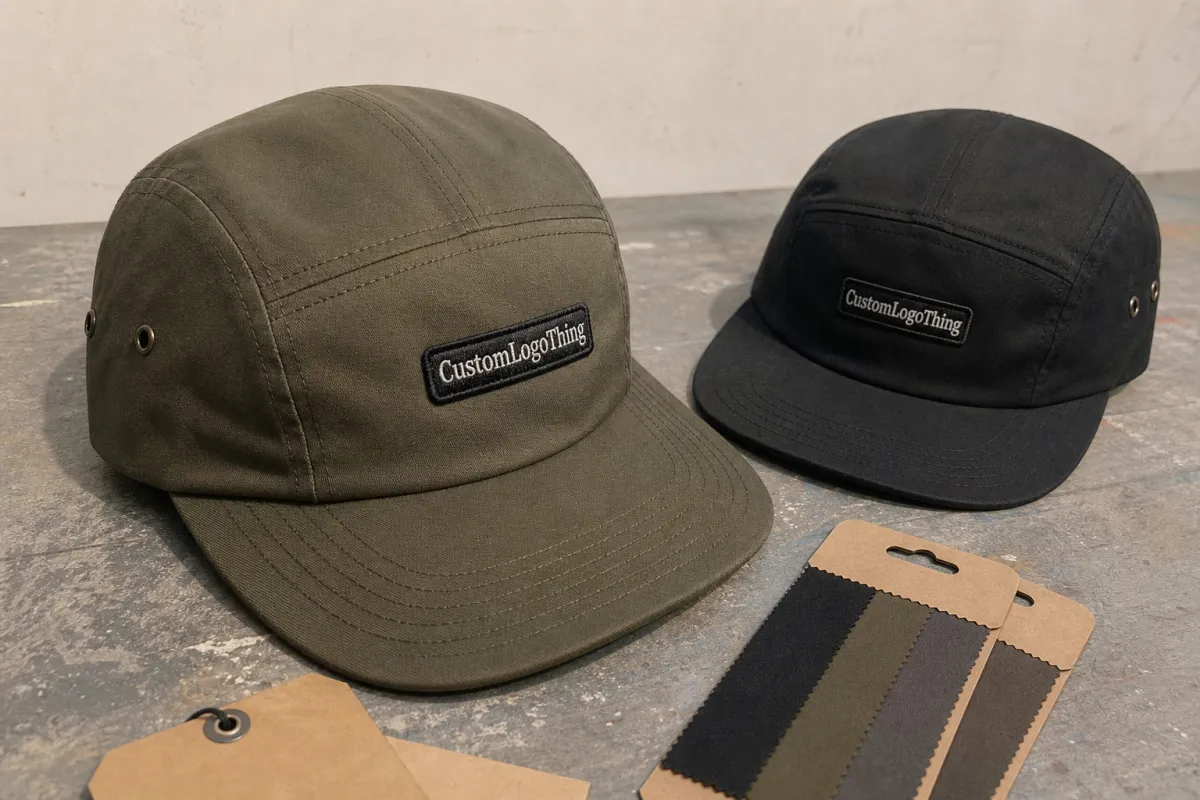
A five-panel cap has one major advantage: the front panel is broad and uninterrupted. That shape gives logos room to breathe. Text reads more cleanly. Block marks stay square. Embroidery does not have to wrap around as much curvature, so the final result often looks sharper than the same artwork on a more segmented cap.
That matters for buyers who are trying to make a small piece of merchandise feel deliberate. A cap can do a lot of work in a product launch, event kit, employee uniform, or retail bundle. It is visible, wearable, and easy to size across a group. If the spec is solid, one style can serve several channels without needing a separate design for each one.
Five-panel caps also fit the kind of buying logic most teams actually use. You want enough structure to avoid a flimsy giveaway feel, but not so much cost that the order stops making sense at volume. That is why they show up so often in bulk programs. They are adaptable, and they do not demand premium decoration to look decent.
There is another practical upside: inventory discipline. Fewer style variations mean fewer SKUs, simpler reorders, and less room for confusion when colors or closure types change. That sounds boring because it is boring, and boring is good when you are trying to keep a production run on track.
If the cap order is part of a wider merchandising system, the same thinking applies to Custom Packaging Products and other branded items. Standardize what you can. Decide the spec once. Then reuse it without reinventing the project every quarter.
Options buyers compare in a custom five panel caps bulk order
Most buyers start with shape, but the bigger differences show up in structure. A low-profile cap sits closer to the head and feels modern. A structured cap uses reinforcement in the front panel, which helps the cap hold its shape and gives embroidery a better base. Unstructured caps feel softer and more casual. They can work well for lifestyle brands, but they are not always the best match for dense logos or patch-heavy artwork.
Closure style matters just as much. Snapback closures are easy to distribute because they fit a wide range of head sizes. Strapbacks look a little cleaner and can feel more retail-oriented. Hook-and-loop closures are simple and functional. Fitted styles are the least forgiving, so they only make sense when size data is reliable and the buyer wants that tailored profile enough to justify the risk.
Then there are the details that make the cap feel custom instead of generic. Crown depth, visor shape, eyelet placement, under-visor color, stitching tone, and side label placement all change how the finished cap reads. A black cap with matching thread looks very different from the same cap with contrast stitching. Neither is right in every case. The point is to choose one direction and commit to it early.
Buyers often try to add value by adding features, but one well-chosen detail usually does more than three half-decisions. A woven side label, a suede patch, a contrast under-visor, or a clean tonal embroidery treatment can carry the entire design. In bulk runs, that approach is usually safer than stacking decorative elements that compete with each other.
Here is the tradeoff in plain language: more customization creates more setup, but not always a dramatic jump in unit price if the order size is large enough. The factory still has to prepare the cap, but the cost of that setup spreads better across volume. If the cap is part of a merch drop that already uses a tight visual system, the same colors and finishes can echo the rest of the release without adding needless complexity.
For a quick comparison, the most common configurations look like this:
| Option | Typical MOQ | Typical Unit Price | Best Use |
|---|---|---|---|
| Blank or minimal decoration | 100-200 pcs | $2.20-$3.50 | Giveaways, internal staff use, fast-fill inventory |
| Front embroidery | 150-300 pcs | $3.80-$6.50 | Simple logos, club merch, uniforms, repeat orders |
| Woven or faux-leather patch | 200-500 pcs | $4.60-$7.90 | Retail-style branding, textured finishes, premium look |
| Mixed trim details | 300-500 pcs | $5.20-$8.50 | Launches, limited drops, higher presentation value |
Those numbers shift with quantity, decoration density, and fabric choice, but the pattern stays fairly consistent. Simple builds are cheaper. More steps cost more. The annoying part is that the extra cost is not always visible from the outside, which is why buyers need to look at the spec rather than the sample alone.
Specs that control fit, structure, and decoration quality
Fabric choice affects how the cap looks, feels, and wears over time. Cotton twill is the familiar option because it feels natural and takes embroidery well. Brushed canvas has a slightly heavier hand and can make the cap feel more substantial. Polyester blends are useful when color consistency and drying time matter more than a pure cotton feel. Performance fabrics can work too, especially for activewear programs, but they need to be matched carefully to the decoration method.
Construction decides whether the cap feels dependable or cheap. Front-panel reinforcement matters because a weak front loses shape after stitching. The sweatband affects comfort and moisture handling. The visor insert changes how crisp the brim feels. Stitch density and seam finishing affect durability. None of those details is flashy, but they are the reasons one cap keeps its shape after a few wears and another starts slumping immediately.
Fit data should never be an afterthought. Crown depth matters more than buyers expect. A shallow cap can sit awkwardly on larger heads. A deeper cap may look fine in a sample but feel oversized on the actual audience. Adjustable range matters too, especially if the order is going to a mixed group. If the run includes adult and youth sizing, that split should be explicit before the proof stage.
Decoration quality lives or dies on artwork prep. Vector files in AI, EPS, or SVG format are the cleanest starting point because they preserve edges. For embroidery, tiny text needs enough stroke width to stitch properly. Fine lines should be simplified. If the logo uses a patch, confirm border thickness, stitch direction, and edge treatment before the sample is approved. A clear proof saves time. A vague proof just moves the problem downstream.
The same discipline helps when the cap sits inside a larger merchandising plan. Coordinating the cap with Wholesale Programs or packaging items keeps the color and finish decisions consistent across the whole order. That matters more than people admit. Mixed specs across related products are a common source of avoidable rework.
Packaging deserves its own check, especially if the caps will be shipped to warehouses, stores, or direct-to-consumer fulfillment centers. Carton count, folding method, and bagging style can affect the final condition of the caps when they arrive. If the buyer wants the paper side of the order to carry a sourcing claim, FSC-certified materials are worth asking about. For transit durability, packaging standards such as ISTA are useful reference points.
One practical buyer habit: ask for the exact panel height, front structure type, visor stiffness, and closure construction in writing. If those items are only discussed on a call, they tend to drift by the time the PO is approved. The cap then arrives “close enough,” which is usually another way of saying not close enough.
Pricing, MOQ, and quote variables that change unit cost
Pricing on a Custom Five Panel caps bulk order usually comes down to six variables: decoration method, stitch count, fabric grade, closure type, packaging format, and quantity. Two caps can look nearly identical from a distance and still price very differently because one requires more operations. A simple embroidered cap might stay near the lower end of the market. Add patch construction, custom labeling, contrast stitching, and retail folding, and the price climbs quickly.
MOQ is not universal. Some suppliers quote low minimums for blank or lightly decorated caps. Others raise the minimum as soon as the order needs custom dyeing, multiple trim changes, or more complex decoration. The useful question is not just “What is your MOQ?” It is “Is the MOQ per color, per design, or per size split?” That one line prevents a lot of bad assumptions.
Sample costs and production costs should be listed separately. So should digitizing, setup, and freight. Embroidery digitizing often falls somewhere around $20 to $60, depending on complexity. Physical samples can cost more, especially if the cap uses custom materials or requires a stitched logo and a fully assembled proof. Freight is the most common surprise on smaller runs, because buyers focus on unit cost and forget about the actual landed cost.
Here is the practical breakdown buyers usually need:
- Lower unit price usually means fewer options, simpler decoration, and a standard closure.
- Mid-range pricing often buys better fabric hand-feel, cleaner stitching, or a patch finish.
- Higher unit price can still be the better deal if it cuts defects, rework, or reshipment costs.
That last point matters more than it sounds. A slightly more expensive order that passes inspection and ships on schedule may cost less in the real world than a cheaper quote that needs revision, extra proofing, or a second shipment because the first carton build was wrong.
For reference, a 500-piece run with clean embroidery often lands around $3.80-$6.50 per cap. Patch-heavy builds, mixed trim details, or more retail-oriented specs can move closer to $5.20-$8.50. Smaller orders usually carry a 10% to 25% premium because the setup gets spread across fewer units. That is normal. What is not normal is a quote that leaves out setup, then adds it after the proof is already approved.
If the cap is part of a larger branded release, it helps to plan it alongside Custom Packaging Products and other merch items before production starts. Coordinating the order can reduce duplicate freight, keep finishes aligned, and stop one item from drifting away from the rest of the program. The cap should fit the release, not fight it.
The cleanest takeaway is simple: the right order is not the cheapest line item. It is the order with the fewest unknowns.
Process, turnaround, and production steps from proof to ship
The best production runs start with a complete inquiry. Send the artwork, quantity, preferred closure, fabric direction, color references, and packing requirements together. That cuts down on revision cycles and gives the supplier enough information to quote the order properly. If the brief is partial, the proof usually becomes the place where everyone discovers what was missing.
Proofing is where expensive mistakes are prevented. A good supplier will check logo scale, placement, thread or print color, and patch dimensions before asking for approval. Virtual proofs are useful for most orders. For dense artwork or larger quantities, a physical sample or pre-production image is worth the extra time. The goal is to catch problems while they are still cheap.
After proof approval, production usually moves through material sourcing, cutting, sewing, decoration, finishing, inspection, and packing. If the material is already in stock and the decoration is straightforward, a Custom Five Panel Caps bulk order can often be completed in about 12-18 business days after proof sign-off. If the order needs special fabric, custom trim colors, or a more complex build, the timeline stretches. Seasonal demand can stretch it too. So can the shipping method chosen at the end.
Rush jobs are possible, but they limit the menu. The factory may push toward standard fabrics, fewer decoration changes, or a simpler closure to meet the deadline. That can be a fair trade if timing matters most. It is only a problem when the buyer expects a premium finish and never got told the rush rules would narrow the spec.
Inspection should be more than a checkbox. Good quality control checks logo placement, stitch tension, thread color, closure function, fabric consistency, and carton counts before the order leaves. If the caps are tied to retail distribution, the packout matters as much as the sewing. The same eye used for branded packaging should apply here. Half-finished thinking tends to show up at receiving.
If the order is moving through a larger procurement cycle, the easiest way to reduce friction is to keep the brief tight. One contact point. One approved proof. One written spec sheet. That sounds basic because it is basic. Basic is what keeps the run from wandering.
How to lock specs, confirm proof, and place the order
A dependable supplier should send a spec sheet, not just a price. That sheet should show crown style, fabric, closure, decoration method, color references, carton count, and estimated turnaround. If one of those pieces is missing, the quote is not complete. A low number without a written spec is just a number waiting to change.
Before approval, check five things carefully: logo placement, color match, closure type, crown shape, and packing method. If any of those shift after sign-off, the order may still be recoverable, but the timeline usually takes the hit. The safest buyer habit is to compare the proof against the original brief line by line. It takes a few minutes. It can prevent a week of cleanup.
Here is a simple order checklist that keeps the process moving:
- Gather vector artwork and color references.
- Choose the cap style, fabric, and closure.
- Confirm quantity, size split, and MOQ.
- Request a quote with setup, sample, and freight listed separately.
- Review the proof for scale, placement, and color accuracy.
- Approve production only after the spec sheet matches the proof.
If the cap is one part of a broader sourcing plan, compare it with the rest of the program before approving anything. That helps standardize buying rules across apparel, inserts, and packaging. It also keeps the brand presentation from drifting between items that are supposed to belong together.
The strongest orders are usually the least dramatic ones. The supplier knows exactly what to build. The buyer knows exactly what to expect. The proof matches the spec. No scrambling. No guessing. No expensive “close enough.” That is the real value of a well-planned custom five panel Caps Bulk Order: it turns a small branded item into something repeatable.
Frequently Asked Questions
What is the typical MOQ for a custom five panel caps bulk order?
MOQ depends on the decoration method and how much custom work the cap needs. Blank or lightly decorated runs may start around 100-200 pieces. Embroidered or patch-heavy orders often sit closer to 150-500 pieces. Always ask whether the minimum applies per color, per design, or per size split.
How long does production usually take after proof approval?
For stocked materials and simple decoration, many orders move in about 12-18 business days after proof approval. Custom fabrics, special trim colors, and heavier seasonal demand can stretch that timeline. Freight time is separate, so ask for production and shipping to be listed independently.
Can I mix colors or sizes in one five-panel cap bulk order?
Often yes, but the split quantities need to be clear before the order is confirmed. Mixed colors add setup complexity, and some closure types are more flexible than others. Adjustable closures usually give the most room if the order needs to cover different head sizes.
Which decoration method works best for five-panel caps?
Embroidery is the most durable option for clean, simple logos. Patches work well when you want texture and a more retail-style finish. Print can work for flatter artwork and tighter budgets, especially when the design is small and does not need heavy build-up.
What files do you need for a quote?
Vector artwork is the best starting point because it keeps the edges clean and makes proofing faster. Include PMS or HEX colors, logo placement notes, and any patch or stitch preferences. A simple spec sheet usually gets a better quote than a loose email thread.
Send the vector art, target quantity, closure choice, and any color splits together so the order can move from quote to proof without avoidable resets.

