A takeaway order can be made with care, packed correctly, and still arrive at the customer looking messy if the carrier does not suit the load. That is the practical value of custom flat Handle Paper Bags for coffee shop takeaway: they hold the final handoff together, keep the order upright, and give the customer something that feels stable instead of improvised.
The bag has a harder job than it looks. It may need to carry a drink tray, a pastry box, a sandwich sleeve, napkins, and a receipt, all while being lifted one-handed by staff in a rush. If the bag is too narrow, too shallow, or built with weak handles, the packer has to work around it. That slows service and increases the odds of a spill or tear.
For coffee shops, the bag is not just a print surface. It is part of the packing system. The right spec improves speed at the counter, supports the brand, and keeps the order feeling deliberate from pickup to arrival. It also pairs neatly with other Custom Packaging Products, so the bag sits inside a wider packaging system rather than floating on its own. For shops already using custom packaging product options across cups, sleeves, and retail packaging, the bag becomes the visible final layer of that system.
Custom Flat Handle Paper Bags for Coffee Shop Takeaway: What They Fix at the Counter
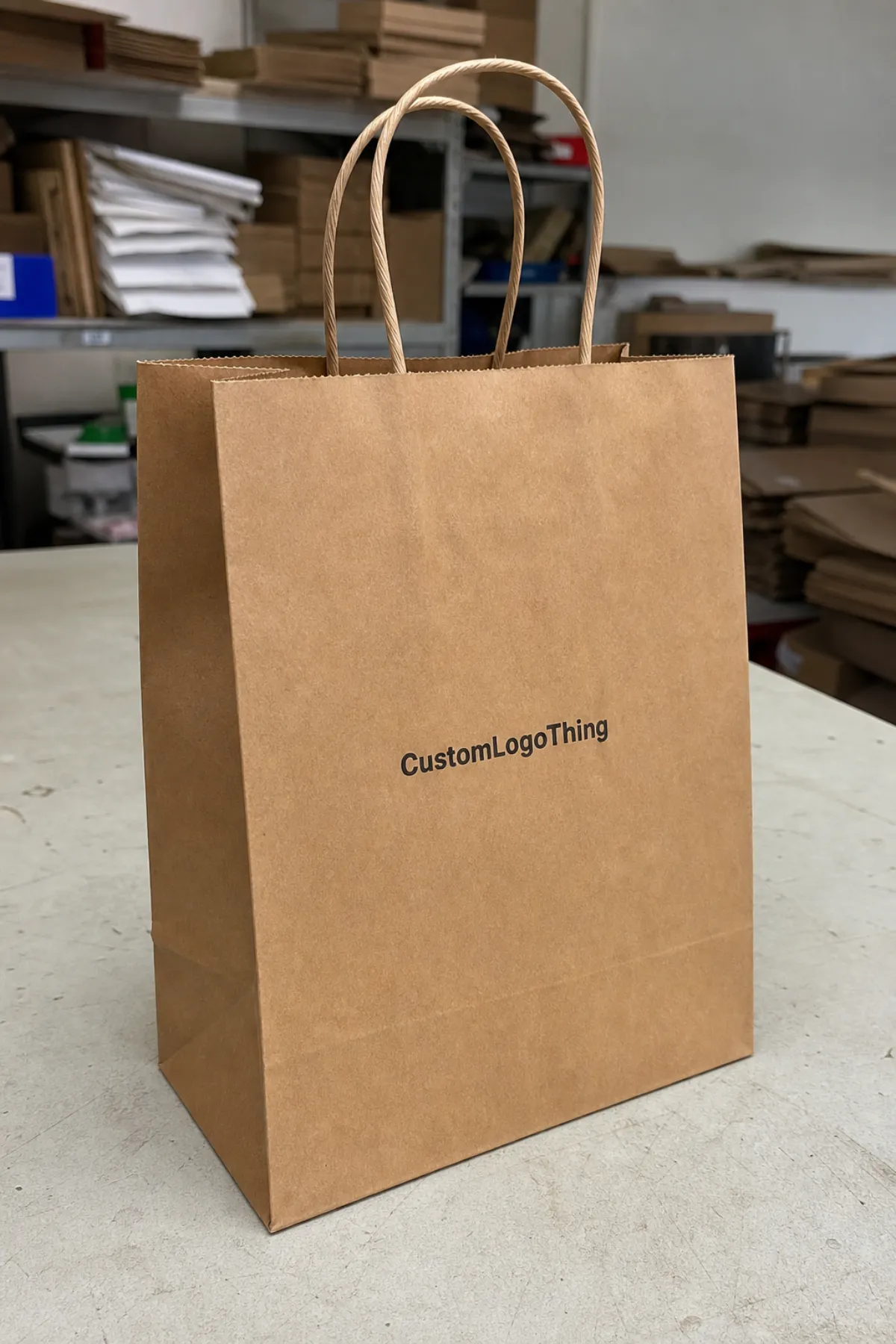
The counter is usually where packaging problems show up first. A bag that looks fine on a spec sheet may still be awkward when staff try to load it with two drinks and a bakery box. Flat Handle Paper Bags solve a lot of small frustrations because they are easy to grab, easy to open, and easy to move through a busy service line.
Handle style matters more than buyers sometimes expect. Flat handles sit neatly against the bag, keep the profile compact, and are quick for baristas to pick up without fuss. That can save a few seconds on each order. During a morning rush, that difference is real.
There is also a customer-side benefit. A customer walking to a nearby office wants the bag to balance without swinging. Someone driving wants the contents to stay upright in the passenger footwell. A guest carrying lunch to a meeting wants the bag to look presentable enough to place on a desk. Those are simple expectations, but they shape how the packaging is judged.
The best bag spec is the one that matches how the shop actually packs orders. If your team often sends out a single drink and pastry, the structure can stay modest. If lunch boxes and multi-drink orders are common, the bag needs more width, more stiffness, and a stronger top edge. A good looking bag that fails under real loads is expensive in a different way, because it creates waste and slows the line.
Branding works better when the bag already feels reliable. A clean logo on a bag that stands open, holds its shape, and carries neatly tends to read as quality without trying too hard. That is the quiet advantage of branded packaging done well.
Paper Grade, Gusset Width, and Handle Reinforcement
Paper choice sets the tone. Kraft paper gives a warmer, more natural look and hides scuffs better during handling. White paper feels cleaner and works well for shops that prefer a bright, minimal presentation. Recycled paper can be a strong option too, provided it still has enough stiffness for the intended load. For coffee shop takeaway, a paper range around 120gsm to 150gsm is common, while heavier builds make sense for lunch sets or larger bundled orders.
Gusset width is one of the most overlooked parts of the design. Height gets attention because it is easy to picture, but the gusset often decides whether the bag behaves well in practice. A narrow gusset can compress pastry boxes, push drink lids off balance, and make the top edge bow outward. A wider gusset gives the contents room and keeps the front panel flatter, which also helps printing look cleaner.
Handle reinforcement deserves careful review. A folded top with well-glued flat handles can perform very well, but the adhesive area, patch size, and fold geometry all need to be consistent from run to run. The weak point is rarely the handle paper itself; it is usually the load transfer at the top edge when the bag is lifted with one hand. A loaded sample is more useful than an empty one, because paper that looks fine without weight can fail when the customer’s full order is inside.
Ink coverage and finishing matter too. Heavy solid print, coating, or lamination can change how the sheet folds and how the top edge behaves. That does not mean a decorated bag is a bad idea. It means the print plan should respect the structure. If the artwork fights the fold lines, the bag becomes harder to build and less pleasant to use.
For buyers comparing durability claims, the logic behind ISTA transport testing standards is useful even for a paper carry bag. The basic question is the same: what happens after the package is lifted, tipped, carried, and set down again?
Cost, MOQ, and Unit Price Drivers
Pricing for Custom Flat Handle Paper Bags for coffee shop takeaway is shaped by a few predictable factors: paper weight, bag size, print colors, print coverage, and reinforcement details. A small kraft bag with a single-color logo is a very different job from a larger white bag with full-panel artwork and a stronger handle patch. The more the bag departs from a standard structure, the more setup, waste control, and press time affect the final quote.
MOQ matters because it changes both cost and storage. Many custom runs begin around 5,000 pieces, though some suppliers can go lower depending on the print method and dimensions. A higher MOQ often lowers unit cost, but it also increases the amount of space and cash tied up in stock. Small shops feel that quickly. Order too little, and the reordering cycle becomes constant. Order too much, and cartons sit in storage longer than planned.
Here is a practical comparison buyers often use:
| Option | Typical MOQ | Unit Price at 5,000 pcs | Best For | Tradeoff |
|---|---|---|---|---|
| Stock kraft with stamp | 1,000-3,000 | $0.10-$0.18 | Testing a new brand or short-term use | Smaller print area and less finish consistency |
| Custom single-color print | 5,000 | $0.14-$0.24 | Simple logo, fast production, clean presentation | Limited artwork complexity |
| Custom multi-color print | 5,000-10,000 | $0.18-$0.32 | Stronger brand identity and retail packaging alignment | More setup time and tighter color control |
| Heavier paper with reinforcement | 5,000+ | $0.22-$0.38 | Lunch bundles, larger orders, higher carry weight | Higher material cost and more storage weight |
Those ranges are useful, but they are not a quote. Freight, packaging format, import duty, and proofing can move the total enough to change the decision. A lower unit price on paper may become the more expensive option once shipping, cartons, and setup charges are included. The cleanest comparison uses the same bag size, same paper weight, same print method, and same delivery terms. Without that, two quotes may not describe the same bag at all.
Some buyers discover that stock bags are not as cheap as they first appear. If a plain bag needs extra labels, stamp labor, or manual handling, the total operating cost can close the gap quickly. A properly printed bag may cost a little more per piece and save time every day. That is often a better trade for a busy cafe.
Ordering Process, Proofing, and Lead Time
The easiest order begins with clear input. Before requesting a quote, send the bag dimensions, quantity, print colors, artwork files, delivery location, and target date. If the bag needs to fit a specific drink carrier or pastry box, include those dimensions too. The more concrete the brief, the less room there is for correction later.
Proofing matters because paper bags are more sensitive than they appear. A design can look clean on screen and still fail once folds, handle holes, and gussets are introduced. Logos should stay clear of fold lines. Artwork on the gusset should be planned with movement in mind, because that area distorts when the bag fills. Color also deserves attention. Dark blacks can print cooler on kraft, and bright reds may shift on uncoated paper. None of that is unusual, but it should be checked before production begins.
If a bag looks right in a mockup but awkward in the hand, the mockup passed the wrong test.
Lead time usually has four parts: sampling, artwork approval, production, and shipping. A straightforward run may take 12 to 15 business days after proof approval. More complex printed bags can take longer, especially if color matching is strict or if the paper spec needs special sourcing. Rush orders are sometimes possible, but they usually increase cost and reduce flexibility in scheduling.
For shops comparing several formats, Custom Packaging Products can help align the bag with cups, sleeves, and retail packaging before the order is placed. That matters more than it sounds, because a consistent print system is easier to manage than a collection of pieces that all look slightly different.
Folding, Packing, and Storage for Busy Drink Rushes
A café bag should speed up the packing process, not create another small decision at the counter. During peak periods, staff need a bag that opens quickly, stays open long enough to load, and folds flat for storage after use. If the bag catches on itself or collapses while being packed, the line slows down and the packaging becomes part of the problem.
Storage conditions make a bigger difference than many buyers expect. Keep cartons dry, off the floor, and away from sink splash or steam. Paper picks up moisture quickly, and once that happens the top edge loses crispness. The bag may still function, but it will not open as cleanly. Flat-packed cartons are the safest format because they protect the handles and make stock rotation easier.
Loading behavior should be tested with real order combinations. Two cups plus a pastry box is a different load than a single drink and a cookie. If the bag can accept the common combinations without needing to be forced open, staff will pack faster and make fewer mistakes. That is especially true for new employees, who often rely on the bag’s shape to guide the packing process.
A few checks are worth making before approval:
- Does the bag stand open enough for quick loading?
- Can the handles be grabbed without catching other bags?
- Does the filled bag stay balanced on a counter or car seat?
- Can the team fold and store it without crushing the top edge?
These are simple checks, but they show up in service quality every day. A bag that passes them feels like part of the system rather than a separate item on the shelf.
Common Mistakes That Lead to Tears, Tipping, or Slowed Service
The most common mistake is choosing a size based on the average order instead of the biggest regular order. A bag that works for one latte and a muffin can fail as soon as a sandwich box or second drink enters the mix. Once the top edge is too tight, the load shifts upward and the handles carry more stress than they should.
Another mistake is judging handle style by appearance alone. Flat handles are practical, but they still need to be tested under the actual filled weight. A bag can feel comfortable with one drink and then feel fragile with two hot cups, a pastry box, and a bottle of water. The load matters more than the sample feel in an empty hand.
Artwork errors create a different kind of trouble. Crowded layouts make the bag look busier than it needs to be. Important branding can disappear into the fold line, and gusset graphics may warp if they are designed as if the bag were a flat sheet. A simple front panel often prints better and reads more clearly from a distance.
Skipping the sample is another expensive habit. People often want to move straight to production, but a sample catches issues that a spec sheet cannot show: seam weakness, handle placement, awkward opening behavior, or an overfilled feel with the real order mix. If the shop sends out drinks and food together, the sample should be tested with that exact combination.
For sustainability claims, it helps to avoid vague assumptions. The EPA’s recycling guidance at EPA recycling basics is a useful reference because paper bags are not all treated the same once coatings, inks, and local collection rules are factored in. The honest question is not whether the bag is paper. It is whether the finished item fits the recycling stream your customers actually use.
Expert Tips for Branding, Sustainability, and Durability
Good branding on a takeaway bag is usually simpler than a lot of mockups suggest. One clear logo position, enough white space or open kraft space around it, and a restrained color plan often work better than a crowded layout. The bag should look premium while half full, not only when it is empty on a design board.
Paper choice should match the shop’s character. Kraft suits rustic, natural, and bakery-led brands. White paper fits clean interiors and sharper graphic systems. If certification matters, ask about FSC-certified fiber and whether the paper source is documented. Certification does not solve every environmental question, but it does help buyers ask better ones.
Durability and sustainability often point in the same direction. A bag that tears less and gets reused for a short carry is usually better than one that fails quickly and has to be replaced. That is why performance should sit at the center of the sustainability conversation. A weak bag can create more waste than a slightly heavier one that actually survives the trip.
Print strategy matters as well. Large dark fills can look dramatic, but they add ink and may raise cost while making the bag feel visually heavy. In many cases, a lighter layout with targeted branding is more effective. It leaves room for QR codes, seasonal messages, or a short line of copy without turning the carrier into a full poster. For coffee shops, restraint usually ages better than novelty.
If the same visual language is used across cups, sleeves, cartons, and bags, the order feels more intentional. A consistent logo size, similar line weight, and disciplined color use across Custom Packaging Products do more for recognition than a louder bag ever will.
Next Steps: How to Request Samples and a Useful Quote
Before asking for pricing, write down the bag size, quantity, print requirements, target budget, delivery address, and reorder frequency. Those details make the quoting process faster and the comparison more accurate. If you want to understand the cost jump between a plain option and a printed one, ask for those versions side by side.
Request a sample or prototype first, then test it with the real café mix: cups with sleeves, pastry boxes, sandwich packs, and whatever else your team typically includes. Watch how the bag opens. Check how the handles feel under lift. See whether the gusset still behaves when the bag is half full. Those small observations tell you more than a polished mockup ever will.
When comparing suppliers, keep every quote aligned to the same spec. Same paper weight. Same dimensions. Same print coverage. Same handle style. Same freight terms. That is the only way to get a fair answer on unit price. If the MOQ or lead time is missing, ask for it before moving forward. A quote without those details is incomplete.
For most cafes, the final decision should be practical: confirm the size, approve the proof, review the sample under real load, and place the first run before a busy period begins. Custom flat handle paper bags for coffee shop takeaway are worth specifying carefully because they protect the order, support the brand, and make the handoff feel finished instead of improvised.
FAQ
What size custom flat handle paper bags work best for coffee shop takeaway orders?
Choose the size around the largest regular order, not the average one, so cups and pastry boxes fit without forcing the top edge open. A wider gusset usually helps more than extra height when the bag needs to carry a drink plus a boxed item. Test the bag with your real packaging before approving production, because lids, sleeves, and inserts change the usable space.
Are custom flat handle paper bags strong enough for hot drinks and pastry boxes?
Yes, if the paper weight, seam construction, and handle attachment are matched to the filled load. Strength depends on how the order is packed, so balanced placement inside the bag matters just as much as the paper spec. For heavier takeaway bundles, ask for a loaded sample using your actual drink and food combination before ordering at scale.
How much do custom flat handle paper bags for coffee shop takeaway usually cost?
Price is driven by size, paper grade, print colors, quantity, and any reinforcement or finishing work. Higher order volumes usually reduce unit cost, but they also increase storage needs and upfront spend. The cleanest quote compares the same dimensions, print setup, and delivery terms across suppliers.
What is the normal lead time for custom flat handle paper bags?
Lead time usually includes artwork proofing, sampling if needed, production, and shipping, so ask for each stage separately. Simple orders move faster than highly printed or heavily customized runs, especially when color matching is strict. Rush timing is possible in some cases, but it often changes cost and should be planned only after the sample is approved.
What should I ask for in a first quote for coffee shop takeaway bags?
Provide bag size, quantity, print requirements, target delivery date, and whether you need plain, branded, or sample units first. Ask whether the quote includes freight, proofing, and setup charges so you can compare totals accurately. Request the MOQ and unit price tiers to see how the cost changes at different order levels.

