Custom Twisted Handle Paper Bags for stationery stores do more than move a purchase from the counter to the door. They set the tone for the sale, protect the contents, and signal whether the store pays attention to the details that customers notice in their hands. For a category built around paper, print, color, and presentation, the bag is part of the product story, not a separate line item.
That matters because stationery orders are rarely uniform. One customer buys a single pen and a notebook; the next leaves with a planner, sticky notes, index tabs, and a boxed gift set. The packaging has to handle that range without looking overbuilt for the small sale or flimsy for the larger one. A good bag quietly does both jobs.
Why custom twisted handle paper bags for stationery stores punch above their weight
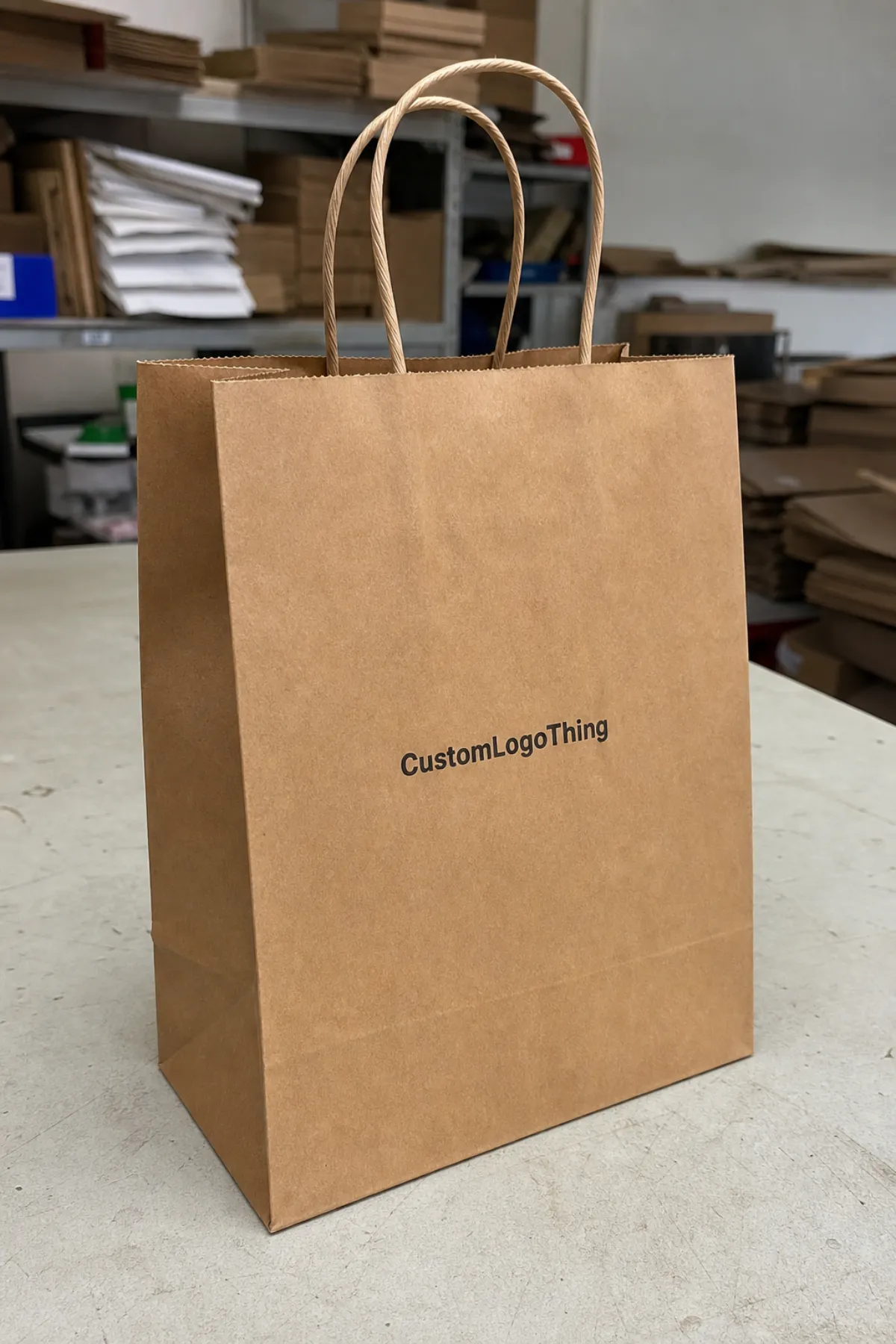
Stationery sits in a strange middle ground. It is practical, but it also has an emotional side. Customers buy supplies, yet they are also buying organization, gifting, planning, and a little sense of order. A tidy carrier reinforces that feeling. A weak one interrupts it.
The first branded surface many shoppers carry is the bag itself. It leaves the store before the receipt does, and it stays visible longer than the shelf display. If the paper sags, the handles twist unevenly, or the print rubs off too easily, the packaging speaks louder than the merchandise. That is why the bag deserves the same spec discipline as the product inside it.
For stationery retailers, the bag also affects perceived price. A well-made carrier can make a modest notebook set feel considered and giftable. The same items in a thin, unbranded sack feel closer to impulse stock. The contents do not change, but the experience does.
“A bag that holds its shape and keeps the handles straight makes even a small purchase feel intentional.”
There is another practical reason these bags matter: they influence packing speed. Counter staff need bags that open cleanly, stand upright, and accept rectangular items without forcing them in at an angle. A carrier that slows down the handoff creates friction on the busiest days, especially during back-to-school seasons and holiday spikes.
That is why retail packaging should be matched to the store’s actual product mix. If the shop mainly sells slim journals and pens, a lighter structure can work well. If the mix includes hardbound planners, gift boxes, and multi-item bundles, the bag needs more body and a wider footprint. The best spec follows the merchandise, not the mood board.
How the bag structure carries weight without looking bulky
Twisted handles are popular because they spread load across several layers of paper instead of relying on one thin attachment point. The twist itself, the glued reinforcement at the top, and the folded rim all share the stress. That is what lets the bag stay neat while still carrying a fair amount of weight.
The base matters just as much. A bottom board helps flat goods sit evenly, while the gussets give notebooks, boxed sets, and accessories enough room to settle without forcing the sidewalls outward. Stationery products are often rigid and square-edged, so a bag with weak structure can crease early, bow at the sides, or look tired before it leaves the store.
Paper choice changes both the look and the performance. Natural kraft usually gives a grounded, tactile feel and hides minor handling marks better. White stock prints more sharply and supports finer branding, but it usually costs more and shows scuffs sooner. If the brand leans calm, earthy, or editorial, kraft often fits. If the brand voice is cleaner and more premium, a smoother white stock can be worth the extra spend.
Bag construction can be broken down into a few points that buyers should confirm rather than assume:
- Handle patch: spreads pull force and reduces tear risk at the top.
- Bottom board: keeps the bag upright and supports flat items.
- Side gusset: makes room for boxed goods and layered bundles.
- Paper grade: affects stiffness, print clarity, and cost.
For stationery retailers, the real test is not whether the bag looks good empty. It is whether it still looks composed after a planner, a notebook, and a boxed item have gone in together. That is where structure shows up.
If the bags will travel inside cartons, shipping validation matters too. Ask whether the supplier uses basic drop, stacking, or compression checks, or follows a recognized transit standard such as ISTA handling standards. Not every retail bag needs full laboratory testing, but the supplier should understand how paper reacts to pressure, humidity, and rough handling.
Size, stock, and finish choices that drive cost and pricing
Bag size is usually the first lever on cost. Wider dimensions, taller panels, and deeper gussets all add paper, glue, and freight weight. That sounds obvious, yet buyers still tend to request more sizes than they need. For most stationery stores, two core formats are enough: one for slim items and one for bundled or boxed orders.
Paper weight, often measured as GSM, affects both the feel and the price. A middle range works well for many retail uses because it balances stiffness with efficiency. Too light, and the bag can feel disposable. Too heavy, and the bag may be more expensive than the products it carries justify. For stationery, the useful range often sits somewhere between 120 and 170 gsm, though the exact choice should follow the contents and the print method.
| Spec | Best for | Typical unit cost range |
|---|---|---|
| Natural kraft, 1-color print, no lamination | Journals, pens, light gift sets | $0.18-$0.28 at 5,000 pieces |
| White stock, 1-2 color print, reinforced base | Planners, boxed sets, mixed retail orders | $0.24-$0.40 at 5,000 pieces |
| Coated stock, full-panel print, matte or soft-touch finish | Premium branding, higher-margin product packaging | $0.38-$0.65 at 5,000 pieces |
Those ranges move with order quantity, ink coverage, paper source, and freight. They are still useful because they show where the major jumps happen. A simple kraft carrier with one color of print sits in a very different cost band from a coated, full-panel design with finishing added. Buyers who understand that spread are usually easier to quote and easier to keep on budget.
Finish choice deserves the same attention. Lamination adds protection and gives the bag a cleaner surface, but it also raises the price and can fight the tactile look some stationery brands want. A matte surface can feel calm and restrained. Soft-touch can feel premium but may be excessive for a store whose products are intentionally modest and practical. The finish should support the brand position, not drown it.
One-color printing on natural kraft is usually the lowest-cost custom option. Multiple colors, foil, special coatings, and full-panel coverage all add setup and production cost quickly. That does not make them bad choices. It only means they should be reserved for packaging that can justify the extra spend, such as seasonal gift bundles or higher-margin stationery sets.
If you are comparing packaging formats, it helps to look at the whole system rather than a single quote. Our Custom Packaging Products range can be useful for comparing size, finish, and print complexity before you lock a specification. In some cases, a simple paper carrier is the best fit. In others, a heavier presentation box makes more sense. The right answer depends on what is being sold and how it is handed over.
For sourcing transparency, an FSC claim can matter if the brand wants certified paper input. It is not required for every store, but buyers do ask for it more often, and it gives a clear response when sustainability questions come up.
Production steps and turnaround from file check to delivery
The process begins with the dieline. That template shows the usable print area, fold lines, handle position, glue zones, and safe margins. If artwork sits too close to a crease or lands in a glued section, the final bag can look off even when the design file is technically correct. This is one of the most common issues on first orders.
After file review and proof approval, production usually moves into printing, cutting, folding, handle attachment, and final packing. Each stage is straightforward on its own, but small mistakes compound quickly. Good suppliers can describe the sequence clearly and tell you where quality checks happen. Weak ones tend to give vague status updates and hope the order stays on track.
Turnaround depends on volume and finish. Straightforward custom runs often take around 7-15 working days after proof approval. More complex orders, such as coated stock, heavier board, multiple print colors, or special surface treatment, can take longer. Larger quantities may also stretch the schedule if the factory is balancing several production lines at once. A promise of very fast turnaround without any questions about size, artwork coverage, or material choice usually deserves caution.
Shipping time is separate from production time, and it is easy to underestimate. An order that leaves the factory on schedule can still arrive late if freight is not built into the timeline. The simplest way to avoid that problem is to plan backward from the sales date instead of forward from the day the order is placed.
Quality control should include more than a visual scan of the print. Ask what is checked for handle attachment strength, print registration, base squareness, and carton packing. A stationery bag should stand on the counter without collapsing and should hold its shape after a planner or boxed set goes in. If the supplier cannot explain those checks in plain terms, that is a warning sign.
For color-sensitive branding, printed proofing on the actual stock matters. Digital mockups rarely show how ink sits on kraft fibers or how a dark logo behaves on a coated surface. A proof on the intended paper may cost a little more or add a few days, but it usually prevents the kind of color disappointment that is expensive to correct later.
Choosing MOQ, reorder rhythm, and quantity split
MOQ is one of the few parts of custom packaging that rarely bends much. Smaller runs spread setup cost across fewer bags, so the unit price rises. That is normal. The tricky part is deciding whether the higher per-bag cost is worth the flexibility. For a small stationery shop, the answer is often yes on the first order, then no once the core spec is settled.
It usually makes more sense to start with one or two proven sizes than to spread a first order across four versions. A compact carrier can cover pens, slim notebooks, and small desk items. A wider format can handle planners, boxed sets, and gift bundles. Two usable sizes beat several under-tested ones that sit in storage.
Split quantities according to real sales patterns. Back-to-school months, holiday gifting, and planner launches do not move evenly through the year, so the largest order should follow the size that actually sells most often. Dead stock is not strategy; it is paper sitting in a storeroom.
Reorder timing matters just as much as initial quantity. A practical rule is to reorder when stock reaches four to six weeks of expected demand. That leaves room for proofing, production, and freight without forcing rush charges. It also gives enough buffer if the store sees a sudden jump in sales or if a shipment is delayed.
Ask for pricing in a format that separates size, paper grade, print method, and finish. When those elements are bundled into one vague figure, it becomes hard to compare quotes honestly. A supplier who can explain how much each change affects cost is easier to work with over time than one who only offers a single number and little else.
For brands trying to keep packaging disciplined, the useful goal is not the lowest possible MOQ. It is the smallest order that still gives enough room to test, sell through, and reorder with confidence.
Artwork that prints cleanly on retail paper carriers
Bold logos, solid shapes, and clear type usually print better than delicate line art, especially on natural kraft. Paper has texture, and texture can weaken very fine detail. Tiny reversed text may fill in. Thin rules can disappear. If the design depends on microscopic precision, the final bag may disappoint even if it looks perfect on screen.
Keep key information away from fold lines, handle glue zones, and the lower edge. If the bag needs a website, social handle, or store hours, place those elements where they can be read quickly and where finishing will not distort them. Overcrowded artwork often looks more expensive in the file than it does on the shelf.
Color also behaves differently by substrate. On uncoated kraft, muted tones and deep solids usually hold up better than pale tints. On white stock, the print can look sharper, but only if the file is prepared carefully. If exact color matters, ask for a proof on the actual stock rather than relying on a monitor preview or a generic mockup.
For most stationery brands, the best package branding is restrained. One strong logo, one clear mark, maybe a light pattern if it genuinely supports the brand identity. Too many badges, slogans, and decorative elements make the bag look busy and cheaper than it should.
There is room for more elaborate branding packaging on seasonal lines or gift collections, but even then the bag should still function as a carrier first. If the artwork starts competing with the products inside it, the design has gone too far.
If the bag has to match other custom printed boxes or in-store signage, agree on color targets early. Trying to correct a mismatch after production usually means wasting time on a problem that could have been caught during proofing.
Common mistakes that make the bags feel cheap
The most common mistake is undersizing. A bag that is too narrow or too shallow forces notebooks, boxes, or bundles to bulge. Once the sidewalls bow outward, the carrier stops looking premium, no matter how polished the logo may be. Fit is not a detail. It is the baseline.
Finish mismatches are another issue. Glossy lamination can look out of place for a calm, paper-forward stationery brand. An ultra-matte surface can make a bright, energetic brand feel flat. The surface treatment should support the product story rather than contradicting it.
Weak handles are a bigger problem than they appear. Thin handles, inadequate glue, and skipped reinforcement at the top edge lead to failures before the customer ever gets home. If the quote is low because those details were trimmed out, the order is not cheaper in the long run.
Design clutter also works against the bag. Small text, too many fonts, scattered icons, and crowded claims make the carrier look busy. Good packaging has breathing room. It reads quickly and leaves the product with space to matter.
“A clean bag makes a small purchase feel deliberate. A crowded bag makes even a good one feel rushed.”
Carton packing is easy to overlook as well. Flat-shipped bags should be stacked and packed so they do not curl, crease, or absorb moisture in transit. Ask how many pieces go into each carton and whether protective wrapping is used. A bag that arrives warped or scuffed has already lost part of its value.
One final trap is overcommitting to a trendy finish or color before testing it against the actual merchandise. A carrier should work with notebooks, planners, boxed sets, and gift items across the season. If it only looks right in a presentation deck, it is probably too fragile a decision for production.
Next steps: lock the spec before you request quotes
Start with the products, not the bag photo you liked in a catalog. Measure the top three items you expect the bag to carry, then allow enough clearance for easy packing and a neat fit. A good size should make the contents look intentional and should not force staff to wrestle with the opening.
Set the paper grade, handle style, print colors, and target quantity before asking for pricing. That gives suppliers a clean brief and makes it possible to compare quotes fairly. A cheaper quote that leaves out reinforcement, uses thinner stock, or reduces print coverage is not the same product at all.
Request a sample or proof, confirm the turnaround, and define the reorder point while the first order is still manageable. That is the practical rhythm for Custom Twisted Handle Paper Bags for stationery stores: one clear spec, one controlled production cycle, and a repeatable path back into stock.
For stationery retailers, the best product packaging is the kind that holds up in daily use, matches the core assortment, and keeps the sale feeling finished when the customer leaves the counter. If the spec is clear, the artwork is disciplined, and the build matches the load, the bag becomes a small but reliable part of the store’s identity.
That is also the best way to compare quotes. Ask suppliers to price the same custom twisted Handle Paper Bags for stationery stores specification so the differences are real and visible. Once the spec is locked, the numbers become easier to trust.
What size custom twisted handle paper bags work best for stationery stores?
Choose a bag that fits your most common notebook or gift set with enough clearance to pack quickly. A narrower format works for pens and slim journals, while a wider gusset is better for planners, boxed sets, and bundled items. The right size is the one that fits the merchandise cleanly without forcing the sides outward.
How much weight can twisted-handle paper bags hold for retail use?
Capacity depends on paper weight, handle reinforcement, base structure, and how the contents are distributed. Many retail bags handle around 1-4 kg safely when built well, but dense or sharp-edged items may need stronger stock and a reinforced handle patch. If the products are heavy, do not rely on handle style alone.
What MOQ should I expect for custom paper bags for a stationery shop?
Printed custom runs often start around 500-1,000 pieces per size, though the actual minimum depends on the factory, print method, and finish. Lower quantities usually carry a higher unit price because setup cost is spread across fewer bags. If several sizes are needed, it is usually wiser to start with one core size and expand later.
How long does production usually take for stationery-store paper bags?
File checks and proofing can take a few days if artwork or dielines need revision. Straightforward production often takes about 7-15 working days after proof approval, while more complex finishes or larger orders may take longer. Freight should be added separately to the schedule so the bags arrive before the selling date.
Can I print detailed designs on custom twisted handle paper bags?
Yes, but bold logos, clean type, and simple shapes usually print better than fine detail, especially on natural kraft. If the design depends on exact color or small elements, request a proof on the actual substrate. Simple artwork often produces the sharpest and most reliable retail result.

