Buyer Fit Snapshot
| Best fit | Custom Foil Labels With Logo projects where brand print, material claims, artwork control, MOQ, and repeat-order consistency need to be specified before quoting. |
|---|---|
| Quote inputs | Share finished size, material target, print colors, finish, packing count, annual reorder estimate, ship-to region, and any compliance wording. |
| Proofing check | Approve dieline scale, logo placement, barcode or warning zones, color tolerance, closure strength, and carton packing before bulk production. |
| Main risk | Vague material claims, crowded artwork, missing packing details, or unclear freight terms can make a low unit price expensive after revisions. |
Fast answer: Custom Foil Labels With Logo: Design, Cost, and Use should be specified like a repeatable production item. The safest quote records material, print method, finish, artwork proof, packing count, and reorder notes in one written spec.
Production checks before approval
Compare the actual filled-product size with the drawing, then confirm tolerance on folds, seals, hang holes, label areas, and retail display edges. Reserve space for logos, QR codes, warning copy, and material claims before decorative graphics fill the panel.
Quote comparison points
Review material grade, print process, finish, sampling route, tooling charges, carton quantity, and freight assumptions side by side. A quote is only useful when the supplier can repeat the same color, closure quality, and packing count on the next order.
Custom Foil Labels with logo can change the way a jar, bottle, or carton reads the moment someone sees it at arm's length. The product does not need louder graphics or a busier layout. It needs a label that catches light with intention, then keeps doing its job after the package has been handled, shipped, chilled, or set under harsh store lighting. That is the real promise behind custom foil labels with logo: stronger shelf presence, a more premium look, and a label that still has to hold up in the real world.
That real-world part matters more than most buyers want to admit. A shiny label that lifts at the corners, smears after a cold storage run, or turns muddy under fluorescent lights is not premium. It is a shiny problem. Good custom foil labels with logo depend on the right artwork, the right stock, the right adhesive, and a production method that fits the product instead of fighting it. I've seen a lot of nice concepts go sideways simply because somebody picked the effect first and the environment second.
There is also a brand side to this that gets overlooked. Foil is not just decoration. It signals hierarchy, helps a logo stand apart, and gives the eye a place to land quickly. Used well, it makes a package feel considered. Used badly, it makes the label look like it is trying a little too hard, which is kinda the opposite of premium.
Custom foil labels with logo: what they actually do
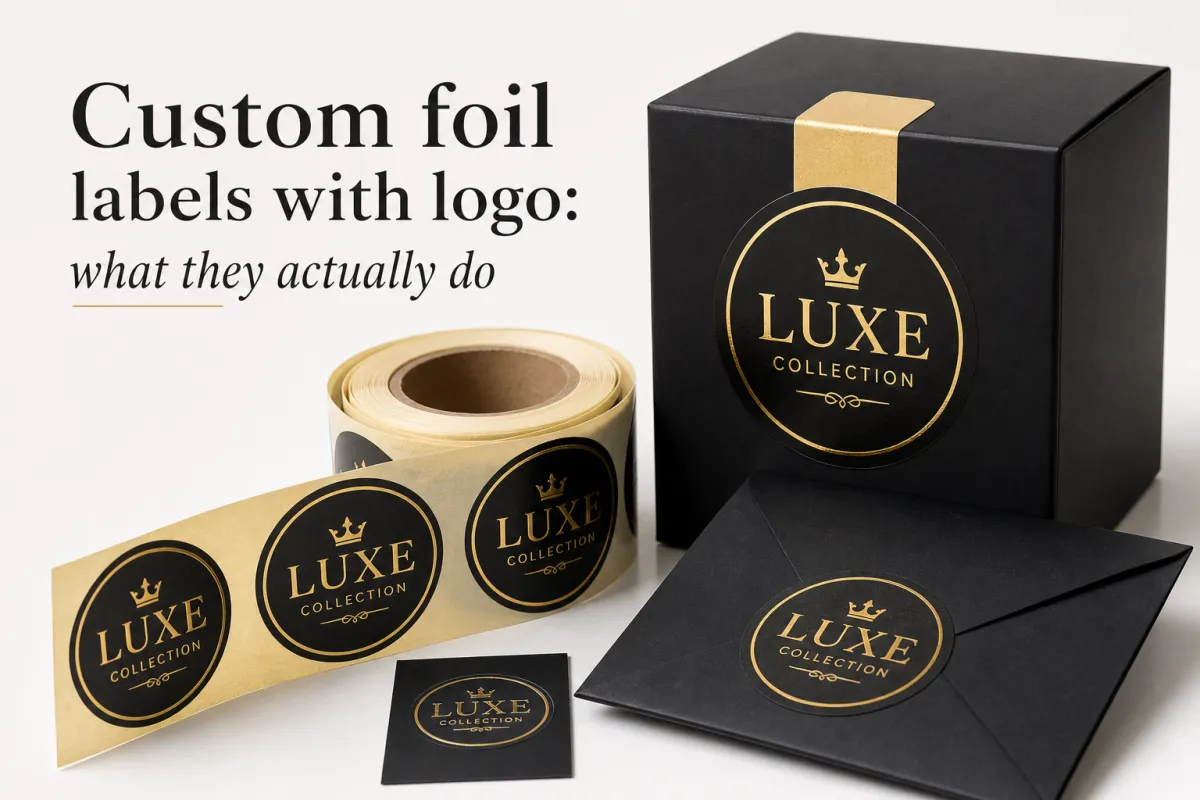
Walk through a candle shop, a specialty food aisle, or a cosmetics display and the pattern shows up fast: the packages with a reflective accent tend to read first. That is why custom foil labels with logo show up so often in retail packaging. They attract attention without needing an oversized layout. A single foil logo on a matte jar can do more for package branding than a crowded design packed with decorative effects.
Custom foil labels with logo are pressure-sensitive labels that use metallic foil, foil stamping, or foil-like effects to add reflectivity and contrast. They are not the same as a standard glossy print. The goal is specific: flash, shimmer, and a clean visual break between the logo and the rest of the package. Used well, they work on cosmetics, candles, gourmet foods, supplements, spirits, and short-run product packaging where a brand wants a stronger premium cue without moving to custom printed boxes right away.
Buyers sometimes focus so hard on the shine that they forget the label still has to live on a container. Custom foil labels with logo need to bond to glass, PET, coated paper, or metal tins. They need to handle oil, moisture, refrigeration, rubbing, and shipping friction. If the label looks good only before it leaves the packer, it failed. A pretty failure is still a failure.
From a packaging buyer's point of view, the strongest labels usually do three jobs at once: they identify the product clearly, they support branding, and they survive the environment the product actually lives in. That is one reason custom foil labels with logo often beat more elaborate packaging ideas when the goal is impact without a long lead time. They are smaller than a full carton redesign, less expensive than many structural changes, and easier to test before a broad rollout.
Practical rule: if the label needs to survive chilled storage, finger contact, or a humid bathroom shelf, choose the substrate and adhesive first. The foil comes second. Always.
Custom foil labels with logo also make it easier to separate product tiers. A standard line can stay on paper or film, while a limited edition gets a silver, gold, rose-gold, or holographic accent. That kind of tiering is common in branded packaging because it gives a company a premium signal without reworking the whole product family. If you already sell Custom Labels & Tags, foil is often the fastest way to give one SKU more shelf presence without redesigning the rest.
The cleanest results usually come from a quiet background and a logo that takes the lead. That is not a compromise. It is good packaging design. A single foil mark on a matte stock often reads more expensive than a crowded label with five effects competing for attention. Custom foil labels with logo work best when they create hierarchy instead of noise.
There is a simple way to sanity-check the idea: hold the mockup at arm's length. If the logo still reads instantly and the foil adds emphasis rather than confusion, the design is probably on the right track. If the eye wanders around the label trying to figure out what matters, the foil may be doing too much.
How custom foil labels with logo are made
Four common methods show up in custom foil Labels With Logo: hot foil stamping, cold foil, digital foil effects, and print setups that mimic foil with specialty inks or metallic films. Each one brings a different mix of cost, speed, and finish quality. Hot foil is the classic option. Heat and pressure transfer foil onto the label surface, which produces crisp edges and strong reflectivity. Cold foil ties more closely to printing and can make sense for larger runs. Digital foil effects work well for shorter runs and variable artwork, though the finish behaves a little differently from true foil stamping. Different result, different tool, same basic goal.
The artwork matters just as much as the press setup. Clean vector files, well-separated foil layers, and consistent line weights make custom foil labels with logo much easier to produce. Tiny serif details, hairline rules, and reversed text can turn muddy fast if the file is messy. The more controlled the logo artwork, the cleaner the foil transfer tends to read on press. That is why production teams ask for clear dielines, exact foil callouts, and a proof that shows where the foil starts and stops.
Under the reflective surface, the label is still a stack of materials. There is the face stock, the adhesive, the liner, and then the finish on top. Custom foil labels with logo can use paper, BOPP, PET, or other stocks depending on whether the product needs moisture resistance, oil resistance, or better scuff protection. Dry shelf product can usually stay on paper. Chilled bottles and lotion jars usually call for film.
There are limits built into the process. Fine detail can break down. Gradients inside a foil area may look flat or uneven. Very small typography can lose sharpness. Those issues do not happen at random. They come from the method you chose. Custom foil labels with logo look crisp when the foil area is bold enough, the art is simplified, and the press setup matches the intended finish. They look tired or patchy when the design asks for more precision than the process can reasonably deliver.
The labels that look expensive usually share the same qualities: controlled art, foil placed where it can reflect light cleanly, a substrate that supports the effect, and print layers that leave the logo room to breathe. Pack too much into one label and the foil stops doing its job. A lot of packaging design problems start when one label is expected to carry three different visual messages at once.
If you are comparing packaging options across a product line, it helps to look at the label alongside other items in your system, including Custom Packaging Products. A label never lives alone. It sits inside the full retail packaging experience, which includes cartons, inserts, shipping performance, and the way the brand appears when the customer opens the box.
For durability expectations, many buyers also borrow from testing language used in packaging standards. ISO and ASTM are not magic words, but they do remind teams to think about scuffing, abrasion, temperature, and moisture before production starts. Shipping performance references from groups like ISTA can help when the labeled product will face rough handling. If the packaging uses paper-based materials, FSC-certified options from FSC can matter too, especially for brands that want packaging design to align with sustainability claims.
What affects cost and pricing for custom foil labels with logo
Pricing for custom foil labels with logo comes down to a handful of predictable factors: size, shape, coverage, material, finish, and quantity. Bigger labels cost more. Strange shapes cost more. More foil coverage costs more. Lower quantity costs more per label because setup gets spread across fewer pieces. That is not a trick. It is simply how the math works.
Short runs usually come in at a higher per-unit price because the setup, plate or die preparation, and finishing steps do not shrink much when the order gets smaller. A simple accent-foil label might land around $0.18 to $0.35 per unit at 5,000 pieces, while a run of 500 to 1,000 pieces can climb into the $0.45 to $1.20 range or more depending on the size, shape, and foil method. Those are broad planning ranges, not promises, since artwork complexity and material selection can move things around pretty quickly. Add a custom die-cut, multiple foil colors, or a specialty film stock and the cost can move up fast.
A practical way to think about the budget: accent foil usually costs less than full coverage foil, standard shapes usually cost less than custom dies, and paper usually costs less than film. Custom foil labels with logo are most cost-efficient when the foil highlights the logo or a key brand mark instead of spreading across the entire label face. Full-coverage foil looks dramatic. It also increases material waste, finishing complexity, and the chance of inconsistency from piece to piece.
| Option | Typical Use | Relative Cost | Buyer Tradeoff |
|---|---|---|---|
| Accent foil on paper | Candles, dry goods, gift items | Low to medium | Good shelf impact without pushing budget too hard |
| Accent foil on BOPP or PET | Bottles, jars, refrigerated items | Medium | Better durability, slightly higher material cost |
| Full foil coverage | Luxury editions, promo packs | Medium to high | Strong visual impact, but more sensitive to scuffing and setup |
| Multi-effect foil with die-cut | High-end retail packaging | High | Great appearance, but easy to overpay if the run is small |
Unclear specs are where hidden costs start to show up. Multiple versions of the same label, frequent artwork changes, or vague durability requirements can add cost very quickly. Custom foil labels with logo get expensive when the quoting team has to guess at the final use case. If the label will face condensation, oil, freezer storage, or abrasion, say so early. A dollar saved on the quote can become three dollars wasted on reprints.
Print method matters too. Digital can be smart for short runs and faster art changes. Traditional foil stamping can be a better fit for a fixed high-volume layout. Cold foil can work well when the printer wants to combine metallic effects with broader print production. None of these methods wins every time. The right choice depends on quantity, artwork, and how much sparkle the brand really needs. More is not always better.
For buyers building a branded packaging line, it helps to compare label spend with the cost of other visual upgrades. Sometimes custom foil labels with logo are the best value because they change the shelf read without increasing carton complexity. Other times, a stronger insert, a different cap, or a more refined custom printed boxes structure delivers more visible impact. Smart budgets follow the customer's eye, not the supplier's favorite process.
If you are quoting a new line, ask for pricing with at least two material paths: one practical option and one premium option. That makes tradeoffs visible right away, and it keeps the conversation grounded in actual performance rather than wishful thinking.
Key material, adhesive, and finish choices
Stock selection is where a lot of custom foil labels with logo projects either start looking right or start getting annoying. Paper still works well for dry indoor products, especially when the brand wants a natural or tactile look. BOPP is a common choice for moisture resistance and solid handling on bottles and jars. PET often gets selected when the label needs stronger clarity, more scuff resistance, or a firmer feel. The stock should match the environment first, then the visual goal.
Adhesive choice matters just as much. A permanent adhesive is the standard for most retail packaging. Removable adhesive fits temporary promotions or items that should not leave residue. Freezer-safe adhesive is a must for chilled or frozen products, because a label that lifts in cold storage is a waste of print time. For curved or hard-to-stick surfaces, some projects need a more aggressive adhesive that can grab and stay put. Custom foil labels with logo can look perfect on press and still fail on the bottle if the adhesive is wrong.
Finish shifts the tone. A matte base with bright foil gives strong contrast and feels modern. A gloss base with subtle foil can look polished and a little more upscale. Textured stocks add tactility that works well for artisanal product packaging. Texture can also scatter light and soften the foil read, so the effect may be less sharp. That is fine when the brand wants warmth. It is not fine when the brand wants a crisp luxury signal and chooses a stock that absorbs the shine.
Topcoats and laminates help protect custom foil labels with logo from scuffing, fingerprints, and color fade. A clear laminate can be useful when the label will be handled often, packed tightly, or shipped in cartons that rub against each other. Not every finish needs a laminate, but if the product is expensive and the label is exposed, the added protection is often worth it. A slightly quieter foil under a good protective layer often ages better than a dramatic foil that looks scratched after one day in the wild.
Surface compatibility is another practical issue. Glass is usually straightforward, though curved glass still needs careful sizing. Plastic bottles vary a lot in surface energy and flexibility. Metal tins can be easy or difficult depending on coatings and curvature. Textured packaging is the real test, because the adhesive has to bridge tiny highs and lows. Custom foil labels with logo on textured surfaces should always be sampled first. Guessing here gets expensive fast.
For buyers who want a straightforward path, the safest sequence is usually: define the use case, choose the substrate, confirm the adhesive, then refine the foil effect. That order prevents a lot of avoidable rework. It also keeps the label aligned with the broader packaging design, especially if the product line includes matching cartons, inserts, or other package branding elements.
One more practical note: finish samples should be checked under the lighting where the product actually lives. Office light, daylight, and retail shelf light each tell a slightly different story, and foil can look rich in one setting and flat in another.
Step-by-step process and production timeline
The cleanest custom foil labels with logo projects usually follow a simple workflow. First comes the brief: size, quantity, placement, substrate, finish, and how the product will actually be used. Then comes artwork prep, which usually means cleaning up the logo file, building a dieline, and separating foil areas from printed areas. After that, the team reviews a proof, confirms the material, sets up the press, runs production, finishes the labels, and ships them out. Nothing glamorous, just a long chain of small decisions that determine whether the final labels look expensive or merely expensive-looking.
Revisions slow everything down. So do unclear specs, missing artwork, and waiting too long to approve the proof. Custom foil labels with logo are not slow because foil is mysterious. They are slow because details pile up. If the logo needs a new outline, the foil area changes. If the size changes, the dieline changes. If the substrate changes, the adhesive and setup may change too. One small revision can affect four different parts of the job.
A realistic timeline depends on complexity and quantity. Simple custom foil labels with logo for a short run can sometimes move through production in about 7 to 12 business days after proof approval. More involved jobs with specialty materials, multiple versions, or custom die-cuts often land in the 12 to 20 business day range. Big or complicated runs can take longer if materials need to be sourced or if the project includes several approval rounds. Buyers love asking for a fast turnaround right before making three rounds of changes. Classic move.
If you want to reduce delays, approve the dieline early, confirm the foil placement before print, and lock the final quantity before production starts. Those three things solve more schedule problems than wishful thinking ever will. It also helps to decide up front whether the labels need a sample, a printed proof, or a production-ready mockup. For new packaging design, a proof usually makes sense. For repeat orders with stable art, a sample on the actual surface is often enough to move forward.
Inventory needs a buffer. If your average monthly sell-through is 2,000 labels, do not order exactly 2,000 unless you enjoy panic. Better to cover expected demand plus a small safety margin for spoilage, line setup, or a surprise promotion. Custom foil labels with logo are too useful to run out of because someone guessed too tightly. That is how brands end up paying rush fees for a problem they created themselves.
Decision rule: request a physical sample when the packaging surface is unusual, request a proof when the artwork is new, and move straight to production only when the material, size, and quantity are all locked. That keeps custom foil labels with logo on schedule and reduces the chance of reprints.
When the clock is tight, the fastest projects are usually the ones that arrive prepared. Final art, clear material notes, and one person with approval authority can shave off a surprising amount of time.
Common mistakes that make foil labels look cheap
The fastest way to ruin custom foil labels with logo is to cram too much detail into the foil area. Tiny text, thin rules, and crowded logos often print badly because the foil cannot hold every microscopic edge the designer imagined on screen. Foil likes bold shapes. It likes breathing room. It does not care about a beautiful 0.4-point line. That line may come out as a mushy silver suggestion instead of a clean design element.
Material mismatch is another common miss. A paper label on a wet bottle or oily cosmetic jar is a bad bet unless the environment is tightly controlled. Yet people still do it, then act surprised when the corners lift or the print smears. Custom foil labels with logo can still fail if the adhesive does not fit the surface or if the stock cannot handle the product environment. A shiny label that peels is not premium. It is evidence that somebody wanted to save eight cents and paid for it later.
Poor artwork files create expensive problems too. Low-resolution logos, unseparated foil layers, missing bleed, and no safe area all lead to weak results. If the file is sloppy, the production team spends more time fixing than printing. That can affect both timing and appearance. Custom foil labels with logo really reward clean files because the finish does not hide mistakes. The foil highlights them faster than plain print does.
Overdesign is another trap. Too many finishes in one label can make the result feel busy instead of premium. Matte paper, gloss varnish, metallic foil, embossing, spot UV, and textured stock can all work separately. Put them all on one small label and the result may feel noisy rather than elevated. Good branded packaging usually shows restraint. One strong idea beats five half-ideas piled together.
Proofing matters more than most buyers think. What looks sharp on a monitor is not the same as what reflects light on a finished label. The angle of the foil, the color of the base stock, and the surface of the bottle all change the final read. That is why custom foil labels with logo should be reviewed under real lighting whenever possible. A product that looks luxe under a designer's desk lamp might look flat on a retail shelf. Shelf lighting has no mercy.
Watch for this: if a label mockup looks perfect only when zoomed in on a screen, it probably needs another round of real-world testing.
One more practical mistake: treating the label as a separate project from the rest of the package. The strongest retail packaging systems keep the label, carton, cap, and shipper visually aligned. If the line includes custom printed boxes, the foil treatment on the label should match the tone of the box graphics. Not identical. Just coordinated. That is how the whole package looks intentional instead of cobbled together.
I have seen designs get approved because they looked polished in a mockup, only to turn out awkward once they were wrapped around a curved bottle or viewed under store lights. That is usually where the cost of skipping a sample shows up.
Expert tips and next steps for better results
Test one sample on the actual packaging surface before approving a full run. Not on a similar bottle. Not on a material that is close enough. On the real thing. Custom foil labels with logo can behave differently on curved glass, coated paperboard, matte plastic, or textured tins, and that small test often exposes adhesive or fit problems early. It is a cheap way to avoid a very expensive reprint.
Use foil as an accent, not a crutch. Put it where the eye lands first, usually the logo, a seal, or one key brand mark. That is the cleanest way to get impact without making the design look desperate. A small foil detail on a strong layout often outperforms a full shiny surface on a weak one. Custom foil labels with logo work best when the rest of the design knows when to step back.
Request a proof that shows scale, placement, and contrast clearly. If the foil area is too large, too small, or off-center, the proof should make that obvious before production starts. Custom foil labels with logo are much easier to approve when the proof is honest. If the vendor only shows a pretty mockup and not a production-oriented proof, push back. Pretty is not the same as printable.
Plan inventory with actual sell-through in mind. If the product has steady demand, order enough to cover the run plus a small buffer. If it is seasonal or promotional, keep a tighter eye on quantity and timing. Custom foil labels with logo are a smart fit for limited editions, but they still need a realistic ordering plan. Nothing kills a premium launch faster than running out of labels halfway through a re-order cycle.
Before you quote, gather the final artwork, confirm the label size, decide on the substrate, and note where the product will be stored and used. If the item will face moisture, oil, refrigeration, or abrasion, say that plainly. That information improves the quote and helps the supplier recommend the right stock and adhesive. It also keeps the conversation grounded in actual use, which is where good packaging decisions usually happen.
If you are building out a broader packaging line, keep the label decision connected to the rest of the product packaging system. The same visual cue can carry across labels, cartons, and other branded packaging pieces, so the customer gets one clear message instead of a pile of disconnected parts. That is where custom foil labels with logo do their best work: not as a gimmick, but as a practical tool for stronger package branding.
My blunt advice is simple. Start with the real use case, Choose the Right material, keep the foil placement disciplined, and check the proof like you actually care about the money you are spending. Do that, and custom foil labels with logo can deliver a lot of shelf impact without blowing up your budget. Skip those steps, and you will end up paying for shiny mistakes. Custom foil labels with logo are only expensive when the project is underthought. Done right, they are one of the cleanest upgrades you can make to a label program.
The best takeaway is straightforward: define the environment first, then build the foil treatment around it. That one habit saves more time, money, and rework than any fancy finish ever will.
How much do custom foil labels with logo usually cost?
Cost depends on size, foil coverage, material, and quantity. Small runs usually cost more per label because setup is spread across fewer pieces. Accent foil is typically cheaper than full-coverage foil or multi-effect finishes. For planning, many buyers see short-run pricing land in the higher per-unit range, while larger runs come down once setup is amortized. The cleanest quote usually comes from giving the supplier exact size, quantity, and use conditions up front.
What is the best material for custom foil labels with logo on bottles?
Film labels like BOPP or PET are usually better for moisture, condensation, and handling. Paper can work for dry indoor products, but it is less forgiving. The final choice should match the bottle shape, surface texture, storage conditions, and whether the label needs a laminate or extra scuff resistance. If the bottle will live in a cooler or get handled often, film is usually the safer bet.
How long does it take to produce custom foil labels with logo?
Timeline depends on artwork readiness, proof approval, and production method. Simple jobs move faster; specialty foil jobs with custom dies or multiple revisions take longer. A basic run may be completed in about 7 to 12 business days after approval, while more involved jobs often take 12 to 20 business days or more. If the project is rushed, the biggest speed boost usually comes from locking the artwork early.
Can custom foil labels with logo be used on curved or textured packaging?
Yes, but adhesive choice matters a lot. Curved surfaces need labels that can conform without lifting at the edges. Textured packaging may require testing because not every adhesive bonds well. Sampling on the actual container is the safest way to avoid surprises, especially if the surface has a lot of texture or the product sees temperature swings.
What should I send to get an accurate quote for custom foil labels with logo?
Provide label size, quantity, substrate preference, finish preference, and where the labels will be applied. Include final artwork or at least a usable logo file. Share whether the product is exposed to water, oil, refrigeration, or abrasion so pricing reflects the real use case and the right material can be recommended. If you already know the shelf environment, mention that too; it usually helps narrow the right construction faster.

