Buyer Fit Snapshot
| Best fit | Custom Foil Stamping for Cartons projects where brand print, material claims, artwork control, MOQ, and repeat-order consistency need to be specified before quoting. |
|---|---|
| Quote inputs | Share finished size, material target, print colors, finish, packing count, annual reorder estimate, ship-to region, and any compliance wording. |
| Proofing check | Approve dieline scale, logo placement, barcode or warning zones, color tolerance, closure strength, and carton packing before bulk production. |
| Main risk | Vague material claims, crowded artwork, missing packing details, or unclear freight terms can make a low unit price expensive after revisions. |
Fast answer: Custom Foil Stamping for Cartons: Board, Finish, Dieline, and Unit Cost should be specified like a repeatable production item. The safest quote records material, print method, finish, artwork proof, packing count, and reorder notes in one written spec.
Production checks before approval
Compare the actual filled-product size with the drawing, then confirm tolerance on folds, seals, hang holes, label areas, and retail display edges. Reserve space for logos, QR codes, warning copy, and material claims before decorative graphics fill the panel.
Quote comparison points
Review material grade, print process, finish, sampling route, tooling charges, carton quantity, and freight assumptions side by side. A quote is only useful when the supplier can repeat the same color, closure quality, and packing count on the next order.
Custom Foil Stamping for cartons can make a plain carton feel expensive before the board, size, or structure changes at all. That is the strange little magic of it. A thin foil layer changes how light lands on the surface, and the brain reads that shift as value almost instantly. For brands building retail packaging, gift packaging, or a short seasonal run of custom printed boxes, the effect can beat another hit of ink by a mile.
From a packaging buyer's point of view, this finish is less about decoration and more about signal. The right foil accent lifts package branding, sharpens a logo, and makes product packaging feel more intentional the second someone picks it up. Done badly, it looks loud and a little cheap. Done well, Custom Foil Stamping for cartons becomes the quiet detail that makes the whole carton read as premium without screaming for attention.
I have seen this play out on shelf tests more than once. Two cartons, same structure, same print, same product. The one with the foil mark won because it gave the eye a place to land. Nothing fancy. Just cleaner hierarchy and better light play. That is usually the whole story.
Foil works best when it has a job. It should lead the eye, frame the mark, or separate one product tier from another. It should not try to rescue weak packaging design.
What Custom Foil Stamping for Cartons Really Changes
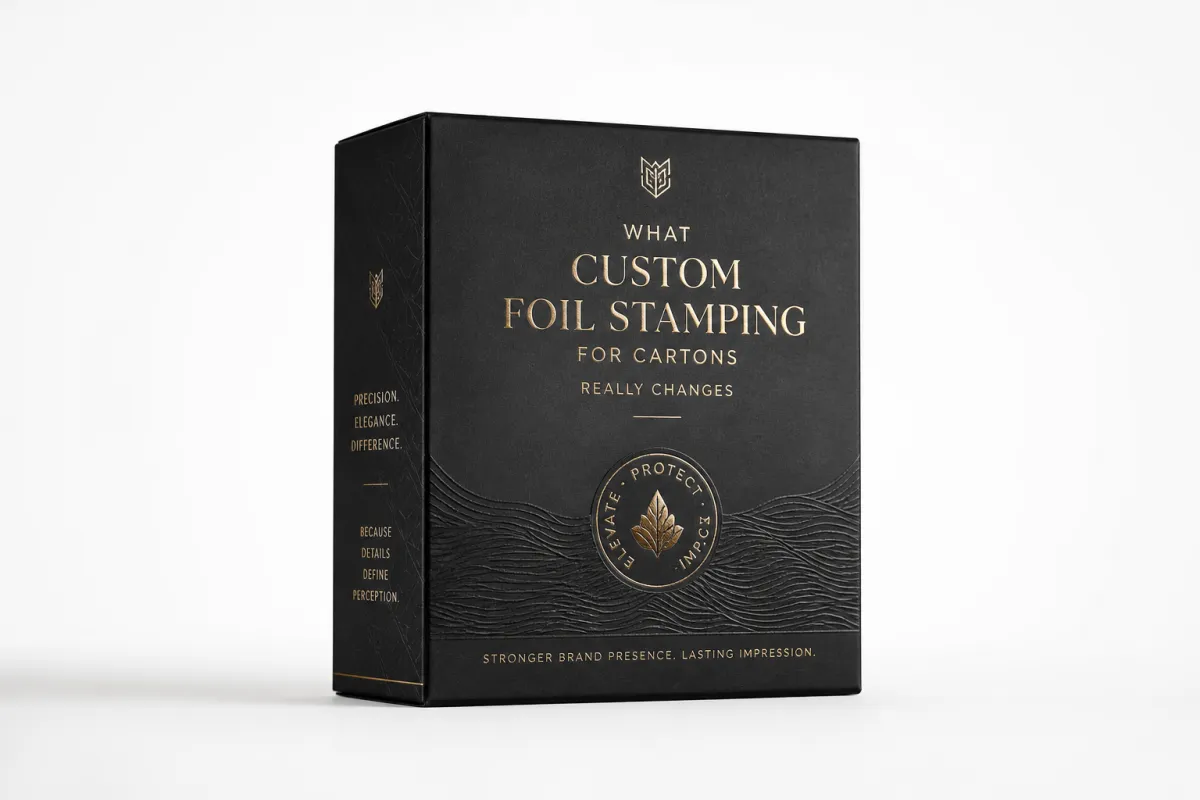
Custom foil stamping for cartons is a finishing process that transfers a thin metallic or pigmented layer onto a board surface with heat and pressure. A metal die presses the foil film against the carton, and the finish bonds only where the design calls for it. In plain English, it changes the way the carton catches light. That is why even a tiny logo can look sharper than the same logo printed in metallic ink.
That difference matters. Metallic ink is printed, so the reflectivity stays softer and the edges can blur a bit. Custom foil stamping for cartons is pressed, so the result is usually brighter, cleaner, and more tactile in hand. Buyers notice that fast, especially on premium branded packaging where the finish has to support a higher shelf price or a more giftable presentation.
The most common uses are the ones where visual hierarchy matters. Custom foil stamping for cartons shows up on logo marks, brand names, frame lines, seals, holiday editions, limited runs, and subscription or gift sets that need to signal value quickly. It also works well when package branding needs to feel more refined without changing the structural carton itself. In other words, custom foil stamping for cartons can improve perception without forcing a full redesign.
That is why the finish is not just ornamental. On retail packaging, a clean foil element can improve shelf contrast, support brand recall, and guide the unboxing moment so the first touch feels deliberate. For many teams, the real value of custom foil stamping for cartons is not the shine alone. It is the way that shine changes how the carton gets read, from three feet away and in the customer's hands.
There is also a very practical side to it. If a product line has several tiers, foil can help separate the hero SKU from the rest without changing every carton in the family. That saves design chaos later. It also keeps the brand system from turning into a mess of random sparkle. Nobody needs that. We have all seen packaging that looks like it lost a fight with a craft store aisle.
How Custom Foil Stamping for Cartons Is Applied
Custom foil stamping for cartons starts with separated artwork and a die made from the foil shape. The press heats that die, positions the foil film over the board, and applies controlled pressure so the finish bonds where the design sits. In a clean run, the process is simple enough to explain in one breath: artwork, die, heat, pressure, transfer. The catch is that custom foil stamping for cartons depends on how well each step is prepared, not just on the steps themselves.
The die is the part most buyers underestimate. Its material, relief depth, and edge sharpness all affect the result. Magnesium dies are common for shorter runs because they are cost-effective, while brass dies usually handle more detail or longer production better. If the artwork has thin serif type, tiny line work, or narrow borders, the die has to carry those edges cleanly. With custom foil stamping for cartons, a design that looks fine on screen can fail if the die cannot hold the detail without losing definition.
Timeline is another place where expectations drift. Approved artwork moves to die making, then to proofing, then to press setup, then to the actual run, and finally to finishing and carton conversion. For custom foil stamping for cartons, the slowdowns usually come from missing dielines, late file changes, or the need to align foil with embossing, spot coating, or die cutting. A simple logo foil job might move quickly, but custom foil stamping for cartons with multiple finishes can add several handoffs before the first production sheet is approved.
There are also different application styles, and they are not interchangeable. Flat stamping gives a clean, crisp impression. Embossing plus foil adds height and gives the carton a more tactile premium cue. Multi-pass work, where the press returns to the sheet for a second or third finish, raises complexity and often increases waste. In custom foil stamping for cartons, quality control should focus on registration accuracy, foil adhesion, clean edges, and whether the board can still crease without cracking once the carton is assembled.
- Artwork is cleaned up and separated so the foil area can be produced as its own layer.
- A die is made from the approved file, with enough relief to carry solid shapes and enough edge control for fine detail.
- The press aligns the foil film, then uses heat and pressure to transfer the finish to the board.
- If embossing is part of the spec, a second tool adds depth either in the same station or in a follow-up pass.
- The finished sheet is checked for registration, adhesion, and whether the foil survives folding and scoring.
Material, Artwork, and Finish Choices
Custom foil stamping for cartons behaves differently depending on the stock beneath it. Coated paperboard usually gives the cleanest result because the surface is smooth and consistent. Uncoated stock can work, but the foil has to fight more fiber texture, which often means larger shapes and less ultra-fine detail. Recycled-content board can also perform well, yet the surface variation is often higher, so sample checks matter. For custom foil stamping for cartons, the board choice is not just a cost decision; it is a visual decision.
Artwork has to be drawn for the process, not just for the screen. The safest specs keep thin lines out of the danger zone, maintain enough spacing between elements, and avoid tiny reversed-out type that might fill in during pressing. As a rule of thumb, many converters want strokes around 0.25 to 0.4 mm minimum, though the exact threshold depends on the foil, the die, and the board. With custom foil stamping for cartons, a cleaner file usually beats a more elaborate one.
Foil finish choice changes the tone of the carton fast. Bright metallic foil feels assertive and is common in luxury or holiday packaging. Matte metallic reads more restrained. Pigment foils can echo brand colors without the reflectivity of silver or gold. Holographic or specialty tones grab attention, but they can overwhelm a design if the carton is already busy. For custom foil stamping for cartons, the safest visual strategy is often to let one foil finish do one job very well.
Combination finishes are where the details get interesting. Soft-touch lamination can make the foil pop because the contrast between matte and shine is stronger. Spot UV can create a similar effect, though it should be planned carefully so the two finishes do not fight each other. Embossing can add depth that makes the foil feel more crafted, while full-bleed print can support the foil by giving it a darker or cleaner field to sit against. In custom foil stamping for cartons, the hard part is not choosing finishes in isolation. It is making sure they work together after folding, scoring, and die cutting.
One practical warning: keep foil away from major crease lines unless the design and board are tested for it. A foil band placed across a heavy score can crack, flake, or distort after the carton is erected. If the package needs to survive storage and handling, the finish has to respect how the carton moves. That is why custom foil stamping for cartons should always be designed with the converted structure in mind, not just the flat mockup.
And yes, the sample board can lie to you if you let it. A finish may look fantastic on a wide flat panel and then get cranky right at the corner wrap or the tuck flap. That is the kind of thing that does not show up in a polished render, only in the real world where cartons get folded, packed, and handled by people who are not trying to ruin your day but kinda do anyway.
Custom Foil Stamping for Cartons: Cost and Pricing Factors
Custom foil stamping for cartons is priced from a mix of fixed and variable costs. The fixed part is the tooling: die creation, setup time, and proofing. The variable part is run length, foil coverage, carton size, and how much press time the job eats up. A simple logo on one panel is far easier to price than a full-bleed or multi-panel treatment. In practice, custom foil stamping for cartons gets more expensive as the finish covers more surface area and demands tighter registration.
Short runs usually look expensive because the setup is spread across fewer cartons. That is why a 2,000-piece order can carry a higher per-unit cost than a 10,000-piece order, even if the design is the same. For custom foil stamping for cartons, the pricing curve usually works like this: the first dollars go into tooling and make-ready, then the unit price drops as quantity rises. Buyers who only look at per-unit production cost can miss that fixed setup fee and misread the quote.
| Option | Typical setup cost | Typical unit impact at 5,000 pcs | Best fit |
|---|---|---|---|
| Flat logo foil | $150-$350 | $0.08-$0.18 | Clean branding on folding cartons |
| Foil + emboss | $300-$700 | $0.15-$0.30 | Premium gift or retail packaging |
| Multi-panel foil | $350-$900 | $0.20-$0.45 | Launches, seasonal runs, display cartons |
| Specialty foil colors | Varies by film and proofing | Often higher than standard metallics | Distinct package branding or color-matched campaigns |
Complexity Changes the Quote faster than most teams expect. If custom foil stamping for cartons has to wrap two or three panels, line up with a window patch, or land within a tight die cutting tolerance, the press may need more setup and slower production speed. Multi-pass work can also create waste if the registration window is narrow. That is why one quote for custom foil stamping for cartons can be wildly higher than another even when the carton size looks similar.
Ask every vendor what is actually included. Does the number cover tooling, a press proof, freight, and a buffer for rework? Does it include the carton board, or only the finishing step? Honest quotes matter more than low quotes because they make comparison possible. If the carton is part of a broader branded packaging program, pair it with Custom Packaging Products so the structure and decoration are spec'd together instead of being managed as two disconnected jobs.
Value is not the same thing as price. A carton with custom foil stamping for cartons might cost a few cents more per unit, but if the finish improves conversion, reduces the need for extra outer packaging, or lifts the product into a better retail tier, that spend can be easy to justify. The useful question is not "What is the cheapest quote?" It is "What finish level gives the right shelf impact for the number of cartons that will actually reach the market?"
Step-by-Step Production Timeline
Start with the goal. Is the carton trying to feel luxurious, seasonal, playful, or technical? Which panel needs the foil, and which panels need to stay clean so the design does not turn into clutter? Custom foil stamping for cartons works best when the brief is specific, because the finish has to support the tier of the product rather than just decorate the artwork. A smart spec sheet keeps the conversation focused before quotes start landing in your inbox.
The production sequence is straightforward, but each handoff matters. Brief the supplier, confirm the dieline, clean up the artwork, approve the layout, make the die, check the proof, schedule the press, and then move to carton conversion. For custom foil stamping for cartons, this is usually the order that keeps late surprises out of the job. If one step is weak, the rest tends to wobble.
- Define the carton goal, quantity, and target ship date.
- Confirm the dieline and note exactly where the foil should land.
- Prepare artwork with separate layers for foil, print, emboss, and cut lines.
- Approve a proof or sample board before production starts.
- Release tooling and book the press window.
- Review the first-off sheets before the run continues.
Timing is usually fastest when the file is clean and the spec is complete before quoting. A simple custom foil stamping for cartons run might move through approval and production in 12 to 15 business days after the proof is signed, but that is a practical range, not a promise. Extra finishes, revised dielines, or uncertain stock choices can add several days. If a launch date is fixed, build in room for sample approval instead of hoping the first proof will magically be perfect.
The biggest delays are usually avoidable. Missing dielines force the supplier to guess panel placement. Late changes to type size can trigger a new die or a new proof. Special stocks may need extra conditioning. And if the carton has to survive a tougher distribution path, ask for a test plan that aligns with ISTA methods so the finish spec and the transport spec are not working against each other. For custom foil stamping for cartons, the launch schedule is usually controlled by the slowest approval, not by the press itself.
A good handoff bundle is small, clear, and complete. Include the final dieline, the artwork package, the board specification, the finish priority, the quantity, the target delivery date, and one contact person who can answer questions fast. If sourcing or recycled fiber claims matter, check the language against FSC guidance before the board is locked. That one step can prevent awkward rework later, especially in regulated or sustainability-conscious product packaging.
One more thing: if a supplier cannot tell you how they inspect first-off sheets, ask again. A serious shop should have a plain answer for registration, foil fill, edge crispness, and fold performance. If the answer sounds vague, the output will probably be vague too. Not exactly a thrilling mystery.
Common Mistakes That Undercut the Result
The most common mistake is overcrowding the design. Foil needs breathing room. When every element is asking for attention, custom foil stamping for cartons loses its force and starts to look like noise instead of a highlight. A single foil logo, frame, or seal often makes more impact than a full-panel treatment because the eye understands what matters first.
Another common problem is choosing the wrong substrate because the mockup looked good on a screen. A carton stock that seems elegant in a digital render can behave unpredictably under heat and pressure, especially if the surface is textured or heavily recycled. Custom foil stamping for cartons is far more forgiving on smooth coated board than on rough or absorbent surfaces. The safest move is to test the actual stock before the run is approved.
Screen approval is not enough. Foil reflects light differently in person, and that means a finish can look strong on a monitor while feeling too loud, too dull, or too light in a sample. Custom foil stamping for cartons deserves a physical check because the human eye judges reflection, edge quality, and depth in a way a flat file cannot. If the carton matters enough to affect retail packaging perception, it matters enough to sample.
Foil should behave like a spotlight, not wallpaper.
Manufacturing limits also get ignored too often. Tiny type can fill in. Foil too close to trim can nick or lift. A design that crosses a score line without a tolerance check can crack after folding. With custom foil stamping for cartons, the most expensive mistake is usually not the finish itself. It is the assumption that every nice-looking design is automatically producible at scale.
Finally, poor communication with the supplier creates avoidable waste. If quantity, finish priority, acceptable variation, and ship date are not written down, the team has to guess. That is how a project starts with a premium concept and ends with a compromise. Custom foil stamping for cartons rewards precise instructions more than vague excitement. If the carton is part of a larger run of custom printed boxes, that precision matters even more because consistency across the line becomes part of the brand story.
I have also seen teams pick foil just because the brand deck said "luxury" ten times in a row. That does not make the carton better. Usually it makes it busier. The finish should support the product, the route to shelf, and the way the box is handled. If it does not, skip it. Simple as that.
Expert Tips and Next Steps for Better Cartons
Start with one hero element instead of foiling everything. A strong mark, border, or seal usually creates more contrast than a carton covered in shine. For custom foil stamping for cartons, restraint is often the better premium cue because it lets the eye identify one focal point quickly. That is especially true for branded packaging that has to work in a busy retail setting.
Ask for a test board or sample panel before full production whenever the stock, foil, or artwork is unfamiliar. A small sample can reveal whether the foil sits cleanly, whether the board accepts the finish evenly, and whether any tiny type needs to be opened up. Custom foil stamping for cartons is much easier to adjust after one sample than after 10,000 cartons are already scheduled.
Build a one-page spec sheet before requesting quotes. Include the carton size, board choice, artwork placement, foil type, finish priority, quantity, and target ship date. If the carton is part of a broader packaging design program, pair the structural spec with the visual spec so no one is guessing about the final result. That makes custom foil stamping for cartons easier to price, easier to produce, and easier to compare across suppliers. It also keeps the conversation grounded in actual product packaging needs instead of vague style preferences.
Compare suppliers on technical confidence, not just on the lowest number. Ask how they handle registration, what they do when the foil lands near a crease, and how many proof cycles are included. If the answer is clear, specific, and measured, that is a good sign. If the answer sounds generic, expect generic results. For custom foil stamping for cartons, the best supplier is often the one that asks the hardest questions first. That is usually what separates decent packaging from polished package branding.
Here is the practical next move: gather the dieline, mark the foil zones, choose the board, and send a supplier-ready brief with the quantity and target date. Once those pieces are on one page, custom foil stamping for cartons becomes much easier to price, test, and approve. Done with care, custom foil stamping for cartons can give custom printed boxes a stronger shelf read, sharper retail packaging contrast, and a more persuasive finish without changing the carton structure at all.
If you only do one thing after reading this, make it a sample on the actual board. Not a render. Not a mockup floating on a slide. A real sample. That one step tells you whether the foil belongs there or whether it is just decoration wearing a suit.
What is custom foil stamping for cartons, and how is it different from metallic ink?
Foil stamping transfers a thin metallic or pigmented layer with heat and pressure, so the finish usually looks sharper and more reflective than metallic ink. Metallic ink is printed directly onto the board, which gives a flatter visual effect and less tactile distinction. For premium cartons, foil is often chosen when crisp branding detail and stronger light reflection matter more than simple color coverage.
How much does custom foil stamping for cartons usually cost?
Pricing depends on tooling, setup, foil type, board size, and how much of the carton gets stamped. Small runs carry more overhead per unit because the fixed costs are spread across fewer cartons. The cleanest way to compare quotes is to separate tooling, production, proofing, and freight so the numbers are being judged on the same basis.
What carton materials work best for custom foil stamping for cartons?
Coated paperboard usually gives the most consistent adhesion and the sharpest edge definition. Uncoated and textured stocks can work, but they usually need more testing because the surface is less predictable. Recycled or heavily recycled boards can still be suitable, though they often benefit from sample checks before full production.
How long does custom foil stamping for cartons take from artwork to delivery?
A clean file can move quickly, but the real timeline depends on die making, proof approval, and press scheduling. Delays usually come from missing dielines, design changes, or adding multiple finishes that need extra setup. If the carton launch is tied to a product release, build sample approval into the schedule early.
Can custom foil stamping for cartons be combined with embossing or coating?
Yes. Foil is often paired with embossing for a raised premium feel or with soft-touch coating for stronger contrast. The combination needs careful planning because registration and fold lines matter more when multiple finishes overlap. A supplier should confirm that the chosen board and design can handle the extra finishing steps before production starts.

