Buyer Fit Snapshot
| Best fit | Custom Folding Cartons Recycled Board projects where brand print, material claims, artwork control, MOQ, and repeat-order consistency need to be specified before quoting. |
|---|---|
| Quote inputs | Share finished size, material target, print colors, finish, packing count, annual reorder estimate, ship-to region, and any compliance wording. |
| Proofing check | Approve dieline scale, logo placement, barcode or warning zones, color tolerance, closure strength, and carton packing before bulk production. |
| Main risk | Vague material claims, crowded artwork, missing packing details, or unclear freight terms can make a low unit price expensive after revisions. |
Fast answer: Custom Folding Cartons Recycled Board: Board, Finish, Dieline, and Unit Cost should be specified like a repeatable production item. The safest quote records material, print method, finish, artwork proof, packing count, and reorder notes in one written spec.
Production checks before approval
Compare the actual filled-product size with the drawing, then confirm tolerance on folds, seals, hang holes, label areas, and retail display edges. Reserve space for logos, QR codes, warning copy, and material claims before decorative graphics fill the panel.
Quote comparison points
Review material grade, print process, finish, sampling route, tooling charges, carton quantity, and freight assumptions side by side. A quote is only useful when the supplier can repeat the same color, closure quality, and packing count on the next order.
One of the most misunderstood parts of packaging is that Custom Folding Cartons recycled board can still look refined, feel deliberate, and carry a premium brand message even when the sheet includes a high share of recovered fiber. A lot of buyers still picture recycled board as rough, dull, or inconsistent. That picture is dated. With the right fiber mix, coating, and converting setup, the carton can print cleanly, fold neatly, and hold its place on a crowded retail shelf without calling attention to the substrate in a negative way.
That matters because packaging is doing several jobs at once. It protects the product, signals value, supports brand presentation, and communicates sustainability in a way shoppers can grasp fast. For many categories, Custom Folding Cartons recycled board sit right at that intersection: practical enough for production, strong enough for handling, and attractive enough to carry a brand story with confidence.
Recycled board is not one fixed material, though. Two cartons can both be described as Custom Folding Cartons recycled board and still behave very differently on press, in the die cutter, and on a packing line. Fiber mix, caliper, coating, ink coverage, and score design all shape the result. That is why experienced packaging teams treat the board specification as part of the design process instead of a simple sustainability checkbox. I have seen a board that looked perfect on a sample table crack the minute a crew ran it through a tighter folding sequence, and that kind of surprise is exactly what a disciplined spec avoids.
Custom Folding Cartons Recycled Board: What It Is
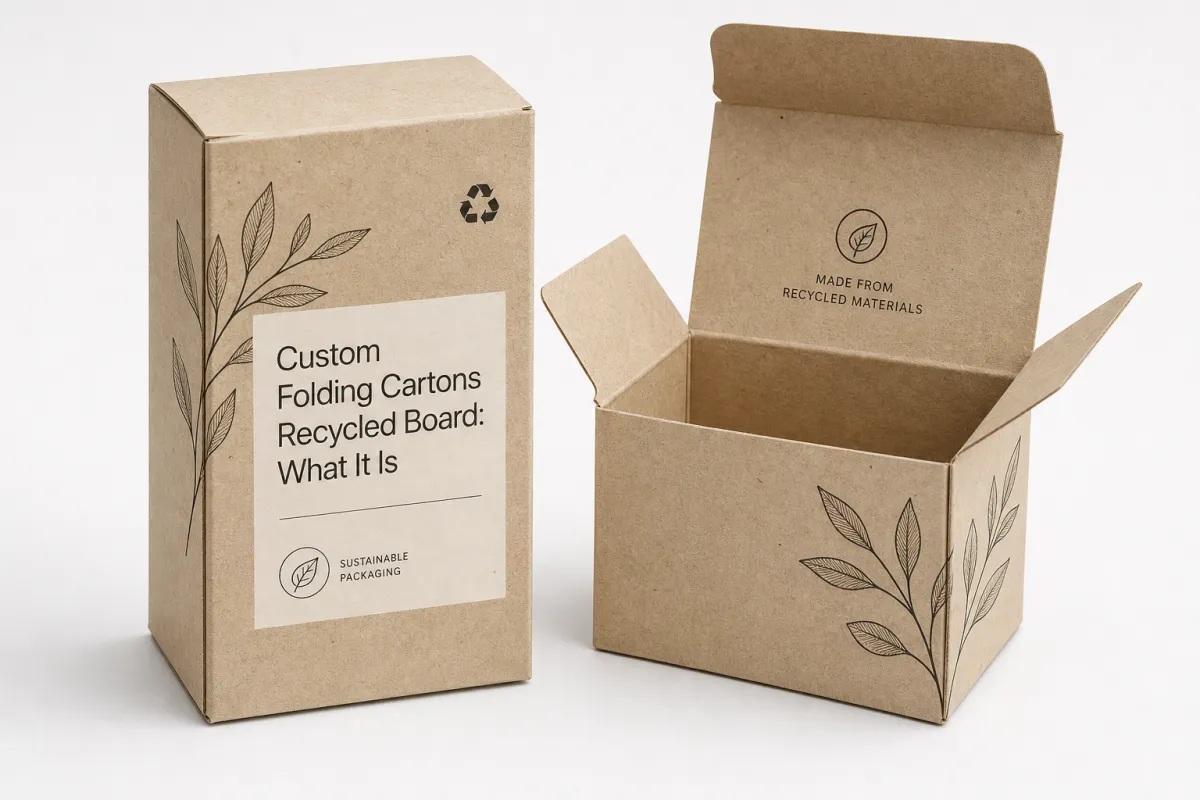
Custom Folding Cartons recycled board are paperboard cartons made from recovered fiber that has been cleaned, repulped, formed into sheets, and converted into packaging stock. The recovered fiber can come from post-consumer paper, post-industrial scrap, or a blend of both. That mix matters. Post-consumer fiber tends to support a stronger sustainability claim, while post-industrial fiber can bring more consistent quality and a cleaner surface for demanding print work.
Compared with virgin board, recycled board begins with a different fiber history. Virgin board is made from fresh pulp and can deliver very steady brightness and stiffness. Recycled board depends more on how well the recovered fibers were sorted, cleaned, and refined. That does not automatically mean lower quality. The performance profile simply shifts. Some recycled grades print with excellent detail. Others place more emphasis on strength or fold behavior. The right grade depends on what the carton has to do.
You will see these cartons across a wide range of products: retail packaging for health and beauty items, subscription kits that need a folding-carton structure with a polished look, lightweight consumer goods, supplements, candles, small electronics, and outer packaging for e-commerce. They are also common in seasonal and promotional packaging because they can be produced in moderate quantities without the freight and material burden that comes with heavier formats. When a project needs shelf presence and responsible sourcing in the same package, custom folding cartons recycled board often rise to the top of the list.
Here is the point many buyers miss: recycled board is not one thing. A 16 pt sheet with a matte aqueous coating behaves differently from a 24 pt board with a soft-touch film. A one-color carton with a simple dieline has a different risk profile than a heavily printed package with foil and tight registration. The carton design matters as much as the paperboard itself, which is why custom folding cartons recycled board should be specified as a complete system rather than as a single line item.
If a supplier says “recycled board” and stops there, you do not yet have enough information to compare quotes. Ask about caliper, stiffness, recycled-content mix, coating, and whether the board is tuned for print or compression resistance.
For teams working through Custom Packaging Products, the first question is rarely “Can recycled board work?” It is usually “Which recycled board works best for the product, channel, and print plan?” That shift moves the conversation away from generic sustainability language and toward a real packaging decision. That is usually where better results begin with custom folding cartons recycled board.
How Custom Folding Cartons Recycled Board Are Made
The process starts with recovered paper collection and sorting. Old corrugated containers, office paper, printed scrap, and other fiber streams are separated by quality and contamination level. Cleaner feedstock makes it easier to produce stable custom folding cartons recycled board. Contamination matters more than many buyers expect. Ink, adhesive, plastics, and mixed materials can reduce yield and create visible defects later in the process.
Next comes pulping. The recovered fiber is mixed with water and broken down into slurry. That slurry is cleaned, screened, and refined to remove staples, coatings, sticks, and fines that would weaken the board or leave rough spots on the surface. From there, the pulp is formed into sheets, pressed, and dried. If the board is intended for premium print work, manufacturers may add additional surface treatment, calendaring, or coating to improve smoothness and ink holdout. Those steps are what allow custom folding cartons recycled board to carry crisp detail instead of a tired, absorbent look.
Surface treatment is one of the main reasons recycled board can still look polished. Calendering compresses the sheet to improve smoothness and control thickness. Coatings create a more printable face and can add scuff resistance. That matters in custom folding cartons recycled board because retail handling is tough on packaging. Cartons slide in trays, rub against other cartons, and get touched repeatedly before a shopper ever picks one up. If the surface is underprepared, the package can look worn before it reaches the shelf.
After the board is made, it moves into converting. Sheets are printed, die cut, scored, folded, and glued into finished cartons. Each step changes how the package performs. A score that cuts too deeply can crack the print layer. A score that is too shallow can make folding rough or uneven. Glue flap geometry affects seam strength. Even the sequence of print and finishing steps can affect the result. That is why the best custom folding cartons recycled board programs are planned with converting in mind from the first dieline review, not added later as a fix.
There is also a direct link between board quality and line performance. Better fiber control, cleaner scoring, and more consistent caliper usually mean fewer cracks at the fold, fewer warped blanks, and better glue adhesion. In practice, that means fewer line stoppages and less waste. Over a run of 10,000 units, even a 2% reduction in breakage can mean the difference between a steady production day and a long one full of adjustments. That is why experienced buyers treat custom folding cartons recycled board as a production choice as much as a sustainability choice.
If you want a broader packaging reference, the ISTA site is useful for thinking about shipping performance and test methods. For sourcing documentation, the FSC system is one of the most recognized references for chain-of-custody records. Those standards do not design the carton for you, but they do help define what a responsible and testable custom folding cartons recycled board program should look like.
Key Factors That Decide Performance and Quality
When a carton performs well, several small decisions usually line up. The first is board thickness, often discussed as caliper. A package that needs a premium feel may use 18 pt to 24 pt board, while lighter products can work in thinner grades. Caliper alone does not tell the full story, though. Stiffness, fold endurance, smoothness, and moisture response all affect how custom folding cartons recycled board behave in the real world.
Print finish is another important factor. An aqueous coating is common because it adds scuff resistance without changing recyclability as dramatically as some other options. Varnish can offer a cost-conscious protective layer and a softer visual look. Matte finishes reduce glare, while soft-touch coatings create a more tactile premium feel. Foil can raise shelf impact, but it also adds complexity and can complicate end-of-life claims depending on the construction. The finish decision is not only visual. It changes how custom folding cartons recycled board communicate quality and how easy it is to explain the sustainability story.
Product fit matters just as much. A fragile cosmetic vial, a supplement bottle, and a lightweight household item each place different demands on the carton. Weight, center of gravity, and shelf stacking all affect structure. If the package needs inserts, windows, or tamper-evident features, those details should be included in the structural spec early. A product that rattles inside the carton or pushes hard against a weak panel will expose the design very quickly. That is why custom folding cartons recycled board should be matched to the product rather than copied from a generic box shape.
Compliance belongs in the discussion too. If the carton touches food or a food-adjacent product, ask for the proper food-contact documentation and make sure the supplier understands the intended use. If the carton carries environmental claims, document recycled content percentages carefully. If the brand needs FSC chain-of-custody language, ask for the records that support it. A supplier should be able to explain what can be proven and what cannot. That kind of clarity is part of a professional custom folding cartons recycled board purchase.
Specs worth asking for
- Caliper: typical ranges such as 16 pt, 18 pt, 20 pt, and 24 pt, depending on product weight and desired shelf feel.
- Stiffness: ask whether the board is better suited to display presence or to compression resistance in transit.
- Recycled content profile: request post-consumer, post-industrial, or blended percentages in writing.
- Coating type: aqueous, varnish, matte, gloss, soft-touch, or specialty finish.
- Conversion behavior: ask about crack resistance at score lines and seam performance.
These details matter because two sheets with similar recycled content can still perform very differently. One may print cleanly but fold poorly. Another may be sturdy but show visible fiber specking. A third may hold fine detail but struggle with heavy coverage. That is the reality of custom folding cartons recycled board: the material story only covers part of the picture, and the carton spec closes the gap between intention and result.
Cost and Pricing for Custom Folding Cartons Recycled Board
Pricing is where expectations often drift away from reality. Buyers sometimes assume recycled board is always cheaper than virgin board, but that is not consistently true. The total cost of custom folding cartons recycled board depends on board grade, carton size, print complexity, finishing, quantity, and tooling. A simple one-color folding carton in a standard size may be highly economical. A small run with foil, embossing, and a specialty coating can move in the opposite direction quickly.
The main price drivers are easy to name and easy to underestimate. Board grade is one. Dieline complexity is another. A carton with a straight tuck top and tuck bottom is usually simpler than a reverse tuck with locking features or internal fitments. Heavy ink coverage increases press time and can require extra attention during drying. Specialty finishes add both material and setup cost. Even the difference between a stock size and a custom size can change die costs and waste rates. For custom folding cartons recycled board, the cheapest quote is not always the lowest total cost.
As a practical reference, a straightforward run of 5,000 to 10,000 cartons might fall around $0.18 to $0.40 per unit depending on size, print coverage, coating, and finishing. Smaller quantities can raise the unit price because setup work is spread across fewer cartons. Add foil, embossing, or windowing, and the cost can rise beyond that range. These are not fixed numbers, but they are useful for framing the conversation. That is especially helpful when comparing custom folding cartons recycled board with virgin board or with more decorative custom printed boxes.
| Option | Typical Use | Cost Tendency | Notes |
|---|---|---|---|
| Standard recycled board with aqueous coating | Supplements, cosmetics, lightweight retail goods | Lower to moderate | Good balance of print quality, scuff resistance, and value |
| Recycled board with matte or soft-touch finish | Premium branded packaging | Moderate to higher | More tactile, but finish costs can outweigh board savings |
| Recycled board with foil, embossing, or spot UV | Launches, gift sets, prestige products | Higher | Strong shelf impact, more setup, more make-ready time |
| Simple structure with minimal ink coverage | High-volume product packaging | Lower | Often the most efficient route for repeat orders |
| Highly customized die line with inserts and windows | Fragile or display-driven goods | Higher | Added labor and materials usually raise the full package cost |
Design choices can lower spend without flattening the brand. Standardizing box dimensions across multiple SKUs reduces tooling complexity. Cutting total ink coverage lowers press burden. Choosing one insert style instead of three can simplify assembly. Even shaving a few millimeters from the footprint can improve board usage on the sheet. When teams think in terms of total packaging cost, custom folding cartons recycled board often look more attractive than they do when viewed only through the board price line.
Freight, storage, and damage reduction belong in the same conversation. A carton that resists crushing may reduce returns. A box that stacks better may save pallet space. A design that folds more cleanly can speed up the packing line. Those gains are easy to overlook because they do not appear in the quote. Over several production cycles, though, they can matter just as much as the per-unit price of custom folding cartons recycled board.
Step-by-Step Process and Timeline
The cleanest projects begin with a disciplined brief. Before asking for pricing, define the product weight, retail channel, target sell price, sustainability requirements, and any special handling concerns. A carton destined for a pharmacy shelf needs different visual and structural choices than one built for direct-to-consumer shipping. If the carton is part of a larger product packaging system, share that context too. It helps the supplier recommend the right board and finish instead of guessing.
From there, the workflow usually follows a familiar path. The packaging team develops or reviews the dieline. Artwork is applied and proofed. A prototype or sample run is approved. The press is set up. Production begins. After that come finishing, folding, glue application, quality checks, and packing. The exact order can vary by supplier, but the logic stays the same. The carton should be validated before a full run of custom folding cartons recycled board starts moving through the line.
Timelines vary, but a simple order can often move from approved artwork to finished cartons in about 12 to 15 business days. More complex jobs usually take longer, especially when they include specialty coatings, structural changes, custom inserts, or compliance review. If the project needs several proof rounds, add time. If the product is fragile and the carton needs fit testing, add more. Buyers run into trouble when they treat custom folding cartons recycled board like stock inventory and then discover the structure needs real development work.
Prototype testing is worth the time. A carton can look right when flat and still fail once assembled. The fold may crack. The seam may not close cleanly. The product may shift in transit. A short line test can reveal those issues before they become expensive. If the package is going into retail packaging, test it under handling conditions that mirror real use: shelf stacking, case packing, opening, and transport vibration. That is how the team learns whether the custom folding cartons recycled board spec is actually ready for production.
If you are also refreshing branded packaging or a broader Custom Packaging Products lineup, align the carton project with the rest of the visual system early. Fonts, panel hierarchy, claims language, and regulatory copy all need room to breathe. A last-minute redesign can force a costly rework. With custom folding cartons recycled board, early coordination is often the least expensive form of risk management.
Common Mistakes to Avoid
The first mistake is assuming all recycled board is interchangeable. It is not. Two suppliers may both advertise recycled content, yet one board may have a smoother printable face, tighter caliper tolerance, or better fold memory. Another may be cheaper but more prone to cracking. If you compare only recycled percentages, you can end up with weak print results or structural issues. That is why custom folding cartons recycled board should be judged on specs and samples, not on a single sustainability claim.
The second mistake is under-specifying the structure for the actual product weight. A carton that works for a 2 oz jar may fail with a 6 oz bottle. Weak seams, crushed corners, and bowed panels usually trace back to design decisions made too early or too casually. Buyers sometimes focus on artwork first and structure second, but the carton has to survive handling before it can sell anything. The strongest custom folding cartons recycled board programs start with product fit and build the visual layer on top of that.
The third mistake is overpromising sustainability claims. If the carton is made from recycled fiber, say so accurately and keep the documentation close. If the board is FSC-certified, have the paperwork ready. If the package includes foil, film, or unusual finishes, think carefully about recyclability language. A well-intended claim that cannot be backed up creates more risk than value. A supplier should help explain what can be documented for custom folding cartons recycled board, but the buyer still needs to approve the final wording.
The fourth mistake is testing only the flat sample. Flat samples are useful, but they do not tell the full story. Real handling exposes weak scoring, poor fold behavior, glue issues, and transport wear. Ask for an assembled sample. If possible, test with the actual product inside. If the carton will run on a machine, test it on the machine. If it will ship in master cartons, simulate that path too. Those tests are where hidden flaws in custom folding cartons recycled board usually show up.
Do not ignore the print finish either. Some finishes improve appearance but make handling more difficult. Others are modest visually but far easier to run at scale. A buyer choosing between a glossy premium feel and a matte, lower-scuff finish needs to decide what matters more: shelf drama, cost control, or line efficiency. There is no single right answer. The best choice depends on the product, the channel, and the brand promise behind custom folding cartons recycled board.
- Test one carton with the product inside before approving the full run.
- Ask for board specifications in writing, not just a recycled-content percentage.
- Verify that the finish supports the sustainability claim you want to make.
- Review line fit, opening behavior, and transport performance, not just artwork.
Expert Tips and Next Steps for Better Orders
Start by asking suppliers for a clear board spec sheet and a sample pack. You want to see how the board prints, how it scores, and how it folds. If possible, compare two options side by side: one that favors print smoothness and one that favors stiffness. A slightly higher-grade board can sometimes reduce damage rates, improve shelf presentation, and save money indirectly. That is a much better way to buy custom folding cartons recycled board than chasing the lowest starting quote.
It also helps to align structure, artwork, and claims language at the same time. If the design team creates a polished layout before the carton size is final, there is a real chance the legal copy, barcodes, or product claims will run out of room. If sustainability claims are added late, they may crowd the brand story. In well-run packaging workflows, structure and message grow together. That is especially true for custom folding cartons recycled board, where the material choice itself is part of the brand story.
Another useful habit is to think in terms of conversion efficiency. Ask whether the carton is easy to erect, easy to glue, easy to pack, and easy to open. Ask whether the board can tolerate the expected humidity range. Ask whether the carton stacks well in shipping cases. Those operational questions often matter more than a glossy mockup. A carton that looks good but slows the line is expensive. A carton that supports speed, consistency, and visual appeal is more valuable. That balance is the real promise of custom folding cartons recycled board.
Here is a practical decision path that works for many brands:
- Request a quote with two board options, not one.
- Review samples for print quality, fold quality, and surface durability.
- Test the assembled carton with the actual product.
- Check freight, storage, and packing-line behavior before final approval.
- Document the sustainability claim so it can be used accurately in marketing.
If you are building branded packaging for retail or e-commerce, this is the point where a small amount of disciplined testing pays off. Ask for a short prototype run, verify fit, and then adjust before committing to scale. That approach reduces waste and protects schedule. It also gives you better data for your next order, which matters because custom folding cartons recycled board usually get better and more economical after the first round of learning. A little patience here is gonna save you from a lot of rework later.
For teams expanding a product packaging line, the smartest next move is to request a quote, compare at least two board grades, and run one prototype through the actual product and packing process. That is the simplest way to see whether custom folding cartons recycled board fit your brand, your operations, and your budget.
What are custom folding cartons recycled board made from?
They are usually made from recovered paper fibers that are cleaned, repulped, formed into new board, and converted into carton stock. The exact mix can vary, so ask whether the board uses post-consumer fiber, post-industrial fiber, or a blend of both. Surface treatment matters too, because coating and calendaring affect print quality, scuff resistance, and the final look of custom folding cartons recycled board.
Are custom folding cartons recycled board cheaper than virgin board cartons?
Sometimes, but not always. The final price depends on quantity, finish, print coverage, structural complexity, and tooling needs. Recycled board can be cost-efficient on repeat runs when the design is straightforward and production is standardized. If you add premium finishes, heavy ink coverage, or small-run customization, those extras can outweigh any board-cost savings in custom folding cartons recycled board.
Is custom folding cartons recycled board strong enough for retail products?
Yes, if the board grade and carton design match the product weight, handling conditions, and shelf expectations. Strength depends on thickness, stiffness, score quality, seam design, and whether the package needs inserts or internal support. Always test the carton with the real product, because a flat sample can look fine while the assembled carton fails in transit. That is a common lesson with custom folding cartons recycled board.
What is the typical timeline for custom folding cartons recycled board orders?
Simple projects can move quickly, but you should still plan for time spent on dielines, proofs, samples, and approval rounds. More complex jobs with specialty coatings, custom structures, or compliance review usually need a longer schedule. The safest approach is to build in extra time for prototype testing so you can catch fit or scoring issues before full production of custom folding cartons recycled board.
What should I ask before ordering custom folding cartons recycled board?
Ask for the board specification, recycled-content details, coating options, minimum order quantities, and production lead time. Request samples and a comparison between two board grades so you can evaluate print quality, folding performance, and durability. Confirm what sustainability claims can be documented so your marketing copy stays accurate and defensible. That is the cleanest way to buy custom folding cartons recycled board with fewer surprises.
For the strongest result, treat the board, structure, and finish as one decision instead of three separate purchases. Pick the recycled board that matches the product, run a real prototype, and lock the claim language only after the physical sample proves the package can do the job. That is the practical path to custom folding cartons recycled board that look good, run well, and hold up in the real world.

